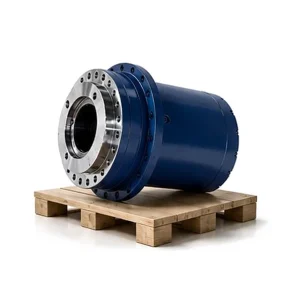
ZL55 Winch Drive Planetary Gearbox — 1-5 Stage
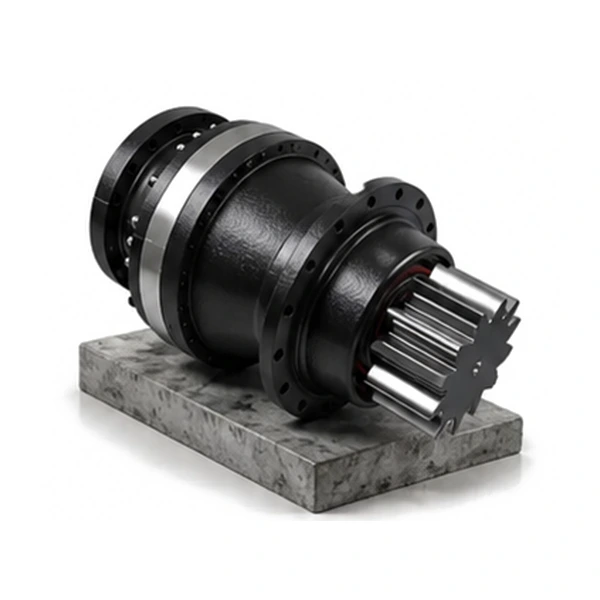
FILLS THE 4xxW GAP
ZL55 — 55,000 Nm
Five stages. The ceiling lifts.
The EP-ZL55 is the fourth model in the ZL electric winch drive planetary gearbox series — and the first to offer five planetary stages. The ZL30, ZL35, and ZL45 all cap at four stages; the ZL55 adds a fifth, extending the maximum ratio from the ZL45 ceiling of 1,745 to 2,190 and reducing the minimum achievable drum speed by a further 26%. At 55,000 Nm continuous torque, the ZL55 also occupies the torque space between the 4xxW 413W3 (42,500 Nm) and the mega-class 414W3 (140,000 Nm) — a 97,500 Nm gap that the hydraulic-era catalogue never filled because few hydraulic winch applications exist in this range. The electric era, with its different motor-speed-torque curves and its different cost structure, creates demand at torque levels the hydraulic catalogue bypassed.
ZL55 Electric Winch Drive Planetary Gearbox — Technical Parameters
| Continuous torque (N2xh=100,000) | 55,000 Nm |
| Peak torque | 112,000 Nm (2.04x continuous) |
| Gear ratio range | 4.14 to 2,190 (1-5 stages) |
| Maximum input speed | 4000 دورة في الدقيقة |
| Thermal power (Pt) | 24 - 74 kW (varies by stage count) |
| Gear type | Helical planetary, 3-planet, DIN 5-6 |
| Integrated brake | None (motor brake or external brake) |
| Sealing | Multi-lip FKM, IP67+ |
| Housing | Ductile iron QT600-3 |
| Gear material | 20CrMnTi, HRC 58-62 |
Five Stages — What the Fifth Planetary Stage Provides and What It Costs
The ZL30, ZL35, and ZL45 stop at four stages. The ZL55 adds a fifth. This is not a trivial extension — it is a step-change in what the gearbox can deliver at the slow end of the speed range, balanced against a measurable cost in thermal capacity and axial length.
What it provides
The fifth stage multiplies the 4-stage maximum ratio by approximately 3.5-5.6x (the per-stage ratio of the additional stage). For the ZL55: 4-stage maximum approximately 400 x 5.5 = 2,190. The drum speed at ratio 2,190 with a 3,000 rpm motor is 1.37 rpm — one revolution every 44 seconds on a 400 mm PCD drum, producing a line speed of 1.72 m/min. This is deep-ocean instrument deployment territory, precision borehole cable control, and nuclear fuel handling speed.
What it costs
Each additional stage adds approximately 60-100 mm of axial length to the gearbox housing, 3 planet gears, 1 sun gear, 6 bearings, 1 carrier, and one more heat-generating mesh. The 5-stage ZL55 Pt drops to approximately 24 kW — the lowest in the thermal range — because the fifth mesh generates heat that the housing surface area cannot fully dissipate without external cooling. For 5-stage applications, an external oil cooler is essentially mandatory for any continuous duty above 50% of the thermal limit.
When it matters
The fifth stage matters only when the application needs ratios above the 4-stage ceiling (~400 for the ZL55) or when the additional reduction provides a control advantage — for example, allowing a standard 3,000 rpm motor to achieve sub-2 m/min line speeds without requiring the VFD to operate the motor at impractically low frequencies where motor torque and cooling degrade. The 5th stage keeps the motor in its efficient operating band while delivering ultra-slow drum speeds through mechanical reduction.
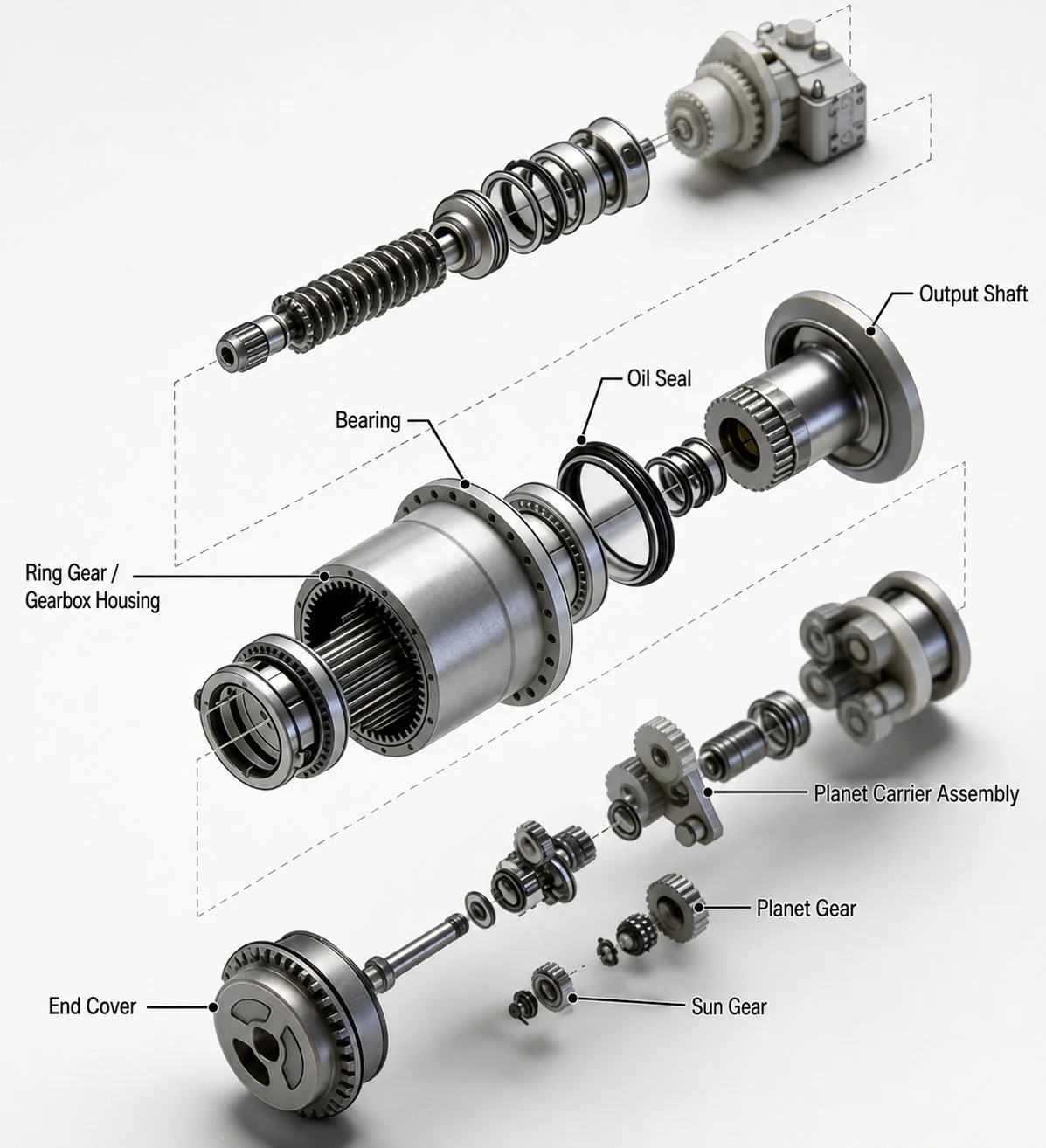
Peak-to-Continuous 2.04:1 — The ZL Trend Converges on the 4xxW Baseline
The ZL peak-to-continuous ratio has been decreasing with each larger model: ZL30 at 2.8:1, ZL35 at 2.5:1, ZL45 at 2.35:1, and now ZL55 at 2.04:1 — approaching the ~2.0:1 that defines the 4xxW series. This convergence is not a design failure. It is physics.
| نموذج | مستمر | Peak | نسبة | Trend |
|---|---|---|---|---|
| ZL30 | 27,000 | 75,500 | 2.80x | ███████ |
| ZL35 | 34,000 | 85,000 | 2.50x | ██████ |
| ZL45 | 40,500 | 95,000 | 2.35x | █████ |
| ZL55 | 55,000 | 112,000 | 2.04x | ████ |
| 4xxW baseline | — | — | ~2.0x | ████ |
As gear module size increases (to carry more torque), the tooth root stress at peak loading approaches the bending endurance limit more closely — leaving less margin between the continuous rating and the peak rating. The ZL30 small gears have proportionally more material headroom above their continuous rating. The ZL55 larger gears are operating closer to their material limit at continuous, so the peak-to-continuous gap narrows. At the ZL55 level, the 2.04:1 peak ratio still provides 57,000 Nm of headroom above continuous — more than enough for grab crane impacts and marine snatch loads — but the proportional advantage over the 4xxW series has converged.
55,000 Nm — The Five-Stage Electric Winch Drive for Heavy Marine and Mining Applications
Heavy Electric Offshore Cranes (30-50 t SWL)
Next-generation all-electric offshore platform cranes and construction vessel cranes where the torque requirement exceeds the ZL45 capacity but falls below the 4xxW mega-class threshold. The ZL55 at ratio 60-150, 2-3 stage, paired with 300-600 kW electric motors fills this gap — delivering heavy-lift torque with electric-era benefits. The slewing drive handles the crane rotation on the same all-electric vessel platform.
Electric Mining Main Auxiliary Hoists
Heavy auxiliary winders at mines where the auxiliary hoist handles equipment, materials, and heavy consumables that exceed the capacity of smaller auxiliary winches. The ZL55 at ratio 150-400, 3-4 stage, provides the torque for 10-20 tonne auxiliary loads at shaft depths of 300-800 metres. The 5-stage option at ratio 800-2,190 serves ultra-slow precision lowering of sensitive equipment — transformers, ventilation fans, drill rigs — where the descent must be controlled to within centimetres per second.
Heavy Industrial Electric Overhead Cranes
Electric overhead travelling cranes in steelworks, power stations, and heavy manufacturing handling 20-40 tonne loads at moderate to high cycle rates. The ZL55 at ratio 60-120 provides the hoist torque, and the 112,000 Nm peak absorbs the shock loads from heavy-load engagement — ladle attachment, mould clamping, and furnace-door handling — that generate transient torques approaching 2x continuous. The helical gears produce noise levels acceptable inside enclosed industrial buildings.
The ZL Electric Winch Drive Family

Electric Winch Drive Planetary Gearbox — ZL55 Five-Stage FAQ
Field Reports
40 t all-electric offshore construction vessel crane, main hoist, ZL55 at ratio 100, 3-stage, 500 kW PMSM motor. The ZL55 replaced our standard 413W3 hydraulic specification for the prototype electric crane. The crane completed its classification survey in 8 weeks — faster than any previous hydraulic crane of this class. The 112,000 Nm peak absorbed the test-load drops (required by the classification surveyor) without any VFD fault. Noise at the operator station during full-load hoisting: 54 dB(A). The vessel builder has ordered 4 additional ZL55 units for the next electric offshore vessel in the series.
Heavy auxiliary winder at a 620-metre nickel mine, ZL55 at ratio 250, 4-stage, 200 kW AC motor with VFD. The winder handles 12-tonne equipment loads — drill rigs, ventilation fans, pumps — that the mine's previous 30 kW auxiliary hoist could not manage, requiring the main production winder to handle oversized equipment and losing production winding time. The ZL55 separated the heavy equipment duty from the production cycle, recovering approximately 4 hours of production winding per week. The regen braking during equipment descent returns energy to the mine grid — measured at 31 kWh per descent cycle for a 12-tonne load from surface to the 620-metre level.
Deep-ocean coring winch on a research vessel, ZL55 at ratio 1,800, 5-stage, 20 kW servo motor. The winch deploys a 3-tonne gravity corer to 5,500 metres at 0.9 m/min controlled descent — the slowest deployment speed we have achieved with any winch system outside a purpose-built scientific deep-sea rig. Depth accuracy at touchdown: 0.4 metres at 5,500 m, measured by ship-mounted acoustic positioning. The 5-stage gearbox keeps the motor at 1,620 rpm during descent — well within its efficient torque band — instead of requiring the VFD to crawl at 30 rpm where the motor overheats. The 4-star is a weight observation: the 5-stage housing is approximately 150 mm longer than the 3-stage we initially dimensioned the drum for. We modified the drum, but the additional length was not in the initial specification — it should be prominently stated on the 5-stage data sheet.
المنتجات ذات الصلة
-
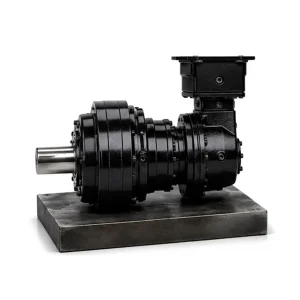
ZR75 Winch Drive Planetary Gearbox — Right-Angle
-
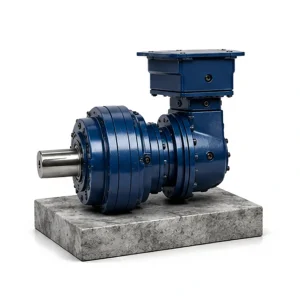
ZR55 Winch Drive Planetary Gearbox — Right-Angle
-

مخفض تروس كوكبي لمحرك الرافعة 417W3
-

مخفض تروس كوكبي لمحرك الرافعة 416W3
-
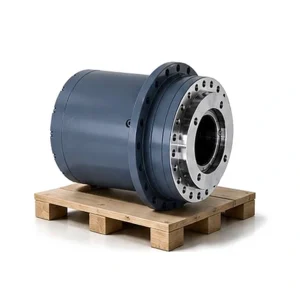
406W Winch Drive Planetary Gearbox Reducer
-
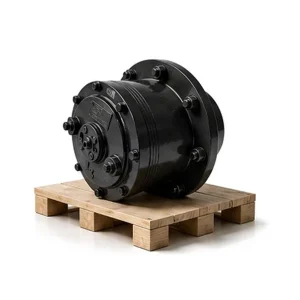
406AW Winch Drive Planetary Gearbox Reducer
-

405.4W Winch Drive Planetary Gearbox Reducer
-
400W1 Winch Drive Planetary Gearbox Reducer