Wheel Drive Series — Port & Logistics Equipment
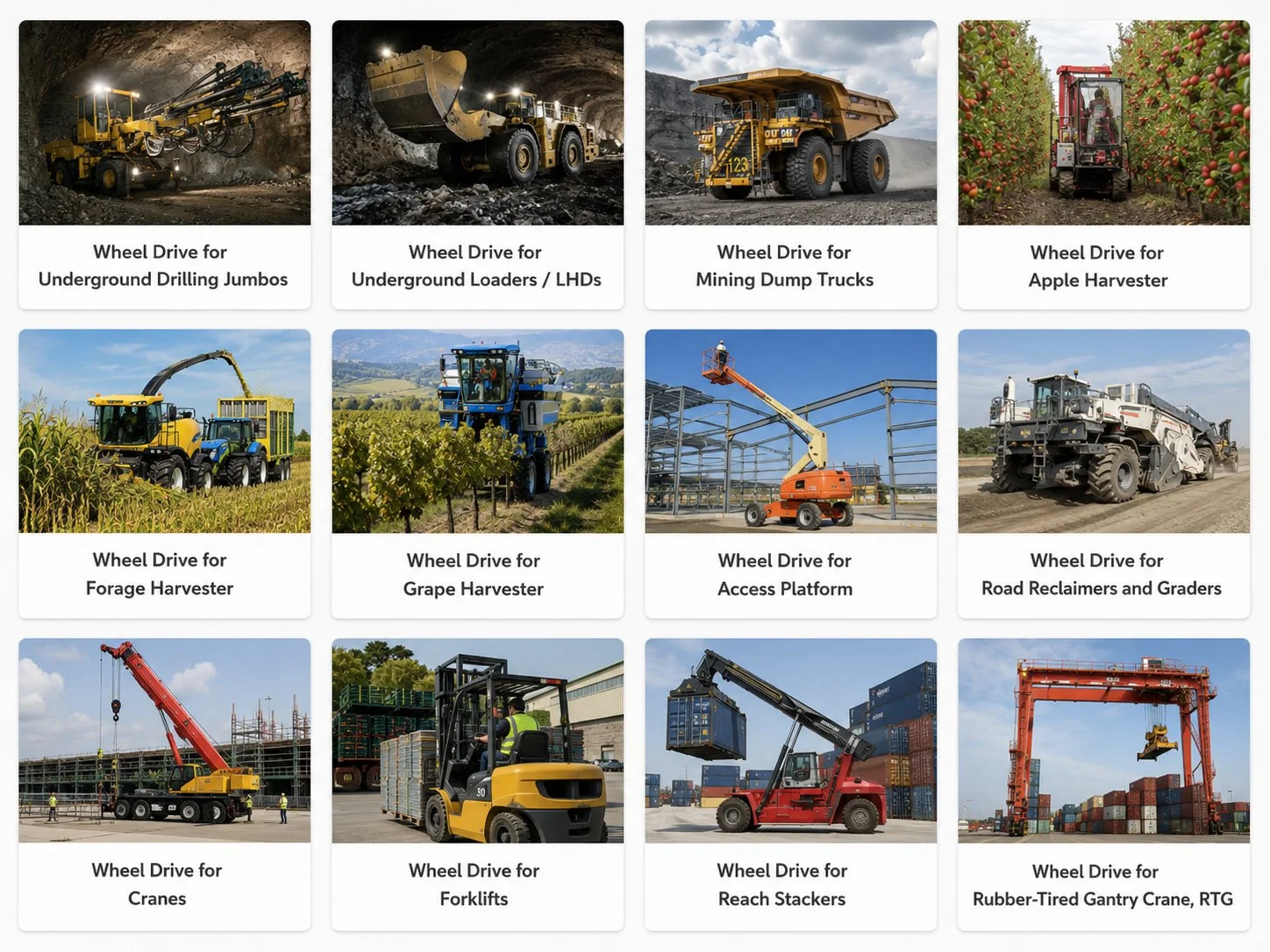
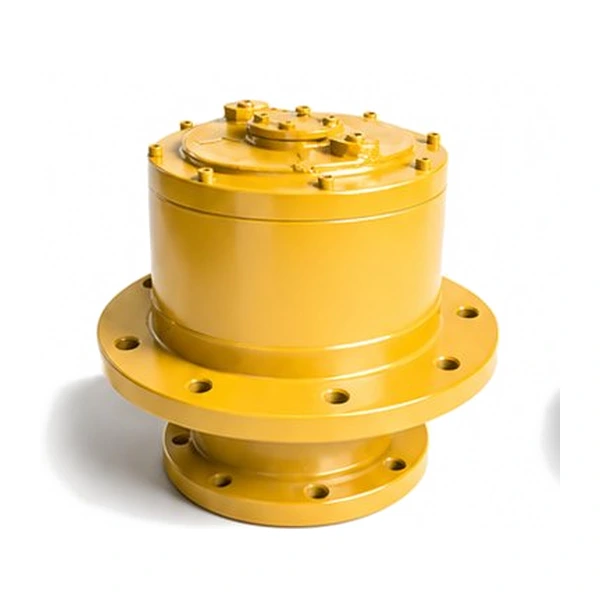
Wheel Drive Planetary Gearbox for Reach Stackers
A reach stacker lifting a 45-tonne loaded container on its second-row reach position places the most extreme combined loading — torsional, radial, and axial — of any wheeled industrial vehicle on its drive axle. The hub-mount planetary gearbox at each driven wheel must transmit this load reliably across 20 years of port terminal service, in salt-air marine conditions, on surfaces ranging from smooth quayside concrete to unpaved intermodal yard gravel.
Reach stackers occupy a unique position in port and intermodal terminal equipment — they combine the mobility and flexibility of a wheeled vehicle with the stacking capability of a rail-mounted crane, allowing a single machine to lift, transport, and stack containers in areas where fixed crane infrastructure cannot be justified. This flexibility comes at a mechanical cost: the reach stacker drive axle must handle torque loads that exceed those of any other wheeled industrial vehicle in routine service. The planetová převodovka pohonu kol fitted to each drive wheel must simultaneously transmit maximum tractive effort during laden travel, withstand the shock torque peaks generated by container landing events, and maintain a sealed, lubricated gear and bearing assembly through the full 20-year service life of the machine without housing replacement. Korea Ever-Power supplies hub-mount planetary drive gearboxes for reach stackers from 35-tonne to 45-tonne capacity class, with output torques from 50,000 Nm to 160,000 Nm and marine-grade engineering as standard.
The Reach Stacker Drive Challenge: Why Ordinary Gearboxes Fail

A reach stacker rated at 45 tonnes in the first-row first-stack position generates a static rear axle load — with counterweight, machine structure, and full container load — of 90 to 120 tonnes when stationary with the boom extended. During travel on an inclined yard surface with a laden container, the rear axle dynamic load can reach 140 tonnes. This load is distributed across two rear driven wheels, each carrying 60 to 70 tonnes of static load under maximum conditions.
The output bearing of the wheel drive gearbox at each rear wheel must carry this radial load continuously. At maximum extension on second-row reach, the combined radial and axial loading on the wheel end — due to the lateral boom offset generating a moment about the machine centreline — requires the output bearing to handle a combined equivalent load that standard forklift wheel drive units are not rated for. Korea Ever-Power reach stacker WD units use large-bore tapered roller bearing pairs at the output, with a bearing L10h life calculated at the maximum dynamic equivalent load of the specific machine rated load case, not at a generic nominal load.
The transmission ratio for reach stacker drive axles is determined by the combination of maximum travel speed (typically 25 to 28 km/h laden), wheel diameter (typically 1,100 to 1,250 mm overall diameter with pneumatic tyre), and the rated speed of the hydrostatic drive motor. Most reach stackers use hydrostatic transmission — a variable displacement hydraulic pump driven by the diesel engine feeding fixed-displacement hydraulic motors at each drive wheel — which means the gearbox ratio must be optimised for the maximum motor speed at maximum travel speed, while providing adequate torque multiplication at maximum tractive effort in the low-speed laden condition.
Operating Conditions: Four Scenarios That Define the Design Envelope
🚚 Maximum Grade Laden Travel
Reach stackers must travel on gradients of up to 10% (1-in-10) at full rated load. On a 10% grade with 120-tonne total machine weight, the rolling and grade resistance requires approximately 130 kN total tractive effort — split between two drive wheels, approximately 65 kN per wheel. With a 1,200 mm diameter tyre, this corresponds to a wheel torque of 39,000 Nm before any efficiency losses. With hydrostatic motor and gearbox losses accounted, the required gearbox output torque at maximum grade is typically 55,000 to 75,000 Nm depending on machine class and motor specification.
⚡ Container Landing Shock
When a reach stacker sets a container onto a trailer or stack under time pressure, the landing event generates a vertical impulse that transmits through the machine structure as a longitudinal shock through the drive axle. Peak dynamic load amplification factors of 2.5 to 3.5 times the static wheel load are recorded in strain gauge studies of reach stacker landing events. The gear teeth and planet bearings of the wheel drive gearbox experience this shock as a torque impulse. Korea Ever-Power reach stacker WD units are rated for a shock factor of 3.0 times rated output torque for impulse durations up to 200 milliseconds, verified by shock load bench testing.
🌵 Outdoor All-Weather Operation
Reach stackers operate outdoors in all weather — rain, sleet, summer heat, and in coastal terminals, persistent salt spray and wind-driven rain. Tyre surfaces on wet concrete or asphalt have a traction coefficient of 0.5 to 0.6, lower than on dry surfaces, requiring the drive control system to limit maximum tractive effort to avoid wheel spin. The wheel drive gearbox must be sealed to IP67 as a minimum, with FKM fluoroelastomer seals resisting long-term salt air and ozone exposure without the hardening and cracking that degrades standard nitrile seals within 3 to 5 years of coastal service.
🔧 Intermodal Yard Surface Variation
While port reach stackers typically operate on paved surfaces, intermodal freight terminals and rail-served container depots often have unpaved or poorly maintained surfaces — compacted gravel, cracked asphalt, concrete block with significant joint steps. These surfaces generate continuous low-frequency vibration at wheel-rotation frequency and occasional high-amplitude impact events at surface irregularities. The wheel drive gearbox housing and internal components must tolerate sustained vibration without fastener loosening, seal fretting wear, or planet pin wear in the carrier bores.
Hydrostatic Transmission Interface: Motor Flange, Shaft, and Case Drain
The majority of reach stackers in service use hydrostatic transmission — a diesel engine driving a variable-displacement axial piston pump, which supplies pressurised oil to two fixed-displacement hydraulic wheel motors, one at each driven wheel. The hydraulic motor mounts directly on the inboard face of the wheel drive gearbox, with the motor output shaft engaging the gearbox sun gear through a splined or keyed coupling.
SAE Flange Standards: Hydraulic wheel motors for reach stacker applications use SAE two-bolt and four-bolt flange standards — SAE A, B, C, and D flanges for motor displacements from 80 cc/rev to 500 cc/rev. Korea Ever-Power reach stacker WD units are available with all four SAE flange standards on the input face, as well as metric IEC flanges for reach stackers fitted with electric wheel hub motors in the current generation of hybrid and battery-electric reach stacker designs. The flange adaptation is a modular input housing rather than a custom-machined one-off, enabling the same gearbox output stage to serve multiple motor specifications with a simple input housing change.
Case Drain Port: Hydrostatic motors require a low-pressure case drain connection to return internal leakage oil to the hydraulic reservoir. The case drain port on the motor must be positioned at the top of the motor in the installed orientation to prevent the motor casing from becoming an oil trap. Korea Ever-Power reach stacker WD gearbox housings are designed with the motor mounting flange oriented so that the case drain port is always at the top regardless of whether the left-hand or right-hand unit is installed — eliminating the field modification that is otherwise required when a standard gearbox is installed on the opposite drive wheel from the one for which the case drain position was designed.
High-Speed Input Shaft Seal: Hydraulic wheel motors for reach stackers operate at shaft speeds of 300 to 600 rpm at maximum travel speed, with shaft diameters of 40 to 80 mm. The input shaft seal of the wheel drive gearbox must prevent gearbox oil from migrating into the motor casing and motor case drain oil from contaminating the gearbox oil at this interface. Korea Ever-Power specifies a dual-lip PTFE-coated seal at the gearbox input shaft bore, with a drain cavity between the two lips connected to an external drain port — any cross-contamination collects in this cavity and drains to a visible point where it can be detected at routine inspection without oil mixing in either direction.
Korea Ever-Power Reach Stacker Drive Selection Guide
| Model | Jmenovitý výstupní točivý moment | Peak Shock Torque | Reach Stacker Class | Input Flange | Pečeť |
|---|---|---|---|---|---|
| ZL24 | 50,500 Nm | 151,500 Nm (3.0x) | 35-tonne light class | SAE B / C / IEC | IP67 FKM |
| EP-WD-80 | 80,000 Nm | 240,000 Nm (3.0x) | 40-tonne standard class | SAE B / C / D / IEC | IP67 FKM |
| EP-WD-120 | 120,000 Nm | 360,000 Nm (3.0x) | 45-tonne heavy class | SAE C / D / IEC | IP67 FKM |
| EP-WD-160 | 160,000 Nm | 480,000 Nm (3.0x) | 45-tonne extended reach | SAE D / IEC | IP67 FKM |
Electric Reach Stackers: Hub Drive Integration for Battery and Hydrogen Platforms
The transition of reach stackers from diesel-hydrostatic to battery-electric and hydrogen fuel cell drive is one of the fastest-moving segments in port terminal electrification. Multiple OEMs introduced battery-electric reach stacker prototypes and pre-series machines in 2023 and 2024, with commercial production volumes expected to grow significantly through the late 2020s as terminal operators face carbon reporting obligations and fuel cost pressures.
The wheel drive gearbox for an electric reach stacker serves the same mechanical function as for the diesel-hydrostatic machine — torque multiplication from the wheel motor to the driven tyre — but the motor interface changes fundamentally. Electric reach stackers use high-torque, low-speed permanent magnet synchronous motors or induction motors rather than hydraulic wheel motors, with IEC B5 or custom-flange interfaces replacing the SAE hydraulic motor mount. The gearbox ratio may also change: electric motors have a wider usable speed range than hydraulic motors, potentially allowing a lower reduction ratio and simpler single-stage planetary rather than the two-stage units required for hydrostatic applications.
Korea Ever-Power supplies wheel drive gearboxes for electric reach stacker development programmes with the following electric-specific features: IEC B5 input flanges in frames 225 to 315 for high-torque electric motors; integrated motor temperature sensor connector provisions on the input housing; and resolver or encoder mounting provisions on the motor-facing input shaft for position feedback to the traction inverter.
For hydrogen fuel cell reach stackers — where the fuel cell generates DC electricity fed to an inverter-motor system — the wheel drive gearbox specification is identical to battery-electric, with the addition of enhanced corrosion protection on the gearbox housing to address the water vapour exhaust characteristics of hydrogen fuel cell systems operating in enclosed or semi-enclosed maintenance areas.
Maintenance Planning for Reach Stacker Wheel Drives
A reach stacker operating two shifts per day in a busy intermodal terminal accumulates approximately 4,000 to 4,500 operating hours per year. At this utilisation, a 20-year machine life corresponds to 80,000 to 90,000 operating hours — a service life that places demands on the wheel drive gearbox far beyond any vehicle application and comparable to the service life targets of fixed industrial gearboxes in continuous process plants. The maintenance strategy for reach stacker wheel drive gearboxes must reflect this long service requirement:
Oil Change Intervals: Korea Ever-Power recommends gear oil change at 1,000-hour intervals for reach stacker applications, using ISO VG 220 synthetic gear oil with EP additive package. The 1,000-hour interval is shorter than the 2,000-hour interval common in lighter applications because the shock loading in reach stacker service generates higher peak contact pressures that accelerate additive depletion. Magnetic drain plugs should be inspected at every oil change — increasing metallic debris quantity between consecutive oil changes is the earliest indicator of developing gear tooth or bearing wear.
Output Bearing Inspection: The main output bearing carries the combined radial and axial load from the tyre and boom offset moment. At the 5,000-hour major service interval, the bearing preload should be verified by measuring the wheel end play with the tyre removed. Preload within specification (typically 0.02 to 0.05 mm negative play) indicates healthy bearing condition. Preload outside specification — either excess play or excess preload causing overheating — requires bearing adjustment or replacement before the next service interval.
Seal Condition Check: The floating face seal at the output should be visually inspected at every 500-hour scheduled service by checking for oil film on the outer face of the seal cassette. Any visible oil film — not to be confused with the thin oil film that is normal lubrication of the seal faces — indicates a seal failure requiring immediate attention. Seal replacement on Korea Ever-Power reach stacker WD units can be performed without gearbox removal: the tyre and wheel hub are removed, the seal cassette is extracted, a new cassette is pressed in, and the assembly is rebuilt in a single maintenance shift.
Why Reach Stacker OEMs and Fleet Operators Choose Korea Ever-Power
3.0x
Shock torque rating on all reach stacker WD units — 3.0 times rated torque for impulse durations up to 200 ms, bench-tested and certified
FKM
Fluoroelastomer seals standard — resisting salt air, ozone, and pressure-wash exposure in coastal port terminal service for the full machine life
SAE A–D
Full SAE and IEC input flange range — covering all hydrostatic motor and electric motor standards used in reach stacker drivetrains worldwide
20 yr
Design-life bearing sizing available — L10h bearing life calculated at machine rated load case, not nominal industrial gearbox assumptions
Korea Ever-Power also supplies the complementary planetová převodovka s pohonem pásů range for straddle carriers and rail-mounted gantry cranes operating in the same port terminal environment — enabling a single supplier relationship for all driven axle gearboxes across the terminal equipment fleet. Contact our application engineering team with your machine specification for a rated load case analysis and dimensional drawing within 48 hours.
Common Wheel Drive Failures in Reach Stacker Service and Prevention
| Režim selhání | Hlavní příčina | Detection | Prevention |
|---|---|---|---|
| Planet gear tooth fatigue fracture | Repeated shock overload beyond 3.0x rating — hard container landings on trailer with chassis height mismatch | Sudden loss of drive one side; large metallic fragments in oil at drain | Enforce boom height limits for container landing; fit hydraulic shock relief valves |
| Output bearing seizure | Sustained operation on unsealed road at speeds above rated; incorrect preload set at rebuild | Hub temperature rise above 80°C at travel speed; audible grinding at slow travel | Verify preload at 5,000 h; limit travel speed on rough intermodal yard surfaces |
| Oil contamination from motor interface | Case drain oil migrating past worn input shaft seal into gearbox oil — mixing hydraulic fluid with gear oil | Oil at inter-seal drain cavity port; discolouration or viscosity change in gear oil at service | Inspect inter-seal drain cavity at every 500 h service; replace dual-lip input seal at first sign of weeping |
| FCS seal failure — oil loss | Foreign material — tyre wire fragments, grit — lodged between cassette seal faces causing groove wear | Oil film visible on outer cassette face at 500 h visual inspection | Replace cassette as cartridge unit at first detection; do not attempt to re-seal worn cassette faces |
| Planet pin bore wear | Lubrication starvation at planet pin — incorrect oil grade causing film breakdown at shock load conditions | Copper content in oil analysis exceeding 50 ppm; increasing noise at partial load | Use specified ISO VG 220 synthetic EP oil; check oil grade at every service — never substitute mineral oil |
Source Your Reach Stacker Wheel Drive Planetary Gearbox
Whether you are specifying new OEM wheel drive units for a reach stacker build programme, sourcing replacement gearboxes for an operating fleet, or engineering the drive axle of a battery-electric or hydrogen reach stacker — Korea Ever-Power delivers marine-duty, shock-rated hub-mount planetary gearboxes built for the full 20-year machine life. Send us your rated load case data and motor specification for a free sizing review and dimensional drawing.
Edit by Cxm