EP-SE400T1 planetgearkasse med bæltedrev
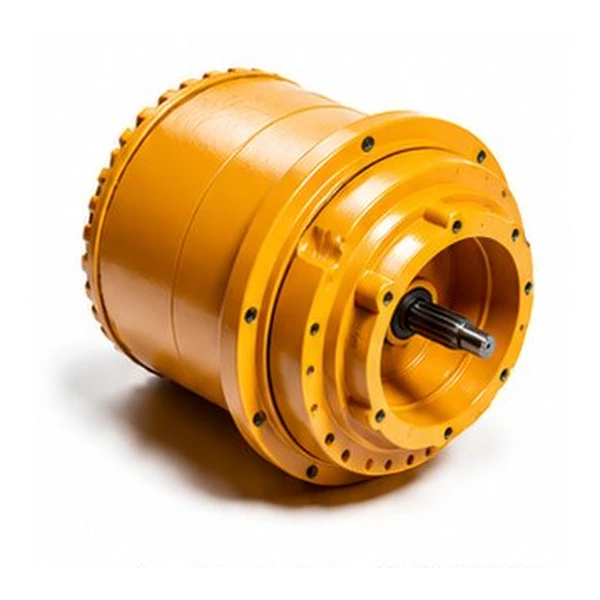
In a standard planetary gearbox, the ring gear is stationary and the planet carrier rotates as the output. The EP-SE400T1 reverses this completely: the planet carrier is fixed to the machine frame via the hollow spindle, and the ring gear — cast as one piece with the outer rotating drum — is the output element. The drum is the sprocket hub. There is no output shaft, no coupling, and no adapter flange. The planetarisk gearkasse med bæltedrev delivers 1,300 N·m directly to the crawler track through the rotating housing, with the entire assembly sitting inside the track frame width — zero axial protrusion beyond the sprocket plane.
The integral spring-applied / hydraulically-released multi-disc parking brake holds 130 N·m without any hydraulic pressure — automatically engaging within one second of pressure loss. The floating metal-to-metal face seals and oil bath lubrication are designed for the mud, grit, and water immersion that tracked machine operation demands.
EP-SE400T1 Series — Single-Stage Track Drive Planetary Gearbox
De EP-SE400T1 is a single-stage track drive planetary gearbox for crawler undercarriages, rotary drilling rigs, mobile crushing plants, and tracked agricultural machinery. At a fixed ratio of i=6.09, it accepts up to 1,000 rpm from an axial-piston or orbit hydraulic motor and delivers 1,300 N·m of output torque through the rotating outer housing directly to the sprocket — sufficient to propel a 3–5 tonne crawler on a 20° gradient using two drives, one per track. The integrated multi-disc spring brake holds 130 N·m without any hydraulic pressure, locking the machine automatically the instant the operator releases the travel control.
Complete Technical Specifications
① Core Performance Parameters
| Parameter | Specification / Value |
|---|---|
| Nominelt udgangsmoment | 1,300 N·m |
| Reduction Ratio (i) | 6.09 — Single Stage |
| Maks. indgangshastighed | 1,000 rpm (rated continuous) |
| Integral Brake Torque (spring-applied) | 130 N·m |
| Efficiency (at rated torque) | > 96% |
| Monteringstype | Roterende ydre husflange — direkte tandhjulsmontering |
| Approximate Weight | ~35 kg (varies slightly by motor adapter configuration) |
| Lubrication System | Oil bath splash lubrication — API GL-5 equivalent gear oil |
| Recommended Oil Viscosity | ISO VG 150 (below +15°C ambient) — ISO VG 220 (above +15°C) |
| First Oil Change Interval | 150 operating hours (run-in); every 1,000 hours thereafter |
| Driftstemperaturområde | −20°C to +90°C (housing surface) |
| Seal Type (drum–spindle interface) | Floating metal-to-metal mechanical face seals (duo-cone type) |
| Applicable Hydraulic Motor Interface | Axial piston motors; hydraulic orbit (gerotor) motors — e.g. A2FE63 |
| Brake Release Method | Hydraulic pilot pressure (spring-applied, hydraulically released) |
| Optional Valve Integration | Pressure relief valve; overcenter (counterbalance) valve — specify at order |
② EP-SE400T1 vs Substandard Market Alternatives — Key Differentiators
| Component / Aspect | Korea Ever-Power EP-SE400T1 | Typical Low-Cost Alternatives |
|---|---|---|
| Gear Metallurgy | High-alloy steel, precision carburised and quenched — deep case hardness for anti-pitting under shock loads | Standard carbon steel, shallow induction hardening — tooth shear risk under impact loads |
| Sealing System | Lifetime floating mechanical face seals — impervious to deep mud, abrasive sand, pressure washing | Standard rubber lip seals — rapid abrasive degradation in soil, oil loss, gear contamination |
| Bearing Selection | Oversized taper roller bearings configured for simultaneous high axial and radial loads from ring gear forces | Undersized standard ball bearings — cage collapse under machine static weight loading |
| Brake System | Wet multi-disc — 130 N·m holding, fade-resistant oil-cooled discs, consistent engagement force | Dry friction pads or poorly toleranced discs — brake drag, overheating, reduced holding torque over time |
| Dimensional Accuracy | Strict 1:1 geometric match to Rexroth GFT / Bonfiglioli 700C equivalents — true plug-and-play | Inconsistent flange tolerances requiring field machining, adapter plates, or hydraulic line rerouting |
③ Selection Guide — Confirming EP-SE400T1 Fits Your Application
| Selection Parameter | EP-SE400T1 Capability | How to Verify for Your Machine |
|---|---|---|
| Max output torque required per drive | ≤ 1,300 N·m | Calculate: (machine weight × gradient force × track radius) ÷ 2 drives. Apply 1.5× safety factor for shock loads. |
| Hydraulic motor output speed | ≤ 1,000 rpm continuous | Check pump flow rate and motor displacement. Ensure max pump flow does not exceed 1,000 rpm at motor output under load. |
| Track frame inner diameter / width | Matches short-profile standard track frames | Request Korea Ever-Power dimensional drawing. Confirm rotating drum OD and spindle pilot dimensions match chassis bore. |
| Parking brake holding requirement | 130 N·m static brake | Calculate: machine gross weight × sin(steepest parking angle) × track radius ÷ 2 drives. Must be ≤ 130 N·m. |
| Replacement fit for existing drive | Rexroth GFT-equivalent / Bonfiglioli 700C-equivalent | Confirm existing model's flange bolt circle, spigot OD, motor interface dimensions. Korea Ever-Power cross-reference service at no charge. |
Six Design Features That Separate a Track Drive Planetary Gearbox from Every Precision Servo Reducer
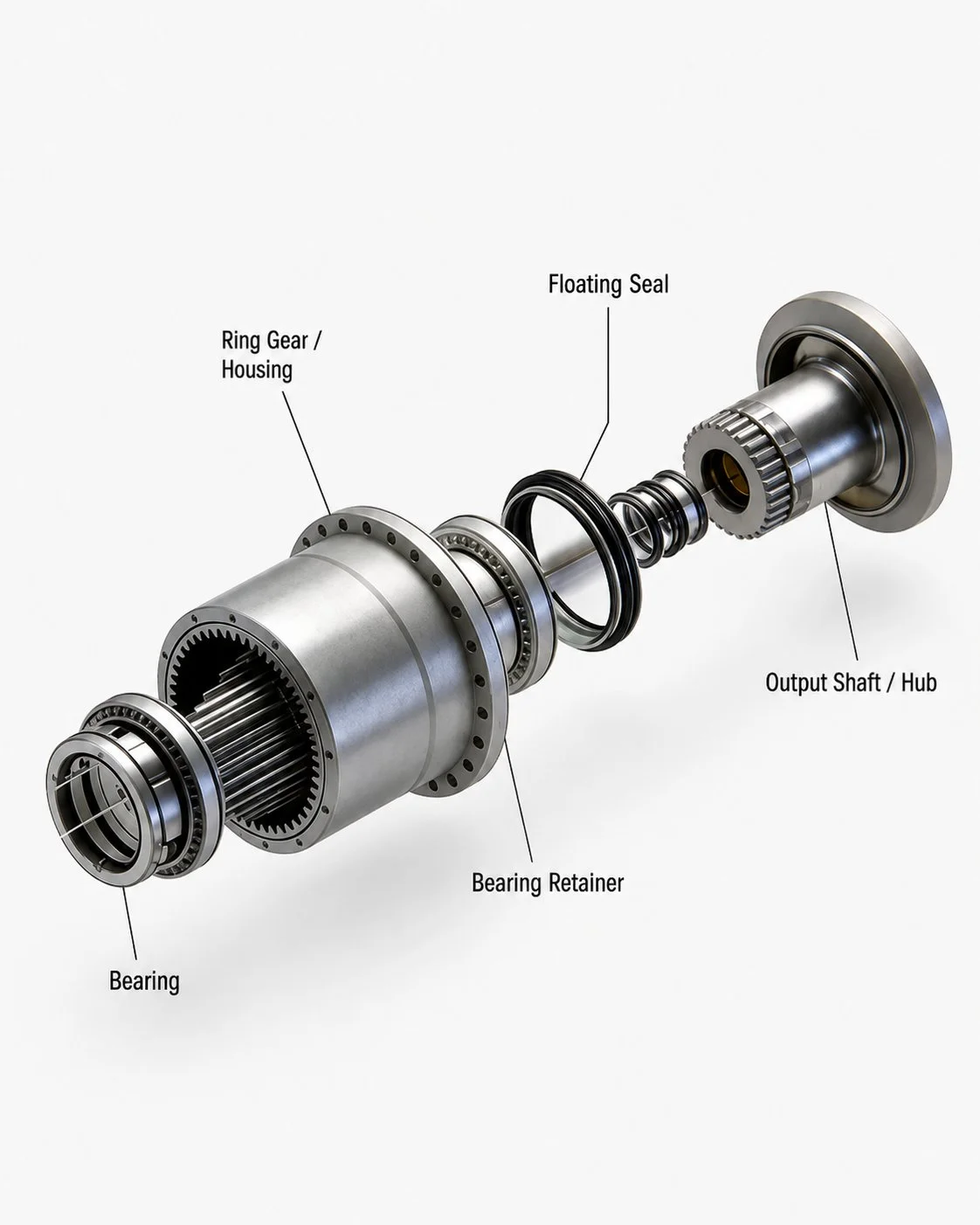
In every EP precision series (TM, TNF, TEG), the ring gear is bolted stationary to the housing and the planet carrier rotates as the output shaft. EP-SE400T1 reverses this: the hollow central spindle (planet carrier) bolts to the machine chassis and remains fixed; the ring gear, cast as an integral part of the outer rotating drum, spins as the output. This lets the gearbox body itself become the sprocket hub. The track chain sprocket bolts to the outer drum face, and the entire assembly sits within the track frame width with no shaft protruding beyond the sprocket plane — a package geometry impossible to achieve with a conventional shaft-output gearbox.
The integrated brake operates on a fail-safe principle that is the opposite of every friction brake in common use: heavy internal Belleville springs permanently clamp a stack of alternating steel and friction discs against the rotating drum, holding 130 N·m of braking torque without any hydraulic pressure. Travel requires the operator to deliberately apply pilot pressure to a dedicated brake port — this hydraulic pressure compresses the spring stack and lifts the disc pack, allowing the drum to rotate. The moment the machine shuts down, hydraulic pressure drops to zero and the spring brake re-engages automatically. A machine parked on a slope cannot roll even on total hydraulic system failure.
The sealing system at the rotating drum–spindle interface uses floating mechanical face seals (sometimes called duo-cone seals or rotating lip metal seals in industry literature). Each seal pair consists of two hardened and lapped-flat metal toric rings pressed together by toroidal elastomer O-rings acting as springs. The sealing action is metal-to-metal contact across lapped surfaces, not elastomer-to-shaft sliding contact. Lapped metal faces do not wear or stiffen with temperature. Abrasive soil particles that cut through rubber lip seals in days cannot penetrate the pressurised metal interface. This is the standard sealing system on excavator final drives worldwide because it is the only design that survives continuous immersion in rock-mud slurry.
The EP precision series uses sealed-for-life synthetic grease lubrication inside a closed housing — no oil fill or drain ports. EP-SE400T1 uses oil bath splash lubrication: a fill of API GL-5 rated gear oil (ISO VG 150–220 depending on ambient temperature) partially submerges the gear train. As the planet gears orbit, they pick up oil and distribute it across all tooth surfaces and bearings. The first oil change is at 150 operating hours (run-in metal particle clearance), then every 1,000 hours. Oil fill, level check, and drain ports are positioned to be accessible without removing the gearbox from the machine — a maintenance design priority absent from sealed-for-life precision gearboxes.
The EP-SE400T1 input is designed for splined shaft plug-in connection to axial piston hydraulic motors (such as the A2FE63 series) or hydraulic orbit motors (gerotors). The motor's output shaft inserts directly into the sun gear bore; the motor face bolts to the gearbox input flange. There is no coupling, no adapter sleeve, and no key — the spline transmits torque over full tooth length contact area. Optional integrated pressure relief valves and overcenter valves (specified at order) simplify the hydraulic circuit by eliminating external cartridge valves that would otherwise sit in the motor case drain line. The 1,000 rpm max input limit applies to the rated continuous duty; the motor displacement should be selected to reach max travel speed within this limit at the system's maximum pump flow rate.
The EP-SE400T1 mounting flange bolt circle, spigot diameters, center bore dimensions, and hydraulic port locations match the equivalent size models in the Rexroth GFT track drive series and the Bonfiglioli 700C crawler drive series (cited for dimensional reference only — Korea Ever-Power claims no trademark affiliation). This dimensional parity means a machine currently running a legacy drive in this torque class can be re-fitted with EP-SE400T1 without modifying the chassis, hydraulic lines, brake pilot circuit, or sprocket hub hardware. Field replacement requires only a drain of the old oil and a refill with GL-5 grade oil before commissioning. Brand disclaimer: Rexroth and Bonfiglioli are trademarks of their respective owners, cited solely for dimensional reference.
How a Track Drive Planetary Gearbox Works — From Hydraulic Motor to Moving Track
The EP-SE400T1 track drive planetary gearbox operates through a four-stage power chain, each stage a distinct form of energy conversion. Understanding the sequence clarifies why each design feature exists.
Stage 1 — Hydraulic to Rotary: Motor Input
Pressurised hydraulic fluid from the machine's main pump enters the axial piston motor (e.g. A2FE63). The fluid forces the pistons across the cylinder barrel's swash plate; the barrel rotates at up to 1,000 rpm. Simultaneously, a separate pilot pressure signal (typically 25–35 bar) enters the gearbox brake port — this pressure compresses the Belleville spring stack against a piston, separating the friction disc pack and releasing the brake. The motor shaft spline engages directly with the sun gear bore.
Stage 2 — Speed Reduction: Planetary Gear Set
The sun gear, spinning at motor speed (≤1,000 rpm), meshes with three or more planet gears carried in the stationary planet carrier (fixed to the spindle, hence to the machine chassis). Because the carrier cannot rotate, the planet gears are forced to roll around the inside of the ring gear. This epicyclic rolling action produces output rotation of the ring gear at exactly 1/6.09 of the input speed — 164 rpm at maximum motor speed. At 1,000 rpm input and 1,300 N·m output, the theoretical power is approximately 22 kW before friction losses.
Stage 3 — Torque Transfer: Rotating Outer Housing
The ring gear, cast integrally with the outer drum housing, transfers its rotational torque directly to the sprocket bolted to the drum face. There is no output shaft, no coupling, and no additional connection. The drum is the output. The mechanical face seals at the drum-spindle interface ensure that oil inside the gearbox does not escape into the track chain even as the drum rotates continuously against the fixed spindle. The taper roller bearings at the drum-spindle junction carry the full weight of the machine side load transmitted through the track and sprocket.
Stage 4 — Brake Engagement: Hydraulic Pressure Loss
When the operator releases the travel control, pump pressure drops, motor rotation stops, and — crucially — the pilot brake pressure also drops to zero. The Belleville spring stack immediately extends, pushing the friction discs together against the drum. The 130 N·m of spring-generated braking torque locks the output drum within milliseconds of pressure release. The machine stops and holds position on any incline within the static brake's capacity without requiring any electrical or mechanical brake actuator input from the operator or the control system.
EP-SE400T1 ENERGY FLOW
↓ high pressure oil
A2FE63 axial piston motor
↓ rotary shaft ≤1,000 rpm
Sun gear (input)
↓ epicyclic i=6.09
Ring gear (output drum)
↓ ≤164 rpm / 1,300 N·m
Sprocket → crawler trackBRAKE PATH
Pilot pressure present →
spring compressed → free
Pilot pressure lost →
spring extends → 130 N·m lock
LUBRICATION CIRCUIT
Oil bath — GL-5 gear oil fills lower housing. Planet orbit splashes oil to all mesh points and bearings. No pump, no filter — gravity and centrifugal distribution only.
How to Select the Right Track Drive Planetary Gearbox — Four Parameters That Cannot Be Guessed
Specifying a track drive planetary gearbox is not the same exercise as specifying a precision servo reducer. There is no backlash figure to compare, no arcminute spec to match. The four parameters below determine whether a track drive works — or fails within the first season of use. Get any one of them wrong and the gearbox will not make it to its first oil change.
QUICK SELECTION CHECKLIST — EP-SE400T1
Track Drive Planetary Gearbox Installation & First Commissioning — Field-Verified Sequence
The sequence below is based on field installation experience across tracked construction, agricultural, and mining equipment. Skipping any step is a common cause of early seal failure or brake malfunction — both of which are installation damage, not manufacturing defects.
Measure the chassis spindle bore diameter and check it against the EP-SE400T1 spindle OD on the Korea Ever-Power dimensional drawing. Tolerance mismatch here causes fretting and spindle micro-movement under load, which rapidly destroys the mechanical face seal at the drum-spindle interface. Clean all burrs, rust, and paint from the bore mating surfaces.
The oil fill and level ports are orientation-specific — they are positioned for the gearbox's operating attitude (typically spindle axis horizontal). If your machine installation places the spindle at a non-standard angle (e.g. tilted on a slope-walking machine), confirm the oil port orientation with Korea Ever-Power before installation. Installing with ports in the wrong position can result in operating under- or over-oiled from day one.
Fill the gearbox to the correct level with API GL-5 gear oil (ISO VG 150 or VG 220) through the fill port before the hydraulic motor is attached. This is easier with clear access to the fill port. Use a filtered funnel. Volume: approximately 0.8–1.2 litres. Check level at the side port — oil should just reach the bottom of the opening with gearbox in operating position.
Insert the motor output shaft spline into the sun gear bore — do not force. Confirm full spline engagement before bolting the motor face. Torque all motor fasteners to the motor manufacturer's specification in a cross (star) pattern. A partially engaged spline transmits torque over a reduced tooth length, generating concentrated stress that shears spline teeth under load.
Before connecting the travel motor work ports, connect only the brake pilot line and apply pressure (25–35 bar). Confirm the drum rotates freely by hand — this verifies the brake has released. Release the pilot pressure and confirm the drum locks. A brake that does not fully release prevents travel; a brake that does not lock on pressure loss is a safety failure. Do not proceed to travel testing until this two-state test is passed.
Operate at 50% maximum load for the first 10 hours. During run-in, gear surfaces micro-seat and fine metal particles enter the oil. At 150 operating hours, drain the oil while warm (particles stay suspended), refill with fresh GL-5 oil of the same grade. This first oil change is not optional — it is the primary protection against abrasive particle recirculation through the bearing and gear train. Thereafter, drain and fill every 1,000 hours or annually.
Track Drive Planetary Gearbox Applications — Six Industries Where EP-SE400T1 Carries the Load
① Crawler Undercarriage — Small to Mid-Size Excavators
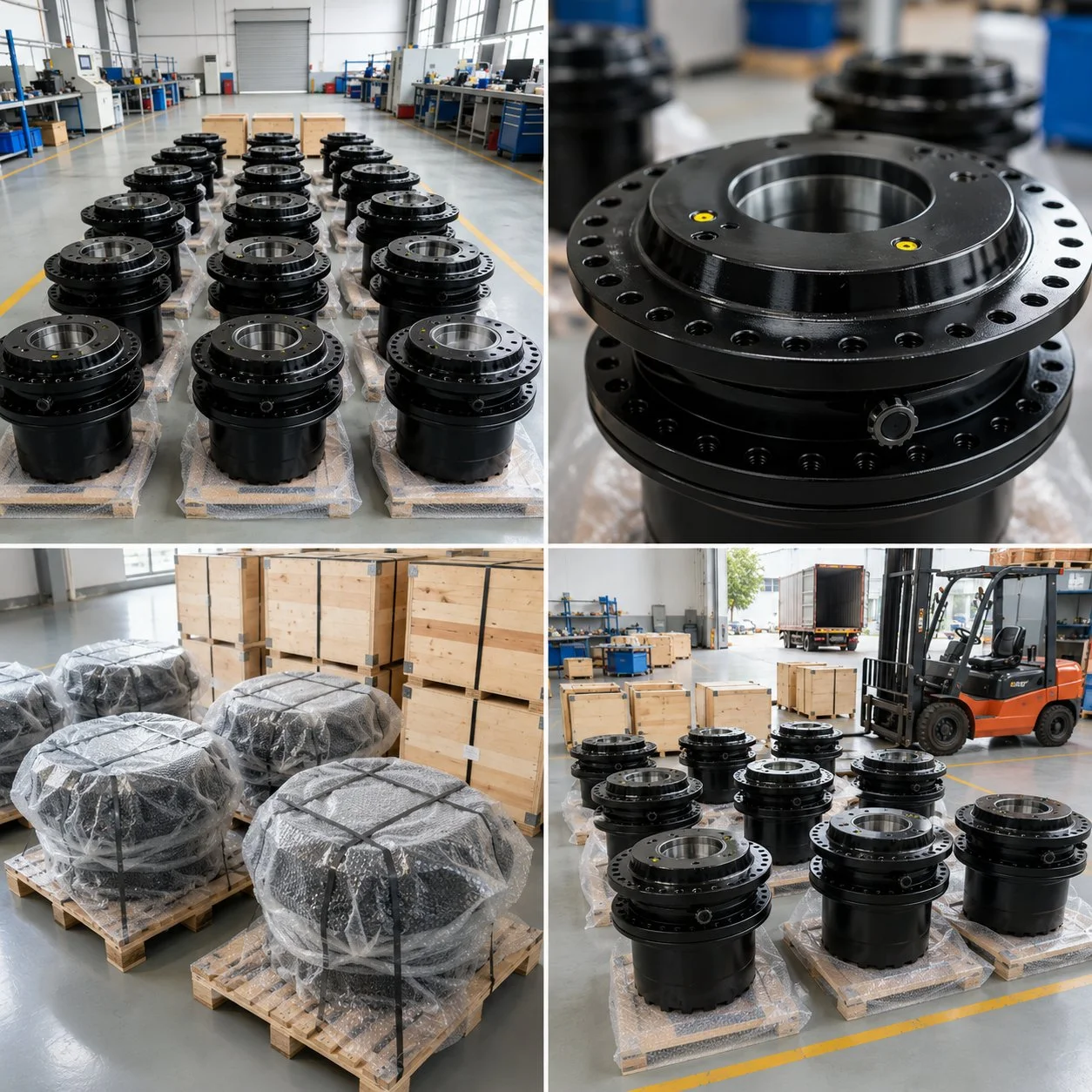
This track drive planetary gearbox at 1,300 N·m rated output covers the travel drive requirement for mini and compact excavator classes (approximately 3–6 tonnes operating weight on 20° gradient). Each machine uses two EP-SE400T1 units, one per track, independently controlled by separate motor flow. Speed differential between the two drives steers the machine — forward flow to both drives for straight travel, differential flow for turning, reversed flow to one drive for pivot steering. The rotating outer housing design keeps the total drive assembly within the track frame width with no axial protrusion beyond the sprocket plane.
② Rotary Drilling Equipment — Site Positioning Drive
Tracked rotary drilling rigs position themselves slowly and precisely across construction sites between bore locations. The travel drive does not need high speed — drilling rigs rarely exceed 2 km/h repositioning speed — but must handle the full machine weight (often 8–12 tonnes for the rig chassis alone) on uneven surface. EP-SE400T1 at i=6.09 provides adequate torque for this weight class in the motor speed range achievable at low pump flow (200–400 rpm output), moving the rig at controlled walking pace without requiring separate travel speed control valves beyond motor displacement adjustment.
③ Mobile Crushing and Screening — On-Site Repositioning
Tracked mobile crushing and screening plants are among the harshest environments for track drives: the machines vibrate continuously at high amplitude from the crusher and screen, the ground surface is fragmented rock, and repositioning movements often cross deep piles of crushed aggregate. The spring-applied brake on EP-SE400T1 holds the machine stationary between movements — the brake engages as soon as the operator releases the travel control, preventing the machine from sliding on aggregate slopes during the frequent brief repositioning moves that characterise quarry operation.
④ Foundation Piling Machines — Precision Slow Travel
Piling rigs require precise positioning of the lead and pile guide at each bore location — travel moves of 1–3 metres, accurate to within ±20 mm. The EP-SE400T1's fixed ratio i=6.09 converts motor speed linearly to travel speed, making closed-loop positional control of machine travel straightforward with a standard electrohydraulic proportional valve in the motor circuit. The mechanical face seals handle the concrete dust and slurry that piling operations generate, which rapidly destroys the lip seals used in lighter-duty track drives.
⑤ Tracked Agricultural Machinery — Wet Field Operation
Tracked combine harvesters and large tracked tractors operating in wet rice paddies, saturated peat soils, and heavy clay fields use EP-SE400T1 or equivalent drives because the distributed track footprint minimises soil compaction compared to equivalent wheeled machines. The mechanical face seals operate indefinitely in the standing water and mud that characterise paddy field harvest conditions. Downstream landbrugsgearkasser med flere udgange distribute the engine power to the cutting platform, threshing drum, grain elevator, and fan — entirely separate from the EP-SE400T1 track propulsion circuit — allowing the implement drive to be optimised independently of ground speed.
⑥ Tracked Pipe-Laying and Trenching Equipment
Pipe-laying machines and chain trenchers require the track drive to pull the machine forward at precisely controlled slow speed (0.1–1.5 km/h) while the trenching attachment excavates a continuous cut. The EP-SE400T1's efficiency of >96% is relevant here: the travel power is a significant continuous load component in addition to the trenching load on the hydraulic system. A snekkegearreduktion on the winch drum of a pipe-laying frame provides the self-locking load hold for the pipe tensioner and cable drum drives alongside the EP-SE400T1 travel system on the same machine platform.
Why Equipment Builders Specify Korea Ever-Power Track Drive Planetary Gearboxes Over Generic Alternatives
📐
Dimensional Drawing Same Day — Cross-Reference Included
Every EP-SE400T1 planetgearkasse quotation includes a full dimensional drawing and confirmation of fit against the legacy drive being replaced. If the machine currently runs a Rexroth GFT or Bonfiglioli 700C equivalent, Korea Ever-Power provides a cross-reference table identifying the matching EP model and confirming the spindle bore, drum OD, motor interface, and brake port dimensions — same business day from enquiry, at no charge and without order commitment.
🔩
Complete Drive Assembly — Motor, Valves, and Gearbox as One Package
While the EP-SE400T1 is designed for standard plug-in motors, Korea Ever-Power can supply a pre-assembled and tested drive package — gearbox, hydraulic motor, pressure relief valve, and overcenter (counterbalance) valve — as a single unit with a single part number. Pre-assembly eliminates motor-gearbox interface errors in the field and reduces machine assembly time. The assembled package arrives test-run and oil-filled, ready for chassis installation.
🛠️
Full Spare Parts Inventory — Seal Kits, Bearings, Disc Sets
Korea Ever-Power maintains stock of all internal wearing components for the EP-SE400T1: mechanical face seal kits, taper roller bearing sets, multi-disc brake friction disc sets, sun gear and planet gear assemblies. A machine in the field with a failed seal or worn brake disc can be back in service from parts arrival — no waiting for an entire new gearbox. Seal kit and bearing set pricing is available on the product technical page without order requirement.
🌡️
−20°C to +90°C — No Specification Adjustment for Cold or Hot Climates
The EP-SE400T1 temperature range covers the full operational envelope from Nordic forestry (ambient −20°C cold-start) to Middle East mining (ambient +50°C with housing reaching +90°C in direct sun). Oil viscosity selection (VG 150 for cold climates, VG 220 for hot) is the only field adjustment required. The mechanical face seals maintain sealing force across this temperature range because the sealing mechanism is spring-loaded metal contact rather than elastomer compression, which varies significantly with temperature.
📋
12-Month Warranty from Commissioning — 18 Months from Shipment
Korea Ever-Power covers manufacturing and material defects for 12 months from commissioning or 18 months from shipment date, whichever comes first. Warranty claims cover internal component replacement or gearbox exchange. The warranty period starts from commissioning — not from order date — which gives OEMs that stock gearboxes before machine assembly a full 12-month in-service coverage period.
⏱️
7–14 Day Stock Delivery — 30–45 Days for Custom OEM Batches
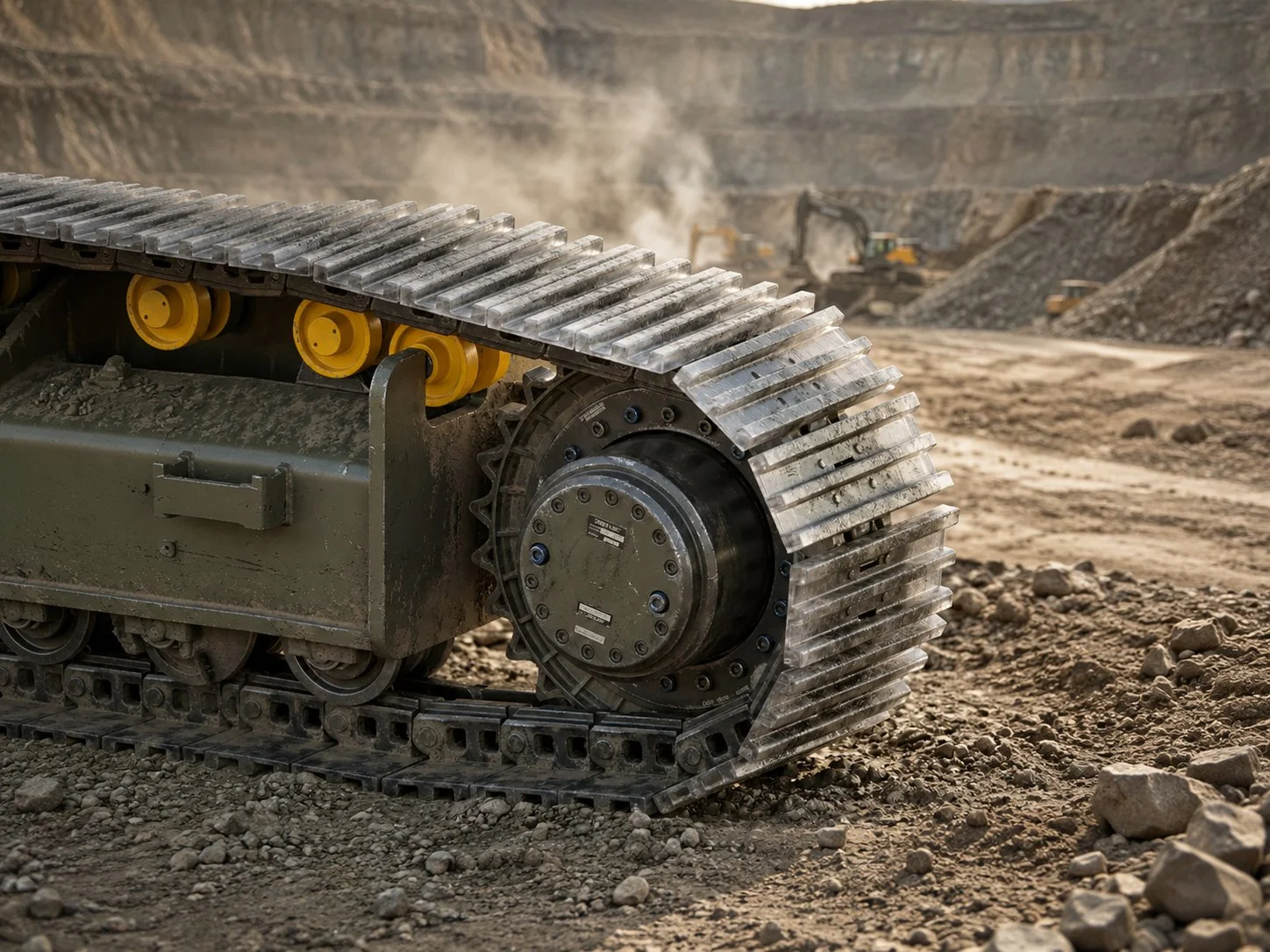
Standard EP-SE400T1 units ship in 7–14 days from Korea Ever-Power stock. OEM batch orders with specific motor interface configurations or optional valve integration: 30–45 days production lead time. Emergency replacement orders for machines already down in the field can be expedited — contact Korea Ever-Power sales directly with the machine urgency level and ship-to location for same-day lead time confirmation.
EP-SE400T1 Track Drive Planetary Gearbox — Field Performance Reviews Across Global Deployments
5 ★
86%
4 ★
12%
≤3 ★
2%
We build compact tracked impact crushers for quarry and demolition contractors. Replaced the travel drives on our 4-tonne model with EP-SE400T1 after chronic seal failures on the previous supplier's units working in high-silica aggregate dust. Korea Ever-Power's dimensional drawings matched our chassis to within 0.3 mm on the spindle bore. After 4,000 operating hours of abrasive dust exposure, zero seal leaks, brake holds perfectly on 20-degree rock stockpile climbs. The spring-applied brake also eliminated a runaway incident on a steep ramp — the machine stops the instant the operator releases the control.
We field these machines in the Alberta boreal forest — deep snow, frozen muskeg, and temperatures that regularly hit −30°C. The previous travel drive units had lip seals that hardened in cold and allowed oil ingestion from frozen mud during river crossing operations. Replaced 1:1 with EP-SE400T1 units. Field swap took under two hours per machine. Metal face seals have survived two full winters including frozen mud packing events that previously destroyed gearboxes within a season. Cold-start performance at −20°C with VG 150 oil is normal with no warm-up delay required.
Our tracked harvesters work wet clay sugarcane fields at +40°C ambient during harvest season. The EP-SE400T1 runs continuously for 12-hour shifts. We measured housing surface temperature at 74°C peak — well within the 90°C spec. Efficiency stays above 96%, confirmed by the fact that our hydraulic cooler temperature doesn't rise when we switched from the previous drives that were running at 92–93% efficiency. Full harvest season complete, zero breakdowns across a fleet of six machines. Cost-to-performance ratio versus the European brand we replaced is dramatically in our favour.
Korea Ever-Power — Beyond the Track Drive: A Complete Industrial Drive Portfolio
The EP-SE400T1 is one product in a broader range of heavy-duty and precision drive solutions. Whether the requirement is lifting, slewing, propulsion, or high-precision servo positioning, Korea Ever-Power manufactures the gearbox at the centre of the system.
Track Drive Planetary Gearboxes — Crawler Final Drives
The EP-SE400T1 is the entry model of the Korea Ever-Power track drive planetary gearbox series. The range extends from 1,300 N·m single-stage units up through multi-stage configurations exceeding 400,000 N·m for large mining excavators, tunnel boring machines, and heavy crawler cranes. Rotating-housing design, spring-applied parking brakes, and floating mechanical face seals are standard across the series.
Winch Drive & Hoist Reducers — Load Holding Under Gravity
Korea Ever-Power winch drive planetary gearboxes are engineered for crane winches, marine deck winches, and construction hoist drives where the load must be held stationary without continuous hydraulic pressure. The worm-planetary combined configuration provides self-locking mechanical hold; the multi-disc wet brake provides the active holding function during load transfer. Rated lifting torques from 2,000 to 1,200,000 N·m.
Wheel Drive Units — Wheeled Mobile Equipment
For wheeled heavy vehicles — agricultural sprayers, aerial work platforms, airport ground support equipment, and industrial container handlers — Korea Ever-Power wheel drive units integrate the planetary reduction and hub bearing in a single assembly that bolts directly to the wheel hub. The shaft-output design differs from the rotating-housing track drive configuration and is optimised for continuous rolling contact rather than intermittent track engagement.
Slewing & Swing Drives — Rotational Positioning Under Load
Excavator upper-structure swing drives, wind turbine yaw and pitch drives, and solar tracker azimuth drives require a planetary gearbox that can resist large overturning moments while positioning a heavy rotating superstructure. Korea Ever-Power slewing drives combine planetary reduction with an integrated slewing bearing — the output pinion engages a large-diameter ring gear on the rotating platform. These drives provide the holding torque required to keep a loaded excavator cab stationary on an incline with the engine off.
High Precision Planetary Gearboxes — Servo & CNC Applications
At the opposite end of the torque and precision spectrum from the EP-SE400T1, Korea Ever-Power's high precision planetary gearbox series — including the EP-TM, EP-TNF, EP-TEG, and EP-TMR — delivers backlash from P0 ≤1 arcmin to P2 grade for servo motor, stepper motor, and electric linear actuator integration. These units serve CNC machine tool rotary axes, collaborative robot joints, semiconductor wafer handling equipment, and precision laser scanning systems where sub-millimetre positioning repeatability is the design requirement.
Technical FAQ — EP-SE400T1 Track Drive Planetary Gearbox Selection & Installation
Specify EP-SE400T1 — Cross-Reference Drawing and Fit Confirmation Before Order
Provide your existing drive model, machine weight class, hydraulic motor specification, and required timeline. Korea Ever-Power returns dimensional cross-reference, fit confirmation, and delivery lead time — same-day response for urgent machine-down enquiries.
1,300 N·m · i=6.09 · Spring brake 130 N·m · Floating metal face seals · Stock 7–14 days
Relaterede produkter
-
EP-SE418T3 Tretrins planetgearkasse med bæltedrev
-
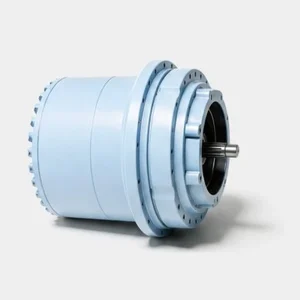
EP-SE417T3 Triple-Stage Track Drive Planetary Gearbox
-

EP-SE416T3 Triple-Stage Track Drive Planetary Gearbox
-
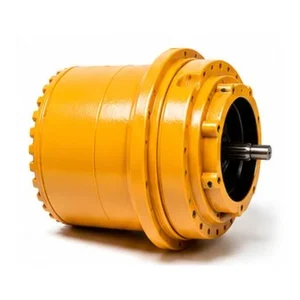
EP-SE410T3 Tretrins planetgearkasse med bæltedrev
-
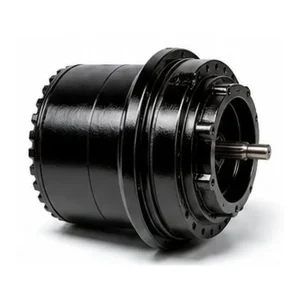
EP-SE406BT3 Tretrins planetgearkasse med bæltedrev
-
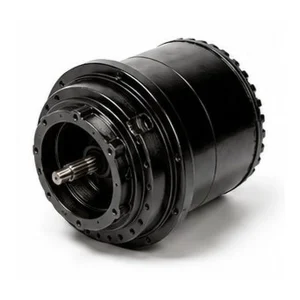
EP-SE406AT flertrins planetgearkasse med bæltedrev
-
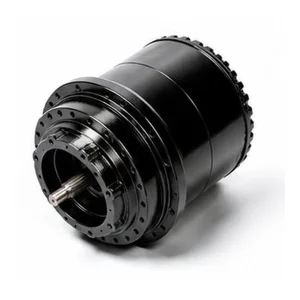
EP-SE402T2 Double-Stage Track Drive Planetary Gearbox
-
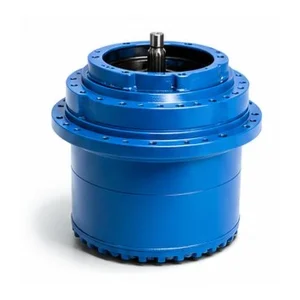
EP-SE401T1 Planetgearkasse med et trin og bæltedrev