Port Container Handling Equipment That Uses Slewing Drive Planetary Gearboxes
Port container terminals use several types of crane and handling equipment — each with a different drejedrev planetgearkasse requirement. The common threads are heavy loads (30 to 65 tonnes per container), high cycle rates (25 to 40 moves per hour), salt-spray environments, and extreme economic pressure to maximise uptime.
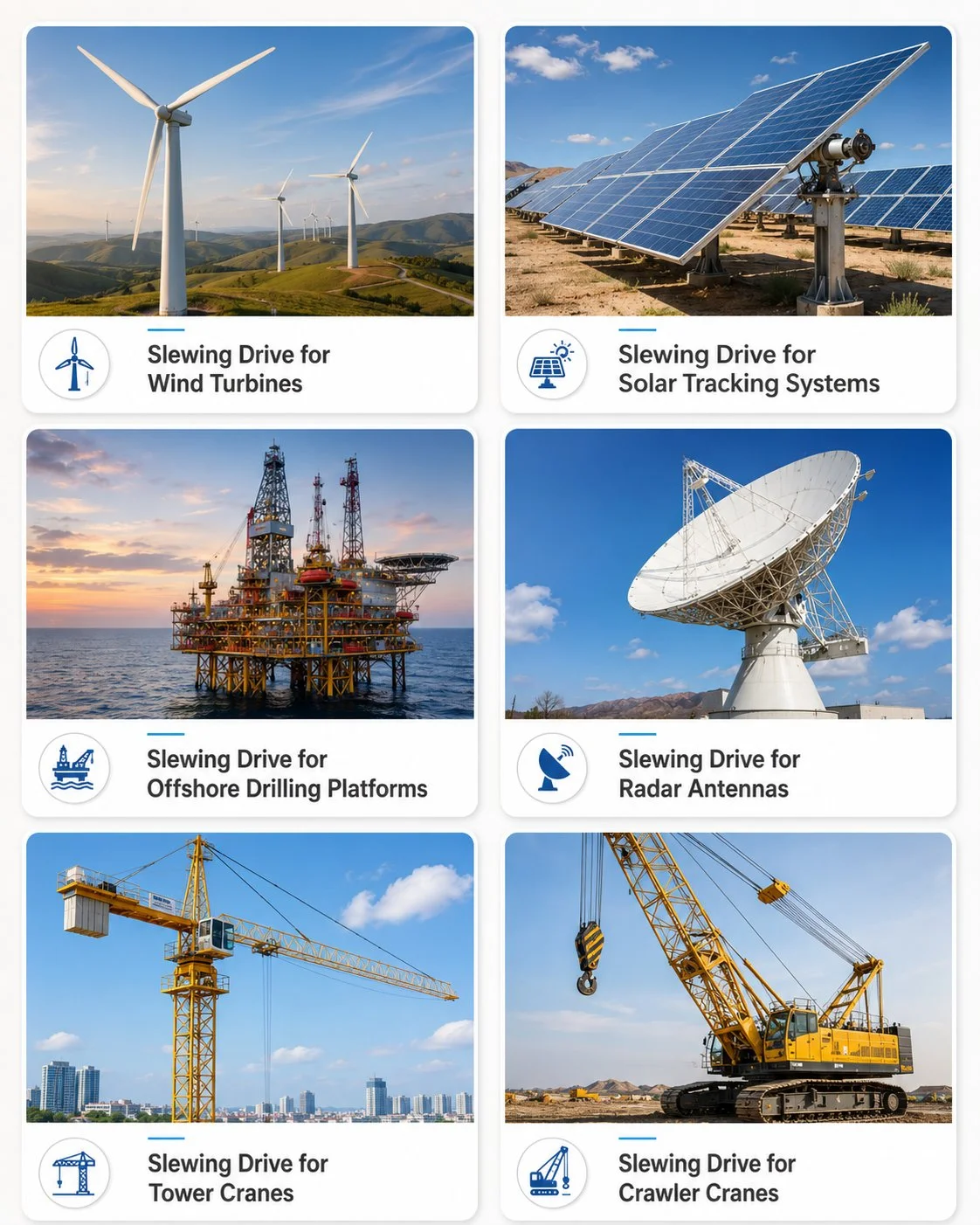
The primary slewing drive application in port container handling. A mobile harbour crane rotates 360 degrees on a pedestal to reach containers on the ship and place them on quayside transport. Lifting capacity: 40 to 200 tonnes. Boom radius: 35 to 56 metres. Slewing torque: 50,000 to 200,000 Nm. The slewing drive must handle 25 to 40 container moves per hour — each involving a loaded slew (ship to quay) and an empty return (quay to ship) — for 18 to 22 hours per vessel call.
Fixed pedestal cranes on the quay wall. The jib luffs while maintaining a level hook path, and the turret slews to reach different ship holds. Slewing torque: 30,000 to 120,000 Nm. These cranes operate in the same salt-spray environment with higher annual hours (6,000 to 8,000 h/year versus 3,000 to 5,000 for MHCs) — making the per-year corrosion and fatigue accumulation more severe.
The spreader that grabs the container from above must rotate to align with containers stowed at different angles. Driven by a compact slewing drive of 3,000 to 8,000 Nm, the spreader must position within ±10 mm for twist-lock engagement. This drive operates in the most corrosive zone: directly above the ship hold, exposed to salt spray and cargo moisture continuously.
The distinction between port cranes and construction cranes is not just environmental — it is economic. A construction crane that stops for maintenance costs the contractor USD 1,000 to 3,000 per hour in idle labour. A port crane that stops for maintenance costs the terminal operator USD 2,500 to 10,000 per hour in lost handling revenue PLUS delays the vessel at USD 5,000 to 25,000 per hour in berth and delay penalties. This economic pressure means that the slewing drive reliability specification for port cranes is driven by revenue mathematics, not by maintenance budgets.
Duty Cycle Economics — Why Slewing Drive Reliability Is a Revenue Issue
Port container handling is the only slewing drive application where the economic cost of one hour of drive failure can be calculated to the dollar — because every container move has a direct revenue value and every hour of crane downtime has a measurable cost.
| Metric | Value | Revenue Impact |
|---|---|---|
| Container moves/hour | 25 – 40 | USD 100–250/move |
| Revenue per crane-hour | — | USD 2,500–10,000 |
| Vessel berth cost | per day | USD 30k–80k |
| 8-hour drive failure | — | USD 60k–280k total |
The reliability ROI: A slewing drive that achieves 99.5% availability instead of 99.0% saves 40 hours of downtime per year. At USD 7,500 average hourly cost, this saves USD 300,000 per year. The price premium for the higher-reliability specification is typically USD 5,000 to 15,000 — paid back within the first 2 to 8 hours of avoided downtime. In port container handling, slewing drive reliability is not a maintenance budget question — it is a capital investment with measurable return.
This economic reality shapes every specification decision. Port crane operators do not ask “what is the cheapest slewing drive that meets the torque requirement” — they ask “what is the drive with the lowest total cost of ownership over 20 years, including the revenue lost during every hour of downtime.” The answer consistently favours higher-grade gears, marine-rated bearings, automatic re-lubrication systems, and premium seal materials — because the incremental cost of these features is a rounding error compared to the revenue impact of a single unplanned failure event.
Salt-Spray Corrosion — 24/7 Marine Exposure for 20 to 30 Years
Port container cranes operate within 50 metres of the waterline — in the most corrosive atmospheric zone on land. The slewing drive housing, slewing ring, pinion, fasteners, and seal interfaces are exposed to continuous salt-laden air and periodic salt-water spray. This exposure is not seasonal — it is 24 hours per day, 365 days per year, for the 20 to 30-year life of the crane.
C5-M marine coating per ISO 12944: zinc primer (75 μm) + epoxy intermediate (150 μm) + polyurethane topcoat (60 μm) = minimum 285 μm total DFT. All fasteners: A4-80 stainless steel or hot-dip galvanised. Standard carbon steel bolts corrode visibly within months in port environments — producing galvanic corrosion with the ductile iron housing that accelerates both the bolt and housing degradation.
The bearing raceway is the most corrosion-sensitive component. Salt moisture penetrates through the bearing seals and mixes with the grease. Chloride ions initiate pitting on the hardened raceway surface. Each pit becomes a stress concentration under rolling contact — propagating into fatigue spalling at 3 to 5 times the rate of corrosion-free raceways. Automatic re-lubrication at 250 to 500-hour intervals with corrosion-inhibiting grease is mandatory.
The exposed gear mesh is wetted by salt spray between greasing intervals. Even overnight, a thin salt-water film initiates micro-pitting that roughens the tooth surface and increases friction. Automatic pinion-ring grease dispensers applying fresh grease every 2 to 4 hours are standard on high-utilisation port crane slewing drives.
The corrosion management system — coatings, stainless fasteners, automatic greasing, seal replacement schedule — is as much a part of the slewing drive specification as the torque and speed ratings. A port crane slewing drive specified without a comprehensive corrosion management plan will fail prematurely regardless of its mechanical quality. The coating system alone adds USD 2,000 to 5,000 to the drive cost — but extends the housing life from 8 to 12 years (standard paint) to 20 to 30 years (C5-M marine system), eliminating one complete housing replacement over the crane life.
The electrical connections and sensors on the slewing drive require the same marine protection. Motor power cables, encoder signal cables, and temperature sensor wiring must use marine-grade connectors (IP68-rated, nickel-plated brass or 316 stainless steel bodies) with heat-shrink junction boots. Standard industrial connectors with zinc-plated bodies develop white corrosion deposits within 6 to 12 months in port environments — eventually causing intermittent contact failures that produce erratic drive behaviour and false fault alarms. Replacing a corroded connector at the top of a port crane boom requires a maintenance crew, a man-basket, and 4 to 8 hours of crane downtime — all avoidable with a marine-grade connector that costs USD 50 to 200 more than the industrial equivalent.
Container Sway and Anti-Sway — How the Slewing Drive Acceleration Profile Determines Placement Precision
A container suspended on hoist ropes forms a pendulum. When the crane slews, the container swings laterally — and when the crane stops, the container continues to swing at its natural pendulum frequency. If the slewing drive acceleration or deceleration resonates with the pendulum period, the swing amplitude grows with each cycle — making accurate placement impossible and potentially striking the ship structure or quayside equipment.
The pendulum period is determined by the hoist rope length: T = 2π x √(L/g). At a 25-metre rope length, the period is approximately 10 seconds. The slewing drive acceleration ramp must be tuned to avoid exciting this pendulum — typically by completing the velocity change in less than one-quarter of the pendulum period. If the ramp is too aggressive, the container swings with increasing amplitude; if too gentle, the cycle time increases and throughput falls.
Modern port cranes use electronic anti-sway systems that modulate the slewing acceleration profile in real time based on the measured rope length. The anti-sway algorithm calculates the optimal acceleration and deceleration ramp for each lift — and the slewing drive must execute this variable ramp with proportional, jerk-free torque delivery. Any dead zone, cogging, or non-linearity in the drive response at low joystick inputs disrupts the anti-sway algorithm and produces residual container swing that the operator must wait to damp before placement — reducing the effective throughput by 10 to 20%. On a crane handling 35 containers per hour, a 15% throughput reduction from anti-sway mismatch costs approximately 5 containers per hour — or USD 500 to 1,250 per hour in lost handling revenue. Over a 6,000-hour operating year, this single drive-quality issue costs USD 3 to 7.5 million — dwarfing the price difference between Class 6 and Class 8 gears (typically USD 1,000 to 3,000 per drive).
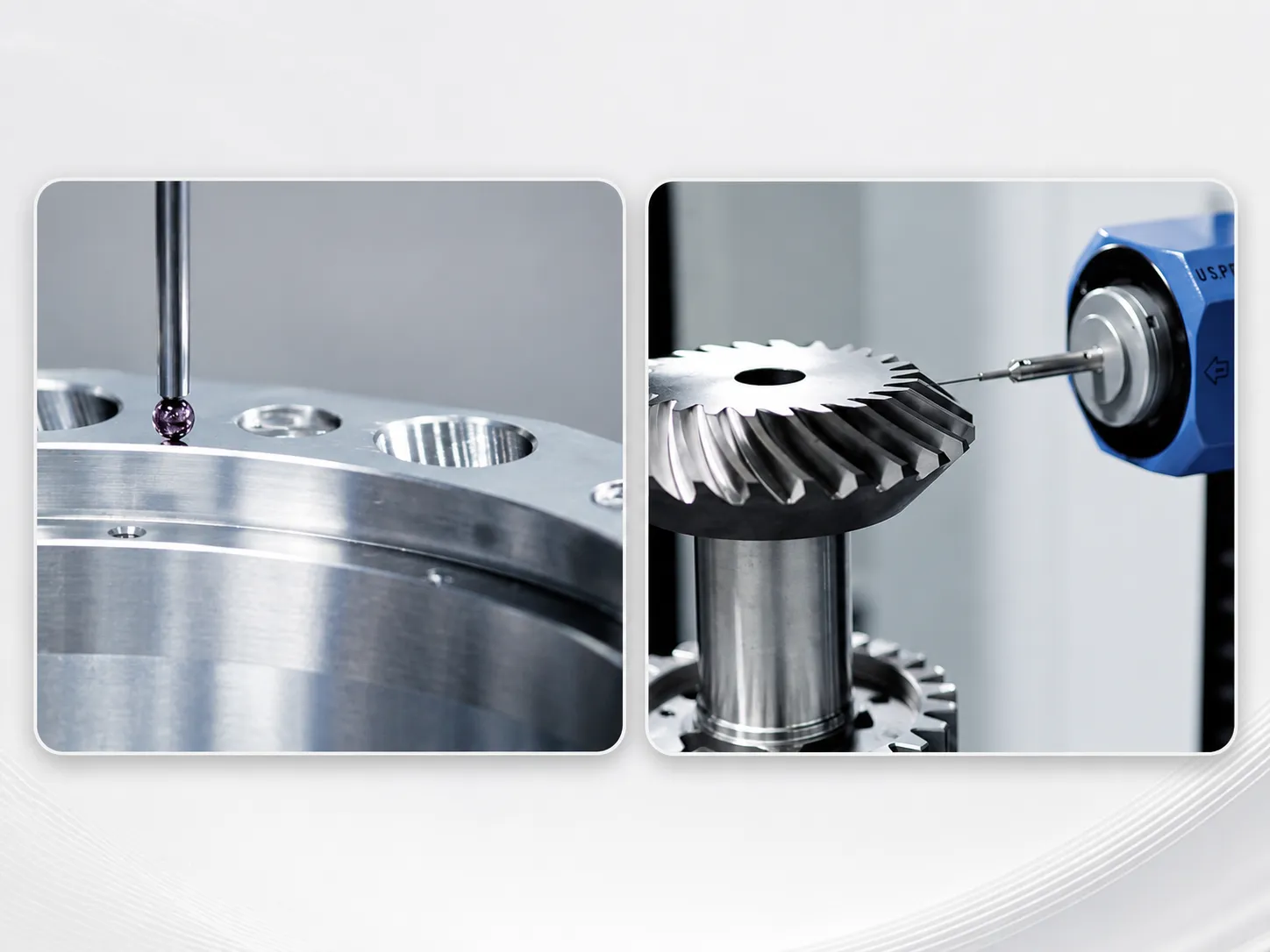
The slewing drive gear mesh quality directly affects the anti-sway effectiveness. A drive with DIN Class 6 gears produces a smooth torque output that the anti-sway algorithm can control precisely. A drive with Class 8 gears produces torque pulsation at the tooth mesh frequency — a disturbance that the anti-sway algorithm interprets as an external force and attempts to compensate, often making the swing worse. For anti-sway-equipped port cranes, the gear quality specification is set by the control system requirement, not by the mechanical strength requirement — and Class 6 is the minimum acceptable standard.
Three Failure Modes That Drive Port Crane Slewing Drive Specification
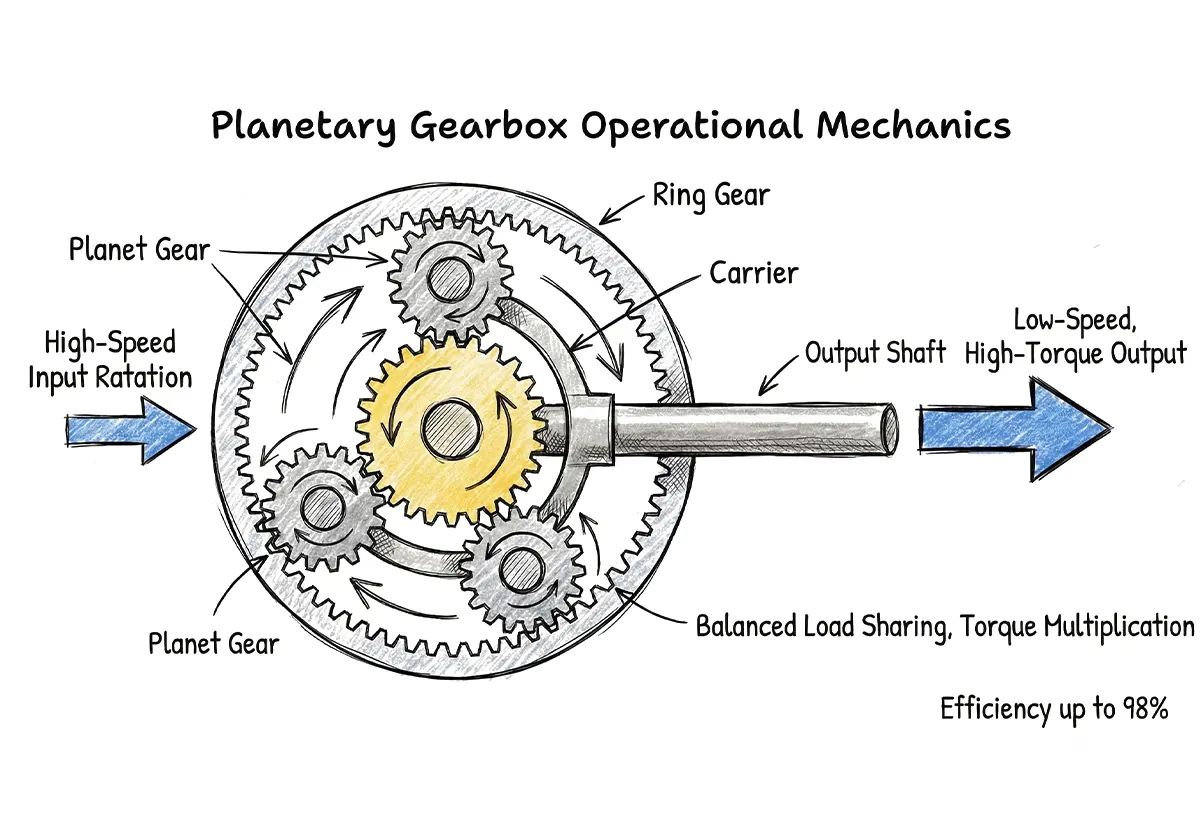
The port crane slewing bearing endures two simultaneous degradation mechanisms: corrosion pitting from salt-water ingress AND contact fatigue from high-cycle container handling (50 to 80 loaded slewing cycles per hour). Each corrosion pit becomes a fatigue stress concentration — and each fatigue crack becomes a corrosion entry point. This synergistic degradation is 3 to 5 times faster than either mechanism alone. A bearing that would last 25,000 hours in a dry-site crane may reach replacement at 10,000 to 15,000 hours in a port — unless corrosion is actively managed through greasing discipline and seal maintenance.
A mobile harbour crane handling 30 containers per hour at 18 hours per day accumulates 540 loaded slewing cycles per day — 197,000 per year. Over 20 years, the gear teeth endure approximately 4 million high-load contact cycles. This is comparable to the excavator swing drive in cycle count — but at 3 to 10 times the torque per cycle. The tooth root bending stress and surface contact stress must both be rated for the infinite-life region of the S-N curve. Standard construction-crane gear ratings (designed for 10,000-hour life) are insufficient — the port crane gear must be rated for the infinite-life endurance limit of the material, with no time-limited fatigue credit.
When the anti-sway system commands a specific acceleration ramp and the slewing drive delivers a different ramp (due to gear mesh cogging, hydraulic valve dead zone, or backlash in the pinion-ring mesh), the container swing is not cancelled — it is amplified. The anti-sway algorithm assumes a specific drive response; if the actual response differs by more than 5 to 10%, the corrective timing is wrong and the algorithm adds energy to the pendulum instead of removing it. The result is growing oscillation that forces the operator to disable anti-sway and wait for the swing to damp naturally — adding 15 to 30 seconds per cycle and reducing throughput by 10 to 20%.
Slewing Drive Planetary Gearbox for Port Container Cranes — Frequently Asked Questions
Korea Ever-Power provides port crane slewing drives from 3,000 to 200,000 Nm with marine coatings, infinite-life fatigue ratings, and anti-sway speed control.
Redaktør: Cxm