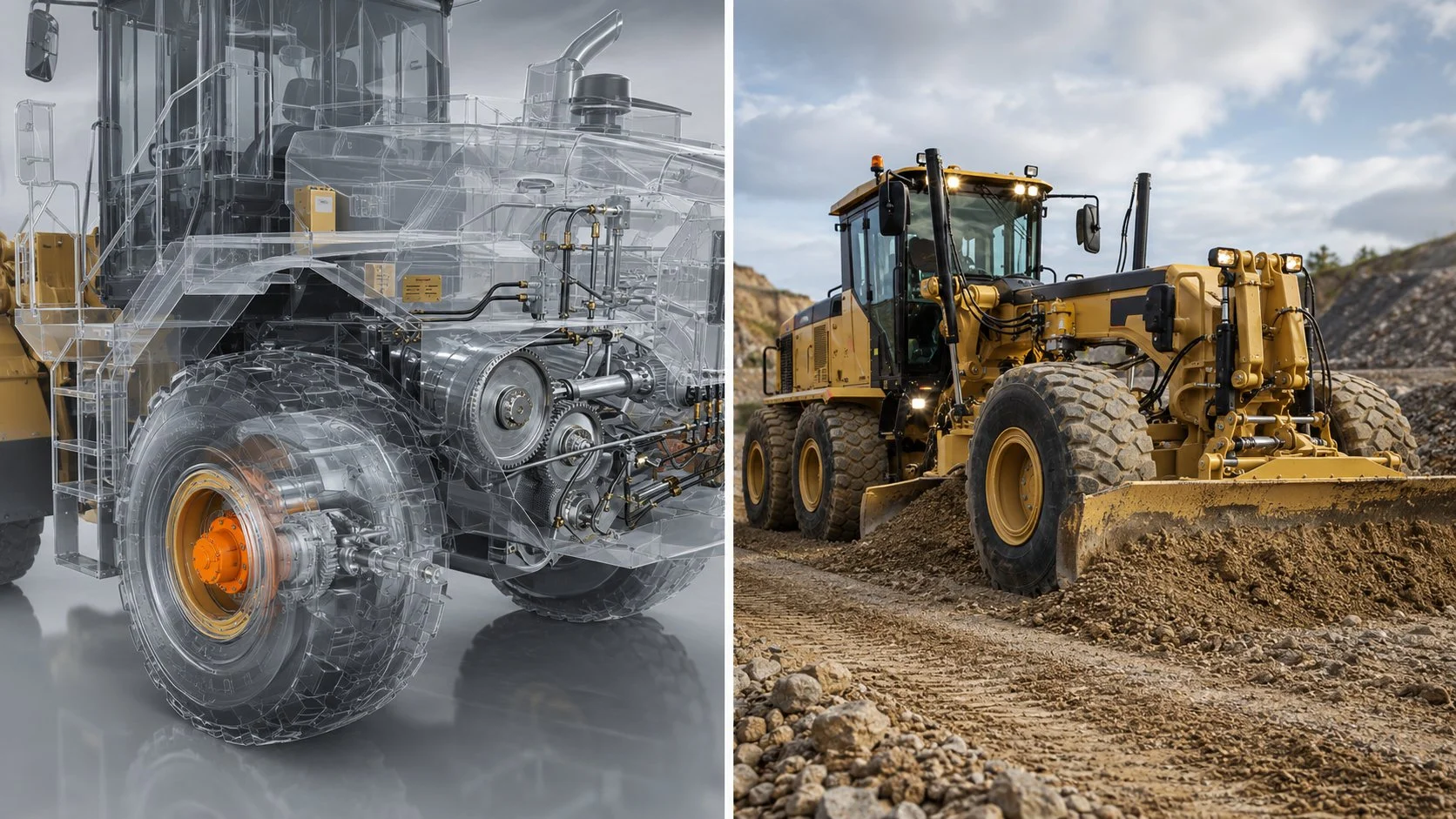
The Underground Environment — The Most Hostile Workplace for a Wheel Drive
Underground hard-rock mining tunnels combine every environmental hazard from the surface applications in this series — and add constraints that do not exist above ground. The tunnel atmosphere contains rock dust (Mohs 5 to 8, finer than 100 microns), water mist from drill-flushing and dust suppression, diesel exhaust particulates (on diesel-powered jumbos), and potentially corrosive groundwater (pH 3 to 11 depending on the ore body chemistry). The tunnel floor is uneven blasted rock covered with a layer of muck (broken rock and water) that the planetgearkasse med hjultræk must navigate while positioning a 25 to 50-tonne machine to within 50 mm accuracy.
The confined space is the first constraint. A typical development heading (the tunnel being drilled) is 4.0 to 5.5 metres wide and 4.0 to 5.0 metres high. The drilling jumbo — which can be 12 to 15 metres long with booms stowed — must drive into this heading, turn to face the rock face, position itself centrally, and extend the drill booms to the prescribed pattern. The turning manoeuvre requires articulated steering or all-wheel steering to fit within the tunnel width — and the wheel drive must provide smooth, proportional torque at the 0.5 to 2 km/h positioning speed without cogging or hesitation that would make precise alignment difficult in the limited visibility of the underground environment.
The tunnel gradient can reach 15 to 20% on ramp access tunnels (declines) that connect surface to underground workings. The jumbo must climb and descend these ramps fully loaded — with the drill booms, rock bolting equipment, and consumables (drill steel, explosives in some configurations) adding 5 to 15 tonnes above the base machine weight. The braking requirement on a 20% decline at 45 tonnes exceeds 88 kN of continuous retarding force — sustained for the 500 to 2,000 metre ramp length. The wheel drive brake must provide this sustained retarding without fade — because a runaway jumbo in a tunnel has nowhere to go except into the rock face or into other vehicles in the tunnel.
The underground temperature is typically stable at 20 to 40 degrees C (increasing with depth at approximately 1 degree C per 30 to 50 metres of depth). In deep mines (1,000 to 3,000 metres below surface), the virgin rock temperature reaches 40 to 60 degrees C — and the tunnel air temperature after refrigeration is 25 to 32 degrees C. The wheel drive oil temperature baseline is therefore 15 to 25 degrees C higher than surface ambient in deep mines — reducing the thermal margin for sustained high-torque operation such as ramp climbing.
The ventilation constraint adds another dimension. Underground tunnels have limited airflow — typically 20 to 40 m3/s through the heading, compared to effectively unlimited natural convection on the surface. The wheel drive relies on convective cooling from the surrounding air to dissipate heat during transit and positioning. In a dead-end heading (where the jumbo drills at the face), the airflow is provided by a ventilation duct that may deliver only 5 to 15 m3/s of air to the face area. This restricted airflow reduces the convective cooling coefficient on the gearbox housing by 50 to 70% compared to surface conditions — meaning the steady-state oil temperature is 20 to 35 degrees C higher than it would be for the same duty on the surface. The combined effect of elevated ambient temperature (deep mine) and reduced convective cooling (restricted ventilation) can push the oil temperature to 100 to 120 degrees C during sustained positioning manoeuvres — requiring synthetic oil and FKM seals as baseline specifications, not premium options.
The electrification trend in underground mining is transforming the wheel drive specification. Battery-electric and cable-electric jumbos eliminate diesel exhaust (improving air quality and reducing ventilation requirements) but introduce new wheel drive challenges: the electric motor produces instant torque from zero RPM (risking wheel spin on wet muck floors if the traction control is not properly calibrated), and the regenerative braking during ramp descent feeds energy back to the battery (requiring the wheel drive to handle bi-directional energy flow without torque ripple). The planetary gearbox for an electric jumbo must accommodate higher input speeds (electric motors typically run at 3,000 to 6,000 rpm versus 2,000 to 3,000 rpm for hydraulic motors) — requiring either a higher gear ratio or an additional intermediate reduction stage.
Drill-Pattern Positioning — 50 mm Accuracy on a Muck-Covered Tunnel Floor
The drill pattern (the arrangement of blast holes in the rock face) determines the advance rate, the fragmentation quality, and the tunnel profile accuracy. A positioning error of more than 100 mm shifts the entire drill pattern — potentially producing overbreak (excavating more rock than needed, wasting explosives and requiring additional support) or underbreak (leaving rock that must be re-drilled and re-blasted, delaying the advance by an entire cycle). The wheel drive must position the machine to ±50 mm on a tunnel floor that consists of broken rock fragments (50 to 300 mm), muck (a slurry of crushed rock and groundwater), and occasionally standing water (100 to 300 mm depth).
The muck floor provides highly variable traction. Dry muck has a coefficient of 0.4 to 0.6; wet muck falls to 0.2 to 0.4; standing water over muck falls to 0.15 to 0.3. The wheel drive must achieve the positioning accuracy across this entire traction range — which requires proportional hydraulic control with real-time traction compensation that reduces the torque when wheel slip is detected and redistributes it to the non-slipping wheels.
Once positioned, the jumbo extends stabiliser jacks (legs) to the tunnel floor and walls — anchoring the machine against the drill-thrust reaction forces. During drilling, each boom applies 15 to 30 kN of thrust against the rock face — and the reaction force must be absorbed by the stabilisers, not by the wheel drive. The wheel drive parking brake must hold the machine during the stabiliser deployment sequence (before the jacks are fully loaded) and must remain engaged as a backup throughout drilling — because a stabiliser jack that slips or fails must not allow the machine to move while the drill steel is embedded in the rock face. A machine that moves during drilling can bend or break the drill steel (USD 200 to 500 per rod), damage the drill boom hydraulics (USD 5,000 to 15,000 per boom), and — in the worst case — cause the operator to lose control of the drill, resulting in injury from a whipping hydraulic hose or a flying drill-steel fragment.
Modern drilling jumbos use automated drill-pattern positioning systems that read the face location using laser scanners or total stations and calculate the required machine position automatically. The wheel drive receives positioning commands from the automation system — and must respond with the same accuracy and smoothness as a manually operated drive, but without the operator feedback loop. Any cogging, dead-band, or response delay in the wheel drive hydraulic control system manifests as a positioning error that the automation system must detect and correct — adding correction cycles that extend the total positioning time and reduce the productive drilling time. A wheel drive with less than 0.3-second response time and less than 2% speed cogging enables single-pass automated positioning — reaching the target position in one continuous motion rather than the hunt-and-oscillate pattern that results from a drive with slower response or higher cogging.
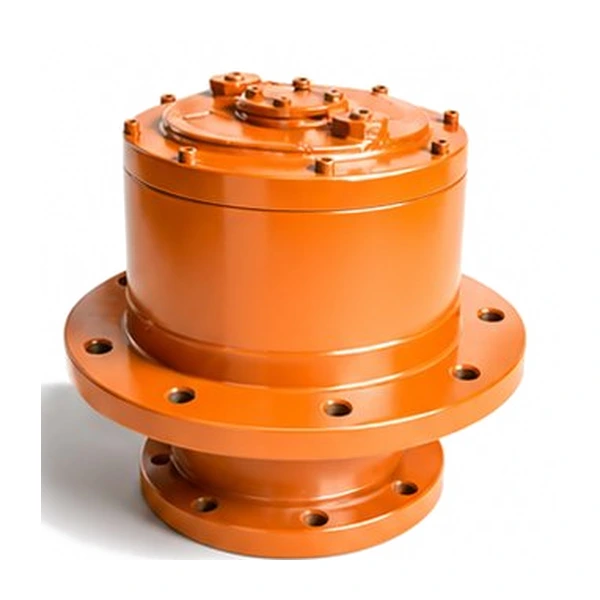
Mine-Water and Rock-Dust Sealing — The Dual Contamination Challenge
Underground wheel drives face simultaneous water and dust contamination — a combination that is more damaging than either hazard alone. The drill-flushing water (used to cool the drill bit and flush the cuttings from the hole) sprays from the drill face at 5 to 15 litres per minute per boom — drenching the entire machine including the wheel drives. This water carries rock-dust particles that range from 1 to 500 microns — the same abrasive particles that destroy seals on stone crushers (WD-07), but suspended in a water stream that forces them into every gap under hydrostatic pressure.
The groundwater chemistry adds a chemical attack dimension. In sulphide ore bodies (copper, zinc, lead, gold), the groundwater can be highly acidic (pH 2 to 4) from the dissolution of iron sulphide (pyrite) — attacking steel, copper, and standard seal materials at rates comparable to the grape juice on vineyard harvesters but at much higher volumes and for much longer exposure periods. In carbonate ore bodies (limestone, dolomite), the groundwater is alkaline (pH 8 to 11) — similar to concrete wash water. The wheel drive seal and housing material must be specified for the site-specific groundwater chemistry — because a seal that lasts 4,000 hours in neutral water may last only 1,000 hours in pH 3 acid mine water.
Duo-cone face seals are the standard specification for underground mining wheel drives — because the combination of rock dust, water pressure, and chemical attack overwhelms any lip-seal arrangement within 500 to 1,500 hours. The duo-cone seal runs metal-to-metal (hardened steel or tungsten carbide faces) and is not affected by the dust abrasion or the chemical attack that degrades elastomeric seals. The seal life with duo-cone arrangement reaches 3,000 to 6,000 hours underground — 2 to 4 times longer than the best lip-seal arrangement in the same conditions.
Three Failure Modes Specific to Underground Jumbo Wheel Drives
Groundwater at pH 2 to 4 penetrates the gearbox through seal imperfections, breather vents, or housing gasket joints. Once inside, the acid water attacks the bearing raceway surfaces, producing pitting corrosion that initiates fatigue spalling within 500 to 1,000 hours of continued operation. The corrosion products (iron oxide, copper sulphate) contaminate the oil and accelerate the wear on all internal surfaces. In the worst cases, the acid water dissolves the copper content of the bronze bearing cages — weakening the cage structure and causing cage fracture that jams the bearing and seizes the gearbox output.
A 45-tonne jumbo descending a 1,500-metre ramp at 15% grade must dissipate approximately 99 MJ of potential energy. If the engine retarder is insufficient (due to engine derating from altitude or exhaust back-pressure from the tunnel ventilation system), the wheel drive brakes absorb the excess energy. Underground, the air cooling capacity is 30 to 50% lower than on the surface (reduced airflow, higher ambient temperature) — meaning the brakes cannot dissipate heat as effectively. A brake that passes the surface-grade descent test may overheat and fade on the same gradient underground. The confined tunnel means there is no option to stop and cool the brakes — the machine behind cannot pass, and blocking the ramp stops the entire mining operation.
The tunnel floor after blasting contains rock fragments from 50 to 500 mm — sharp, angular, and randomly distributed. The jumbo drives over these fragments at 10 to 15 km/h during transit between the face and the remuck bay. Each fragment impact produces a 3 to 8 g shock at the wheel drive output bearing — similar to the bulldozer transit-speed impact (WD-14) but with sharper, more angular loading profiles from the fractured rock. The cumulative impact fatigue from 200 to 500 fragment strikes per transit trip accelerates bearing Brinelling at 5 to 10 times the rate of smooth-surface driving — making underground transit the most bearing-destructive driving condition in the entire Wheel Drive series.
Ofte stillede spørgsmål
Korea Ever-Power provides underground jumbo wheel drives from 8,000 to 40,000 Nm with duo-cone mine-water sealing, wet-disc ramp braking, and acid-water corrosion protection.
Redaktør: Cxm