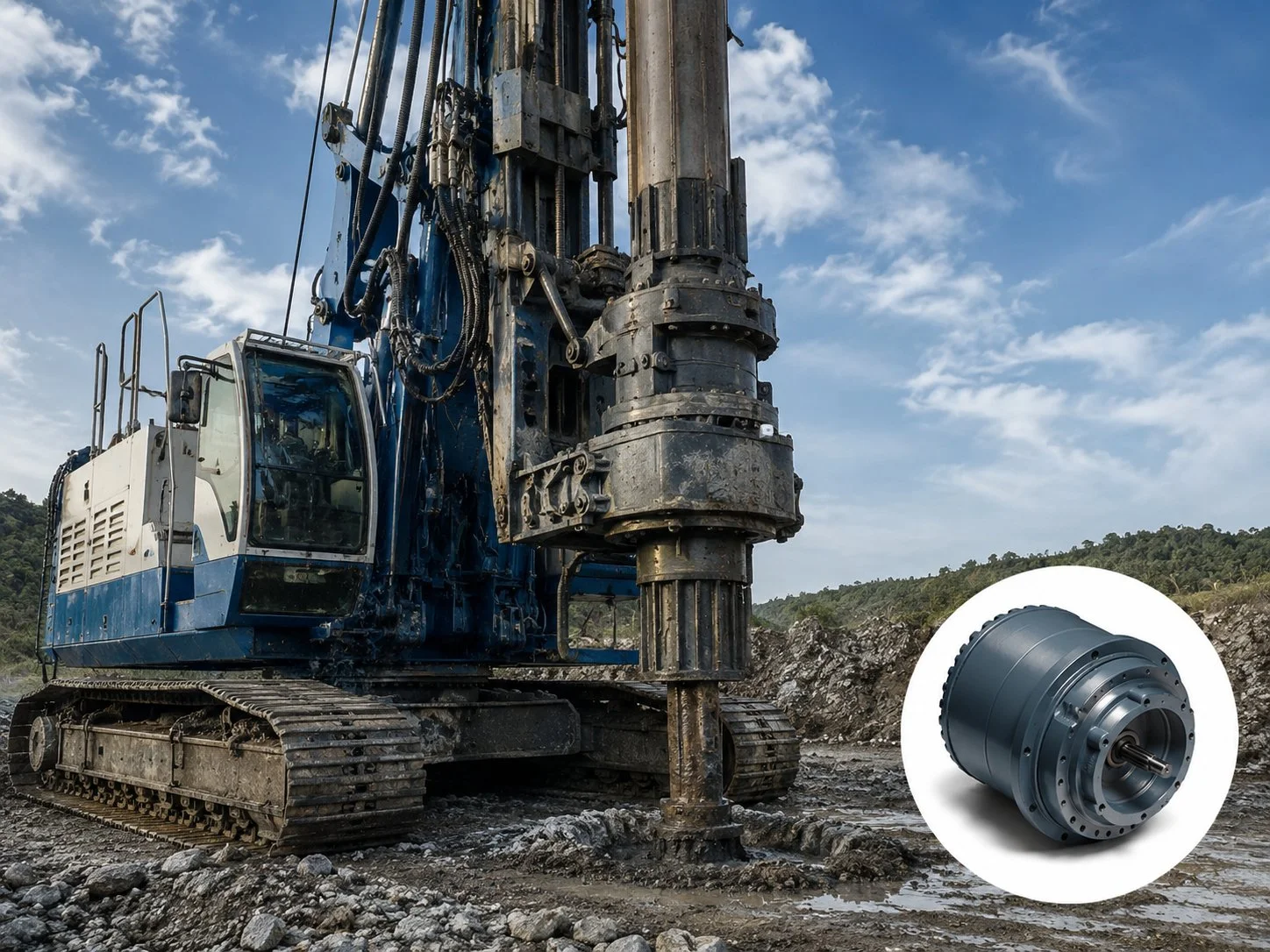
What Makes a Drilling Rig Track Drive Different from Every Other Final Drive
Excavators steer constantly. Bulldozers push continuously. Dump trucks haul for hours. A drilling rig does none of these. It sits stationary — drilling — for 85 to 95% of its operating time. The Planetengetriebe mit Kettenantrieb engages only during tramming: the brief repositioning movement between drill holes that typically covers 5 to 30 metres, takes 1 to 3 minutes, and occurs 15 to 60 times per shift.
This low duty cycle might suggest that the track drive is lightly loaded. The opposite is true. During each tram, the track drive must accomplish three demanding tasks in rapid sequence:
The rig has been stationary for minutes to hours while drilling. The tracks may have settled into the ground surface. Breakaway torque — the torque needed to overcome static friction and ground adhesion — can exceed the steady-state tramming torque by 1.5 to 2.5 times. The track drive must deliver this peak without hesitation.
The rig moves across the bench or pad surface at 1.5 to 3.5 km/h, navigating around spoil piles, other equipment, and blast-pattern markers. The operator must maintain directional control on slopes up to 10 to 15% that are common on quarry and mine benches.
The last 0.5 to 2 metres of the tram require the rig to decelerate smoothly and stop with the drill mast centreline within 50 to 100 mm of the target hole position. This micro-positioning at near-zero speed demands backlash-free torque transmission — any play in the planetary gears translates directly into positional overshoot or hunt.
Pad-to-Pad Cycle Time — How the Track Drive Determines Drilling Productivity
In production drilling — blast-hole patterns on mine benches, foundation piling on construction sites, geotechnical investigation grids — the number of holes drilled per shift is the primary productivity metric. Each hole requires three time components: tramming (track drive), setup (levelling and mast positioning), and drilling (rotary head). The tramming time is the component most directly affected by track drive performance.
| Rig Type | Weight (t) | Tram Distance | Tram Speed | Tram Time | Track Torque (Nm) |
|---|---|---|---|---|---|
| Blast-hole drill (rotary) | 60 – 120 | 5 – 15 m | 1.5 – 2.5 km/h | 30 – 90 sec | 50,000 – 100,000 |
| Piling rig (CFA / driven) | 40 – 90 | 3 – 10 m | 1.0 – 2.0 km/h | 20 – 60 sec | 35,000 – 75,000 |
| DTH hammer rig | 25 – 55 | 5 – 20 m | 2.0 – 3.5 km/h | 20 – 60 sec | 20,000 – 45,000 |
| HDD (horizontal directional) | 15 – 45 | 50 – 500 m | 2.5 – 4.0 km/h | 2 – 10 min | 15,000 – 40,000 |
Productivity calculation: A blast-hole drill producing 40 holes per shift at 7 metres per hole: total drilling time = 40 x 8 min = 320 min. Total tramming time at 60 sec/tram = 40 min. Setup time at 90 sec/hole = 60 min. Total = 420 min (7 hours). If the tram speed can be increased by 30% through a faster track drive, the tramming time decreases from 40 to 28 min — saving 12 minutes per shift that translates to 1.5 additional holes. At USD 3.50 per tonne of blasted rock and 500 tonnes per hole, that 12 minutes of saved tramming time produces USD 2,625 of additional output per shift.
Precision Positioning — How the Track Drive Achieves Centimetre-Level Accuracy at 80 Tonnes
A blast-hole pattern on a quarry bench has holes spaced at 3 to 5 metre intervals. The drill rig must position its mast within 50 to 100 mm of the designed hole centre. On modern GPS-guided rigs, the navigation system directs the operator to the target — but the track drive must deliver the final positioning accuracy.
When the operator releases the travel lever to stop the rig, the hydraulic motor decelerates to zero. Any backlash in the planetary gear train allows the sprocket to rotate slightly beyond the intended stop point — the machine coasts by the backlash amount multiplied by the sprocket radius. At 10 arcminutes of backlash on a 600 mm PCD sprocket: overshoot = (10/60) x (pi/180) x 300 = 0.87 mm. This is negligible. But at 30 arcminutes (a worn gearbox): overshoot = 2.6 mm. And with the dynamic effects of a 100-tonne machine decelerating on a slope, the actual positional error from gearbox backlash can reach 20 to 50 mm — a significant fraction of the 50 to 100 mm total accuracy budget.
The last 0.5 to 2 metres of every tram require the track drive to operate at very low output speed — 0.1 to 0.5 rpm at the sprocket. At this speed, the hydraulic motor is running at 10 to 50 rpm (through a 100:1 ratio) — near the lower limit of smooth hydraulic motor operation. Any cogging, torque pulsation, or stick-slip in the planetary gear train at this speed translates into jerky movement that the operator cannot compensate. The gear tooth profile and surface finish must be optimised for smooth, uniform torque transmission at near-zero output speed — a requirement that standard construction-grade track drives are not designed to meet.
Tramming Torque Calculation — Sizing the Track Drive for a Blast-Hole Drill Rig
Unique to drilling rigs — the breakaway factor: A drill rig that has been stationary for 10 to 30 minutes while drilling a hole settles into the ground surface. The tracks compress the soil, and the soil partially consolidates around the track shoes. Breaking away from this settled position requires 1.5 to 2.5 times the steady-state tramming force — a peak that excavators and dump trucks rarely encounter because they move frequently and do not settle. The breakaway torque is the peak sizing condition for drill rig track drives, even though it occurs for less than 2 seconds per tram event.

Three Failure Modes Specific to Drilling Rig Track Drives
The breakaway event produces a torque spike at the motor-to-gearbox input interface — the sun gear spline. On rigs that drill in clay soils (which consolidate tightly around stationary tracks), the breakaway spike can reach 2.5 times the steady-state torque. Repeated high-amplitude spikes fatigue the sun gear spline teeth, producing micro-cracking at the spline root radius. Eventually a spline tooth fractures and the motor shaft spins freely inside the gearbox — total loss of drive on that side.
As the planet gear teeth wear over thousands of tram-and-position cycles, backlash increases from the delivery specification (typically 8 to 15 arcminutes) toward 25 to 40 arcminutes. The positioning overshoot grows proportionally. The drill operator compensates by approaching each hole position more slowly — which reduces tramming speed and costs 2 to 5 additional holes per shift in lost cycle time. Many operators do not recognise this gradual productivity loss because it develops over months.
Blast-hole drilling produces a continuous stream of rock cuttings that fall around the base of the rig — covering the track drives in abrasive dust and chips. Unlike excavators (where the track drive is partially shielded by the track frame), drill rig track drives are fully exposed to the cuttings fall zone. Fine rock particles penetrate housing joints, breather valves, and seal interfaces over time. Once inside the oil bath, the particles act as a lapping compound — accelerating gear tooth and bearing surface wear by 3 to 5 times the rate in a clean environment.
Korea Ever-Power Track Drives for Drilling Rig Applications
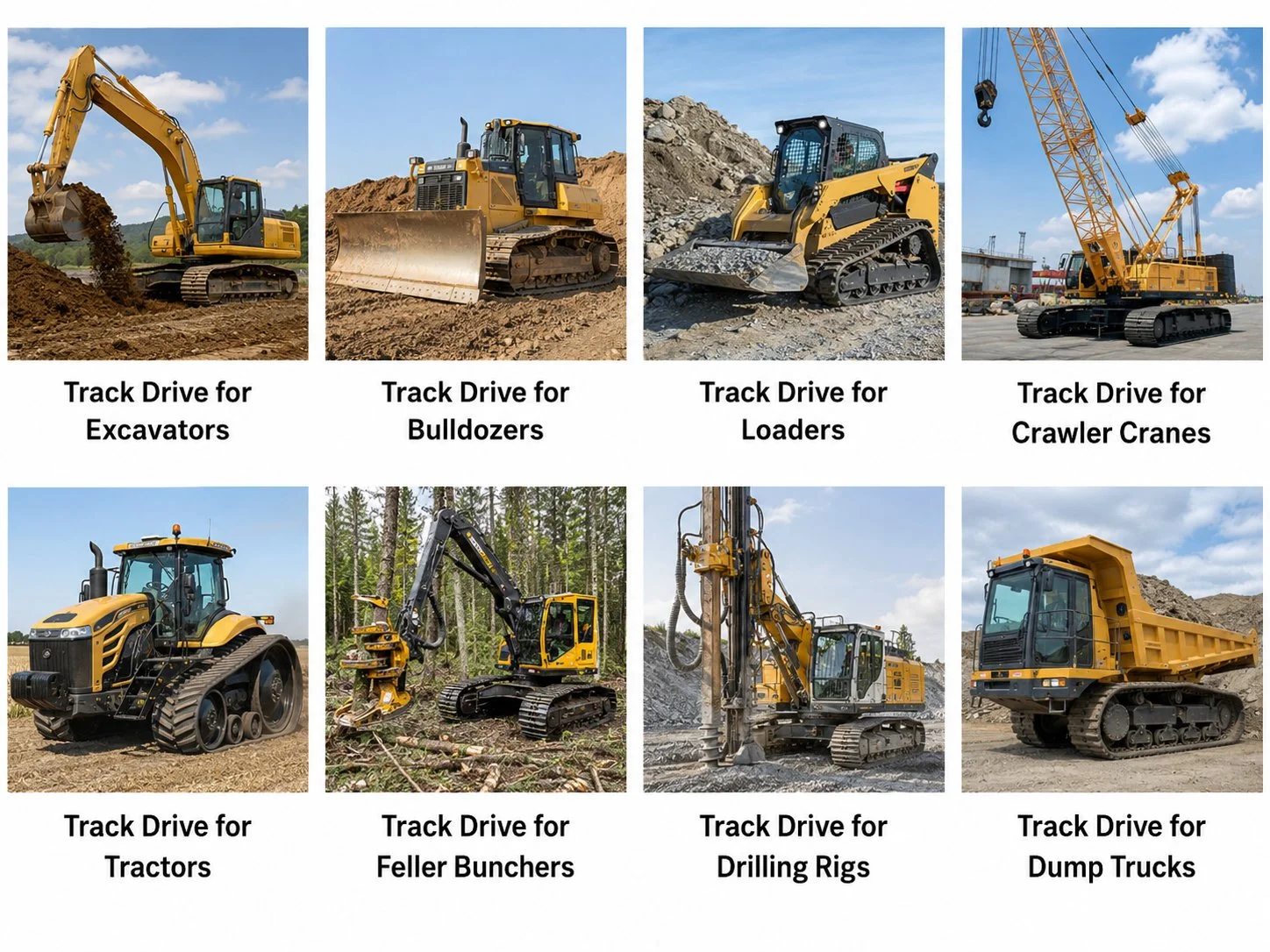
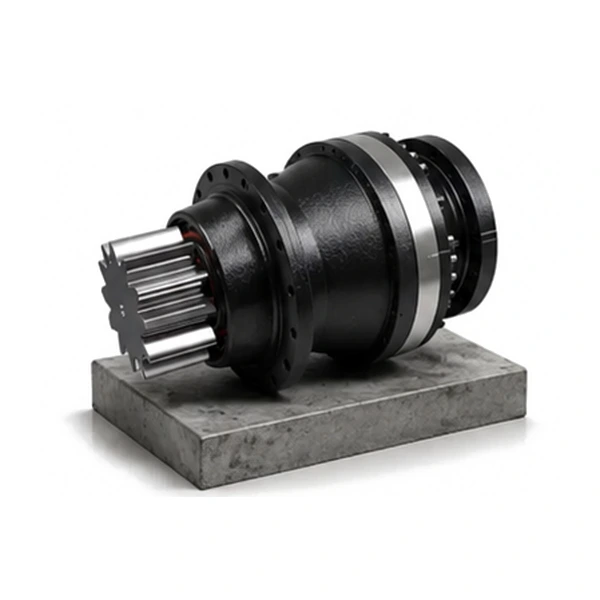
Track Drive Planetary Gearbox for Drilling Rigs — Frequently Asked Questions
Korea Ever-Power provides drilling rig track drive planetary gearboxes from 15,000 to 100,000 Nm with low-backlash and dust-sealed options for blast-hole, piling, DTH, and HDD applications. Provide your rig model and positioning accuracy target for a specification recommendation.
Herausgeber: Cxm