What Makes an Amphibious Excavator Track Drive Fundamentally Different from Land-Based Final Drives
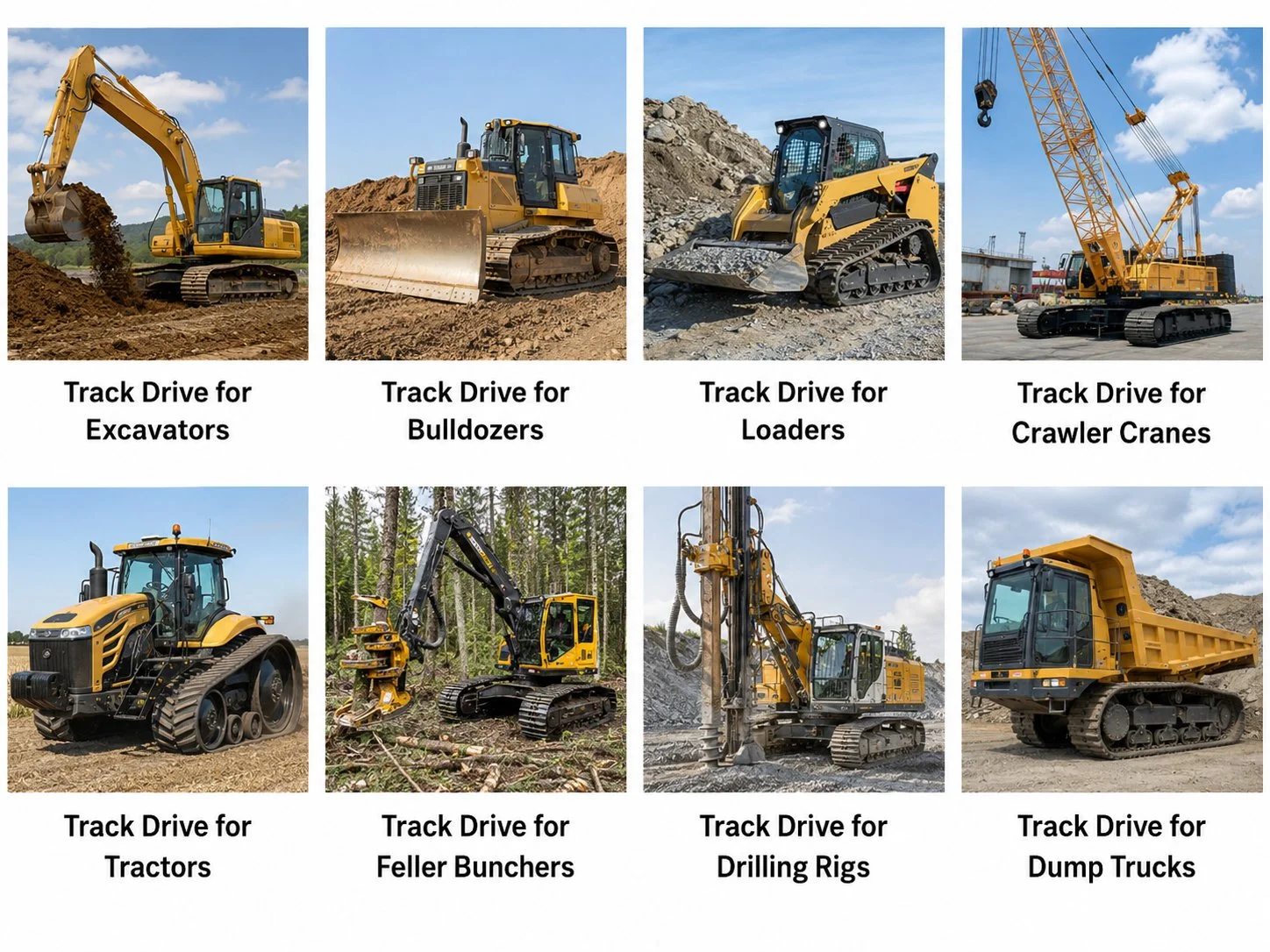
An amphibious excavator — also called a marsh buggy, swamp excavator, or floating excavator — is a standard hydraulic excavator (typically 12 to 35 tonnes) mounted on wide pontoons fitted with track chains or track belts. The pontoons provide buoyancy, and the track drive planetary gearbox on each pontoon propels the machine across water, through mud, and over soft terrain that no conventional tracked machine could traverse.
The engineering differences from a land-based excavator track drive are not incremental improvements — they are fundamental design changes across every component:
| Component | Land-Based Track Drive | Amphibious Track Drive |
|---|---|---|
| Seal requirement | Resist splash and partial submersion | Withstand 0.5 – 2.0 m continuous hydrostatic head |
| Housing material | QT500-7 ductile iron (standard) | QT600-3 with marine anti-corrosion coating or stainless fasteners |
| Breather | Standard atmospheric breather | Sealed expansion chamber or remote-mounted above waterline |
| Corrosion protection | Standard paint | Epoxy + zinc primer, sacrificial anodes for saltwater |
| Oil change trigger | Hours-based (1,000 – 2,000 h) | Water contamination test before every shift (mandatory) |
Hydrostatic Pressure — Why Submersion Changes Everything About Seal Engineering
A land-based track drive seal resists the pressure difference between the internal oil volume and the external atmosphere — typically 0.1 to 0.3 bar during thermal cycling. An amphibious track drive seal must additionally resist the hydrostatic pressure of the surrounding water column. At 1.0 metre of submersion depth, the external pressure is 0.1 bar (approximately 10 kPa) above atmospheric — modest, but applied continuously across the entire seal circumference for hours.
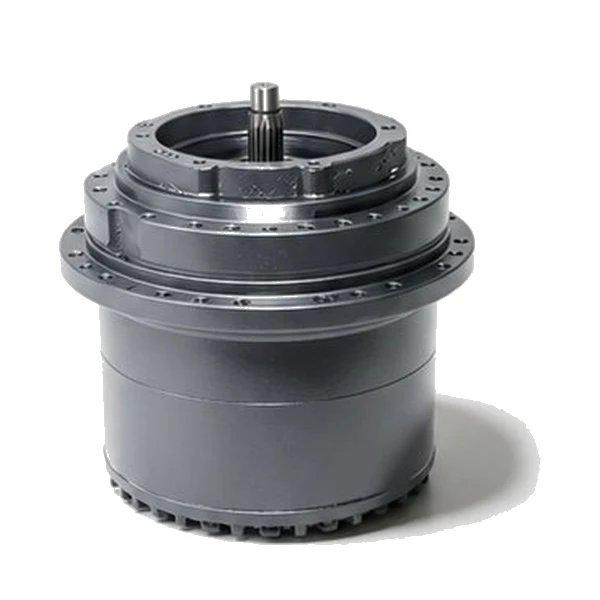
On a land-based machine, the duo-cone seal prevents oil from escaping outward. On a submerged amphibious machine, the seal must also prevent water from entering inward — against the hydrostatic head. Standard duo-cone seals are designed primarily for outward retention. Under inward hydrostatic pressure, the seal lip deflection reverses direction, and the contact geometry that works well for outward retention may allow inward water migration through a different leakage path.
Amphibious track drives require seals validated for bidirectional pressure retention: outward (preventing oil loss when the machine is on dry ground and the oil is warm) and inward (preventing water ingress when the machine is submerged and the external water pressure exceeds internal oil pressure). This bidirectional requirement typically means: higher spring force, tighter face flatness tolerance (0.3 light bands maximum vs 0.9 for standard), and FKM O-rings that resist both oil and water exposure without differential swelling.
The breather problem in submersion: A standard breather valve, if submerged, becomes a water inlet. Amphibious track drives use one of two solutions: (1) a sealed expansion chamber that absorbs thermal expansion without external air exchange — eliminating the breather entirely, or (2) a remote-mounted breather connected to the housing by a hose and positioned above the maximum waterline. The sealed expansion chamber is the preferred solution because it has no external opening that can be blocked by mud or vegetation.
Propulsion Through Three Media — Water, Mud, and Vegetation
A land-based track drive propels through one medium: the ground surface. An amphibious excavator track drive may propel through three media simultaneously: the track shoes push against the mud or riverbed below, the pontoon displaces water at the sides, and submerged vegetation wraps around the sprocket and increases the rotational resistance. The total propulsion resistance is the sum of all three.
The track shoes engage the submerged mud surface. On deep, soft mud (bearing capacity 5 to 15 kPa), the traction coefficient is very low — 0.2 to 0.4 versus 0.5 to 0.7 on dry clay. The track drive must generate propulsion from this limited traction. Wide pontoon tracks (800 to 1,200 mm) and aggressive grouser profiles maximise the available traction area.
The pontoons displace water as the machine moves forward. Water drag increases with the square of the speed — at 3 km/h through shallow water, drag can add 15 to 25% to the total propulsion resistance. At 1 km/h through deep mud, drag is negligible. The track drive must accommodate both conditions within the same shift as the machine transitions between open water and mud flats.
Aquatic vegetation — reeds, lily pads, submerged grasses, mangrove roots — wraps around the sprocket and packs between the track shoes. This vegetation increases the rotational resistance of the track system by 10 to 30% and, if not cleared, can stall the track drive entirely. The sprocket tooth profile on amphibious drives is designed with wider gullets and self-cleaning geometry to shed vegetation during rotation.
Three Failure Modes Specific to Amphibious Track Drives
On a land-based machine, a seal failure produces gradual oil contamination over hundreds of hours. On a submerged amphibious machine, a seal failure produces immediate water ingress under hydrostatic pressure. Within minutes, the oil-water ratio can reach 50/50 — destroying the lubricant film on every bearing and gear surface simultaneously. A single submerged seal failure can condemn the entire planetary gear set and all bearings in a single shift. This is the reason amphibious track drives use dual-seal arrangements (primary duo-cone + secondary backup lip seal) — providing a redundant barrier that no land-based application requires.
Amphibious excavators working in coastal zones, estuaries, and tidal flats encounter saltwater with chloride concentrations of 15,000 to 35,000 ppm. Saltwater in contact with the ductile iron housing and steel fasteners initiates galvanic corrosion — especially at the junction between dissimilar metals (e.g., steel bolts in iron housings, or iron housings mounted to aluminium pontoons). Corrosion rates in saltwater are 5 to 10 times faster than in fresh water. Housing wall thickness can decrease by 0.5 to 1.0 mm per year of saltwater service without adequate protection.
Dense aquatic vegetation — particularly mangrove roots, water hyacinth, and reed beds — wraps around the sprocket hub and packs between the track shoes until the rotational resistance exceeds the track drive torque. The machine stalls with the tracks locked. Attempting to force through by increasing hydraulic pressure risks overloading the planetary gears and motor beyond their rated torque. The operator must shut down, physically clear the vegetation from the sprocket (often by hand, in water), and resume travel. In dense mangrove zones, vegetation clearing can consume 20 to 30% of the working shift.
Track Drive Planetary Gearbox for Amphibious Excavators — Frequently Asked Questions
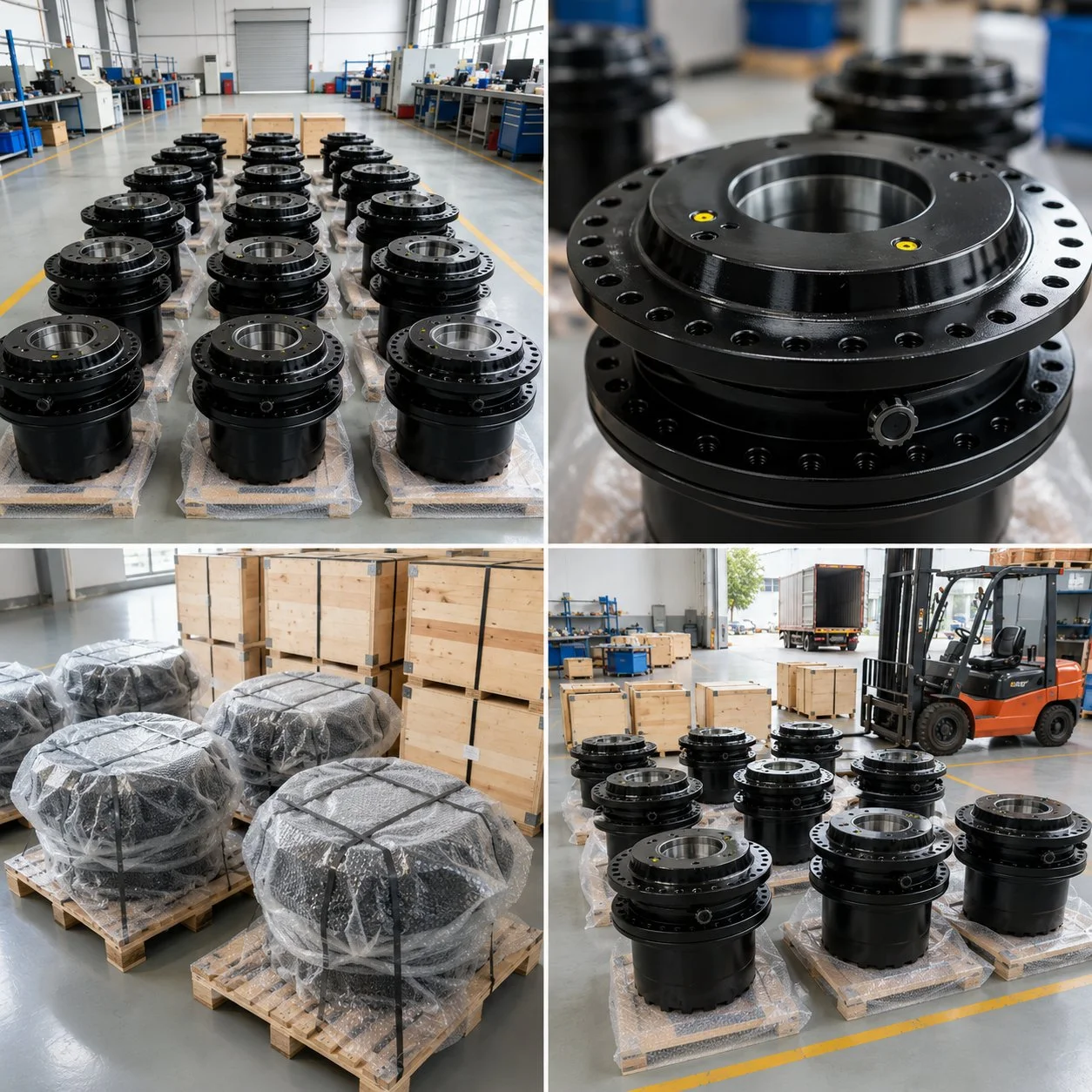
Korea Ever-Power provides amphibious excavator track drive planetary gearboxes with dual seals, marine coatings, and saltwater corrosion protection from 15,000 to 60,000 Nm. Provide your excavator model, pontoon type, and operating water type (fresh/salt) for a waterproof specification recommendation.
Toimetaja: Cxm