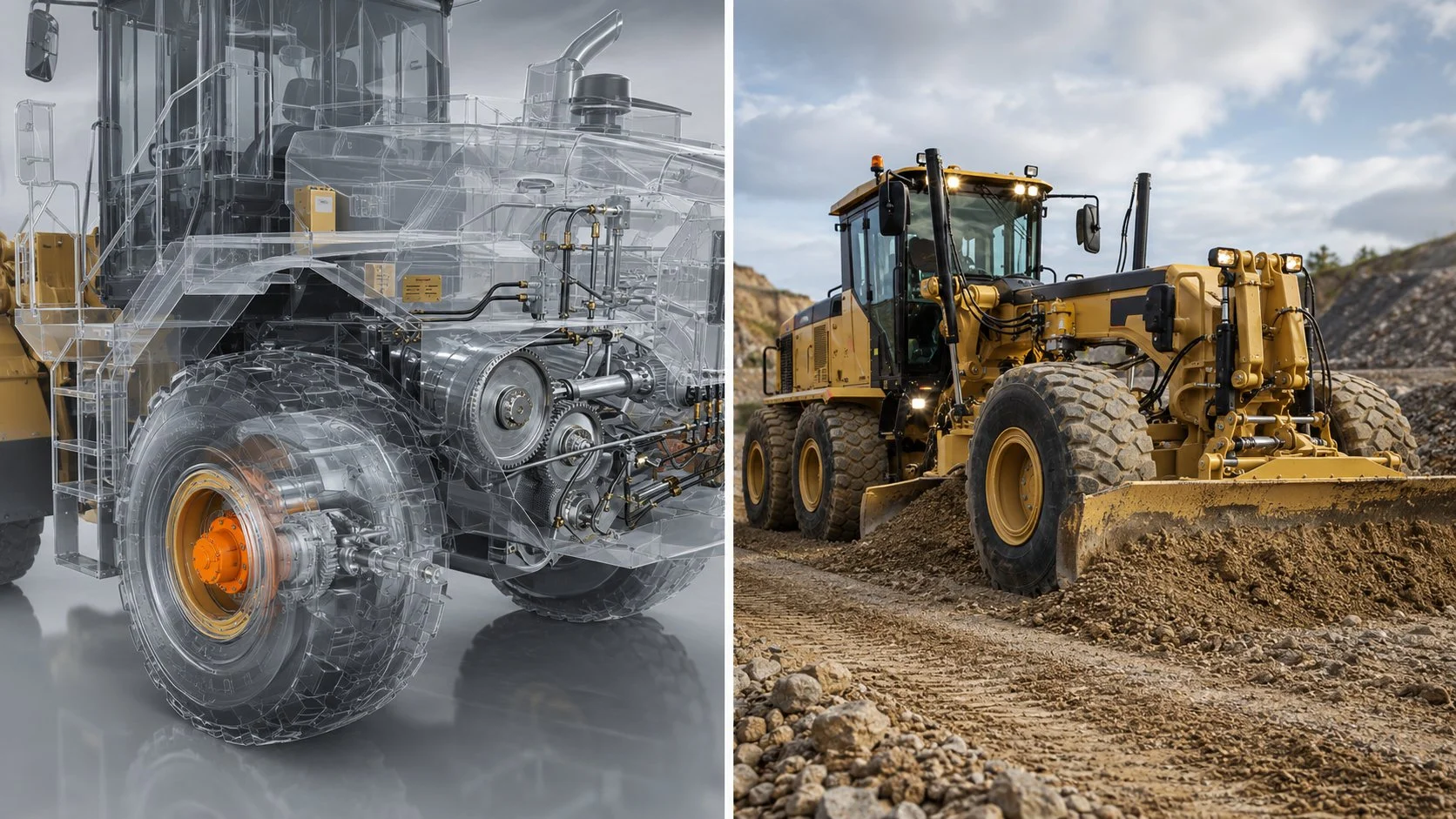
Why Wheel Dozers Exist — Speed Advantage over Tracked Dozers
Most bulldozers use tracks. But wheel bulldozers (rubber-tired dozers) dominate three specific applications: coal stockpile management, municipal landfill compaction, and large-scale earthmoving where travel speed between work areas matters more than maximum dozing force. The wheel dozer travels at 15 to 35 km/h between work positions — 3 to 5 times faster than a tracked dozer — making it far more productive on sites where the dozing distance exceeds 100 to 200 metres.
See planetaarne käigukast on a wheel dozer must handle a speed range that no tracked machine faces: from 2 to 5 km/h dozing speed (maximum blade thrust, minimum wheel speed) to 35 km/h transit speed (minimum thrust, maximum wheel speed) — a 7:1 to 17:1 speed ratio through a single hydrostatic or powershift drivetrain. The dozing mode demands maximum torque at minimum speed; the transit mode demands minimum torque at maximum speed. The gearbox must transition between these extremes smoothly and rapidly — because the dozer alternates between dozing and repositioning every 30 to 90 seconds during stockpile work.

The dozing duty cycle is unique among wheeled machines. In a typical 60-second cycle, the dozer spends 30 to 45 seconds pushing material at 2 to 5 km/h (maximum torque, forward gear), then 10 to 15 seconds reversing at 5 to 10 km/h (moderate torque, reverse gear), and 5 to 10 seconds repositioning at 10 to 20 km/h (low torque, forward gear). This rapid forward-reverse-forward cycling produces 40 to 60 direction changes per hour — each imposing a torque-reversal shock on the gearbox gear teeth and bearings. Over a 4,000-hour annual duty, the total direction-reversal count reaches 160,000 to 240,000 per year — a fatigue loading that is 10 to 100 times higher than any harvester or construction-equipment wheel drive and second only to the irrigation tower start-stop cycling (WD-08) in terms of total cycle count.
The torque reversal at each direction change is not gradual — the operator shifts from full-forward thrust to full-reverse thrust within 1 to 2 seconds through the powershift or hydrostatic system. The planetaarne käigukast must absorb this reversal without gear-tooth backlash impact. If the gear mesh has 0.05 to 0.10 mm of backlash (normal manufacturing tolerance), each direction change produces a momentary unloaded-to-loaded impact at the tooth surface — generating a stress peak of 1.5 to 2.5 times the steady-state tooth loading. Over 200,000 reversals per year, this impact fatigue can initiate tooth-root cracks in standard industrial gears within 3,000 to 5,000 hours. Gears specified for wheel dozer duty must be designed for the reversal-impact fatigue case — not just the steady-state dozing torque case.
| Class | Kaal (t) | Power (HP) | Blade Thrust | Transit |
|---|---|---|---|---|
| Medium (20–30 t) | 20–30 | 200–350 | 150–250 kN | 25–30 km/h |
| Large (35–55 t) | 35–55 | 350–550 | 250–400 kN | 30–35 km/h |
| Mining (55–75 t) | 55–75 | 550–850 | 350–550 kN | 25–35 km/h |
The traction limit on a wheel dozer is determined by the machine weight and the tyre-to-ground friction coefficient. On dry, compacted material (coal stockpile surface, landfill cap), the coefficient is 0.5 to 0.7 — meaning a 50-tonne dozer can develop 245 to 343 kN of traction. On wet or loose material, the coefficient decreases to 0.3 to 0.5 — reducing the available traction by 30 to 50%. The wheel drive must not deliver torque exceeding the traction limit, because a spinning tyre on a coal stockpile or landfill surface destroys the surface layer and creates ruts that impede subsequent passes.
The differential lock (or limited-slip differential) is essential on wheel dozers. During angled dozing (pushing material at 20 to 45 degrees to the direction of travel), the blade reaction force pushes the machine sideways — unloading the inside wheels and overloading the outside wheels. Without a differential lock, the inside wheels (with reduced load and therefore reduced traction) spin freely — wasting drive power and allowing the machine to drift sideways instead of pushing forward. With the differential locked, the torque is distributed equally to all wheels regardless of the load distribution — maintaining forward thrust even during angled dozing. The wheel drive must accommodate differential lock engagement and disengagement smoothly — a sudden lock engagement under load produces a torque spike at the previously-slipping wheel that can fracture the half-shaft or damage the wheel drive output bearing if the drive train is not designed for the impact.
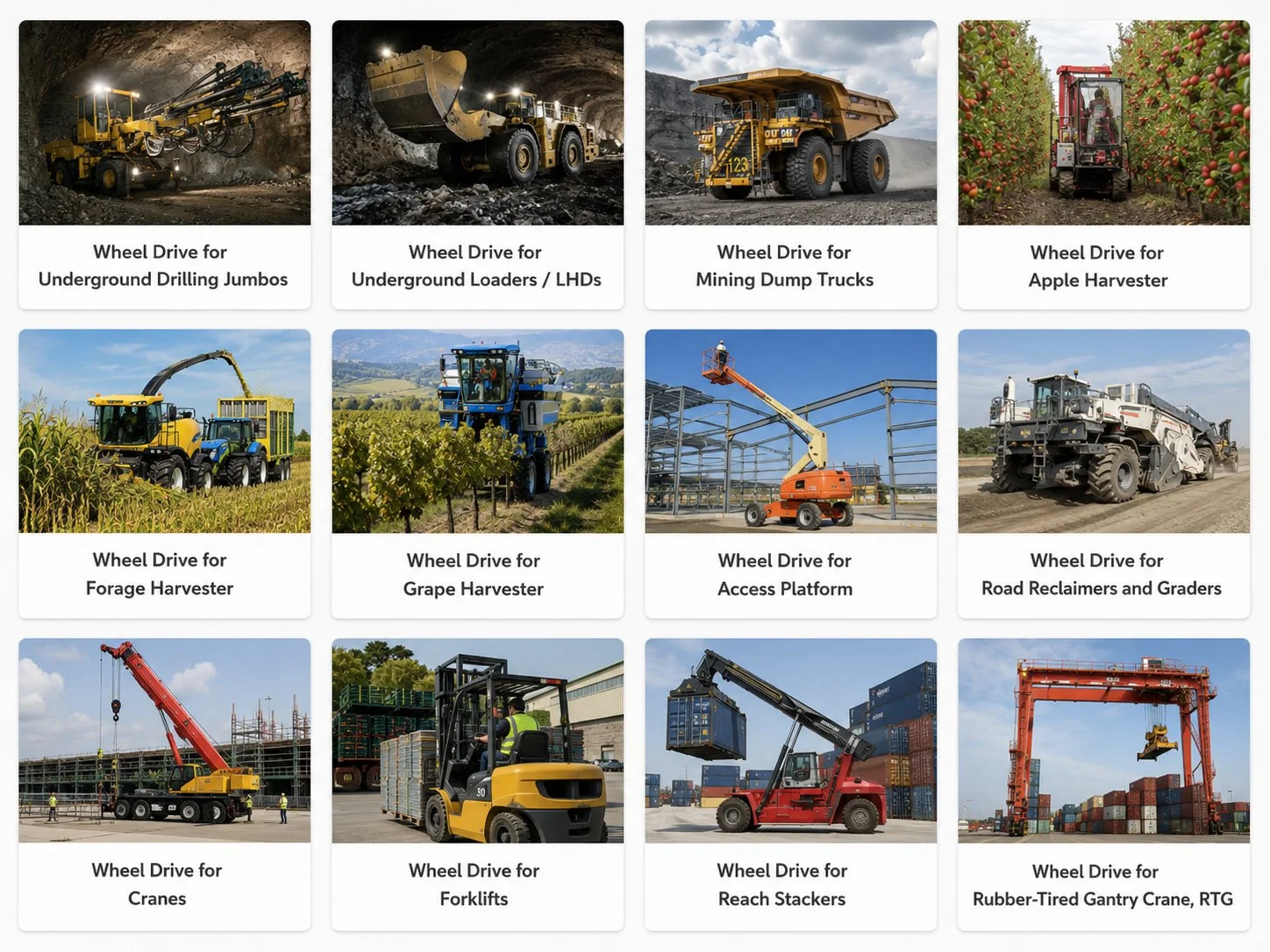
Application Environments — Coal, Landfill, and Mine Overburden
Coal stockpile management is the most common wheel dozer application. The dozer pushes freshly delivered coal into stockpile form, shapes the pile for drainage, and reclaims coal from the pile for conveyor loading. The coal surface temperature can reach 50 to 80 degrees C from self-heating (oxidation) in large stockpiles — and the dozer tyres and wheel drives operate on this hot surface for 8 to 16 hours per day. Coal dust is fine (10 to 100 microns), mildly abrasive (Mohs 1 to 2), and penetrates every seal and housing joint. The combination of heat and coal dust accelerates seal wear at 2 to 3 times the rate of standard construction-site operation. Additionally, coal stockpiles pose a fire risk from spontaneous combustion — and a wheel dozer operating on a burning or smouldering section of a stockpile can expose the wheel drive to surface temperatures exceeding 100 degrees C, with localised hotspots reaching 200 degrees C or more. The tyre rubber softens and degrades above 80 degrees C — and the wheel drive seals, even FKM-rated models, are stressed by the conducted heat from the tyre through the rim to the hub and output bearing. Thermal monitoring of the wheel drive housing temperature is a safety requirement on coal stockpile dozers — because a sustained over-temperature event can cause tyre failure (blowout from internal pressure build-up) as well as gearbox damage.
Landfill compaction is the most punishing application. The dozer drives over and through municipal waste containing steel reinforcement bars, glass, wire, nails, medical waste, chemical containers, and every other material that modern society disposes of. The tyre and wheel drive seals are continuously assaulted by sharp objects that puncture, cut, and abrade. The waste material is also chemically unpredictable — leachate (the liquid that drains from decomposing waste) has a pH that varies from 4 to 9 and contains dissolved metals, organic acids, and biological contaminants that attack standard seal and housing materials.
Mine overburden handling operates the dozer in the most abrasive conditions. The overburden (rock and soil removed to expose the ore body) contains sharp, angular rock fragments of 5 to 300 mm that the dozer pushes, climbs over, and drives through. The wheel drive seals are exposed to rock particles harder than the shaft steel — producing the same Mohs-hardness seal-cutting problem described for stone crushers (WD-07). The mine environment also includes dust, diesel soot, and (on some sites) acidic or alkaline drainage water that adds chemical attack to the physical abrasion.
The utilisation rate on wheel dozers is among the highest for any mobile equipment: 3,000 to 5,000 hours per year on coal stockpile duty, 2,000 to 4,000 hours on landfill duty, and 2,500 to 4,000 hours on mine duty. These rates are comparable to sugar cane harvesters (WD-05) — and produce the same consequence: the wheel drive components must be designed for 8,000 to 12,000-hour total life to align the replacement interval with the annual shutdown window. A gearbox that lasts 4,000 hours on a machine running 4,000 hours per year requires replacement during the operating season — an unplanned downtime event that costs USD 5,000 to 15,000 in lost production plus USD 3,000 to 10,000 for the gearbox and labour. The total cost of an undersized gearbox specification is therefore USD 8,000 to 25,000 per failure event — far exceeding the price premium for a properly rated unit.
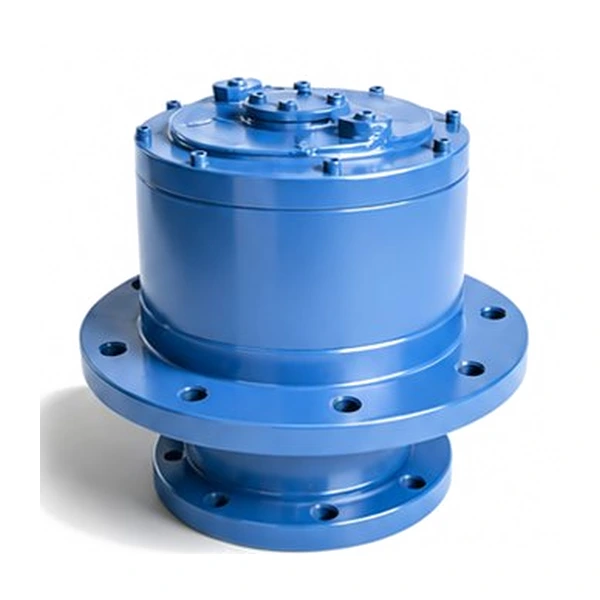
Three Failure Modes Specific to Wheel Bulldozer Drives
During heavy dozing, the blade encounters compacted material or an immovable obstruction. The operator maintains full throttle — and the wheel drive delivers maximum torque at near-zero wheel speed (stall condition) for 5 to 30 seconds. At stall, the wheel drive generates maximum heat with zero airflow for cooling. On a 50-tonne dozer with 400 kW of drive power, a 30-second stall event dissipates approximately 12 MJ of heat through the wheel drives — raising the oil temperature by 30 to 50 degrees C. On coal stockpile duty where the baseline oil temperature is already 80 to 95 degrees C (from the hot coal surface), a stall event can push the temperature to 120 to 145 degrees C — exceeding the thermal limit of mineral oil and accelerating bearing and gear degradation. Multiple stall events per hour (common during heavy ripping or compaction) produce cumulative thermal damage that no oil change can reverse. The thermal damage signature is detectable through oil analysis: elevated iron and copper particle counts indicate that the bearing and gear surfaces have exceeded their tempering threshold and are releasing material. An oil analysis programme with 250-hour sampling intervals can detect the onset of thermal damage 500 to 1,000 hours before the gearbox fails — providing time to schedule a replacement during a planned shutdown rather than experiencing an unplanned breakdown during peak production.
Municipal landfill waste contains steel wire, rebar stubs, glass fragments, and sharp plastic shards that impact the wheel drive housing and wrap around the output shaft — similar to the cane-trash wrapping on sugar harvesters but with far harder, sharper materials. A steel wire wrapped around the shaft can cut through a standard lip seal within a single 8-hour shift. Glass fragments embedded in the waste act as a cutting compound when trapped between the seal lip and shaft. The chemical leachate (pH 4 to 9, containing dissolved metals and organic acids) attacks both the seal material and the housing coating. The combined physical and chemical assault makes the landfill environment the most destructive for wheel drive seals of any application in this entire series.
When a wheel dozer drives over a buried rock, concrete block, or steel beam at transit speed (15 to 30 km/h), the tyre transmits a vertical and longitudinal shock to the wheel drive output bearing and gear train. The shock magnitude depends on the object size, the transit speed, and the tyre stiffness — and can reach 3 to 8 g at the wheel drive mounting flange. At 30 km/h, the wheel drive has 0.05 to 0.10 seconds to absorb the shock — too fast for the hydraulic system to respond and too brief for the operator to react. These transit-speed impact events produce bearing Brinelling and gear-tooth root stress peaks that accumulate fatigue damage at 5 to 10 times the rate of the steady-state dozing duty — making transit-speed driving on uneven surfaces more damaging to the wheel drive than the high-torque dozing operation itself. This counter-intuitive finding (transit more damaging than dozing) is confirmed by bearing failure analysis data from major dozer fleets: 55 to 65% of output bearing failures show impact-fatigue signatures (Brinelling, subsurface cracking) rather than the continuous-load fatigue signatures (spalling, micro-pitting) that would indicate dozing-torque-induced failure. The implication is clear: maintaining smooth haul roads and limiting transit speed on unprepared surfaces extends the wheel drive bearing life by 40 to 60% — a maintenance practice that costs nothing but delivers significant gearbox life extension.
Korduma kippuvad küsimused
Korea Ever-Power provides wheel dozer drives from 15,000 to 80,000 Nm with sustained stall-torque thermal capacity, landfill-grade sealing, and transit-speed impact resistance.
Toimetaja: Cxm