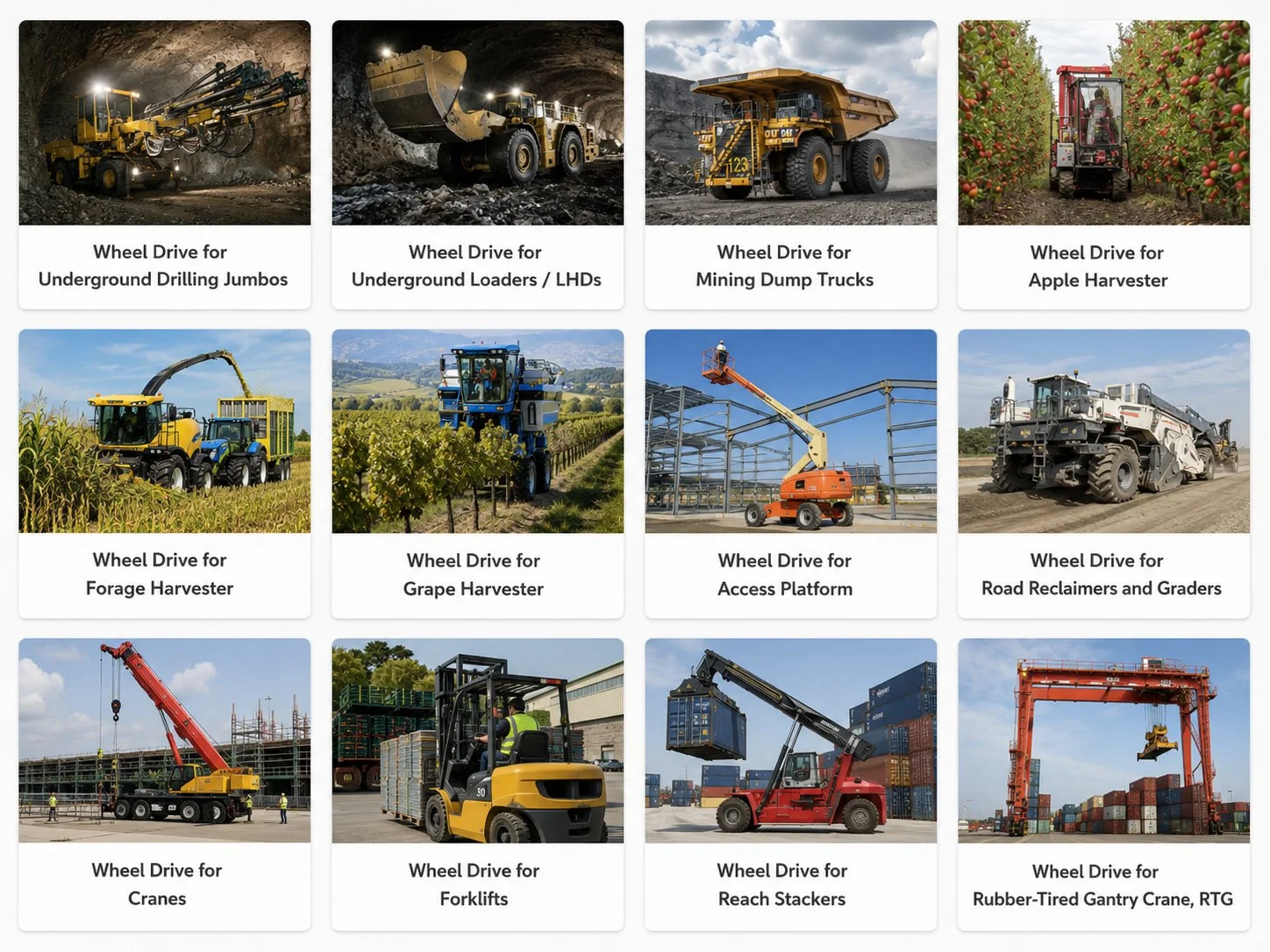
The Largest Wheel Drives in the World — 200,000+ Nm per Wheel
Mining dump trucks (rigid-body off-highway haul trucks) are the largest wheeled vehicles ever built. The smallest class hauls 40 to 60 tonnes of payload; the largest class hauls 360 to 400 tonnes — with a gross vehicle weight (GVW) exceeding 600 tonnes. The planeettavaihteisto at each rear wheel must transmit the torque to propel this mass up a 10% haul-road grade at 15 to 30 km/h — and then retard the same mass during the loaded descent at controlled speed.
| Luokka | Payload (t) | GVW (t) | Engine (HP) | Wheel Torque |
|---|---|---|---|---|
| Small (40–100 t) | 40–100 | 70–170 | 700–1,500 | 30,000–80,000 Nm |
| Medium (100–200 t) | 100–200 | 170–350 | 1,500–2,700 | 80,000–150,000 Nm |
| Ultra (250–400 t) | 250–400 | 400–630 | 2,700–4,000+ | 150,000–250,000+ Nm |
The drive system architecture splits into two categories: mechanical drive (diesel engine through torque converter, transmission, and planetary final drive at each wheel) and diesel-electric drive (diesel engine driving an alternator, which powers electric traction motors at each rear wheel, with planetary final reduction at each wheel). On mechanical-drive trucks (typically the 40 to 150-tonne class), the planetary gearbox is the final reduction stage between the transmission output and the wheel hub — providing 15:1 to 25:1 reduction. On diesel-electric trucks (typically the 150 to 400-tonne class), the planetary gearbox reduces the electric motor speed (1,000 to 3,000 rpm) to the wheel speed (20 to 80 rpm) — providing 20:1 to 40:1 reduction.
The output torque per wheel on an ultra-class truck exceeds 200,000 Nm — the highest of any wheel drive in this entire series by a factor of 3 to 5 over the next largest application (the wheel dozer at 40,000 to 80,000 Nm). The gear module, bearing bore diameter, and housing wall thickness are proportionally larger — with output gears exceeding 500 mm pitch diameter and output bearings exceeding 300 mm bore. These components weigh 200 to 500 kg per wheel drive assembly — and the precision manufacturing requirements (tooth profile, bearing raceway finish, housing bore concentricity) are identical to the smaller drives, making the manufacturing challenge scale with the size while the tolerance remains constant.
Mining trucks operate 5,000 to 7,000 hours per year — on par with sugar cane harvesters and underground LHDs for the highest utilisation in the Wheel Drive series. But unlike those machines (which are seasonal or limited by ore availability), the mining truck operates at maximum load on every cycle: loaded up the ramp, dumped, empty back down, reloaded. There is no light-duty period — every cycle is a maximum-torque, maximum-brake-energy event. This sustained peak-duty operation produces fatigue loading at 2 to 3 times the rate of machines that alternate between heavy and light duty — and the gearbox life must be calculated for the continuous peak case, not the average case.
The economic context amplifies the reliability requirement. An ultra-class mining truck costs USD 5 to 10 million — and generates USD 200,000 to 500,000 per day in ore revenue at full productivity. A final-drive failure that immobilises the truck for 24 hours costs USD 200,000 to 500,000 in lost production — plus USD 50,000 to 150,000 for the gearbox replacement and crane service. At these stakes, the mining industry invests heavily in condition monitoring: vibration sensors, oil analysis, temperature logging, and predictive-maintenance algorithms that detect final-drive degradation 500 to 2,000 hours before failure — providing time to schedule the replacement during a planned maintenance window rather than suffering an unplanned breakdown in the pit.
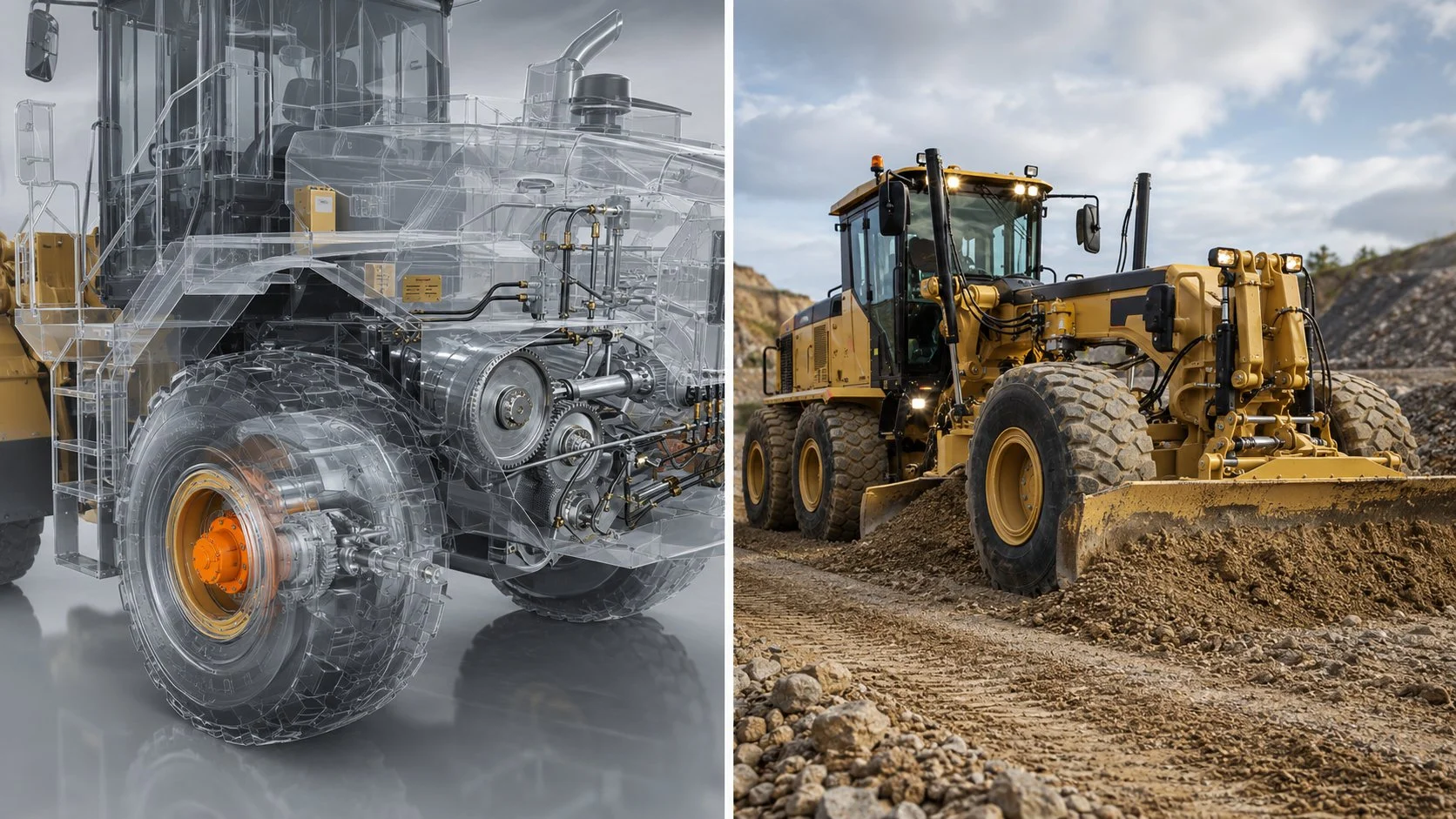
Haul-Road Grade Descent — The Braking Energy That Dwarfs Every Other Application
The loaded haul from the pit floor to the dump point is the defining duty cycle. A loaded truck at 600 tonnes climbs a 3-kilometre ramp at 10% grade — gaining 300 metres of elevation and storing 1,765 MJ of potential energy. During the loaded descent (returning to the pit floor after dumping), this energy must be dissipated. On diesel-electric trucks, the electric traction motors function as generators during descent — converting the kinetic and potential energy to electrical energy, which is dissipated as heat through resistor grids (dynamic retarding). The planetary gearbox transmits this retarding torque from the wheels to the motor/generator — at the same torque levels as during propulsion but in the opposite direction.
On mechanical-drive trucks, the retarding energy is dissipated through the engine compression brake, the transmission retarder, and the wheel-mounted wet-disc brakes. The planeettavaihteisto transmits the braking torque from the wheel to the transmission retarder — and the wet-disc brake (mounted within or adjacent to the planetary housing) provides the final backup retarding capacity. A 170-tonne truck descending a 3-km, 10% grade at 40 km/h must dissipate approximately 500 MJ — sustained over 4.5 minutes. This is approximately 1.85 MW of continuous retarding power — per truck — flowing through the wheel drive in the reverse direction.
The thermal management of this energy flow determines the wheel drive life. The oil temperature in the planetary housing during a loaded descent can reach 120 to 150 degrees C on mechanical-drive trucks — because the wet-disc brake dissipates a portion of the retarding energy directly into the oil bath that lubricates the planetary gears and bearings. Dedicated oil cooling circuits (oil-to-air or oil-to-water heat exchangers) are sized to maintain the peak oil temperature below 130 degrees C during the worst-case descent — a thermal design that is unique to mining truck final drives and is not found on any other wheel drive application in this series.
The loaded-descent speed is controlled by the retarding system — not by the wheel drive brakes. On diesel-electric trucks, the electric retarding capacity is typically 2,000 to 3,500 kW — sufficient to control the descent speed without any mechanical braking. The wheel drive wet-disc brakes are reserved for final stopping and parking — and rarely operate during the descent. On mechanical-drive trucks, the transmission retarder and engine compression brake provide the primary retarding — with the wet-disc brakes contributing 20 to 40% of the total retarding force during steep or long descents. The wheel drive gearbox must transmit the retarding torque in both directions (propulsion and retarding) without backlash impact at the torque-reversal point — because the transition from propulsion to retarding occurs at the crest of the ramp on every cycle.
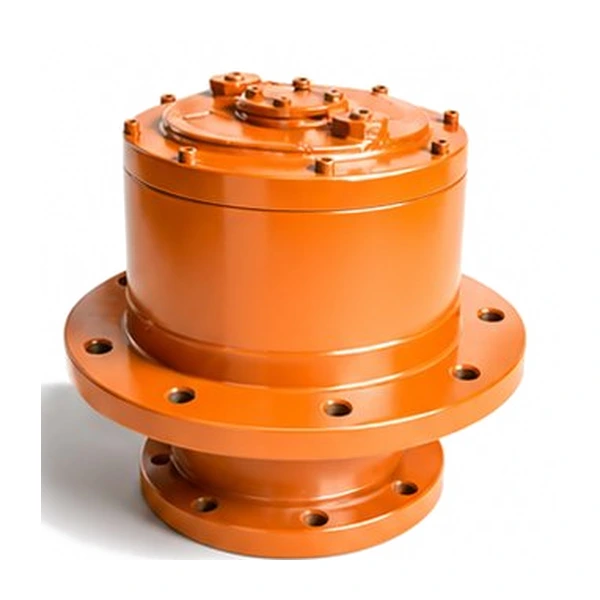
Autonomous Haulage — The Final Drive Without a Driver
Autonomous haulage systems (AHS) are deployed at over 30 mine sites worldwide — with fleets of 20 to 100+ trucks operating without human drivers. The autonomous system controls the throttle, braking, and steering — and the wheel drive must respond to these commands with the same deterministic precision required for autonomous LHDs (WD-22): ±0.5% speed accuracy, ±3% torque response, and sub-0.3-second response time. Any deviation from the commanded speed or torque causes the autonomous system to initiate a safety slowdown or emergency stop — reducing fleet productivity and potentially blocking other autonomous trucks on the haul road.
The condition monitoring on autonomous trucks is more comprehensive than on manned trucks: vibration sensors on the final-drive housing, oil temperature and pressure sensors, speed encoders on the output shaft, and acoustic sensors that detect gear-mesh and bearing noise changes. This sensor suite feeds data to the fleet management system — which uses predictive-maintenance algorithms to forecast the remaining final-drive life and schedule replacements during planned maintenance windows. A final-drive failure on an autonomous truck is more consequential than on a manned truck: the autonomous truck cannot be manually nursed to the workshop, and the breakdown blocks the haul-road lane until a recovery vehicle (another large expense) can reach and tow the disabled truck.
The autonomous duty cycle is more consistent than the human-operated duty cycle — the autonomous system does not over-speed on descents, does not brake harshly at the dump point, and does not overload the truck beyond the rated payload. This consistency actually extends the final-drive life by 10 to 20% compared to human-operated trucks on the same haul profile — because the autonomous system avoids the peak-load events that human operators occasionally produce through aggressive driving. The net effect is that autonomous mining represents both the highest absolute duty (continuous 24/7 operation) and the most controlled duty (no operator variability) — a combination that favours high-quality, precisely specified final drives that can take full advantage of the reduced peak-loading to maximise the consistent-duty service life.
Three Failure Modes Specific to Mining Dump Truck Final Drives
During a 4.5-minute loaded descent, the oil temperature can spike to 120 to 150 degrees C — and if the truck immediately begins the next loaded climb (without a cooling period at the pit floor), the baseline temperature for the next descent is elevated. On a 12-hour shift with 8 to 12 load-haul cycles, the cumulative thermal exposure can degrade mineral oil to the point of measurable viscosity loss within 500 to 800 hours. Synthetic PAO oil extends this to 2,000 to 3,000 hours — aligning the oil-change interval with the scheduled maintenance windows that mining fleets operate on 250 to 500-hour cycles. A single missed oil change after a high-thermal shift sequence can consume 20 to 30% of the remaining gear and bearing service life.
During the loaded climb (600 tonnes up a 10% grade at 20 km/h), the wheel drive operates at 80 to 100% of its rated torque for 6 to 10 minutes continuously. This sustained maximum-torque duty produces gear-tooth surface fatigue (micro-pitting and pitting) at rates that are 5 to 10 times higher than the intermittent peak-torque events on surface loaders and dozers. Over 5,000 hours per year (at 3 to 5 loaded climbs per shift, 2 to 3 shifts per day), the cumulative surface fatigue can initiate pitting on the output-stage sun and planet gears within 8,000 to 12,000 hours — even on case-hardened gears with DIN Class 6 tooth quality. The pitting progression from initiation to functional failure (tooth breakage) is typically 3,000 to 5,000 additional hours — providing a window for detection through oil analysis (increasing iron particle count) before catastrophic failure.
Mining haul roads develop potholes, washboard corrugation, and edge deterioration from the repeated passage of 600-tonne loaded trucks. Each pothole impact at 30 to 40 km/h produces a 5 to 15 g shock at the wheel drive output bearing — and at 600 tonnes GVW, the absolute bearing impact force reaches 300 to 900 kN per event. These impacts are the primary cause of bearing spalling on mining truck final drives — and the road-maintenance quality directly determines the final-drive bearing life. Studies from major mining operations show that final-drive bearing life varies by 30 to 50% between well-maintained haul roads (weekly grading) and poorly maintained haul roads (monthly grading) — making haul-road maintenance the most cost-effective final-drive life-extension strategy available.
Usein kysytyt kysymykset
Korea Ever-Power provides mining truck final drives from 30,000 to 250,000+ Nm — the highest-torque, highest-energy, highest-impact wheel drives in the world.
Toimittaja: Cxm