Pourquoi les défaillances des réducteurs planétaires sont prévisibles et non aléatoires
Les données de retour sous garantie et l'analyse des défaillances sur le terrain dans les applications d'asservissement montrent systématiquement la même tendance : environ 90% de défaillances prématurées de réducteurs planétaires de précision sont directement imputables à cinq erreurs de conception. Les 10% restants sont dus à de véritables défauts de matériaux ou à la fatigue statistique des roulements en fin de vie nominale. La conclusion est importante : l'immense majorité des défaillances prématurées de réducteurs planétaires de précision sont entièrement évitables.
Les cinq causes ne sont pas nouvelles. Elles sont bien connues dans la littérature technique. Ce qui manque à la plupart des guides publiés, c'est la quantification : de combien une surcharge de 1,5 fois réduit-elle réellement la durée de vie ? Quel est l'impact d'une excentricité de 0,1 mm sur la charge des paliers à 3 000 tr/min ? À partir de quelle force axiale un palier EP-ZDE-80 standard commence-t-il à se détériorer prématurément ? Cet article répond à ces questions grâce à des données calculées spécifiques aux spécifications de la série EP.
Cause 1 — Négligence du facteur de service : La défaillance que les calculs mathématiques prévoient, mais que les fiches techniques ignorent
Le facteur de service (FS) tient compte des variations de charge plus rapides que la réponse en boucle fermée du servomoteur, des effets thermiques dus à l'asymétrie du cycle de service et des couples de pointe lors des arrêts d'urgence, qui peuvent atteindre 2 à 3 fois la valeur nominale continue. Lorsqu'un réducteur planétaire de précision est dimensionné pour le couple continu calculé avec précision, sans application de FS, il fonctionne à sa limite de fatigue, voire au-delà, à chaque demande de couple de pointe du servomoteur.
Le mécanisme de défaillance est la fatigue de contact hertzienne sur les flancs des dents de l'engrenage planétaire. Sous surcharge cyclique, les contraintes de cisaillement sous-jacentes initient des microfissures qui se propagent en surface sous forme de piqûres. Chaque piqûre crée une concentration de contraintes qui accélère la dégradation des piqûres adjacentes. Le jeu augmente à mesure que l'épaisseur effective de la dent diminue. Lorsque les piqûres couvrent 20 à 30 % de la zone de travail du flanc, le bruit et les vibrations de l'engrenage augmentent fortement et la défaillance est imminente.
| Couple réel / Couple nominal | Durée de vie du roulement L10 | Durée de vie de la surface des engrenages | Évaluation |
|---|---|---|---|
| ×1,00 (évaluation correcte) | 20 000 h | 20 000 h | Durée de vie nominale atteinte |
| ×1,25 (SF omis, choc léger) | 10 240 h | 2 684 h | Durée de vie réduite de moitié ; une dent d'engrenage casse à la première année |
| ×1,50 (SF omis, choc modéré) | 5 926 h | 520 h | Piqûration des dents d'engrenage en quelques semaines |
| ×2,00 (arrêt d'urgence, sans SF) | 2 500 h | 39 h | Échec dentaire catastrophique en quelques jours |
| ×2,50 (impact violent, collision avec un robot) | 1 280 h | 5 h | Fracture dentaire lors du premier incident |
Le jeu mécanique augmente rapidement durant les 3 000 à 8 000 premières heures. Le bruit des engrenages s'accroît lors des inversions de sens de rotation. Des piqûres sont visibles sur les flancs des dents des planétaires lors du démontage. La durée de vie des machines est proportionnelle à l'intensité du cycle de service : les machines soumises à des arrêts d'urgence fréquents et à des inversions de sens de rotation s'usent plus rapidement que celles utilisées dans un seul sens de rotation à un même couple continu.
T_requis = T_calculé × SF. Pour les articulations de robots avec inversion de direction : SF = 1,5–2,0. Pour les applications de pression et d’impact : SF = 2,0–2,5. Voir la Guide de sélection en 5 étapes Pour des exemples concrets. Le couple d'arrêt instantané de la série EP-ZDS est égal à 2 fois la valeur nominale, offrant un facteur de sécurité intégré pour les charges de pointe lorsqu'il est correctement dimensionné.
Cause 2 — Inadéquation d'inertie : Instabilité des servos qui détruit les porte-planètes
Lorsque l'inertie de la charge renvoyée à l'arbre du servomoteur dépasse environ cinq fois l'inertie du rotor de ce dernier, le réglage de la boucle de régulation de vitesse du servomoteur devient complexe. Les ingénieurs y remédient généralement en augmentant le gain proportionnel (Kv) afin d'améliorer la réactivité. À Kv élevé, la résonance mécanique de la transmission — déterminée par la rigidité torsionnelle de la boîte de vitesses et l'inertie de la charge — est excitée à sa fréquence propre. Il en résulte une oscillation continue qui produit des variations de couple de 10 à 50 Hz dans la boîte de vitesses, bien supérieures à celles prévues dans les fiches techniques.
Ce couple cyclique appliqué à la fréquence de résonance de la transmission ne correspond pas à la charge continue et régulière supposée par le calcul du roulement L10. Il s'agit d'un scénario de fatigue à grand nombre de cycles. Le fretting de l'alésage de l'axe du porte-satellites et la micro-piqûre de la bague du roulement constituent les signatures de défaillance caractéristiques, différentes de la piqûre sur le flanc de la dent due à la négligence du roulement SF, et identifiables lors du démontage.
| Rapport d'inertie J_ref / J_motor | Réglage des servos | Risque de boîte de vitesses | Mode de défaillance |
|---|---|---|---|
| 1:1 à 3:1 | ✅ Stable | Aucun | Plage idéale — réglage précis du servo, charges de boîte de vitesses en douceur |
| 3:1 à 5:1 | ⚠ Marginal | Faible à moyen | Valeur Kv maximale réduite ; réglage précis requis ; surveiller les vibrations |
| 5:1 à 10:1 | ❌ Instable | Haut | Excitation par résonance ; frottement des axes des porte-satellites ; micro-piqûres des paliers |
| >10:1 | ❌ Grave | Très élevé | Oscillation incontrôlable ; augmentation rapide du jeu ; risque de fracture du porte-satellites |
Diagnostic : l’amplitude des oscillations augmente avec le gain Kv du servo ; vibrations audibles à fréquence fixe lors du mouvement de l’axe ; les alésages des axes du porte-satellites présentent une usure elliptique lors du démontage. Solution : calculer J_reflected = J_load ÷ i² aux rapports candidats ; si le rapport est limité par les exigences de vitesse, consulter le fournisseur du moteur pour une variante de rotor à inertie plus élevée. Pour la sélection de la série EP avec des articulations de robot à charge élevée, la rigidité torsionnelle plus élevée de EP-ZDS (Ct jusqu'à 130 N·m/arcmin) augmente la fréquence de résonance, réduisant le risque d'excitation servo même à des rapports d'inertie modérés.
Cause 3 — Excentricité de l'arbre moteur : l'erreur d'installation qui détruit silencieusement les roulements d'entrée
Un arbre moteur non parfaitement concentrique à l'alésage d'entrée du réducteur engendre une charge excentrée rotative sur les roulements d'entrée à chaque tour. Contrairement à une surcharge de couple, souvent perceptible par l'opérateur par une augmentation du jeu et du bruit, l'usure des roulements d'entrée due à l'excentricité se développe silencieusement jusqu'à la rupture brutale du roulement, généralement par fracture de la cage ou écaillage de la bague à haute vitesse de rotation.
La force radiale supplémentaire exercée sur le palier d'entrée par l'excentricité de l'arbre e à la vitesse de rotation ω est : F_ecc = m_eff × ω² × eoù m_eff représente la masse en rotation effective de l'arbre moteur et de l'accouplement. Cependant, dans les réducteurs planétaires de précision, l'effet d'excentricité dominant n'est pas la force centrifuge, mais le moment de flexion transmis par l'interface de serrage au palier de la roue planétaire d'entrée et du pignon solaire.
| Excentricité | Erreur de concentricité | charge radiale supplémentaire sur le palier d'entrée | Effet sur la durée de vie L10 |
|---|---|---|---|
| ≤0,02 mm | ✅ Spécifications | Négligeable | Vie évaluée |
| 0,02–0,05 mm | Marginal | +15–30% radial | −35–60% |
| 0,05–0,10 mm | Excessif | +50–100% radial | −70–85% |
| >0,10 mm | Grave | >100% radial | <2 000 h |
La spécification de concentricité pour les installations d'interface moteur de la série EP est de ≤ 0,02 mm de faux-rond total (TIR) entre l'axe de l'arbre moteur et l'axe de l'alésage d'entrée du réducteur. Ceci n'est garanti qu'avec une bride d'adaptation moteur dédiée (l'entrée de serrage standard de type S de la série EP), et non avec un adaptateur d'alésage générique. Les adaptateurs d'alésage génériques produisent généralement une erreur de concentricité de 0,05 à 0,15 mm, ce qui classe immédiatement le roulement d'entrée dans la catégorie « critique ».
- Bruit métallique à haute fréquence qui augmente avec le régime moteur (et non avec la charge).
- Le boîtier côté entrée chauffe plus vite que le boîtier côté sortie.
- Le roulement d'entrée présente un motif d'usure elliptique lors du démontage.
- Amplitude de vibration proportionnelle à n² (RPM au carré)
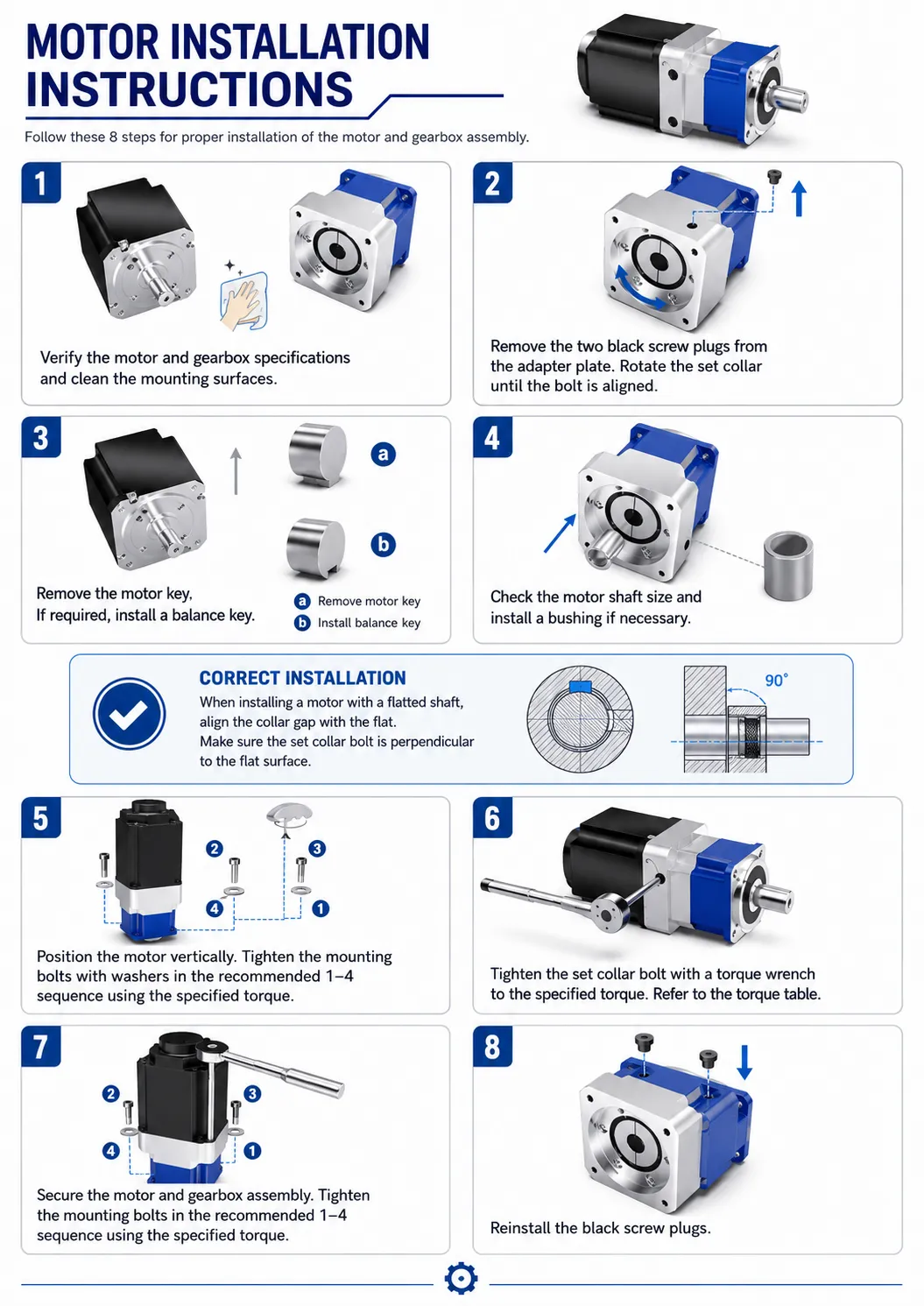
- Utiliser la bride d'entrée dédiée de la série EP adaptée au moteur (préciser le modèle du moteur lors de la commande).
- Vérifiez la concentricité à l'aide d'un comparateur à cadran avant de serrer les vis de serrage.
- Serrer les vis de serrage uniformément en croix au couple spécifié
- Après l'installation, faire fonctionner 5 minutes à basse vitesse et revérifier la concentricité — la dilatation thermique peut modifier l'alignement
Cause 4 — Surcharge de force axiale : Le problème de l’axe vertical est souvent négligé dans les calculs d’ingénierie
La limite de force axiale de l'arbre de sortie d'un réducteur planétaire de précision est l'une des spécifications les plus souvent négligées lors de la conception de systèmes d'asservissement. Les ingénieurs se concentrent sur le couple de sortie et le rapport de réduction, mais vérifient rarement si la force axiale (poussée) de leur application spécifique — en particulier sur les axes verticaux — reste dans les limites de la capacité axiale nominale du palier de sortie du réducteur.
Le mécanisme de défaillance dû à une surcharge axiale est la déformation du joint à lèvres de l'arbre de sortie, suivie de la fatigue de la bague du roulement de sortie. Lorsque la force axiale dépasse la limite nominale, l'arbre de sortie fléchit légèrement axialement. Cette déformation comprime le joint à lèvres, accélérant son usure et provoquant à terme une fuite de graisse. Simultanément, le roulement de sortie subit une charge radiale et axiale combinée supérieure à sa capacité dynamique, amorçant une fatigue prématurée de la bague. Le signe précoce typique de défaillance est un suintement de graisse au niveau du joint d'étanchéité de l'arbre de sortie ; ce suintement, souvent constaté par les ingénieurs, est généralement attribué à tort à l'âge du joint plutôt qu'à la surcharge axiale sous-jacente.
| Application réelle | Force axiale calculée | Limite EP-ZDE-80 450 N |
Limite EP-ZDE-120 1 050 N |
Limite EP-ZDE-160 3 000 N |
Série correcte |
|---|---|---|---|---|---|
| bras robotisé de 30 kg, axe vertical | 294 N | ✅ À l'intérieur | ✅ | ✅ | EP-ZDE-80 adéquat |
| charge de 50 kg, axe servo vertical | 490 N | ❌ +9% | ✅ | ✅ | Minimum : EP-ZDE-120 |
| Charge de 100 kg, verticale | 981 N | ❌ +118% | ⚠ −7% | ✅ | Minimum : EP-ZDE-160 |
| axe vertical du portique de 200 kg | 1 962 N | ❌ +336% | ❌ +87% | ✅ | EP-ZDE-160 ou ZDS-115 |
| véhicule AGV à roue motrice de 500 kg | 2 452 N | ❌ +445% | ❌ +134% | ⚠ −18% | EP-ZDS-115 (12 000N) |
| Portique lourd, broche de 300 kg, axe Z | 2 943 N | ❌ +554% | ❌ +180% | ⚠ −2% | EP-ZDS-115 (12 000N) |
Force axiale = masse × g. Limites axiales EP-ZDE : 80 N (cadre 40), 225 N (cadre 60), 450 N (cadre 80), 1 050 N (cadre 120), 3 000 N (cadre 160). ⚠ = à moins de 20% de la limite — inclure les forces axiales dynamiques dues à l’accélération avant confirmation. Réducteur planétaire série EP-ZDS offre une capacité axiale de 12 000 à 28 000 N pour les applications à charge lourde.
Règle essentielle pour les axes verticaux : Il est impératif d'ajouter systématiquement les forces axiales dynamiques dues à l'accélération et à la décélération à la charge statique due au poids avant de comparer cette dernière à la limite axiale nominale. Sur un axe de 100 kg subissant une accélération verticale de 0,5 g, la force axiale maximale est de 100 × 9,81 × (1 + 0,5) = 1 472 N, et non de 981 N en statique. La limite de 1 050 N de l'EP-ZDE-120 est dépassée par le 40%, même si le calcul statique semblait limite. Pour toute application comportant un axe vertical et une masse en accélération significative, il convient d'utiliser la série EP-ZDS, dont la capacité axiale est de 12 000 à 28 000 N.
Cause 5 — Infiltration environnementale : L’indice IP54 dans un environnement de jet d’eau détruit la lubrification à vie
Le système de lubrification à vie des séries EP-ZDE, EP-ZDF, EP-ZDWE et EP-ZDWF est garanti 20 000 heures, sous réserve du maintien de l'intégrité du boîtier étanche pendant toute sa durée de vie. L'indice de protection IP54 (éclaboussures de toutes directions) est différent de l'indice IP65 (jet d'eau direct de toutes directions). Cette distinction est essentielle dans les usines agroalimentaires coréennes soumises aux protocoles de nettoyage HACCP, dans les ateliers de carrosserie automobile exposés à l'eau de refroidissement et en extérieur.
Accélération de la température : Chaque augmentation de 10 °C au-dessus de la température de fonctionnement nominale divise par deux la durée de vie de la graisse. Une graisse EP-ZDE-80 fonctionnant à 100 °C (température du boîtier) en raison d'une surcharge ne dispose que de 2 500 heures de durée de vie effective (contre 20 000 heures à 70 °C). À 110 °C, cette durée est de seulement 1 250 heures. La combinaison d'une graisse contaminée et d'une température élevée engendre des délais de défaillance de l'ordre de quelques mois, et non de quelques années ; ce problème est totalement invisible pour les systèmes de contrôle de production standard jusqu'au blocage de l'unité.
- Graisse visible à l'extérieur du joint d'étanchéité de l'arbre de sortie (graisse émulsionnée blanche/grise = contamination par l'eau)
- Température du boîtier supérieure à celle prévue pour une charge donnée
- Le bruit augmente régulièrement de semaine en semaine.
- Défaillances groupées au niveau des unités situées dans les zones de lavage de la chaîne de production
Pour tout environnement avec lavage direct au tuyau d'arrosage ou à haute pression : préciser Série EP-ZDS (IP65)L'indice de protection IP65 garantit la résistance à un jet d'eau de 6,3 mm de diamètre à 12,5 L/min, quelle que soit sa direction, conformément à la norme IEC 60529 (test IPX5). Pour les installations solaires/éoliennes extérieures et les lignes de production alimentaire en Corée, l'indice IP65 est la spécification minimale. Il est fortement déconseillé d'ajouter des couvercles d'étanchéité externes à un appareil IP54 : l'étanchéité d'un réducteur assemblé ne peut être améliorée de manière fiable par un revêtement extérieur.

Matrice de diagnostic — Associez vos symptômes de défaillance à la cause première
Lorsqu'un réducteur planétaire de précision tombe en panne, les symptômes observés au moment de la défaillance, ainsi que l'état physique des composants lors du démontage, permettent d'identifier avec certitude l'une des cinq causes principales. Utilisez cette matrice pour identifier la cause et éviter qu'elle ne se reproduise avec l'unité de remplacement.
| Symptôme observé | Moment d'apparition | Constat de démolition | Cause première | Prévention du remplacement |
|---|---|---|---|---|
| Les réactions négatives augmentent rapidement ; du bruit se produit lors des changements de direction. | 3 000 à 8 000 h | piqûres sur les flancs des dents des engrenages planétaires | Cause 1 : Négligence du SF | Recalculer T_requis × SF ; passer à la classe de couple supérieure |
| L'axe oscille pendant le mouvement ; vibration à fréquence fixe | De la mise en service | Frottage de l'alésage de l'axe du porte-satellites ; micro-piqûres du roulement | Cause 2 : Inadéquation d’inertie | Recalculer J_ref/J_motor ; modifier le rapport ou l'inertie du moteur |
| Sifflement aigu à RPM ; boîtier d'entrée chaud | 2 000 à 6 000 heures | usure de la bague elliptique du roulement d'entrée | Cause 3 : Excentricité | Utiliser une bride adaptée au moteur ; vérifier que le TIR est ≤ 0,02 mm avant la mise en service. |
| Fuite de graisse au niveau du joint de sortie ; roulement de sortie bruyant | 1 000 à 5 000 h | Joint à lèvres déformé ; fatigue de la bague axiale du roulement de sortie | Cause 4 : Surcharge axiale | Calculer la force axiale statique et dynamique ; passer à EP-ZDS si nécessaire |
| Graisse blanche/grise au niveau du joint ; augmentation du bruit au fil des mois ; défaillances concentrées dans la zone de lavage | 1 500 à 4 000 h | Graisse émulsifiée ; corrosion par piqûres des roulements | Cause 5 : Infiltration du joint IP | Mise à niveau IP54 → IP65 (EP-ZDS) ; ne jamais utiliser la norme IP54 dans les zones de lavage. |
| Défaillance entre 15 000 et 22 000 heures ; aucun symptôme antérieur | vie proche de la valeur nominale | Fatigue uniforme des roulements ; défaillance de la population L10 | Fin de vie normale L10 | Remplacement programmé à l'intervalle de 20 000 h ; aucune modification des spécifications n'est nécessaire. |
Programme de surveillance préventive — Quatre examens permettant de détecter précocement les cinq causes
Les cinq causes de défaillance entraînent des changements détectables avant une panne catastrophique, à condition que les paramètres appropriés soient surveillés aux intervalles adéquats. Le calendrier ci-dessous s'applique à tous les réducteurs planétaires de précision de la série EP utilisés dans les applications d'asservissement standard. Pour les installations EP-ZDS en environnement contrôlé ou en extérieur, le contrôle d'intégrité IP65 remplace l'inspection générale des joints.
- Aspect visuel : boîtier externe présentant des suintements de graisse (Causes 4 et 5)
- Auditif : tout nouveau sifflement aigu ou bruit d'inversion de direction
- Au toucher : différence de température entre l’entrée et la sortie > 15 °C → enquêter
- Analyse thermique : carte de température du boîtier à charge nominale (valeur de référence lors de la mise en service)
- Contrôle des vibrations : comparer l'amplitude à la vitesse nominale à la valeur de référence de mise en service
- Servomoteur : enregistrement des pics de couple ; signalement si > 2 fois de façon continue plus de 50 fois par poste
- Mesure du jeu au couple nominal ±3% (comparer à la valeur de référence de l'installation)
- Resserrage des fixations de montage (les cycles thermiques provoquent un tassement des joints)
- Interface moteur-réducteur : revérifier la concentricité TIR ≤ 0,02 mm
- Consignez toutes les mesures ; la tendance est plus précieuse qu’une donnée isolée.
- Retard > 150% de la valeur de référence de l'installation → remplacement programmé
- Amplitude de vibration > 200% de la valeur de référence de mise en service → enquêter immédiatement
- Température du boîtier > ambiante + 85 °C à charge nominale → réduire la charge ou remplacer
- Durée de vie L10 atteinte à 20 000 h → remplacer quel que soit l’état
L'équipe d'ingénierie d'application de Korea Ever-Power réalise une évaluation des risques de défaillance des installations existantes, en analysant le facteur de service, le rapport d'inertie, la force axiale et l'indice de protection IP en fonction de vos conditions d'exploitation réelles. Si vous avez constaté une défaillance prématurée ou si vous avez des doutes concernant une spécification existante, contactez-nous en nous fournissant le modèle de votre moteur, les données de charge et les informations relatives à votre environnement d'installation pour bénéficier d'une analyse technique gratuite.
Afficher les spécifications →
Éditeur : Cxm