Why Planetary Gearbox Failures Are Predictable — Not Random
Warranty return data and field failure analysis from servo automation applications consistently show the same pattern: approximately 90% of precision planetary gearbox premature failures trace directly to five engineering mistakes. The remaining 10% are genuine material defects or statistical bearing fatigue at end of rated life. The implication is significant — the overwhelming majority of early precision planetary gearbox failures are entirely preventable.
The five causes are not new discoveries. They are understood in the engineering literature. What is missing from most published guides is the quantification: by how much does a 1.5× overload actually shorten life? What does 0.1 mm eccentricity do to bearing load at 3,000 rpm? At what axial force does a standard EP-ZDE-80 begin to fail prematurely? This article answers those questions with calculated data specific to EP series specifications.
Cause 1 — Service Factor Neglect: The Failure That Engineering Math Predicts but Datasheets Miss
The service factor (SF) accounts for load variations faster than the servo’s closed-loop response, thermal effects from duty cycle asymmetry, and peak torques during emergency stops that can reach 2–3× the continuous rated value. When a precision planetary gearbox is sized to the exact calculated continuous torque with no SF applied, it operates at or beyond its fatigue limit every time the servo demands peak torque.
The failure mechanism is Hertzian contact fatigue on the planet gear tooth flanks. Under cyclic overloading, sub-surface shear stress initiates micro-cracks that propagate to the surface as pitting. Each pitting pit creates a stress concentration that accelerates adjacent damage. Backlash grows as the effective tooth thickness reduces. Once pitting covers 20–30% of the working flank area, gear noise and vibration increase sharply and failure is imminent.
| Actual / Rated Torque | Bearing L10 Life | Umur Permukaan Gigi | Penilaian |
|---|---|---|---|
| ×1.00 (correctly rated) | 20.000 jam | 20.000 jam | Rated life achieved |
| ×1.25 (SF omitted, light shock) | 10.240 jam | 2,684 h | Life halved; gear tooth fails at year 1 |
| ×1.50 (SF omitted, moderate shock) | 5,926 h | 520 h | Gear tooth pitting within weeks |
| ×2.00 (emergency stop, no SF) | 2.500 jam | 39 h | Catastrophic tooth failure within days |
| ×2.50 (heavy impact, robot collision) | 1.280 jam | 5 h | Tooth breakage on first incident |
Backlash grows rapidly within the first 3,000–8,000 hours. Gear noise increases at direction reversals. Pitting visible on planet gear tooth flanks at teardown. Failure timing is proportional to duty cycle intensity — machines with frequent emergency stops and direction reversals fail earlier than single-direction applications at the same continuous torque.
T_required = T_calculated × SF. For robot joints with direction reversals: SF = 1.5–2.0. For press and impact applications: SF = 2.0–2.5. See the 5-step selection guide for worked examples. The EP-ZDS series instant stop torque = 2× rated, providing built-in SF for peak loads when correctly sized.
Cause 2 — Inertia Mismatch: Servo Instability That Kills Planet Carriers
When the load inertia reflected back to the servo motor shaft exceeds approximately five times the motor rotor inertia, the servo velocity control loop becomes difficult to tune. Engineers typically respond by increasing the proportional gain (Kv) to improve responsiveness. At high Kv, the mechanical resonance of the drivetrain — determined by gearbox torsional stiffness and load inertia — is excited at its natural frequency. The result is a sustained oscillation that produces torque cycling at 10–50 Hz in the gearbox, far above what any datasheet load cycle assumes.
This cyclic torque loading at the drivetrain resonant frequency is not the smooth continuous load the bearing L10 calculation assumed. It is a high-cycle fatigue scenario. Planet carrier pin bore fretting and bearing race micro-pitting are the characteristic failure signatures — different from the tooth flank pitting of SF neglect, and identifiable at teardown.
| Inertia Ratio J_ref / J_motor | Servo Tuning | Gearbox Risk | Failure Mode |
|---|---|---|---|
| 1:1 to 3:1 | ✅ Stable | Tidak ada | Ideal range — servo tunes cleanly, gearbox loads are smooth |
| 3:1 to 5:1 | ⚠ Marginal | Low–Medium | Reduced Kv ceiling; careful tuning required; monitor for vibration |
| 5:1 to 10:1 | ❌ Unstable | Tinggi | Resonance excitation; planet carrier pin fretting; bearing micro-pitting |
| >10:1 | ❌ Severe | Sangat Tinggi | Uncontrollable oscillation; rapid backlash growth; possible planet carrier fracture |
Diagnosis: oscillation amplitude increases with servo Kv gain; audible vibration at a fixed frequency during axis motion; planet carrier pin bores show elliptical wear at teardown. Fix: calculate J_reflected = J_load ÷ i² at candidate ratios; if ratio is constrained by speed requirements, consult motor supplier for a higher-inertia rotor variant. For EP series selection with high-load robot joints, the higher torsional stiffness of EP-ZDS (Ct up to 130 N·m/arcmin) raises the resonant frequency, reducing the risk of servo excitation even at moderate inertia ratios.
Cause 3 — Motor Shaft Eccentricity: The Installation Error That Kills Input Bearings Silently
A motor shaft that is not perfectly concentric with the gearbox input bore creates a rotating eccentric load on the input stage bearings with every shaft revolution. Unlike torque overload, which the operator often notices through increased backlash and noise, eccentricity-induced input bearing wear develops silently until the bearing fails suddenly — typically as a cage fracture or race spall at high rotational speed.
The additional radial force on the input bearing from shaft eccentricity e at rotational speed ω is: F_ecc = m_eff × ω² × e, where m_eff is the effective rotating mass of the motor shaft and coupling. However, the dominant eccentricity effect in precision planetary gearboxes is not centrifugal force — it is the bending moment transmitted through the clamping interface to the input planet gear and sun gear bearing.
| Eccentricity | Concentricity error | Input bearing additional radial load | Effect on L10 life |
|---|---|---|---|
| ≤0.02 mm | ✅ Spec | Dapat diabaikan | Rated life |
| 0.02–0.05 mm | Marginal | +15–30% radial | −35–60% |
| 0.05–0.10 mm | Excessive | +50–100% radial | −70–85% |
| >0.10 mm | Severe | >100% radial | <2,000 h |
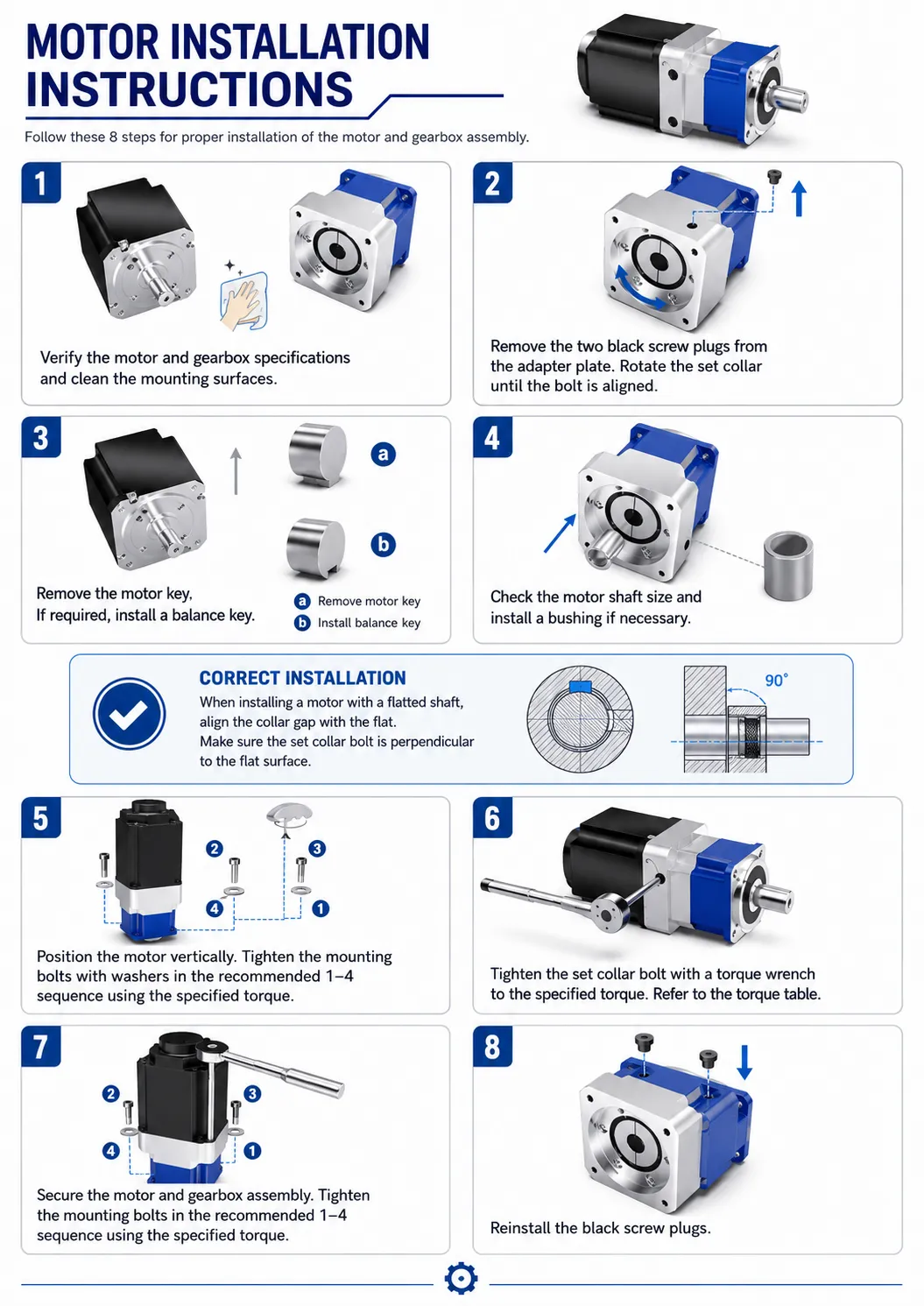
The concentricity specification for EP series motor interface installations is ≤0.02 mm total indicator runout (TIR) between the motor shaft centreline and the gearbox input bore centreline. This is achieved reliably only by using a dedicated motor adapter flange (the standard EP series S-type clamping input) — not a generic bore adapter. Generic bore adapters typically produce 0.05–0.15 mm concentricity error, putting the input bearing immediately into the “severe” band.
- High-frequency metallic noise that increases with RPM (not load)
- Input end housing warms faster than output end
- Input bearing shows elliptical wear pattern at teardown
- Vibration amplitude proportional to n² (RPM squared)
- Use EP series dedicated motor-matched input flange (specify motor model at order)
- Verify concentricity with dial test indicator before tightening clamping screws
- Tighten clamping screws evenly in cross pattern to specified torque
- After installation, run 5 minutes at low speed and recheck concentricity — thermal expansion can shift alignment
Cause 4 — Axial Force Overload: The Vertical Axis Problem Engineering Calculations Often Miss
The axial force limit of a precision planetary gearbox output shaft is one of the most frequently overlooked specifications in servo automation system design. Engineers focus on output torque and gear ratio but rarely check whether the axial (thrust) force from their specific application — particularly vertical axes — falls within the gearbox output bearing’s rated axial capacity.
The failure mechanism for axial overload is output shaft lip seal distortion followed by output bearing race fatigue. When axial force exceeds the rated limit, the output shaft deflects slightly in the axial direction. This deflection compresses the lip seal, accelerating seal wear and eventually causing grease leakage. Simultaneously, the output bearing experiences combined radial and axial loading that exceeds its dynamic capacity, initiating premature race fatigue. The typical early failure signature is grease weeping from the output shaft seal — which most engineers notice but incorrectly attribute to seal age rather than the underlying axial overload.
| Real Application | Calculated Axial Force | EP-ZDE-80 limit 450 N |
EP-ZDE-120 limit 1,050 N |
EP-ZDE-160 limit 3,000 N |
Correct series |
|---|---|---|---|---|---|
| 30 kg robot arm, vertical axis | 294 N | ✅ Within | ✅ | ✅ | EP-ZDE-80 adequate |
| 50 kg load, vertical servo axis | 490 N | ❌ +9% | ✅ | ✅ | Minimum: EP-ZDE-120 |
| 100 kg load, vertical | 981 N | ❌ +118% | ⚠ −7% | ✅ | Minimum: EP-ZDE-160 |
| 200 kg gantry vertical axis | 1,962 N | ❌ +336% | ❌ +87% | ✅ | EP-ZDE-160 or ZDS-115 |
| AGV drive wheel 500 kg vehicle | 2,452 N | ❌ +445% | ❌ +134% | ⚠ −18% | EP-ZDS-115 (12,000N) |
| Heavy gantry 300 kg spindle Z-axis | 2,943 N | ❌ +554% | ❌ +180% | ⚠ −2% | EP-ZDS-115 (12,000N) |
Axial force = mass × g. EP-ZDE axial limits: 80N (40-frame), 225N (60-frame), 450N (80-frame), 1,050N (120-frame), 3,000N (160-frame). ⚠ = within 20% of limit — include dynamic axial forces from acceleration before confirming. The EP-ZDS series planetary gearbox provides 12,000–28,000N axial capacity for heavy-load applications.
Critical rule for vertical axes: always add dynamic axial forces from acceleration and deceleration to the static gravity load before comparing to the rated axial limit. On a 100 kg axis accelerating at 0.5g vertically, the peak axial force is 100 × 9.81 × (1 + 0.5) = 1,472 N — not 981 N static. The EP-ZDE-120 limit of 1,050 N is exceeded by 40% even though the static calculation appeared marginal. Any application with a vertical axis and significant accelerating mass should use the EP-ZDS series with its 12,000–28,000 N axial capacity.
Cause 5 — Environmental Ingress: IP54 in a Water-Jet Environment Destroys Lifetime Lubrication
The lifetime lubrication system in EP-ZDE, EP-ZDF, EP-ZDWE, and EP-ZDWF series is rated for 20,000 hours — but that rating is contingent on the sealed housing maintaining its integrity throughout the service life. The IP54 rating (splash from any direction) is not the same as IP65 (direct water jet from any direction). In Korean food processing facilities under HACCP washdown protocols, automotive body shops with cooling water exposure, and outdoor installations, the distinction is critical.
Temperature acceleration: Every 10°C above the design operating temperature halves grease service life. An EP-ZDE-80 operating at 100°C housing temperature due to overloading has an effective grease life of only 2,500 hours (rated: 20,000 hours at 70°C baseline). At 110°C: 1,250 hours. The combination of contaminated grease and elevated temperature produces failure timelines measured in months, not years — and it is entirely invisible to standard production monitoring until the unit seizes.
- Grease visible outside output shaft seal (white/grey emulsified grease = water contamination)
- Housing temperature higher than expected at given load
- Noise increasing steadily week over week
- Failure clustering at units in washdown zones of the production line
For any environment with direct hose or pressure washing: specify EP-ZDS series (IP65). IP65 withstands 6.3 mm nozzle water jet at 12.5 L/min from any direction per IEC 60529 IPX5 test. For outdoor Korean solar/wind installations and food-processing lines, IP65 is the minimum specification. Do not attempt to add external sealing covers to an IP54 unit — the seal integrity of an assembled gearbox cannot be reliably improved by external wrapping.

Diagnostic Matrix — Match Your Failure Symptoms to Root Cause
When a precision planetary gearbox fails in service, the symptom pattern at the time of failure — and the physical condition of components at teardown — points reliably to one of the five root causes. Use this matrix to identify the cause and prevent recurrence in the replacement unit.
| Observed Symptom | Timing of Onset | Teardown Finding | Root Cause | Prevention for Replacement |
|---|---|---|---|---|
| Backlash growing rapidly; noise at direction reversals | 3,000–8,000 h | Planet gear tooth flank pitting | Cause 1: SF neglect | Recalculate T_required × SF; upgrade to next torque class |
| Axis oscillates during motion; vibration at fixed frequency | From commissioning | Planet carrier pin bore fretting; bearing micro-pitting | Cause 2: Inertia mismatch | Recalculate J_ref/J_motor; change ratio or motor inertia |
| High-pitch whine at RPM; input-end housing hot | 2,000–6,000 h | Input bearing elliptical race wear | Cause 3: Eccentricity | Use motor-matched flange; verify TIR ≤0.02 mm before commissioning |
| Output seal leaking grease; output-end bearing noisy | 1,000–5,000 h | Lip seal deformed; output bearing axial race fatigue | Cause 4: Axial overload | Calculate static + dynamic axial force; upgrade to EP-ZDS if needed |
| White/grey grease at seal; noise rising over months; failure clustered in washdown zone | 1,500–4,000 h | Emulsified grease; bearing corrosion pitting | Cause 5: IP seal ingress | Upgrade IP54 → IP65 (EP-ZDS); never apply IP54 in washdown zones |
| Failure near 15,000–22,000 h; no earlier symptoms | Near rated life | Uniform bearing fatigue; L10 population failure | Normal L10 end-of-life | Replace at scheduled 20,000 h interval; no specification change needed |
Preventive Monitoring Schedule — Four Checks That Catch All Five Causes Early
All five failure causes produce detectable changes before catastrophic failure — if the right parameters are monitored at the right intervals. The schedule below applies to all EP series precision planetary gearboxes operating in standard servo automation applications. For washdown or outdoor EP-ZDS installations, the IP65 integrity check replaces the general seal inspection.
- Visual: external housing for grease weeping (Cause 4 & 5)
- Auditory: any new high-pitch whine or direction-reversal noise
- Touch: input-end vs output-end temperature differential >15°C → investigate
- Thermal scan: housing temperature map at rated load (baseline at commissioning)
- Vibration check: compare amplitude at rated speed to commissioning baseline
- Servo drive: log peak torque events; flag if >2× continuous more than 50 times/shift
- Backlash measurement at ±3% rated torque (compare to installation baseline)
- Mounting fastener re-torque (thermal cycling causes joint settling)
- Motor–gearbox interface: re-verify concentricity TIR ≤0.02 mm
- Record all measurements — trend is more valuable than single data point
- Backlash >150% of installation baseline → schedule replacement
- Vibration amplitude >200% of commissioning baseline → investigate immediately
- Housing temperature >ambient + 85°C at rated load → reduce load or replace
- 20,000 h L10 life reached → replace regardless of condition
Korea Ever-Power’s application engineering team provides failure risk assessment for existing installations — reviewing service factor, inertia ratio, axial force, and IP rating against your actual operating conditions. If you have experienced early failure or are concerned about an existing specification, contact us with your motor model, load data, and installation environment for a free engineering review.
Lihat spesifikasi →
Editor: Cxm