5段階の選定フレームワークの概要
A 精密遊星ギアボックス サーボモーターと機械負荷の間に直接配置されます。このインターフェースにおけるトルク、慣性、構成、IP定格などのあらゆる不一致は、機械が動作するすべてのサイクルで増幅されます。以下の5つのステップは、最低限の厳格なアプローチです。ステップ1と2は、初期故障のほとんどが発生する箇所であり、ステップ4と5は、設置上の問題が発生する箇所です。
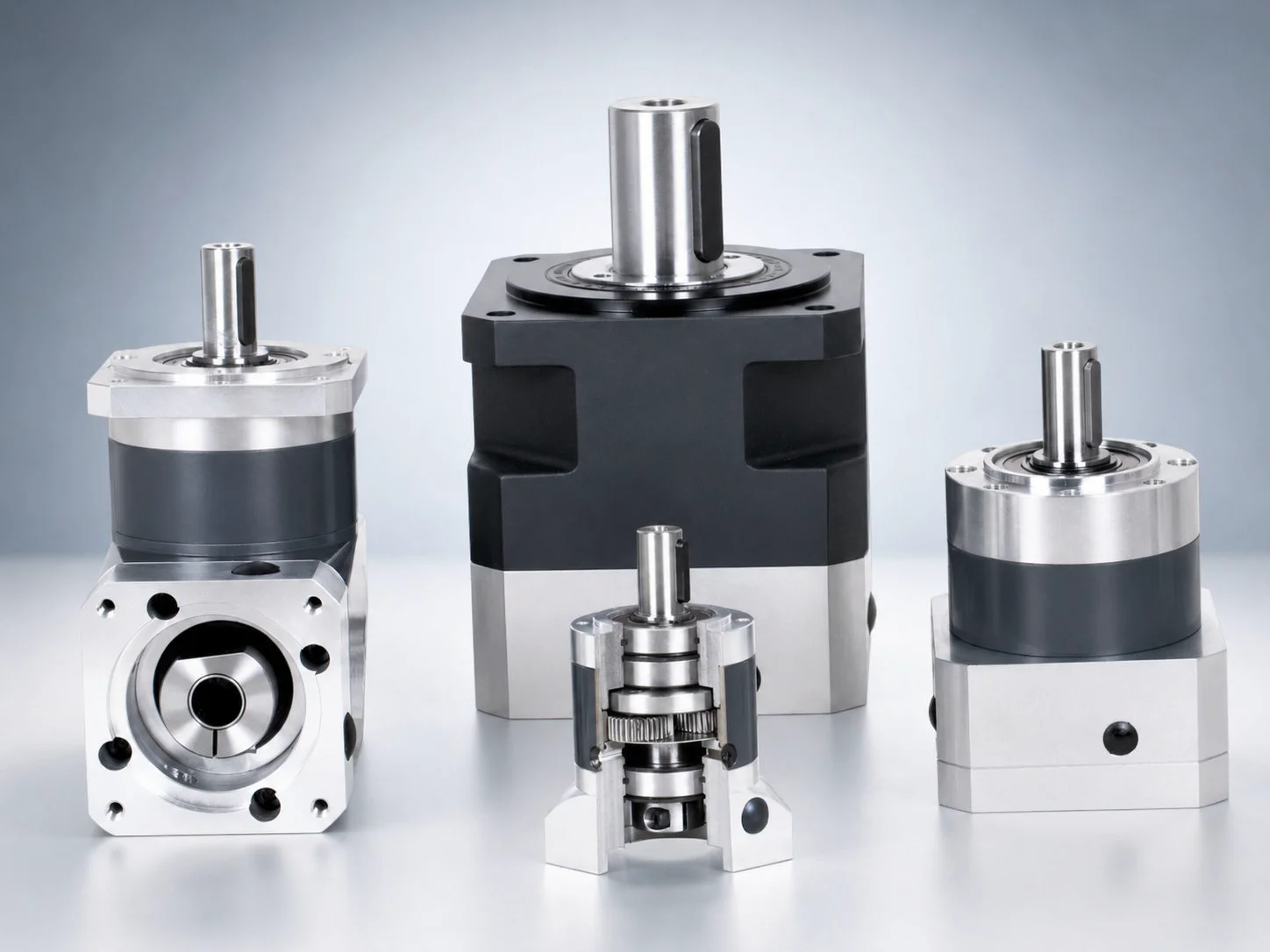
ステップ1 — 負荷プロファイルとデューティサイクルを定義する
ほとんどのエンジニアは 遊星ギアボックス サーボモーターの定格連続トルクを尋ねて、その数値に直接適合するギアボックスを選定するという方法は、不完全です。ギアボックスが実際に耐えなければならないのは、平均値だけでなく、時間経過に伴うトルク要求の完全な形状です。
単一の数値を算出する前に、負荷プロファイルの次の4つの要素を記録してください。
負荷が持続的な定常動作時に要求するトルク。一定速度で動作するロボットアームの場合、これは重力トルクと摩擦力の合計です。この値が熱設計の最低値となります。
加速、減速、または衝撃時に要求される最大トルク。位置決めサイクルが速いサーボ軸の場合、これは通常、連続トルクの2~4倍になります。ギアボックスの瞬時停止定格は、この値を超える必要があります。
IEC規格とDIN規格では、衝撃荷重を3つのレベルに分類しています。軽度の衝撃(均一なコンベアベルト)にはSF=1.0~1.25を適用します。中程度の衝撃(方向転換を伴うインデックステーブル)にはSF=1.5~2.0を適用します。重度の衝撃(衝撃プレス、ロボット衝突停止)にはSF=2.0~2.5を適用します。
モーターがトルクを発生させる各サイクルの割合。例えば、5秒周期の60%デューティサイクルでは、3秒間作動、2秒間停止となります。これは、特に密閉型永久潤滑式ユニットにおいて、ギアボックスと潤滑油にかかる熱負荷を決定します。
| アプリケーションの種類 | 衝撃クラス | 典型的なED% | おすすめのSF |
|---|---|---|---|
| 一方向コンベア、ファン、ポンプ | ライト | 80–100% | 1.0~1.25 |
| AGV駆動輪、包装ラインサーボ軸 | 軽度~中等度 | 50–80% | 1.25~1.5 |
| CNC回転軸、インデックステーブル、ロボットアームジョイント | 適度 | 30–60% | 1.5~2.0 |
| ライン転送、衝突定格ロボット軸 | 中程度~重度 | 20–50% | 2.0~2.5 |
| サーボプレス主駆動、高衝撃伝達 | 重い | <30% | 2.5+ |
ステップ2 — サービスファクターを考慮した必要出力トルクの計算(ほとんどのエンジニアが省略するステップ)
サービス係数(SF)は、慎重なエンジニアが追加する官僚的な安全マージンではありません。これは、単純な定格トルク計算では捉えられない3つの実際の物理現象を考慮に入れたものです。すなわち、サーボのクローズドループ応答よりも速い負荷変動、デューティサイクルの変化に伴う潤滑油膜強度への熱影響、そして加速フェーズと減速フェーズ間のデューティサイクルの非対称性によって生じる、定常状態の連続トルクが示唆する以上の累積的なベアリング疲労荷重です。
サービス要素を省略すると サーボオートメーションシステムにおける初期段階のギアボックス故障の最も一般的な原因高サイクルサーボアプリケーションにおける約40%の早期故障の原因となっている。
実例 — 自動車搬送ロボットJ2アーム軸
韓国の自動車板金工場向け部品サプライヤーは、6軸搬送ロボットのJ2(大型アーム)ジョイント用のサーボギアボックスを必要としています。サーボモーターは1.5kW、回転数3,000rpmのユニットです。機械サイクルは、方向反転を伴う高速位置決め(中~重度の衝撃クラス)を含みます。選択されたサービスファクターはSF = 2.0です。
SF(安全機能)がない場合、エンジニアは定格トルク71.9 N·mのギアボックス(EP-ZDE-60シリーズのユニット)を選択します。緊急ブレーキ時の実際の最大トルク(推定2×連続=143.8 N·m)では、サーボが緊急停止をトリガーするたびに、ギアボックスは定格負荷の200%で動作します。このような動作が数千回繰り返されると、遊星歯車の側面にピッチングが発生し始めます。バックラッシュが増大します。8か月後には軸に振動が発生し、ギアボックス全体の交換が必要になります。これは仮説ではなく、序論で言及した韓国のTier-1事例で文書化された故障パターンです。
ステップ3 — ギア比の選択と慣性モーメントのマッチング
ギア比 サーボ遊星ギアボックス 出力軸の回転速度と、モーターから見た負荷の慣性モーメントという2つの要素を同時に決定します。トルクを正しく設定しても慣性モーメントを誤って判断すると、サーボドライブのチューニングがうまくいかず、機械的に適切なギアボックスを使用していても、急加速時に振動、オーバーシュート、過電流障害が発生する可能性があります。
下の表は、ギア比の変更によって、同じ負荷慣性がモーター軸に反映される値に劇的に変化する様子を示しています。これが、ギア比の選択が単なる速度計算ではなく、サーボモーターと機械的負荷をマッチングさせるための主要な手段となる理由です。
| ギア比 i | ステージ | J_reflected (kg·m²) * | 慣性比 | サーボチューニングの状態 |
|---|---|---|---|---|
| 3:1 | 1 | 0.00222 | 2.2 : 1 | ✅理想的 |
| 5:1 | 1 | 0.000800 | 0.8 : 1 | ✅ 良い |
| 10:1 | 1 | 0.000200 | 0.2 : 1 | ⚠️ギア比が高すぎるため、反応が遅い |
| 20:1 | 2 | 0.000050 | 0.05 : 1 | ❌ トルクが十分に活用されておらず、反応が悪い |
* 例:J_load = 0.02 kg·m²、J_motor = 0.001 kg·m²。実際の値は、負荷の形状とモーターの仕様によって異なります。
サーボドライブの速度フィードバックループのKvゲインは実質的に制限されています。そのため、軸は速度指令に対して反応が鈍く、位置ストップでオーバーシュートを起こします。比例ゲインを上げて補正しようとすると、機械共振が発生します。これは、駆動系の慣性ミスマッチという物理的な問題に起因するため、ソフトウェアだけでは完全に解決できない問題です。
この範囲の比率では、単一の遊星歯車機構(EP-ZDE/ZDF/ZDWE/ZDWF、1段)で、96%の効率(インライン)または94%の効率(直角入力)が得られます。これは、慣性比と効率の両方が等しく重要な、高ダイナミックなサーボ軸(CNC送り軸、レーザー切断ヘッド、ピックアンドプレースロボットなど)に最適な範囲です。
定格モータ速度で出力速度を非常に低く(200rpm未満)する必要がある場合は、2段式ユニットが適しています。効率は94%(インライン)または92%(直角)に低下します。トルク増幅のための高比率よりも効率損失が重要でないAGV駆動輪、パレットチェンジャー、ソーラートラッカーには適しています。バックラッシュは単段式よりもわずかに広くなります。
ステップ4 — 適切な構成を選択する(インライン型か直角型か、丸型フランジか角型フランジか)
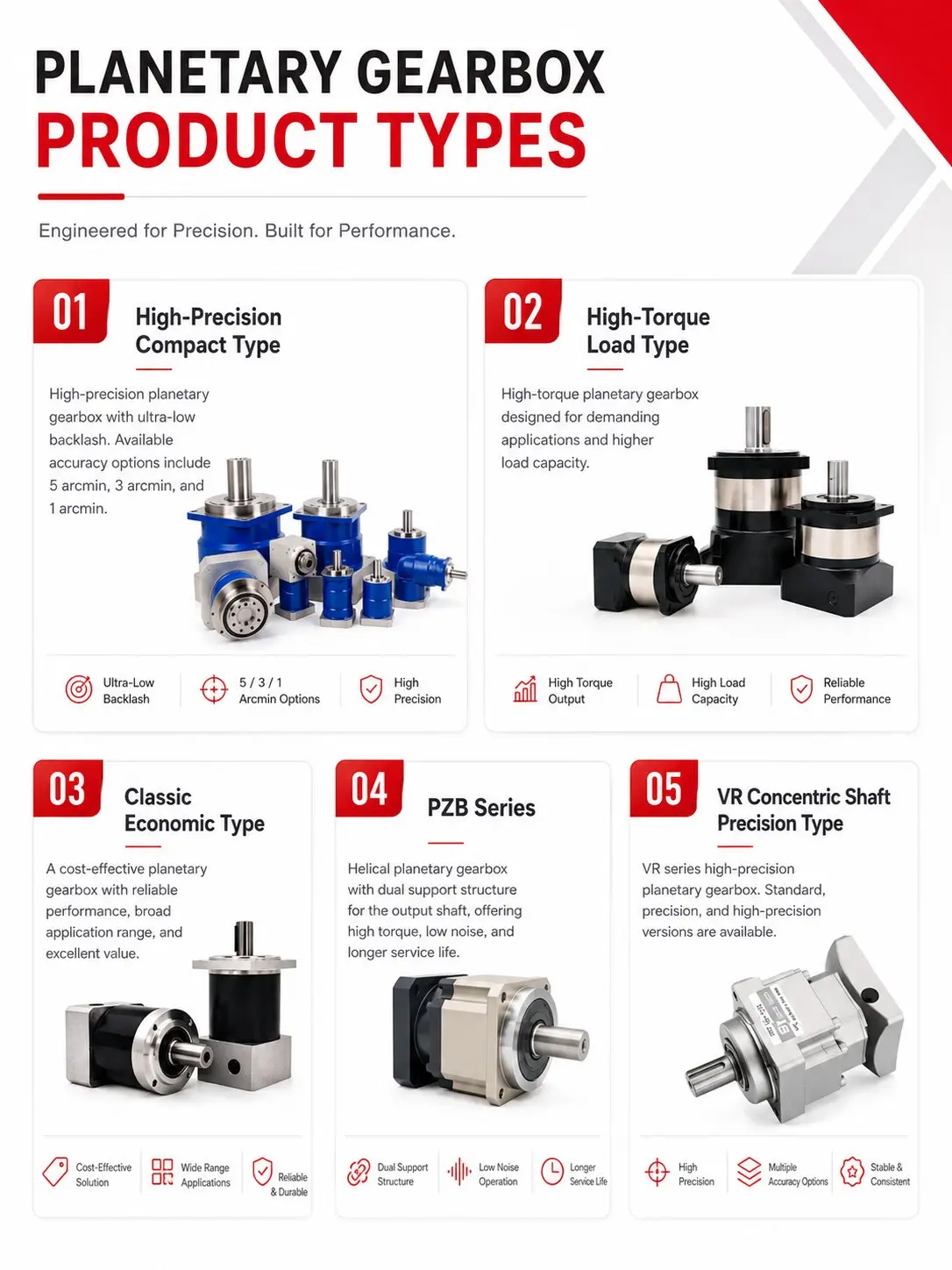
韓国エバーパワーEPシリーズの 精密遊星歯車装置 5つの製品ラインにわたって、4つの物理的構成をご用意しています。それぞれが、特定の設置上の制約の組み合わせに対応します。これは、性能上の好みではなく、機械の形状と利用可能な機械加工設備によって決定される構造上の決定です。
| シリーズ | Motor Input | 出力フランジ | 最大トルク | IP | 最適な用途 |
|---|---|---|---|---|---|
| EP-ZDE | 列をなして | Round Φ | 800 N·m | IP54 | Standard precision servo axes — CNC, robot, laser cutter |
| EP-ZDF | 列をなして | Square □ | 800 N·m | IP54 | Plate-mount frames — no boring needed |
| EP-ZDWE | 90° bevel | Round Φ | 800 N·m | IP54 | 30–50% shorter axial depth — compact machine heads |
| EP-ZDWF | 90° bevel | Square □ | 800 N·m | IP54 | AGV/AMR low-profile chassis, welded frames |
| EP-ZDS | 列をなして | Square □ | 1,800 N·m | IP65 | Heavy robot joints, press drives, food processing, washdown |
Right-angle input efficiency trade-off (ZDWE/ZDWF): The 90° bevel gear input stage adds approximately 2% efficiency loss compared to an inline unit of the same frame size. For a 750 W servo motor running 16 hours per day, this equates to approximately 15 W additional heat generation — negligible for most applications. For continuous 24/7 high-power operation, verify thermal budget using the formula: P_heat = P_input × (1 − η), where η = 0.92 for ZDWE/ZDWF two-stage.
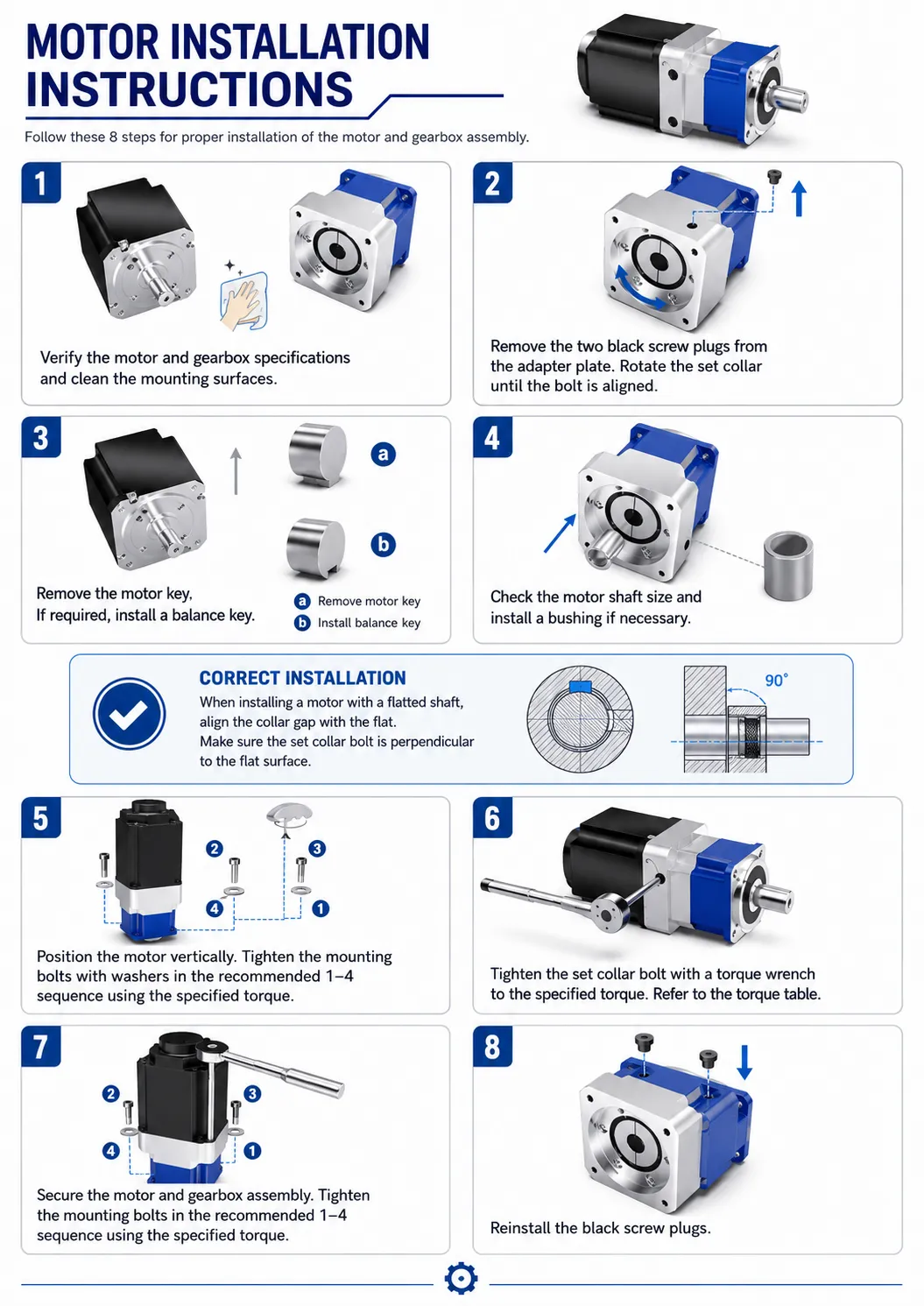
Step 5 — Motor Interface Verification: The 12-Point Checklist
A 精密遊星歯車減速機 correctly sized for torque, ratio, and configuration can still fail in service within weeks if the motor-to-gearbox interface is improperly specified. Interface errors typically manifest as elevated vibration, early input bearing failure, and in severe cases, input shaft coupling fracture. This 12-point checklist covers every dimension of the motor-gearbox interface that must be verified before order placement.
Backlash Specification — Matching Precision Grade to Application Requirement
Once torque, ratio, and configuration are confirmed, verify that the backlash specification of the selected precision planetary gearbox is appropriate for your positioning accuracy requirement. Backlash is the angular play at the output shaft when the input direction reverses — measured in arcminutes (arcmin), where 1 arcmin = 1/60th of a degree.
Do not over-specify backlash. A unit with <1 arcmin backlash may cost 3–5 times more than a <8 arcmin unit of the same frame size, with no measurable performance benefit in applications that position in a single direction or where the servo closed-loop compensates for the backlash contribution. Match the specification to the actual requirement:
Three Sizing Errors That Lead Directly to Early Failure
The most frequent error. A gearbox rated at the calculated steady-state output torque appears to match on paper. At the first emergency stop or direction reversal under full load, the actual torque spikes to 2–3× continuous. Without SF, the unit is operating at 200–300% of its design point. After several thousand such events, planet gear surface fatigue initiates and backlash begins to grow rapidly.
When load inertia reflected to the motor exceeds five times the motor rotor inertia, the servo velocity loop becomes difficult to tune. Engineers who push the proportional gain up to compensate create mechanical resonance — a problem that manifests as axis oscillation, audible vibration, and ultimately early planet carrier bearing fatigue from cyclic overload at the resonant frequency. Software filters help but cannot fully resolve the underlying mechanical mismatch.
An IP54-rated 遊星ギアボックス resists water splashing from any direction — but it does not protect against a direct water jet. Korean food-processing facilities under HACCP protocols apply high-pressure hose washing to all machine surfaces including gearboxes. Over 6–18 months, even IP54-rated lip seals degrade under repeated chemical cleaning cycles. Water ingress emulsifies the lifetime lubricant, destroying the grease film and dramatically accelerating bearing wear. The gearbox housing temperature rises, the noise increases, and the rated 20,000-hour lifespan may be achieved in under 5,000 hours.
Selection Summary and Next Steps
Korea Ever-Power’s application engineering team provides gearbox selection support — including service factor verification, inertia ratio calculation, and motor interface confirmation — in Korean and English for Korean OEM manufacturers. Provide your servo motor model, load parameters, and installation constraints to receive a complete selection recommendation at no charge.
編集者: Cxm