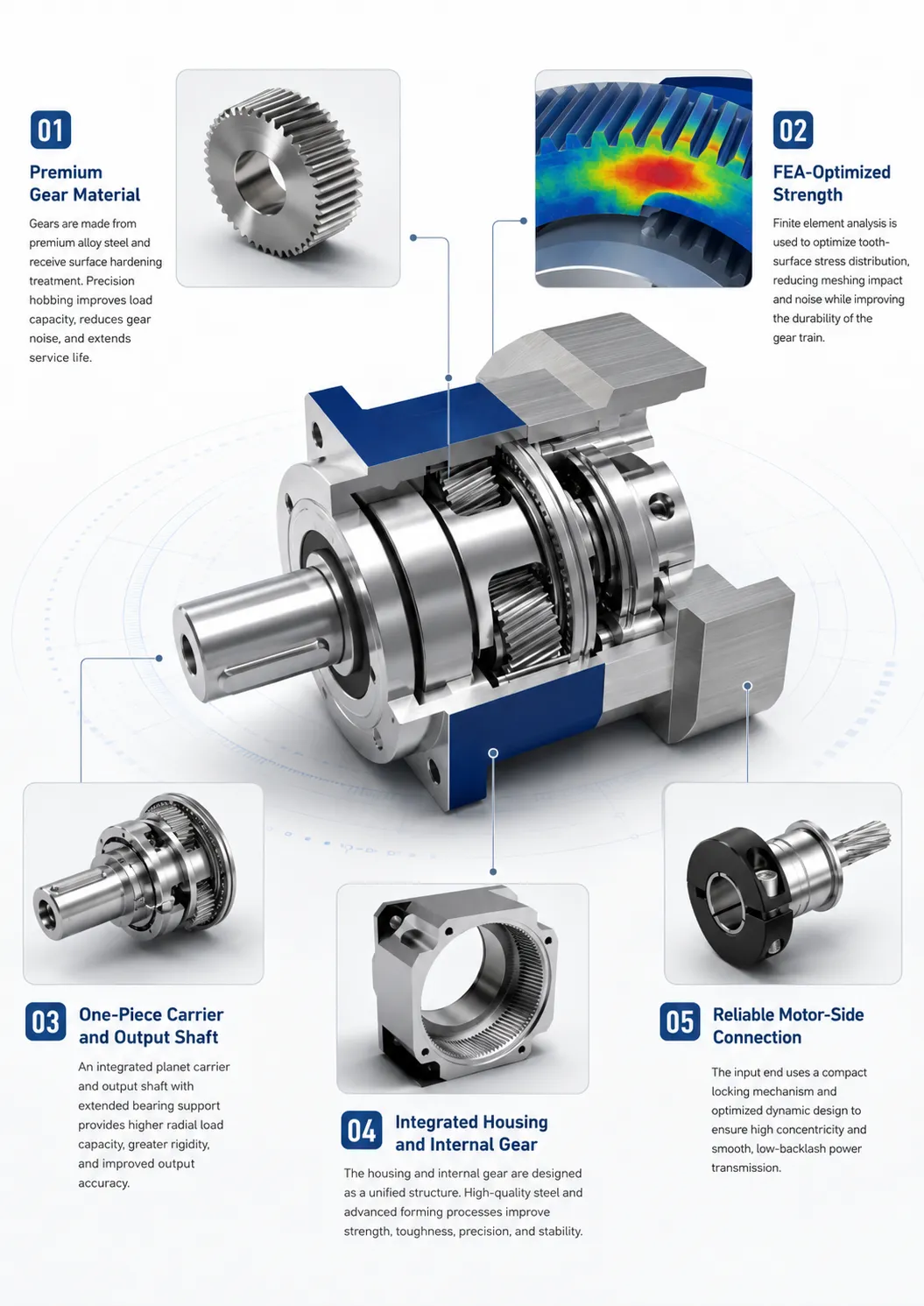
Three Loss Mechanisms — Where Planetary Gearbox Power Goes
Planetary gearbox efficiency is not a single number — it is the product of three independent loss mechanisms that each respond differently to load, speed, and temperature. Understanding each mechanism separately allows Korean engineers to predict efficiency under actual operating conditions rather than relying on the catalogue’s rated-load value, which may overstate efficiency at the partial loads that dominate real production cycles.
① Gear mesh friction loss
Generated at each tooth contact point from the combination of rolling and sliding motion. Power loss ∝ transmitted torque × mesh friction coefficient × sliding velocity. The planetary arrangement distributes load across N planet contacts simultaneously, reducing the load per mesh contact and thus the friction loss per contact compared to a parallel-shaft gear of the same output torque — one key reason planetary efficiency exceeds that of worm or helical single-mesh reducers at equivalent ratios.
Typical mesh loss per stage: 0.5–1.5%
Two-stage total mesh loss: 1.0–3.0%
Dominant at high load, moderate speed
② Rolling bearing friction loss
Generated at the contact between bearing rolling elements and raceways. Bearing loss has two components: a load-dependent term (proportional to transmitted radial/axial force) and a speed-dependent viscous drag term (proportional to speed² at high speeds). At typical servo output speeds (50–300 rpm), the load-dependent term dominates. Planet carrier bearing losses are the largest single contributor to total bearing loss in a planetary stage because the planet bearings carry both the planet’s own weight and the gear mesh reaction force.
f₀, f₁ = bearing-type constants
Typical bearing loss: 0.3–0.8% per stage
Increases with speed² at high input RPM
③ Grease churning and seal drag loss
Sealed grease gearboxes incur two sources of no-load (speed-dependent, load-independent) losses. Grease churning occurs when rotating components displace lubricant, generating viscous drag proportional to speed and grease viscosity. Shaft seal lip drag adds a small constant frictional torque that is independent of both load and speed. Together these “spin losses” are small at normal temperatures but become significant at cold start when grease viscosity is high — explaining why measured efficiency at cold start is lower than steady-state efficiency.
P_seal = T_seal_drag × ω (constant torque)
Typical spin loss: 0.1–0.3%
Dominant at low load, cold temperatures
TOTAL EFFICIENCY — COMBINING ALL THREE MECHANISMS
For a two-stage gearbox:
η_total = η_stage1 × η_stage2 × η_seals
Typical single-stage EP-AB at rated load, 25°C:
P_mesh ≈ 1.0%, P_bearing ≈ 0.6%, P_churn ≈ 0.2%
η_stage ≈ 1 − 0.018 = 98.2%
Two-stage EP-AB at rated load:
η_total ≈ 0.982 × 0.982 × 0.997 = 96.1%
Published catalogue value: “≥95%” → consistent ✓
At 30% load (partial-load condition):
P_mesh drops proportionally, P_churn stays constant
η_total ≈ 92–94% (spin losses now dominate)
Efficiency vs Load Ratio — Why Partial Load Drops Planetary Gearbox Efficiency
The rated efficiency stated in a Korea Ever-Power EP catalogue — typically ≥95% for two-stage, ≥97% for single-stage — is measured at 100% of rated torque. In Korean production applications, gearboxes rarely run at 100% load continuously. A packaging machine servo that averages 40% of rated torque across its duty cycle operates on the efficiency curve at a point well below the catalogue peak. Understanding this partial-load efficiency drop is critical for accurate energy cost calculations.
The mechanism is straightforward: at partial load, gear mesh friction loss decreases proportionally with torque (less force, less friction), but grease churning and seal drag remain constant. These spin losses, which are negligible as a fraction of rated power, become a significant fraction of the reduced transmitted power. The result is a characteristic efficiency-load curve that droops at light load.
| Load fraction (% of rated torque) | EP-AB single-stage η | EP-AB two-stage η | Worm reducer η (i=20) | η gap: planetary vs worm |
|---|---|---|---|---|
| 100% (rated) | 97.5% | 95.3% | 68% | +27.3 pp |
| 75% | 97.1% | 94.3% | 63% | +31.3 pp |
| 50% | 96.2% | 92.6% | 56% | +36.6 pp |
| 25% | 94.1% | 88.5% | 44% | +44.5 pp |
| 10% | 88.3% | 77.9% | 28% | +49.9 pp |
Values at 25°C steady-state, n_input = 1,500 rpm. Worm reducer i=20 at standard oil temperature. “pp” = percentage points. Actual values vary by frame size and lubricant — use Korea Ever-Power datasheet for specific model.
The efficiency gap between planetary and worm gear reducers widens at partial load. A Korean conveyor that runs at 50% load for 70% of its cycle is operating at a point where the worm reducer delivers only 56% efficiency versus the planetary’s 96% — a 40 percentage-point gap, larger than the 27-point gap at full load. Engineers who calculate energy savings using only the rated-load efficiency figures significantly underestimate the actual annual savings from switching to planetary gearboxes on partial-load Korean conveyor and mixer drives.
Multi-Stage Efficiency Multiplication — Why Each Additional Stage Costs More Than the Last
A two-stage planetary gearbox does not have twice the losses of a single-stage unit at the same ratio — it has losses compounded multiplicatively. This compounding effect means that adding stages to achieve a high ratio has an accelerating cost in efficiency terms: each additional stage reduces efficiency by a larger absolute power amount because the second stage’s input power is already reduced by the first stage’s losses.
MULTI-STAGE EFFICIENCY MULTIPLICATION
η_total = η₁ × η₂
= 0.982 × 0.982 = 96.4%
Three-stage (very high ratio drive):
η_total = η₁ × η₂ × η₃
= 0.982 × 0.982 × 0.982 = 94.7%
Loss comparison at P_input = 5,000 W:
1-stage loss = 5,000×0.018 = 90 W
2-stage loss = 5,000×0.036 = 180 W (not 90+90)
3-stage loss = 5,000×0.053 = 265 W (not 90+90+90)
The compounding effect:
Stage 2 input = 4,910 W (not 5,000 W)
Stage 2 loss = 4,910×0.018 = 88.4 W
Total 2-stage = 90.0 + 88.4 = 178.4 W ✓
This compounding explains why planetary gearbox selection should favour the fewest stages that satisfy the ratio requirement. A single-stage EP-AB at i=10 achieves better efficiency than a two-stage at i=10 (which could be i=3.16×3.16) — even though the gear mesh friction per stage is identical. Korean engineers who select two-stage configurations for ratios achievable in single-stage simply to gain margin are paying an unnecessary efficiency penalty that accumulates continuously in energy cost.
Single-stage EP-AB covers i = 3–10. Two-stage covers i = 10–100. For i ≤ 10 on an efficiency-critical application (high-cycle conveyor, continuous mixer), specify single-stage even if a two-stage unit with higher safety margin is available — the efficiency difference accumulates to ₩150,000–400,000 per year on a typical Korean 15 kW drive.

Temperature Effect on Planetary Gearbox Efficiency — Cold Start and Steady State
The three efficiency loss mechanisms all have significant temperature dependence. Grease viscosity — which governs churning loss and boundary lubrication film thickness that affects gear mesh friction — is highly temperature-sensitive: at −10°C (the lower operating limit for standard EP-AB), grease viscosity may be 10–20× higher than at steady-state 60°C. This produces a characteristic cold-start efficiency dip that Korean engineers operating in unheated winter factories must account for in energy calculations.
Grease viscosity is at maximum. Churning losses dominate all other mechanisms. Measured efficiency at cold start can be 5–10 percentage points below steady-state — a two-stage EP-AB may show 85–90% efficiency in the first 5 minutes. For Korean winter operations, this matters for energy metering but not for machine safety (the gearbox generates more heat, warming itself faster).
Grease viscosity decreases with temperature, reducing churning loss. Gear mesh efficiency is relatively flat across this range. Net effect: efficiency improves slightly from cold-ambient to normal operating temperature. The catalogue value applies in this range.
As temperature rises above 70°C, grease base oil begins to separate (Art13 overheating article). Separated oil has reduced film strength at the gear mesh, increasing boundary friction and reducing efficiency. A gearbox that begins overheating also begins losing efficiency — a double penalty: higher energy cost and accelerated wear.
の EP-KF/KH hypoid gear stage has lower rated efficiency than standard helical planetary (typically 92–95%) due to the hypoid gear sliding contact geometry. This efficiency trade-off is accepted for the noise reduction benefit (6–8 dB lower noise than standard planetary). Do not use KF/KH below 0°C — cold hypoid gear oil produces extreme churning losses that can exceed 25% of input power.
EFFICIENCY vs TEMPERATURE — QUICK REFERENCE
T_housing = −10°C (cold start): η ≈ 88–91% ← churning dominant
T_housing = +20°C (ambient): η ≈ 96–97% ← approaching rated
T_housing = +60°C (steady-state): η ≈ 97.5% ← rated catalogue value
T_housing = +90°C (limit): η ≈ 95–96% ← film breakdown begins
For annual energy calculations: use η = 96.5% (two-stage EP-AB)
weighted average accounting for ~20 min cold start twice daily
in Korean 3-shift operation with 10°C winter morning starts.
Planetary Gearbox Efficiency Calculation — Step-by-Step Procedure
The following four-step procedure calculates actual annual energy consumption for a planetary gearbox under a realistic Korean production duty cycle — accounting for load variation, partial-load efficiency, and cold-start losses. This is the calculation that produces accurate ROI figures for worm-to-planetary conversion decisions.
STEP-BY-STEP EFFICIENCY CALCULATION
Typical load fraction = 55% (Korean conveyor)
Operating hours/yr = 6,300 hr (3-shift)
Cold starts: 2/day × 20 min = 40 min/day = 210 hr/yr
Step 1 — Average input power at typical load:
P_input_avg = P_motor × load_fraction = 7.5 × 0.55 = 4.125 kW
Step 2 — Look up efficiency at operating load fraction:
EP-AB two-stage at 55% load: η ≈ 93.5% (from Module 2 table, interpolate 50%–75%)
Worm reducer at 55% load: η ≈ 60.0% (interpolate)
Step 3 — Annual energy consumption:
E_planetary = P_input_avg / η × hours = 4.125/0.935 × 6,300 = 27,796 kWh/yr
E_worm = P_input_avg / η × hours = 4.125/0.600 × 6,300 = 43,313 kWh/yr
Step 4 — Annual energy saving (planetary vs worm):
ΔE = 43,313 − 27,796 = 15,517 kWh/yr
At Korean industrial electricity rate ₩150/kWh:
Annual saving = 15,517 × 150 = ₩2,327,550/yr per drive
The calculation above uses steady-state efficiency. In Korean winter operations, the 210 cold-start hours per year (at ~90% efficiency for the planetary, ~50% for worm) slightly reduce but do not reverse the advantage. Re-calculation with cold-start hours included changes the planetary annual energy by approximately +180 kWh (+₩27,000) — negligible relative to the ₩2.3M annual saving. Cold-start efficiency is more relevant for a single-drive system where the cold-start period represents a larger fraction of total operating hours.
Full ROI Calculation — Worm Reducer to EP-BPG Planetary Payback Period
The Korea Ever-Power EP-BPG省エネシリーズ is specifically designed for worm reducer replacement: it uses an IEC-standard mounting flange that accepts the same motor without an adapter, and the housing dimensions follow IEC standard footprints that often allow direct bolt-in replacement on Korean conveyor and agitator drives. The ROI calculation below uses the Module 5 figures plus the Korean procurement cost difference.
| Cost / Saving Element | Worm Reducer | EP-BPG Planetary | Difference |
|---|---|---|---|
| Unit price (7.5 kW, i=20) | ₩280,000 | ₩520,000 | +₩240,000 |
| Installation (bolt-in swap) | — | ₩80,000 | +₩80,000 |
| Total upfront investment | ₩280,000 | ₩600,000 | +₩320,000 |
| Annual electricity saving | — | — | +₩2,327,550/yr |
| Annual oil change saving (worm requires annual) | ₩45,000/yr | ₩0 (sealed) | +₩45,000/yr |
| Total annual net saving | — | — | ₩2,372,550/yr |
| Simple payback period | ₩320,000 ÷ ₩2,372,550 = 49 days | ||
Based on 7.5 kW motor, i=20, 3-shift Korean operation (6,300 hr/yr), 55% average load, Korean industrial electricity rate ₩150/kWh. Prices indicative — request current quotes for your specific model and volume.
An investment that pays back in 49 days has an annualised return on investment of approximately 740%. For Korean factories operating 50 worm reducers on conveyor and mixer drives in the 5–15 kW range, the total investment for a planetary conversion programme is approximately ₩16,000,000 — returning ₩118,600,000 annually in electricity savings. This is not a marginal improvement but a transformation of the facility’s energy cost profile. The EP-BPG’s bolt-in installation means conversion can be executed during scheduled maintenance shutdowns without structural modifications.
Economic Line vs Precision Line — Efficiency Is Not Sacrificed for Cost
Korean engineers who encounter the Korea Ever-Power Economic Line sometimes assume that its lower price reflects lower efficiency — a trade-off that would be relevant for energy-cost-sensitive applications. This assumption is incorrect and worth addressing directly.
The Economic Line’s lower price comes from two design choices: higher backlash (6–8 arcmin vs ≤1–5 arcmin for precision series) and a simplified housing design that reduces manufacturing cost. Neither of these affects the fundamental gear mesh efficiency. The Economic Line uses the same helical planetary gear architecture — same gear material, same tooth geometry, same mesh efficiency — as the precision EP-AB series. Its rated efficiency is essentially identical to EP-AB at equivalent load and speed.
The Economic Line is the correct choice for applications where backlash tolerance is wide (speed control, constant-direction drives, agitators) and where precision servo positioning is not required. Using EP-AB precision series on these applications provides no performance benefit in efficiency, load capacity, or service life — it adds cost without adding value. The right efficiency choice for Korean agitator and speed-control conveyor drives is Economic Line or EP-BPG, not EP-AB P0.
| Korea Ever-Power Series | Rated Efficiency | 反発 | Relative Cost | 最適 |
|---|---|---|---|---|
| EP-BPG Energy-Saving | ≥97% | P1 std | 1.3× | Worm replacement, conveyor, mixer, agitator |
| EP-AB 精度 | ≥95–97% | P0–P2 | 1.0× (base) | Servo positioning, CNC, robot, packaging |
| Economic Line | ≥95% | 6~8分 | 0.65× | Speed control, constant-direction drives, cost-first |
| EP-AFH Ultra-Precision | ≥95–97% | ≤1′標準 | 1.8倍 | Wafer handler, rotary table, CNC ultra-precision |
| EP-AH新ライン | ≥95% | 1–2′ | 2.2× | Heavy-duty conveyor, crane, solar tracker, outdoor |
| Worm reducer (comparison) | 40–70% | 15~30分 | 0.4× | Self-locking, very slow, low-cycle — not energy applications |
Factory-Level Energy Audit — Applying Efficiency Calculations Across Multiple Drives
Korean factories conducting ISO 50001 energy management audits — increasingly required for Samsung and Hyundai tier-1 suppliers — must document and justify energy reduction measures. The planetary gearbox efficiency calculation provides a directly auditable energy saving that can be included in the facility’s annual energy reduction target. The following worked example covers a Korean food processing facility with a mixed drive population.
| ドライブタイプ | Qty | Motor kW | Avg load % | Old η (worm) | New η (planetary) | Annual saving/unit |
|---|---|---|---|---|---|---|
| Main conveyor belt | 8 | 7.5 | 55% | 60% | 93.5% | ₩2,328K |
| Mixer / agitator | 12 | 11 | 70% | 65% | 94.3% | ₩2,891K |
| Elevator screw conveyor | 4 | 5.5 | 80% | 68% | 95.0% | ₩1,654K |
| Total annual saving — 24 drives | ₩78,000K/yr (₩78M/yr) |
|||||
| Total conversion investment | ≈₩14,400K | |||||
| Simple payback | 67 days | |||||
Example figures. Actual results depend on specific motor ratings, operating profiles, electricity rates, and local installation costs. Korea Ever-Power provides a factory-level energy audit template in Korean for ISO 50001 documentation purposes.
Frequently Asked Questions — Planetary Gearbox Efficiency
Calculate Your Energy Savings with Korea Ever-Power
Korea Ever-Power produces a Korean-language energy saving report — including annual kWh, ₩ saving, CO₂ reduction, and ISO 50001 documentation — for any worm-to-planetary conversion at your Korean facility. Same working day.
編集者: Cxm