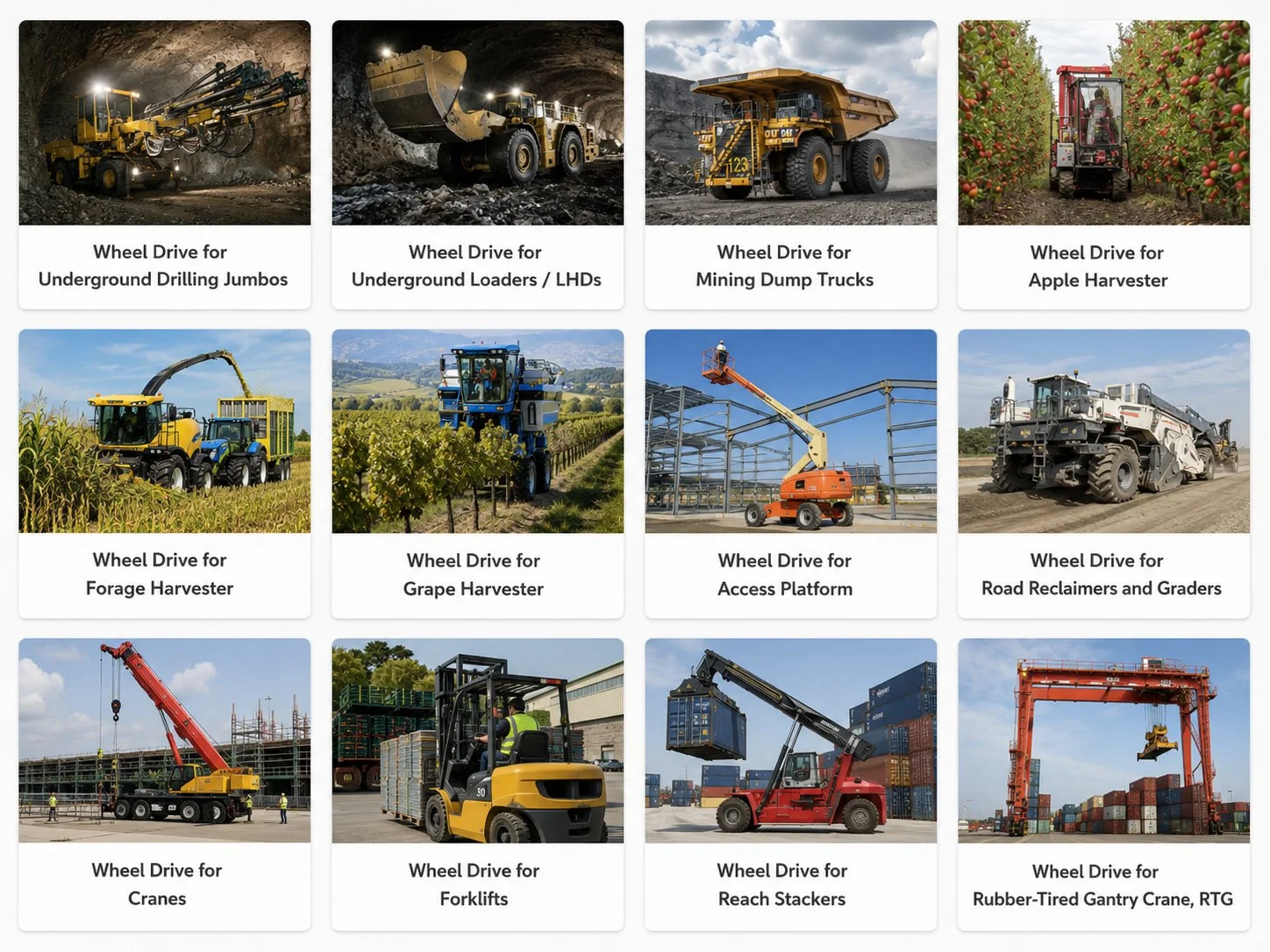
Crane Types and Their Wheel Drive Requirements
Three categories of mobile crane use ホイール駆動式遊星歯車装置 for self-propelled travel — each with a different balance between jobsite mobility and road-transfer capability.
| タイプ | 重量(トン) | Lift (t) | Site Speed | Road Speed |
|---|---|---|---|---|
| Rough Terrain (RT) | 20–55 | 15–90 | 0.5–5 km/h | 時速25~35km |
| All-Terrain (AT) | 30–100+ | 30–500 | 0.5–3 km/h | 60–85 km/h |
| City / Industrial | 12–25 | 8–30 | 0.5–3 km/h | 20–30 km/h |
The all-terrain crane represents the most extreme speed range of any machine in this entire Wheel Drive series: from 0.5 km/h jobsite creep to 85 km/h highway transfer — a 170:1 speed ratio. This range cannot be covered by a single planetary gearbox ratio — it requires a multi-speed transmission (typically 6 to 8 forward gears) with planetary reduction at each wheel. The wheel drive planetary gearbox provides the final reduction stage (typically 15:1 to 30:1), and the transmission provides the range selection for the speed extremes.
The rough terrain crane prioritises jobsite mobility over road speed. With 4WD, 4-wheel steering, and crab-steering capability (all wheels turning in the same direction for lateral movement), the RT crane can position itself in tight construction-site spaces that would be inaccessible to a truck-mounted crane. The wheel drive must support all three steering modes — normal (front wheels steer), coordinated (front and rear steer in opposite directions for tight turns), and crab (all wheels steer in the same direction for lateral movement) — while maintaining smooth, proportional drive torque at the ultra-low positioning speed of 0.5 to 2 km/h.
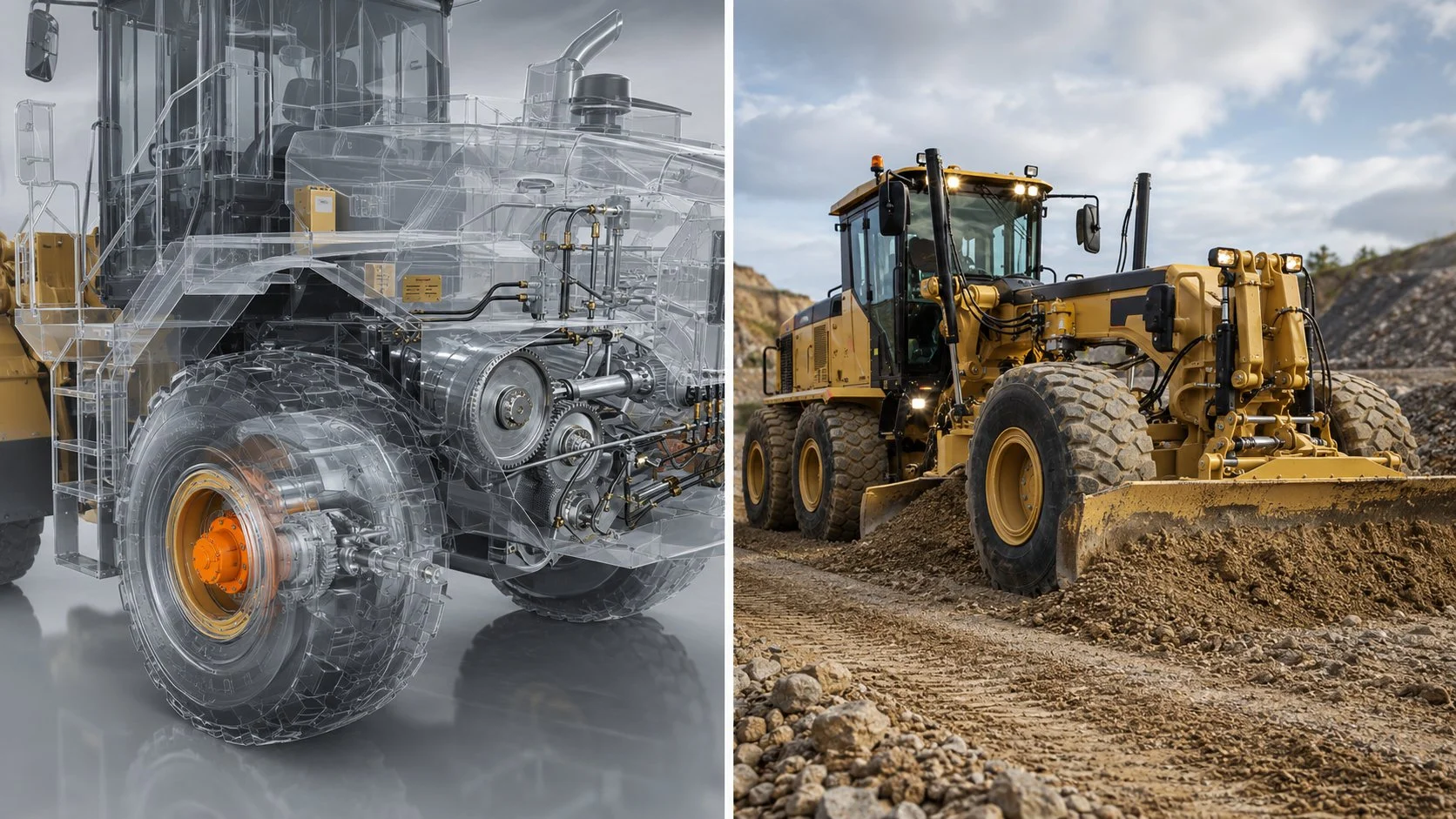
Jobsite Positioning — 50 mm Accuracy at 35 Tonnes on Unprepared Ground
Crane positioning accuracy determines lift safety. The crane must be positioned so that the boom can reach the load at the correct radius — and the lift capacity decreases with radius (a crane rated at 50 tonnes at 3-metre radius may be rated at only 10 tonnes at 18-metre radius). A positioning error of 500 mm can change the effective lift radius enough to exceed the rated capacity for the planned load — turning a safe lift into an overload condition. The wheel drive must therefore deliver positioning accuracy of ±50 to 100 mm at the final approach speed of 0.5 to 1.0 km/h — a precision requirement comparable to the seeder planter (WD-09) but at 3 to 10 times the machine weight.
The ground surface at the lift position is typically unprepared — gravel, compacted earth, grass, or the construction-site surface. The crane must approach on this surface without sinking (which changes the crane level and therefore the lift capacity chart) and without wheel slip (which prevents precise positioning). The ホイール駆動遊星歯車機構 must deliver smooth, cogging-free propulsion at 0.5 to 1.0 km/h — because any torque pulsation at this speed produces a jerky advance that makes final positioning difficult and forces the operator to overshoot and reverse repeatedly.
The counterweight (5 to 20 tonnes of steel ballast mounted on the crane superstructure) shifts the machine CG rearward — improving lift stability but making the driving handling different from a conventional vehicle. The rear-heavy weight distribution (55 to 70% on the rear axle) means the front wheels have reduced traction and reduced steering authority. On wet or loose surfaces, the front wheels may slip sideways during turns — making the crane difficult to steer precisely into the lift position. Individual wheel-motor traction control, which reduces the torque to any slipping wheel, is essential for maintaining directional control during low-speed positioning on soft ground.
Some crane operations require driving with a suspended load — repositioning the crane a short distance while the load remains attached to the hook. This is one of the most dangerous crane operations: the suspended load acts as a pendulum, swinging in response to any acceleration, deceleration, or direction change of the carrier vehicle. The wheel drive must provide completely smooth, jerk-free propulsion during load-suspended driving — because any torque pulsation excites the load pendulum, and a swinging load can shift the crane CG beyond the tipping threshold. Most crane manufacturers limit the load-suspended driving speed to 1.0 to 2.0 km/h and prohibit it entirely above a specified load weight (typically 50 to 75% of the rated capacity at the working radius).
The outrigger deployment sequence also involves the wheel drive. Before lifting, the crane extends its outriggers (hydraulic legs that widen the support base and transfer the machine weight from the tyres to the outrigger pads). During deployment, the machine weight transitions from the tyres to the outriggers — and the wheel drive brake must hold the machine stationary throughout this transition. If the brake releases prematurely (before the outriggers are fully loaded), the machine can roll during the weight-transfer phase — especially on a slope where the gravitational force is actively trying to move the machine. The wheel drive parking brake must remain engaged until the outrigger-deployment-complete signal is received from the crane control system — and must re-engage automatically if the outrigger pressure decreases (indicating a hydraulic leak or pad sinking).
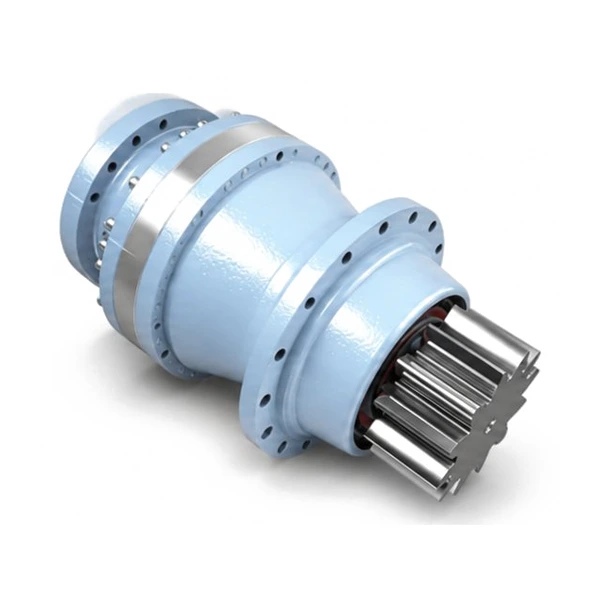
Road Transfer — The Highway Drive That Most People Never Notice
All-terrain cranes drive on public highways at 60 to 85 km/h — the highest road speed of any machine in this Wheel Drive series. At these speeds, the wheel drive operates as a conventional heavy-vehicle final drive — and must meet the same noise, vibration, braking, and fatigue standards as a truck axle. The gear mesh quality at highway speed must produce noise below 80 dBA measured at 7.5 metres — the regulatory limit for heavy vehicles in most jurisdictions. This noise requirement demands DIN Class 5 to 6 gears — higher quality than most construction-equipment specifications.
The braking requirement at highway speed is governed by ECE R13 (Europe) or FMVSS 121 (North America) — the same regulations that apply to commercial trucks. A 50-tonne all-terrain crane at 80 km/h has a kinetic energy of approximately 12.3 MJ — all of which must be absorbed by the wheel drive brakes and the engine retarder in an emergency stop. The wheel drive service brake must achieve a deceleration of 5.0 m/s2 or better — bringing the crane from 80 km/h to zero in approximately 4.4 seconds over 49 metres. This is a fundamentally different braking requirement from any construction-site or agricultural application — and the brake disc, calliper, and pad materials must be automotive-grade (ventilated disc, multi-piston calliper, semi-metallic pad) rather than the simpler wet-disc or single-piston designs used on off-road equipment.
The bearing life calculation for an AT crane wheel drive must account for both the low-speed, high-torque jobsite duty and the high-speed, low-torque highway duty. The highway duty generates bearing heat from high-speed rotation (500 to 800 rpm at the gearbox output) — while the jobsite duty generates bearing stress from high torque (at 2 to 10 rpm). The bearing must be sized for both conditions simultaneously — a combined fatigue and thermal analysis that is more complex than any other wheel drive application in this series.
The multi-axle configuration of AT cranes (4 to 9 axles) distributes the vehicle weight across 8 to 18 tyres — meeting the road weight regulations that limit the axle load to 10 to 13 tonnes depending on the jurisdiction. Each driven axle requires its own wheel drive planetary gearbox — and all gearboxes must produce identical output speed at the same transmission input speed. A speed mismatch between axles on the highway produces tyre scrubbing (the faster axle pushes the tyres against the ground surface), increased fuel consumption, and accelerated tyre wear. Manufacturing tolerance of ±0.5% on the output speed across all axles is the standard specification for AT crane wheel drives — tighter than any other multi-axle application.
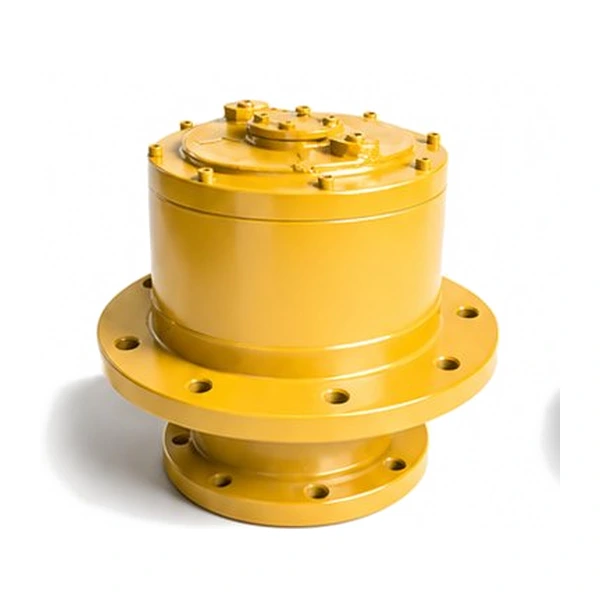
Wind Load and the Wheel Drive Parking Brake
A mobile crane with the boom erected presents a large wind-catching area — the boom, the jib, the load block, and the counterweight form a combined windage area of 20 to 80 m2 depending on the boom length and configuration. At the EN 13000 design wind speed of 20 m/s (72 km/h), the wind force on a 50 m2 area is approximately 12 to 15 kN — applied at the centre of pressure, which is typically 10 to 25 metres above the ground. This wind force produces an overturning moment of 120 to 375 kNm that the outriggers and the machine weight must resist. If the crane is parked on a slope without outriggers deployed (during transit with boom stowed), the wind force adds to the gravitational slope component — and the wheel drive parking brake must hold against both simultaneously. A sudden wind gust during overnight parking on an exposed site can exceed the parking brake holding capacity if the brake was sized for slope-only holding without the wind-load addition.
The wheel drive parking brake on a mobile crane must therefore be rated for the combined slope-plus-wind case: maximum rated slope (typically 5 to 10% for overnight parking with boom stowed) plus design wind speed (20 m/s per EN 13000). This combined holding requirement is 1.5 to 2.0 times the slope-only requirement — and undersized brakes that pass the slope-only test can fail the combined test, potentially allowing the crane to roll in a storm while unattended.
Three Failure Modes Specific to Mobile Crane Wheel Drives
An all-terrain crane descending a mountain pass at 50 to 70 km/h must continuously retard its 50 to 100-tonne weight against gravity. The braking energy on a 5-km, 6% grade descent at 60 km/h is approximately 180 to 360 MJ — dissipated across 4 to 5 driven axles over 5 minutes. If the engine retarder and exhaust brake are insufficient (due to engine malfunction or operator error), the wheel drive service brakes absorb the full retarding load — and can reach fade temperatures within 2 to 3 km of continuous braking. A runaway crane on a mountain road is among the most dangerous heavy-vehicle accident scenarios — making the combined braking capacity (engine retarder + exhaust brake + service brake + emergency/parking brake) the single most critical specification parameter.
At the 0.5 to 1.0 km/h final positioning speed, the wheel drive output shaft rotates at 1 to 3 rpm — where each gear-tooth engagement is perceptible as a discrete rotational step. On a gearbox with 30 output-stage teeth and a 0.8-metre tyre rolling radius, each tooth engagement advances the machine by approximately 84 mm. If the cogging torque variation is 10% of the mean torque (typical for DIN Class 8 gears), the machine advances in 84 mm steps with perceptible acceleration and deceleration — making it impossible for the operator to stop the machine within a 50 mm positioning window. DIN Class 6 gears reduce the cogging to less than 3% — producing a smooth, continuous advance that the operator can position to within ±25 mm.
During crab steering (all wheels turned to the same angle for lateral movement), the tyre contact patch generates a side force as well as a driving force. This side force (15 to 30% of the vertical wheel load at typical crab angles of 10 to 20 degrees) is transmitted through the wheel hub to the wheel drive output bearing as a combined radial and axial load. Standard radial bearings are not designed for sustained axial loading — and crab steering on a 50-tonne crane generates axial forces of 15 to 40 kN per wheel that can damage the bearing cage and reduce the bearing life by 30 to 50% if the bearing is not rated for the combined load. Tapered roller bearings in a back-to-back arrangement are the minimum specification for cranes with crab-steering capability.
よくある質問
Korea Ever-Power provides mobile crane wheel drives from 10,000 to 60,000 Nm with jobsite positioning accuracy, highway braking capacity, and multi-mode steering support.
編集者: Cxm