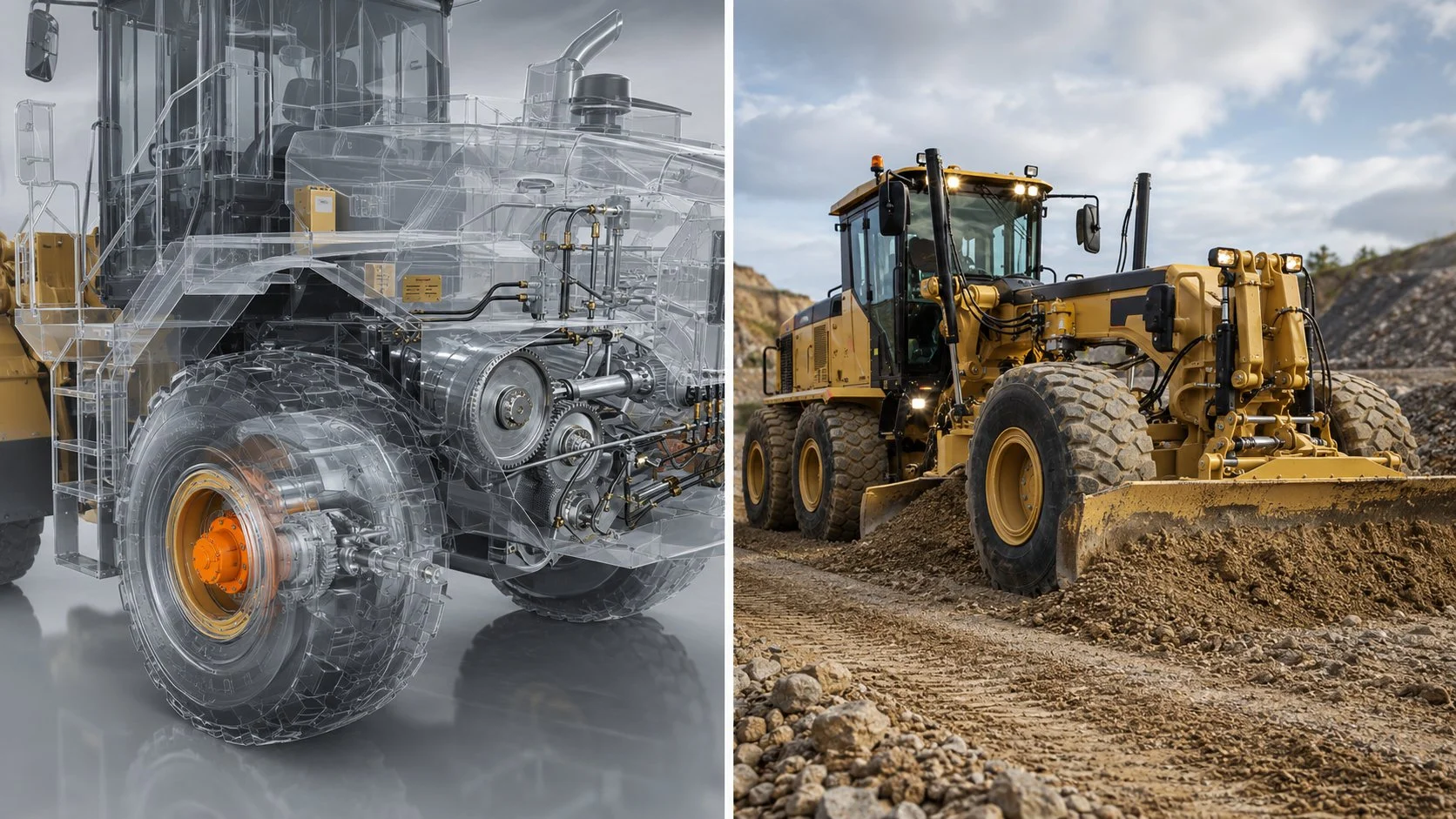
Roller Types and Their Wheel Drive Configurations
Compaction rollers use three fundamentally different configurations — each placing the ホイール駆動遊星歯車機構 in a different position relative to the vibration source and the compacted surface.
| タイプ | Drive Location | Vibration at Drive | Hot Surface |
|---|---|---|---|
| Single-drum (soil) | Rear tyres | 2–5 g (transmitted) | いいえ |
| Tandem (asphalt) | Both drums (drum-mounted) | 5–15 g (direct) | Yes (100–160 °C) |
| Pneumatic (asphalt finish) | All tyres | 0.5–2 g (minimal) | Yes (80–140 °C) |
The tandem vibratory roller presents the most demanding wheel drive environment: the drive motor and planetary gearbox are mounted inside or adjacent to the vibrating drum — experiencing 5 to 15 g of continuous intentional vibration at 25 to 50 Hz while simultaneously driving over asphalt at 100 to 160 degrees C. This combination of continuous high-frequency vibration and high surface temperature does not exist in any other wheel drive application — and requires a gearbox specification that borrows from both the stone crusher (vibration resistance) and the sugar cane harvester (thermal management).
The single-drum soil roller positions the wheel drive on the tyre-driven rear axle — separated from the vibrating front drum by the machine frame and an isolation mount. The vibration at the wheel drive is reduced to 2 to 5 g (from the 10 to 30 g at the drum) — still higher than standard construction equipment but lower than the tandem configuration. The rear tyres operate on compacted soil (not hot asphalt) — eliminating the thermal challenge but introducing a traction challenge on loose fill material where the tyre must push the 10 to 20-tonne machine forward while the vibrating drum resists forward motion through the soil engagement.
Pneumatic-tired rollers (PTR) use 7 to 11 rubber tyres instead of drums — kneading the asphalt surface to seal it and improve the aggregate interlock. The wheel drive powers all tyres simultaneously at 3 to 8 km/h over freshly laid asphalt at 80 to 140 degrees C. The tyre contact with the hot asphalt heats the tyre rubber and transfers heat to the wheel hub and bearing — raising the wheel drive temperature by 15 to 30 degrees C above the ambient-surface baseline. Because PTR tyres are inflated (not solid), they also have a higher rolling resistance on soft, warm asphalt than steel drums — requiring 20 to 40% more drive torque per tonne of machine weight. The wheel drive must deliver this higher torque at the same speed accuracy (±3%) as a drum roller to maintain the kneading uniformity across the mat width.
Combination rollers (drum front, tyres rear) split the drive between a drum-mounted gearbox (front) and a tyre-mounted gearbox (rear). The front and rear drives must be speed-matched to within ±2% — because a speed mismatch causes the drum to either push or pull against the tyres, producing shear stress in the asphalt mat that can tear the freshly laid surface. This speed-matching requirement between fundamentally different drive configurations (drum versus tyre, different rolling radii, different surface conditions) is unique to combination rollers and requires careful calibration at commissioning and re-verification whenever a tyre is replaced (changing the rolling radius).

Compaction-Speed Consistency — Why ±3% Speed Accuracy Determines Density
Compaction density is a function of three variables: the static weight of the drum, the dynamic force from the vibration, and the number of vibration impacts per linear metre of surface — which is determined by the ground speed. At a vibration frequency of 30 Hz and a ground speed of 3 km/h, the surface receives 36 impacts per metre. At 4 km/h (33% faster), the impact density falls to 27 per metre — a 25% reduction that produces measurably lower compaction density.
The compaction specification for road construction typically requires a minimum density of 95 to 98% of the modified Proctor density — measured by nuclear gauge or non-nuclear density meter. A speed variation of ±10% across the roller pass width produces density variation of ±3 to 5% — which can push the low-density zones below the 95% minimum and fail the specification. The contractor must then either re-compact the failed zone (at additional cost and time) or remove and replace the material (at much greater cost). The ホイール駆動遊星歯車機構 speed consistency of ±3% or better eliminates the speed-related density variation — ensuring the entire pass meets specification in a single compaction sequence.
On asphalt compaction, the speed consistency is even more critical because the asphalt is cooling continuously during the compaction window. Fresh asphalt arrives at 140 to 160 degrees C and must be compacted before it cools below 80 to 90 degrees C — a window of approximately 15 to 30 minutes depending on the ambient temperature, wind speed, and lift thickness. Every pass must achieve the target density within this time window — and a speed variation that reduces the compaction effectiveness of one pass means an additional pass is required, consuming precious minutes from the cooling window. A roller that operates 10% too fast on the first two passes may require a fifth corrective pass — by which time the asphalt may have cooled below the compaction temperature, resulting in a permanently under-compacted surface.
Modern compaction rollers use intelligent compaction systems (CCC — Continuous Compaction Control) that measure the drum-ground interaction in real time — inferring the stiffness of the compacted material from the vibration response. The CCC system adjusts the vibration amplitude and frequency automatically to optimise the compaction energy for the current material condition. The ground speed is an input to the CCC calculation — and speed errors propagate directly into the CCC output, causing incorrect vibration adjustments. A wheel drive with ±5% speed error can cause the CCC system to over-vibrate already-compacted material (producing aggregate fracture) or under-vibrate loose material (producing insufficient density) — defeating the purpose of the intelligent compaction technology.
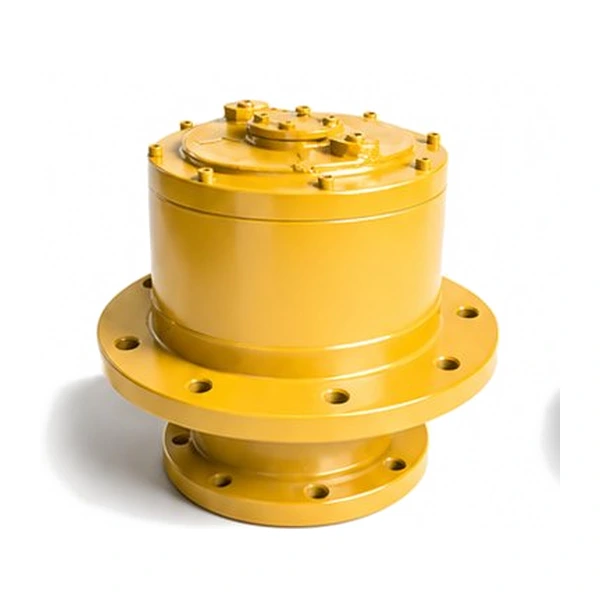
Intentional Vibration — Living Inside the Earthquake Machine
Unlike every other vibration-exposed wheel drive in this series (stone crusher, road reclaimer) — where the vibration is an unwanted byproduct of the cutting or crushing process — the roller vibration is intentional, controlled, and continuous. The eccentric weight inside the drum rotates at 1,500 to 3,000 rpm (25 to 50 Hz), producing a centrifugal force of 80 to 350 kN that alternately lifts and compresses the drum against the ground surface. This vibration is transmitted through the drum bearings, the frame, and the mounting structure to the wheel drive — at amplitudes of 5 to 15 g on tandem rollers and 2 to 5 g on single-drum rollers.
The vibration frequency is controlled by the operator through the vibration-amplitude and frequency settings on the roller control panel. At the design frequency (typically 30 to 40 Hz for asphalt, 25 to 33 Hz for soil), the machine frame is tuned to isolate the operator station from the drum vibration — but the wheel drive receives the full vibration amplitude. If the operator changes the frequency to match the soil or asphalt conditions, the vibration at the wheel drive changes accordingly — potentially passing through a resonant frequency of the gearbox housing or bearing assembly. A gearbox that is vibration-rated for 30 Hz may experience amplified vibration at 28 Hz or 35 Hz if the housing has a structural resonance near those frequencies.
The continuous nature of the vibration is the key difference from stone crushers. A stone crusher produces random, intermittent vibration — high-amplitude impacts separated by lower-amplitude background vibration. The roller produces continuous, sinusoidal vibration at a constant frequency and amplitude for hours at a time. The cumulative vibration exposure on a roller wheel drive in 1,000 operating hours exceeds the cumulative exposure on a stone crusher in 3,000 hours — because the roller vibration is constant while the crusher vibration is intermittent. The bearing preload, seal design, and fastener retention must be specified for the cumulative continuous exposure — not just the peak amplitude.
The direction-reversal pattern on a roller is also more demanding than on most equipment. A typical compaction sequence consists of 4 to 8 forward-reverse passes over the same strip — with direction changes every 20 to 100 metres. At 3 km/h, a 50-metre pass takes 60 seconds — meaning the wheel drive reverses every 60 seconds, accumulating 30 to 60 reversals per hour. Over a 1,000-hour season, the total reversal count reaches 30,000 to 60,000 — each imposing a torque-reversal impact on gear teeth that are simultaneously experiencing continuous vibration loading. The combined vibration-plus-reversal fatigue case is more severe than either loading alone — and the gear tooth root stress calculation must account for both simultaneously, using a cumulative damage model (Miner Rule) that sums the vibration fatigue and the reversal fatigue at their respective frequencies and amplitudes.
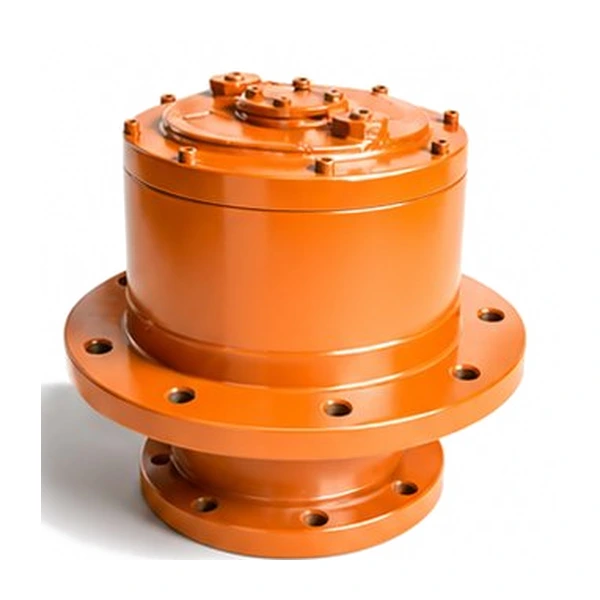
Three Failure Modes Specific to Compaction Roller Wheel Drives
The continuous sinusoidal vibration at 25 to 50 Hz produces bearing false Brinelling at 3 to 5 times the rate of the intermittent vibration on stone crushers and reclaimers. In 1,000 hours of continuous roller operation, the bearing accumulates the same false-Brinelling damage that a stone crusher bearing accumulates in 3,000 to 5,000 hours. The damage progression follows the same pattern as described for stone crushers (WD-07): micro-marks form at 200 to 500 hours, deepen to measurable play at 500 to 1,500 hours, and initiate spalling at 1,500 to 3,000 hours. On tandem rollers (5 to 15 g direct vibration), the bearing life can be as short as 1,500 to 2,500 hours without elevated preload — making bearing replacement the most frequent maintenance item on the wheel drive.
Tandem asphalt rollers drive both drums directly on the hot asphalt surface at 100 to 160 degrees C. The drum-mounted wheel drive housing absorbs heat through the drum bearing and the drum shell — raising the housing temperature to 70 to 100 degrees C and the internal oil temperature to 90 to 120 degrees C during continuous compaction passes. Multiple consecutive passes (4 to 8 passes is typical for asphalt compaction) maintain this elevated temperature for 20 to 60 minutes per mat section. Over a full paving day (6 to 10 hours), the cumulative thermal exposure degrades mineral oil and hardens NBR seals at 3 to 5 times the rate experienced on soil rollers operating at ambient ground temperature.
The continuous 25 to 50 Hz vibration loosens bolted joints at a rate proportional to the vibration amplitude and frequency — and the roller vibration is both higher-frequency and more continuous than the stone crusher vibration. A housing bolt on a tandem roller at 10 g and 35 Hz loses preload 2 to 3 times faster than the same bolt on a stone crusher at 10 g and random frequency — because the continuous sinusoidal excitation is more efficient at walking the bolt threads than random impacts. The torque-check interval on roller wheel drives must therefore be shorter (every 150 to 200 hours) than on stone crushers (every 250 hours) despite similar peak vibration levels.
よくある質問
Korea Ever-Power provides roller wheel drives from 3,000 to 25,000 Nm with continuous vibration resistance, hot-asphalt thermal protection, and compaction-speed consistency.
編集者: Cxm