How a Compact Track Loader Steers — And Why the Track Drive Takes All the Punishment
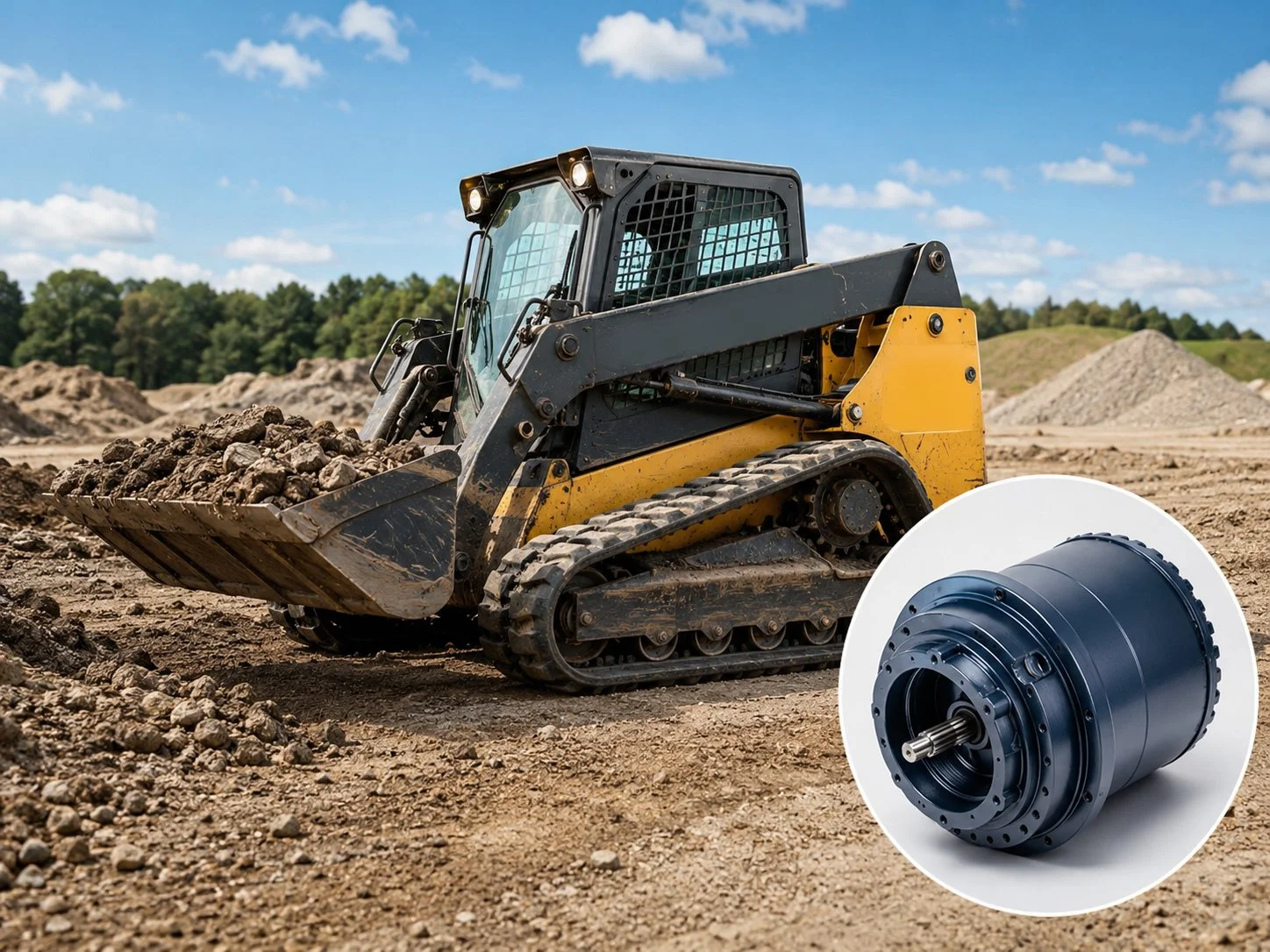
A wheeled vehicle steers by turning its front wheels. A compact track loader (CTL) steers by running its two tracks at different speeds — or in opposite directions. There is no steering axle, no tie rod, no Ackermann geometry. The 트랙 구동 유성 기어박스 on each side is the steering mechanism. This architectural decision makes the CTL extraordinarily manoeuvrable — it can spin 360 degrees within its own track length — but it also makes the track drive the most fatigue-loaded component on the entire machine.
Three steering modes define the CTL track drive duty cycle. Gradual turn: one track runs at 80 to 100% speed, the other at 30 to 60% — producing a wide arc. The speed differential generates a torsional load between the two track drives through the undercarriage frame. Pivot turn: one track runs forward, the other is stationary — the machine pivots around the stopped track. The stopped drive must resist being back-driven by the ground reaction force. Counter-rotation (zero-radius turn): both tracks run at equal speed in opposite directions — the machine spins on the spot. Both drives operate at full torque simultaneously, exactly like an excavator counter-rotation pivot but at 5 to 10 times the daily frequency.
CTL vs Wheeled Skid Steer — Why the Track Drive Replaced the Wheel Drive
The compact track loader evolved from the wheeled skid-steer loader. Both machines use differential steering (speed difference between left and right sides). The fundamental change is the ground contact: rubber tyres became rubber tracks. This change transformed the final drive requirement from a 휠 구동 유성 기어박스 to a track drive planetary gearbox — and the engineering consequences extend far beyond swapping the output interface.
| 매개변수 | Wheeled Skid Steer | Compact Track Loader (CTL) |
|---|---|---|
| Ground contact area | 4 tyres, ~0.12 m2 total | 2 tracks, ~0.8 – 1.2 m2 total |
| Ground pressure | 140 – 220 kPa | 25 – 45 kPa (5 – 8x lower) |
| Traction on mud/turf | Poor — tyres dig in | Excellent — floats on surface |
| Steering force at drive | Tyre scrub friction (moderate) | Track shear friction (2 – 3x higher) |
| Final drive torque | 5,000 – 12,000 Nm | 10,000 – 25,000 Nm (2x) |
| Drive type | Wheel drive planetary | Track drive planetary |
| Top speed | 12 – 18 km/h | 10 – 12 km/h |
| Surface damage | Heavy — tyre ruts, turf destruction | Minimal — distributes weight |
The track drive engineering trade-off: The CTL rubber track distributes weight over 6 to 10 times the contact area of four tyres — dramatically reducing ground pressure and enabling work on soft ground, finished landscapes, and indoor surfaces. But the larger contact area also means higher steering resistance: to pivot a rubber track across the ground surface, the track drive must overcome the shear friction of the entire track footprint against the ground. This steering friction is 2 to 3 times higher than the tyre scrub friction of a wheeled skid steer — requiring a track drive with 2 times the torque capacity of the equivalent wheel drive.
Counter-Rotation Frequency — Why CTL Track Drives See More Bidirectional Load Cycles Than Any Other Machine
An excavator performs 150 to 300 counter-rotation pivots per shift. A compact track loader performs 500 to 1,500 counter-rotations per shift — and adds 1,500 to 3,000 differential-speed steering events where one track drive operates faster than the other. The total bidirectional or differential loading event count per shift is 2,000 to 4,500 — the highest of any tracked machine.
CTLs work in tight spaces — backyard landscaping, interior demolition, farm buildings, warehouse floors. The machine is constantly manoeuvring around obstacles, backing into corners, turning in confined areas, and repositioning between tasks. Every directional change is a track drive event. An excavator repositions once every 5 to 10 minutes; a CTL repositions every 15 to 30 seconds during active loading and grading work.
At 3,000 steering events per shift, 250 shifts per year, and a target 5,000-hour machine life: the track drive planet gears endure approximately 3.75 million differential load cycles. The planet pin bearings endure the same count of partial or full radial load reversals. This exceeds the excavator track drive fatigue requirement by 2.5 to 3 times — despite the CTL being one-tenth the weight of the excavator. The fatigue rating, not the torque rating, is the design driver for CTL track drives.
Rubber Track vs Steel Track — How the Track Type Changes the Drive Engineering
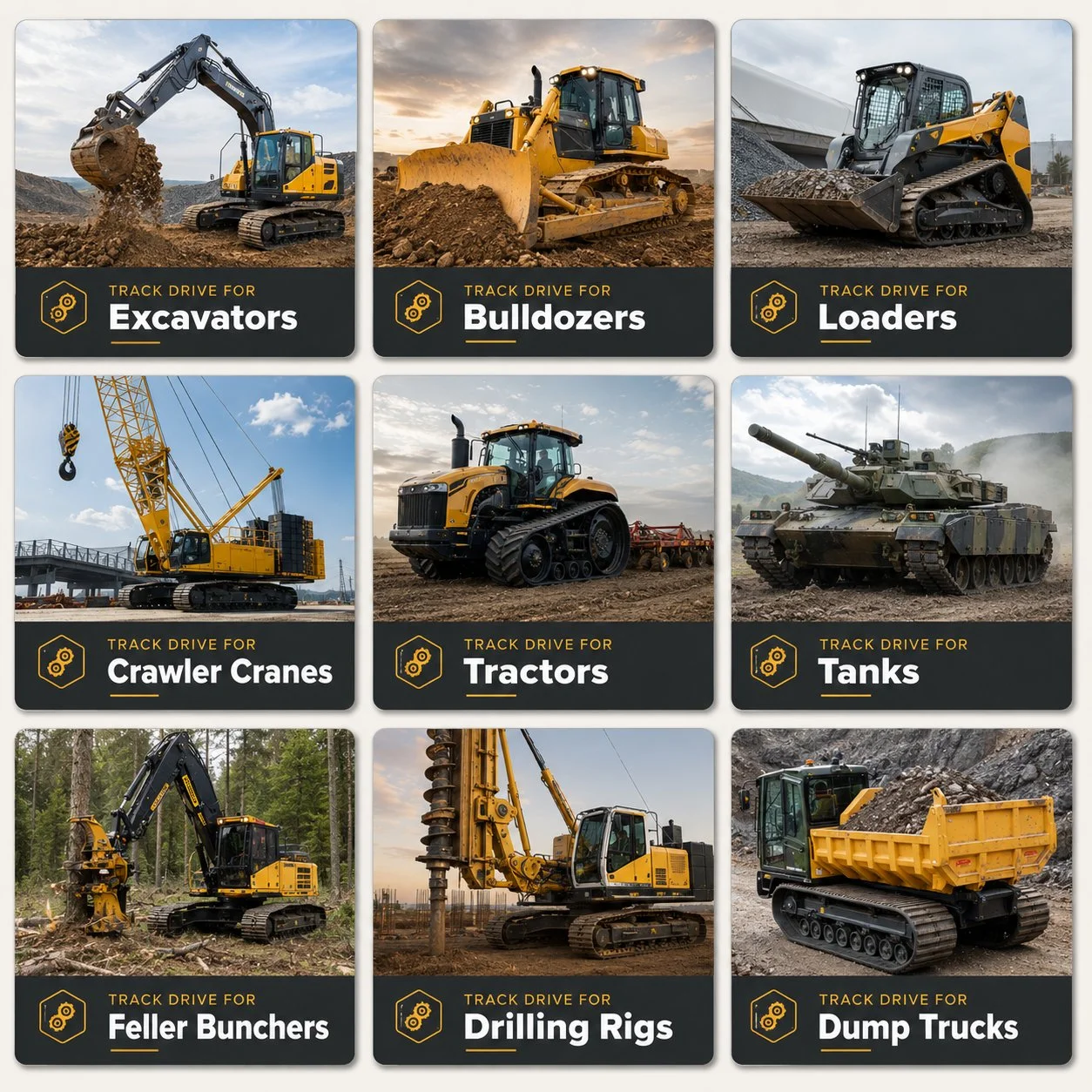
Most CTLs run on rubber tracks with embedded steel cords — not the steel chain-and-shoe tracks used on excavators, bulldozers, and crawler cranes. The rubber track changes the sprocket-to-track engagement mechanics, the tension control, and the vibration profile that the track drive planetary gearbox experiences.
Rubber tracks use internal drive lugs (moulded rubber teeth) that engage with the sprocket teeth. The engagement is softer than the steel-on-steel mesh of chain tracks — producing lower impact noise and vibration. But the rubber drive lugs wear faster than steel shoes, especially on hard surfaces (concrete, asphalt). Worn lugs reduce the effective sprocket engagement depth, increasing the risk of track jump-off during aggressive counter-rotation on hard ground.
Rubber tracks are tensioned by a hydraulic or spring-loaded idler — maintaining a constant pre-load against the sprocket. This pre-load generates a continuous radial force on the sprocket bearings (and therefore on the track drive output bearings) even when the machine is stationary. Steel chain tracks also carry tension, but the compliance of the rubber track allows more dynamic tension variation during direction changes — producing fluctuating radial loads on the track drive output bearing.
CTLs operate in noise-sensitive environments — residential areas, commercial properties, indoor spaces. The rubber track reduces ground-transmitted noise but the track drive planetary gearbox becomes the dominant noise source at operating speed. CTL track drives require tighter gear tooth tolerances and lower backlash than excavator track drives to meet operator comfort and neighbourhood noise expectations. Gear whine at 10 km/h that would be inaudible on an excavator is clearly perceptible in the relatively quiet CTL cabin.
Sizing the CTL Track Drive — Where Steering Torque, Not Driving Torque, Sets the Specification
In an excavator or bulldozer, the track drive is sized for the driving torque — the force needed to move the machine forward against grade and rolling resistance. In a CTL, the critical sizing condition is different: the steering torque during counter-rotation on a high-friction surface exceeds the straight-line driving torque by 1.5 to 2.5 times.
The 14:1 ratio between steering and driving torque is the defining characteristic of CTL track drive sizing. An engineer who sizes the track drive based on the straight-line driving torque (155 Nm in this example) and applies even a generous service factor of 3.0 would specify a 465 Nm unit — which would fail on the first counter-rotation attempt on concrete. The steering torque on high-friction surfaces is the governing load case, and it must be the basis for specification.
Three Failure Modes That Drive CTL Track Drive Replacement Decisions
The single most common CTL track drive failure. At 3,000+ steering events per shift, the planet pin bearings accumulate fatigue cycles 3 times faster than an excavator. The bearing needles develop surface pitting at 2,000 to 4,000 hours — earlier than any other track drive application at the same torque rating. Symptoms: increasing travel noise at low speed, audible clicking during counter-rotation, metallic particles in oil.
As the rubber drive lugs on the track wear down, the engagement depth between the lugs and the sprocket teeth decreases. The remaining contact area carries the full driving and steering force — concentrating the stress on a smaller sprocket tooth surface. Accelerated sprocket wear follows, and the worn sprocket-lug interface allows the track to skip during aggressive counter-rotation. A skipped track on a CTL carrying a loaded bucket is an immediate tip-over risk.
CTL track drives with hydraulic motors typically have a case drain line that returns internal leakage oil to the tank. On CTLs working in dusty, muddy, or freezing conditions, the case drain line can become restricted or blocked. The pressure inside the motor and gearbox housing rises until it exceeds the seal capacity — blowing out the duo-cone seal or the motor shaft seal and dumping hydraulic oil onto the ground. The machine loses travel drive on that side immediately.
Track Drive Planetary Gearbox for Compact Track Loaders — Frequently Asked Questions
Korea Ever-Power CTL track drive planetary gearboxes are fatigue-rated for the ultra-high steering cycle counts that compact track loaders demand. 3,000 to 25,000 Nm, 2-stage and 3-stage, with OEM cross-reference for all major CTL brands. Provide your machine model for a specification recommendation.
편집자: Cxm