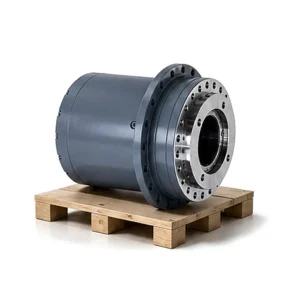
ZL95 Winch Drive Planetary Gearbox
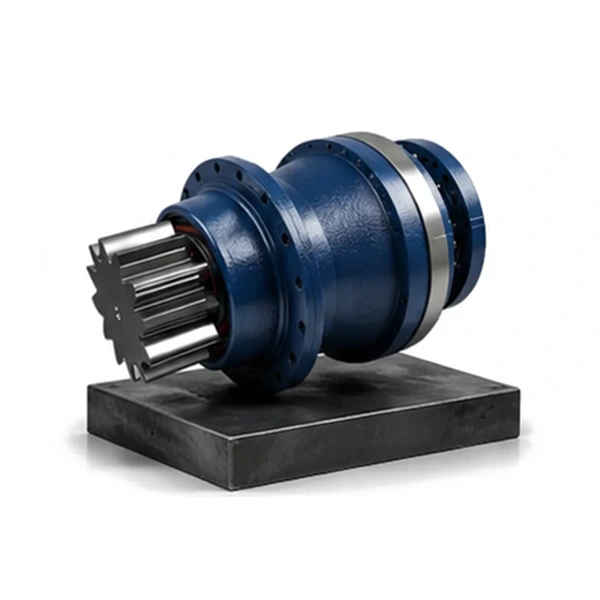
RATIO 4,800 — NEW RECORD
ZL95 — 115,000 Nm
Smaller motors. Higher speeds. Deeper ratios.
The EP-ZL95 is the winch drive planetary gearbox where the ZL series stops competing with the 4xxW hydraulic era and starts defining a capability that the hydraulic catalogue never imagined: 115,000 Nm of continuous torque from a platform that accepts the newest generation of high-speed PM and induction motors — motors that did not exist when the 4xxW series was designed.
Two firsts define the ZL95. The 5,000 rpm input speed means the helical gear teeth and the input bearing arrangement have been validated for tooth peripheral velocities 25% higher than any previous ZL model — enabling smaller, lighter motors that produce the same shaft power at higher speed. And the ratio 4,800 at five stages extends the catalogue ceiling by 37% beyond the ZL85 record — producing drum rotations so slow that the practical positioning limit is no longer the gearbox resolution but the elastic stretch of the wire rope under load.
ZL95 Electric Winch Drive Planetary Gearbox — Technical Parameters
| Continuous torque (N2xh=100,000) | 115,000 Nm |
| Peak torque | 245,000 Nm (2.13x continuous) |
| Gear ratio range | 5.07 to 4,800 (1-5 stages, catalogue record) |
| Maximum input speed | 5,000 rpm (catalogue first) |
| Thermal power (Pt) | 26 - 90 kW (varies by stage count) |
| Gear type | Helical planetary, 3-planet, DIN 5-6 |
| Integrated brake | None (motor brake or external brake) |
| Sealing | Multi-lip FKM, IP67+ |
| Housing | Ductile iron QT600-3 |
| Gear material | 20CrMnTi, HRC 58-62 |
5,000 RPM — Smaller Motors, Higher Speeds, Lower System Weight
Every ZL model from the ZL30 to the ZL85 accepts 4,000 rpm maximum. The ZL95 steps to 5,000 rpm — a 25% increase that changes the motor selection equation for every winch system designer.
Shaft power = torque x speed. At 4,000 rpm, a 600 kW motor produces 1,432 Nm of input torque. At 5,000 rpm, the same 600 kW produces 1,146 Nm — a smaller motor frame achieves the same power because it runs faster. Alternatively, the 5,000 rpm motor produces 25% more power from the same frame: 750 kW instead of 600 kW. For crane OEMs, this means the ZL95 can be paired with the same motor frame as the smaller ZL85 while delivering 31% more continuous torque — or the motor frame can shrink by one IEC size for the same torque output.
A typical IEC 355 frame motor at 4,000 rpm weighs approximately 850 kg and produces 500 kW. The same frame at 5,000 rpm produces 625 kW. If the application needs 500 kW, the motor can drop to an IEC 315 frame at 5,000 rpm — weighing approximately 650 kg. Weight saving: 200 kg. On a crane head where every kilogram affects the boom structural design and the counterweight requirement, this saving translates to structural cost reductions far exceeding the motor price difference.
Modern VFDs (variable-frequency drives) produce better torque control and higher efficiency at higher motor speeds. At 5,000 rpm, the motor operates further from the low-frequency torque derate zone where current-limited drives lose controllability. The ZL95 allows the winch system to be designed with the motor running at 3,000-5,000 rpm for the primary hoisting duty and de-stroking to 500-1,500 rpm for precision positioning — keeping the motor in its efficient operating band throughout. Contact Korea Ever-Power for motor-gearbox pairing recommendations at 5,000 rpm.
Ratio 4,800 — The New Catalogue Maximum and the Diminishing Returns of Ultra-High Ratios
At five-stage ratio 4,800 with a 3,000 rpm motor on a 300 mm PCD drum, the line speed is 0.59 m/min — 9.8 millimetres per second. With the 5,000 rpm motor at maximum speed: 0.98 m/min. These numbers approach the limit where increasing the gear ratio no longer improves practical positioning accuracy.
Where Ratio 4,800 Still Helps
Applications where the motor must maintain efficient mid-speed operation while the drum barely moves: deep borehole logging at 5,000+ metres where the wireline speed must be held constant at 0.5-1.0 m/min for the entire descent. At ratio 4,800, the motor runs at 2,400-4,800 rpm for this line speed — firmly in the efficient torque band. At ratio 2,000, the motor would need to run at 1,000-2,000 rpm — closer to the low-speed derate zone where torque ripple and thermal limits degrade the cable speed consistency.
Where Higher Ratios Stop Helping
At ratio 4,800, the encoder resolution through the gearbox produces cable position increments of 20 microns or less. But the wire rope stretches 0.1-0.5% under load — which at 5,000 metres of deployed cable is 5-25 metres of elastic elongation. The position uncertainty from cable stretch is 100,000 times larger than the encoder resolution. Beyond ratio 4,800, increasing the ratio improves the theoretical gearbox resolution without improving the practical cable position accuracy. The cable, not the gearbox, is the precision bottleneck.
115,000 Nm at 5,000 RPM — The Electric Winch Drive for the Newest Motor Generation

Heavy Electric Cranes With High-Speed Motors (60-100 t)
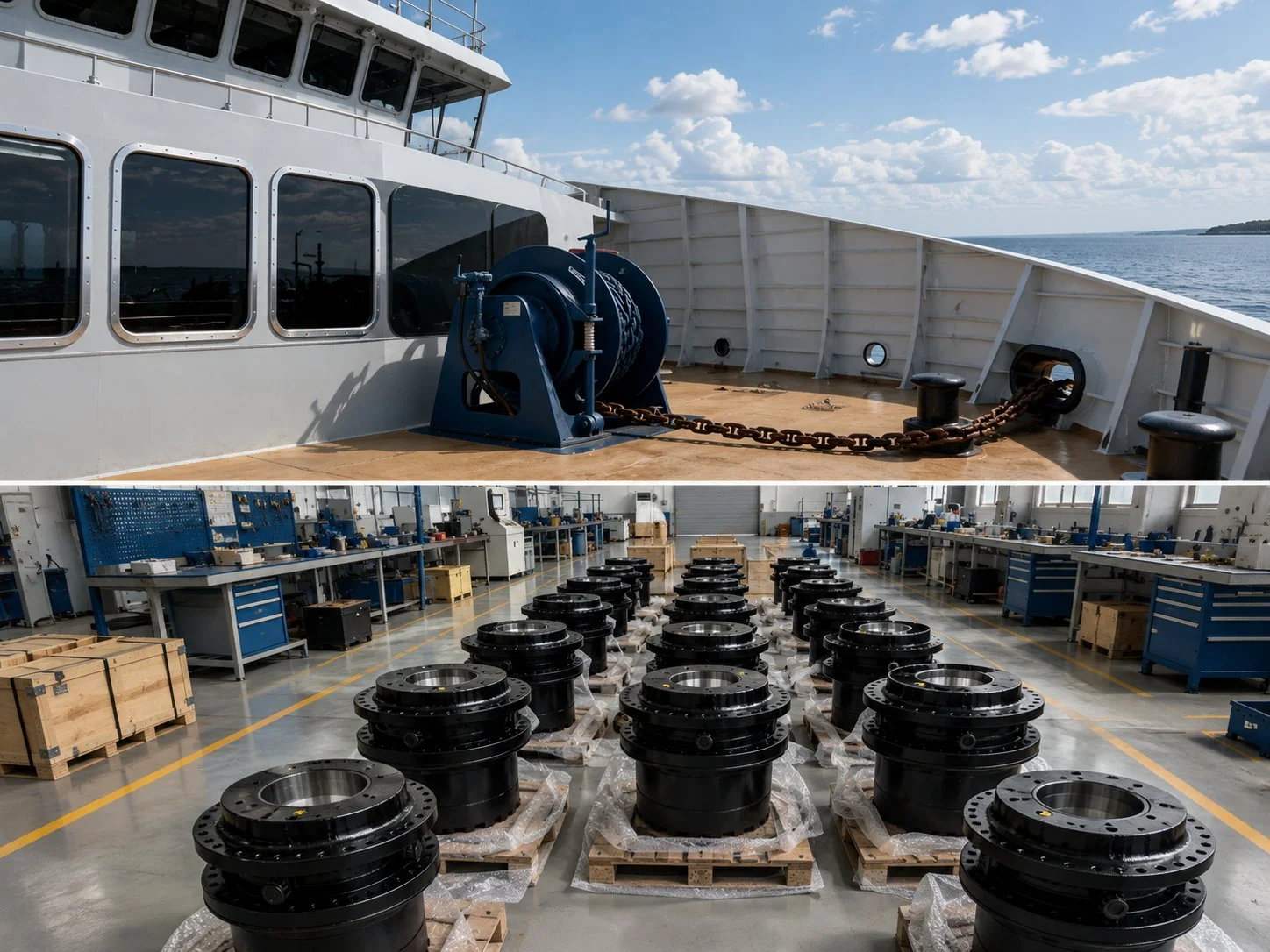
The ZL95 at ratio 80-200, 2-3 stage, paired with 500-900 kW high-speed PMSM motors at 5,000 rpm serves the 60-100 tonne electric crane class with motors one IEC frame smaller than the equivalent 4,000 rpm configuration. For offshore construction vessel cranes where the crane head weight directly affects the vessel stability, the motor downsizing translates to a lighter crane that can lift heavier cargo. The slewing drive En wheel drive complete the all-electric crane system.
Electric Mining Main Production Hoists
Main production winders at mines with shaft depths of 400-800 metres where the sustained drum torque stays within the ZL95 115,000 Nm continuous limit. The 5,000 rpm input allows a compact high-speed AC motor (500-800 kW, IEC 315-355 frame) to replace the larger, heavier motor frame that 4,000 rpm demanded — reducing the headframe winder house footprint and the structural load on the headframe. Regen recovery during skip descent returns 20-35% of the hoist energy to the mine grid.
Deep Borehole and Wireline Winches
Wireline logging winches for oil and gas well logging, geothermal exploration, and deep scientific drilling at depths of 3,000-8,000 metres. The ZL95 at ratio 2,000-4,800 (4-5 stage) maintains constant wireline speed (0.5-2 m/min) through the entire well depth with the motor running at efficient mid-speed (2,500-5,000 rpm). The 115,000 Nm continuous handles the combined tool string and cable weight at the deepest logging points. The DIN 5-6 gear accuracy ensures the depth encoder signal remains reliable through the full borehole depth.
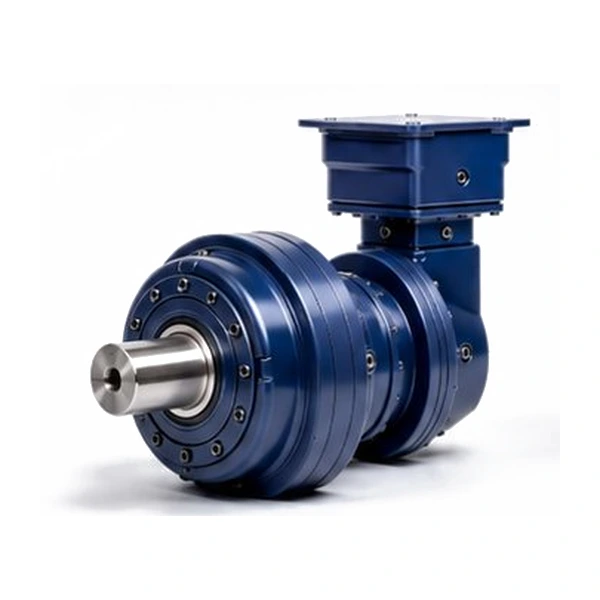
The ZL Electric Winch Drive Family

Electric Winch Drive Planetary Gearbox — ZL95 High-Speed FAQ
Field Reports
80 t all-electric offshore crane, ZL95 at ratio 100, 2-stage, 750 kW PMSM at 4,800 rpm. The high-speed motor is an IEC 315 frame — one size smaller than the IEC 355 we would have needed at 3,600 rpm. Weight saving: 220 kg at the crane head. The naval architect used this saving to extend the boom by 1.5 metres, increasing the crane working radius by 8% without adding counterweight. The ZL95 245,000 Nm peak handled the classification society proof-load test (100 t at 1.25x) without any overcurrent trip. After 6 months of vessel operation, the VFD data log shows the motor has never exceeded 4,600 rpm during normal crane duty — the 5,000 rpm headroom is available but not routinely needed.
Wireline logging winch for a 6,500-metre geothermal exploration well. ZL95 at ratio 3,500, 5-stage, 40 kW servo motor at 5,000 rpm. The winch maintains 1.0 m/min wireline speed through the entire well depth — the motor runs at 3,500-4,200 rpm in its efficient band while the drum barely turns. Depth accuracy verified by magnetic mark counting on the wireline: within 0.3% of the total depth at 6,500 m (approximately 19.5 metres cumulative error). The previous winch system (hydraulic, lower ratio) required the motor to crawl at 200 rpm to achieve the same wireline speed — causing torque ripple that produced 2-3% depth error at the same well depth. The ZL95 high ratio eliminated the motor-speed-related depth error entirely.
Main production winder at a 580-metre copper-gold mine, ZL95 at ratio 350, 4-stage, 600 kW AC motor at 4,500 rpm. The 5,000 rpm capability allowed us to specify an IEC 315 frame motor (720 kg) instead of the IEC 355 (950 kg) we had budgeted. The 230 kg saving simplified the headframe crane installation and reduced the winder bed foundation load. Regen recovery: 26% of the hoist energy, measured at 22 kWh per cycle for a 15-tonne skip from 580 m. The 4-star reflects a VFD compatibility note: our existing VFD switching frequency was set for 4,000 rpm maximum. Running the motor at 4,500 rpm required a firmware update and a higher switching frequency that slightly increased the VFD audible noise at the control cabinet — resolved by adding a line reactor, but it would have been caught earlier if the ZL95 data sheet had included a VFD minimum switching frequency recommendation for operation above 4,000 rpm.
Aanvullende informatie
| Editor | Cxm |
|---|
Gerelateerde producten
-
ZR55 Winch Drive Planetary Gearbox — Right-Angle
-
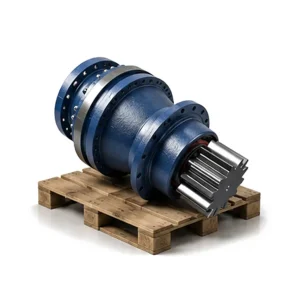
ZL75 Winch Drive Planetary Gearbox
-
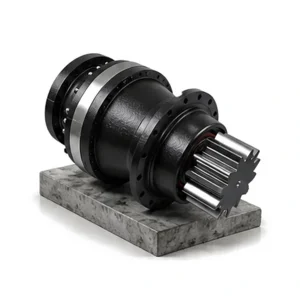
ZL55 Winch Drive Planetary Gearbox — 1-5 Stage
-
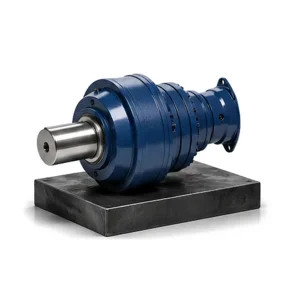
ZL45 Winch Drive Planetary Gearbox — 1-4 Stage
-

416W3 Lieraandrijving Planetaire tandwielkast Reductor
-
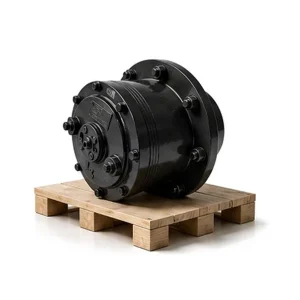
406AW Winch Drive Planetary Gearbox Reducer
-
402W2 Winch Drive Planetary Gearbox Reducer
-

401W1 Winch Drive Planetary Gearbox Reducer — Single-Stage