The Sloshing-Load Problem — Liquid Concrete as a Dynamic CG Hazard
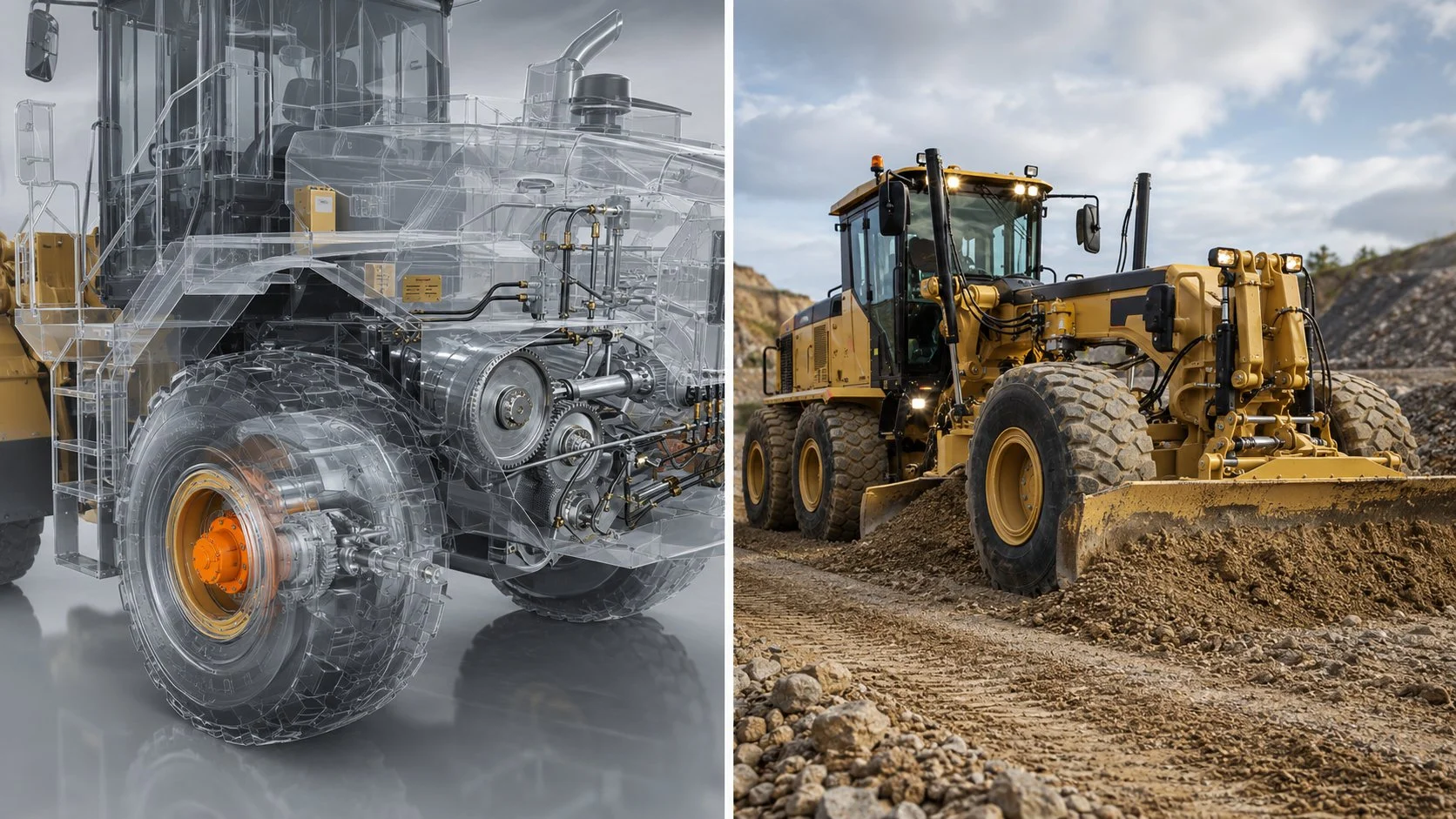
A concrete mixer truck carries its load as a liquid — 8 to 10 cubic metres of wet concrete with a density of 2,300 to 2,400 kg/m3 and a total load mass of 18 to 24 tonnes. Unlike solid cargo that stays fixed relative to the chassis, liquid concrete sloshes in response to every acceleration, deceleration, turn, and slope change. The sloshing shifts the load CG by 200 to 500 mm laterally during a turn and 100 to 300 mm longitudinally during braking — directly affecting the vehicle stability and the planetaire versnellingsbak met wielaandrijving loading.
The rotating drum partially mitigates the sloshing — the internal spiral fins that mix the concrete also resist the free-surface movement. But the drum rotation speed (12 to 18 rpm during transit) provides only moderate damping — and a sudden braking event at highway speed can produce a sloshing amplitude that exceeds the drum damping capacity. The resulting forward CG shift increases the front-axle loading by 10 to 20% and decreases the rear-axle loading by 15 to 25% — changing the braking balance between axles and potentially causing the rear wheels to lock (on a non-ABS system) or the front brakes to overheat (on an ABS system that biases the braking to the more heavily loaded front axle).
The wheel drive must accommodate these dynamic load transfers without producing torque disturbances that amplify the sloshing. A torque spike from the wheel drive during a turn on a sloped jobsite access road can excite the concrete sloshing — and the resonant sloshing frequency of the drum (typically 0.3 to 0.8 Hz depending on the drum diameter and fill level) can coincide with the natural frequency of the vehicle suspension — producing a coupled oscillation that amplifies the lateral CG shift by 50 to 100% beyond the initial sloshing amplitude. This coupled mode is the primary mechanism for concrete mixer truck rollovers on construction-site access roads.
The fill level affects the sloshing severity. A full drum (95 to 100%) has minimal free surface and minimal sloshing. An empty drum has no liquid to slosh. The worst case is a half-full drum (40 to 60% fill) — where the free surface area is maximised and the sloshing amplitude can reach 400 to 600 mm of lateral CG shift during an emergency manoeuvre. Return trips (after partial discharge at the first pour) with a half-full drum are therefore the highest-risk driving condition for concrete mixer trucks — and the wheel drive speed and smoothness requirements are most critical during these return transits.
The delivery time constraint adds urgency to every driving decision. Ready-mixed concrete must be discharged within 60 to 90 minutes of batching — beyond this time, the cement hydration progresses to the point where the concrete begins to stiffen in the drum, reducing its workability and potentially rendering it unusable. A concrete mixer truck that is delayed by a wheel drive problem — a traction failure on a jobsite ramp, a brake-system fault that requires a slow descent, or a speed limitation from a detected sloshing instability — may not reach the pour point within the time window. The wasted load (8 to 10 m3 at USD 120 to 200 per m3) costs USD 960 to 2,000 per event — plus the delay cost to the construction project and the returned-concrete disposal cost. Wheel drive reliability on concrete mixer trucks has a direct, per-load financial consequence that compounds across 5 to 10 loads per day.
The drum rotation itself loads the wheel drive indirectly. The rotating drum generates a gyroscopic moment that resists changes in the vehicle heading — meaning the truck requires slightly more steering effort during turns than a static-load truck of the same weight. At the 12 to 18 rpm mixing speed, the gyroscopic effect is moderate; at the 4 to 6 rpm agitating speed used during transit, it is minimal. But during discharge (when the drum reverses to push the concrete toward the chute), the gyroscopic direction reverses — and the operator may notice a momentary change in steering feel that can be misinterpreted as a steering problem. The wheel drive must provide consistent traction and braking response regardless of the drum rotation direction and speed.

Jobsite Access — Climbing Unpaved Slopes with 32 Tonnes and a Sloshing Load
Construction-site access roads are temporary, unpaved, steep, and often muddy. The concrete mixer truck must climb grades of 10 to 20% (occasionally 25% on poorly designed site access) on surfaces with traction coefficients of 0.3 to 0.5. At 32 tonnes on a 15% grade, the gravitational traction demand is approximately 47 kN — and the rolling resistance on an unpaved road adds 16 to 32 kN — for a total drive force requirement of 63 to 79 kN. This force must be sustained while the concrete continues to slosh in the drum and the CG shifts continuously with every surface irregularity.
Many concrete mixer trucks are rear-wheel-drive only (6×4 or 8×4 configuration with non-driven front axle). On a 15% unpaved slope with the rear axle carrying 60 to 65% of the vehicle weight (19 to 21 tonnes), the maximum rear-axle traction at 0.4 coefficient is approximately 77 to 82 kN — barely above the 63 to 79 kN demand. This leaves a traction margin of 3 to 19 kN — which can be consumed entirely by a wet patch, a muddy section, or a sloshing-induced weight transfer that shifts 2 to 3 tonnes from the drive axle to the front axle.
All-wheel-drive concrete mixer trucks (6×6 or 8×8) add driven front axles that increase the total available traction by 35 to 50% — providing the margin needed for reliable access on the worst construction-site roads. Each driven axle requires its own planetaire versnellingsbak met wielaandrijving — typically 2 to 4 units per vehicle depending on the axle configuration. The gearboxes must produce identical output speed across all driven axles to prevent inter-axle driveline wind-up that wastes power and accelerates tyre and drivetrain wear.
The reversing manoeuvre at the pour point is often the most demanding traction event. The truck must reverse into the pour position — frequently uphill, on soft ground, with the fully loaded drum. Reversing uphill at 32 tonnes requires the same traction force as climbing forward — but the driver has less visibility, less control authority, and the sloshing load shifts rearward (loading the drive axles more heavily, which actually helps traction but increases the risk of front-wheel lift on steep grades). The wheel drive must deliver full torque in reverse gear without hesitation or delay — because a stalled reverse attempt on a slope with concrete setting in the drum is a double emergency: the truck is stuck AND the concrete is approaching its workability limit.
Concrete Chemical Exposure — pH 12 to 13 Alkaline Attack on Seals and Housing
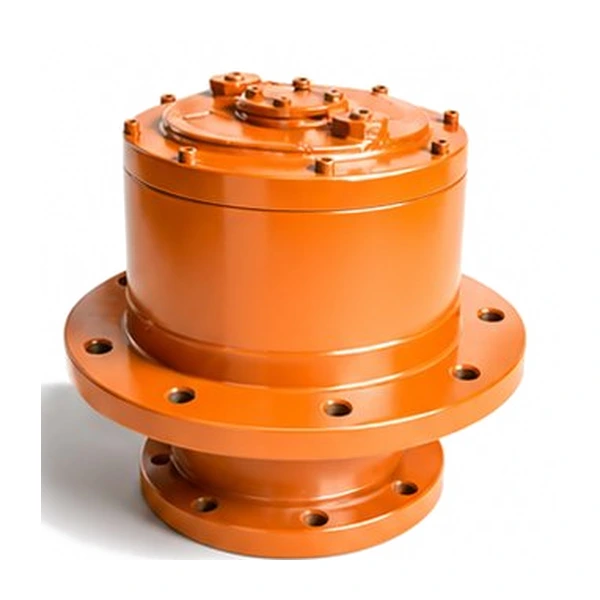
Wet concrete is highly alkaline — pH 12 to 13 from the calcium hydroxide (lime) produced during cement hydration. During loading, transit, and discharge, concrete splashes onto the chassis, axles, and wheel drive housings. The alkaline concrete attacks standard NBR seals (causing swelling and softening), corrodes aluminium fittings, and etches exposed steel surfaces. Dried concrete forms a hard, calcium-carbonate crust that is difficult to remove and traps moisture against the metal surface — maintaining a continuously wet, alkaline micro-environment that accelerates corrosion.
The wheel drive housing is particularly vulnerable because it is positioned at wheel level — directly in the splash zone during discharge and during driving through concrete spillage on the jobsite. A single day of concrete splashing without cleaning deposits a 1 to 3 mm layer of concrete on the housing surface. After 5 to 10 days without cleaning, the concrete crust reaches 5 to 15 mm thickness — enveloping the seal retainer, breather, and drain plug in a hard shell that is difficult to penetrate for routine maintenance. An operator who cannot access the drain plug skips the oil change — and the gearbox oil degrades undetected behind the concrete crust.
The concrete contamination is most severe at the chute-discharge end of the truck — where the wet concrete flows from the drum through the chute to the pour point. The rear-axle wheel drives are directly below the chute and receive the heaviest concrete splashing. The front-axle wheel drives (if driven) receive less direct splashing but are exposed to the concrete that falls from the drum exterior during transit. Daily power-washing of all wheel drive surfaces is the only reliable defence — and the wash water must be collected (not discharged to the ground) because concrete wash water is itself a regulated pollutant in most jurisdictions.
Three Failure Modes Specific to Concrete Mixer Truck Wheel Drives
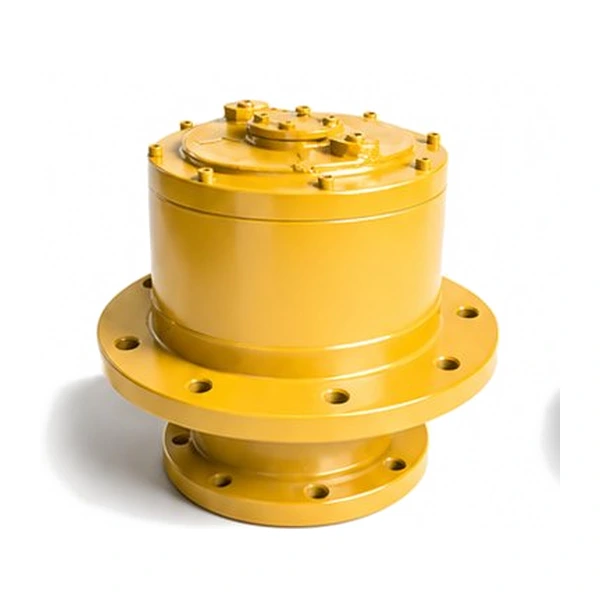
A half-loaded mixer truck (40 to 60% drum fill) turning on a 10% cross-slope experiences coupled vehicle-suspension and concrete-sloshing oscillations that can amplify the lateral CG shift by 50 to 100% beyond the static sloshing amplitude. At a critical combination of turn radius, speed, slope, and fill level, the combined CG shift exceeds the rollover threshold — and the truck tips onto its side. Concrete mixer truck rollovers on construction-site access roads cause 15 to 30 fatalities per year in the US alone — making this failure mode a leading cause of construction-vehicle fatalities.
Concrete splashing that is not washed off daily dries into a hard calcium-carbonate crust (pH 12 to 13) that envelops the seal retainer, breather vent, and housing surfaces. The alkaline crust attacks the seal material from the outside while trapping moisture that accelerates housing corrosion underneath. The breather vent becomes blocked by dried concrete — converting the sealed gearbox into a pressure vessel that cycles internal pressure with temperature changes. The pressure cycling forces oil past the seals (causing leaks) and draws atmospheric moisture into the gearbox when the oil cools (causing emulsification). Within 500 to 1,000 hours of uncleaned concrete exposure, the combined seal degradation, breather blockage, and oil contamination can reduce the gearbox to a non-functional condition.
A loaded concrete mixer at 32 tonnes descending a 5 km, 6% grade at 60 km/h must dissipate approximately 94 MJ of braking energy. If the engine retarder is insufficient, the wheel drive service brakes absorb the excess energy — and can reach fade temperatures within 2 to 3 km. The concrete load makes this more dangerous than other heavy vehicles of the same weight: the sloshing load shifts forward during braking (increasing the front-axle load and the front brake duty), and the high CG of the loaded drum increases the forward pitch under braking (further loading the front). The front-axle wheel drive brakes must therefore be rated for a disproportionate share of the total braking energy — typically 60 to 70% of the total versus the 50 to 55% that the static weight distribution would suggest.
Veelgestelde vragen
Korea Ever-Power provides concrete mixer truck wheel drives from 5,000 to 40,000 Nm with sloshing-load stability, concrete-chemical seal protection, and highway-grade braking.
Redacteur: Cxm