Two Technologies That Are Not Interchangeable — Even When They Look Similar
Walk through any Korean industrial facility and you will find both planetary gearboxes and worm gear reducers performing superficially similar jobs — reducing motor speed to move a load. A catalogue comparison reinforces this impression: both come in similar torque ratings, both mount the same way, both cost comparable amounts per unit. The similarity ends there.
The two technologies are built on fundamentally different gear mechanics. A планетарный редуктор uses rolling contact between sun gears, planet gears, and a ring gear — distributing load across multiple simultaneous contact points and achieving inherently high efficiency. A червячный редуктор drives a worm wheel through a sliding-contact screw interface — the sliding friction that enables self-locking also generates heat that must go somewhere, and that heat comes directly out of efficiency.
For machines that run continuously — three-shift Korean factories, 24-hour packaging lines, year-round solar trackers — the efficiency gap between these mechanisms accumulates into a measurable energy and motor-sizing cost that a naive catalogue comparison never reveals. This guide quantifies that gap and provides the engineering framework for choosing correctly the first time.
“Worm reducers are for heavy loads, planetary for precision.” In reality, planetary gearboxes handle heavier torques than most worm reducers in the same frame size, deliver higher efficiency under continuous load, and are available in precision grades the worm geometry cannot match. The worm reducer’s genuine advantage is specific and non-negotiable: self-locking — and that advantage only matters in a minority of industrial applications.
(single-stage)
(varies with ratio)
backlash (arcmin)
backlash (arcmin)
How Each Mechanism Works — and Why the Difference Matters
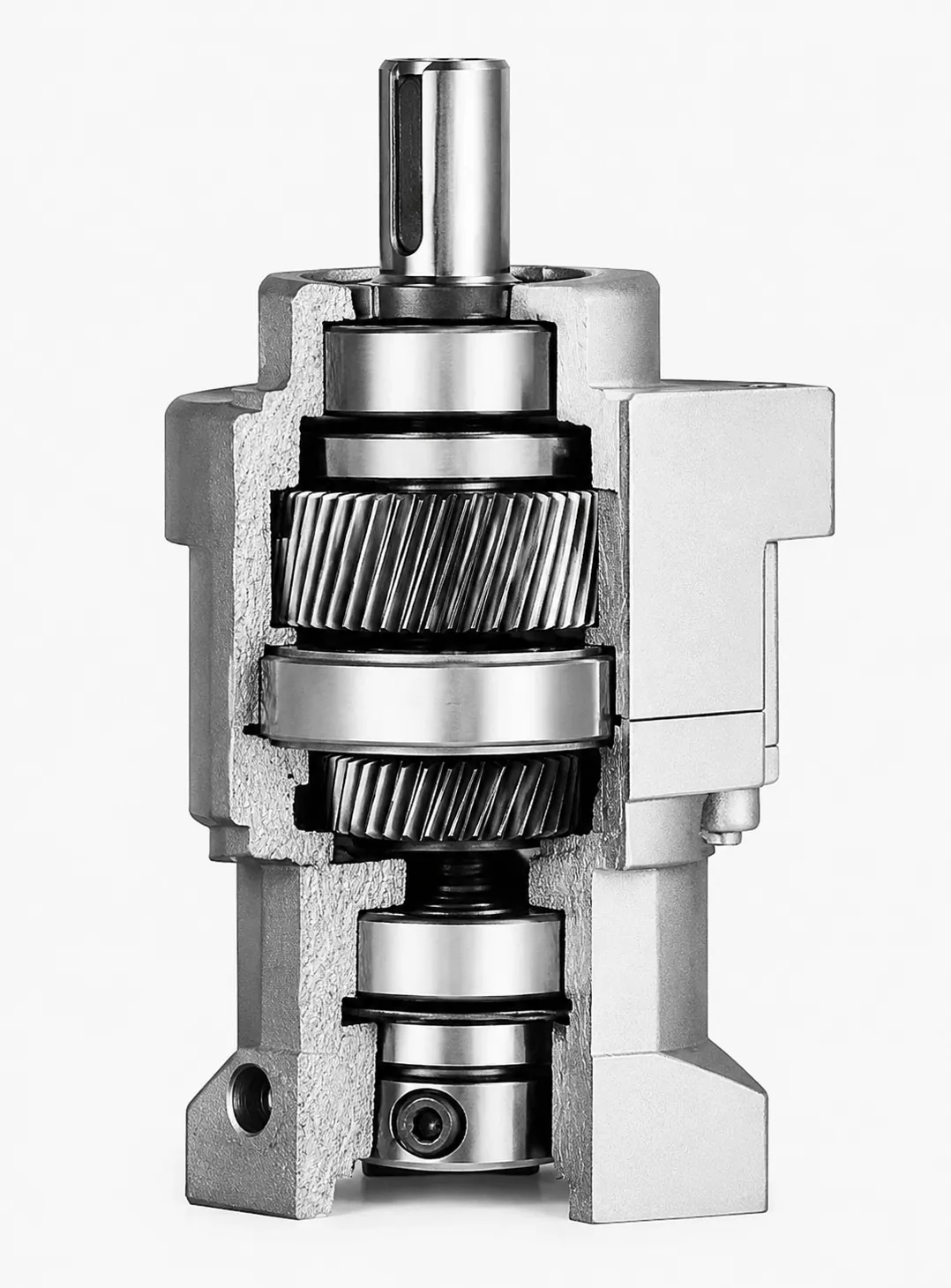
Planetary Gearbox — Rolling Contact
↓
[SUN GEAR] ←── rotates at motor speed
↙ ↓ ↘
[P1] [P2] [P3] ← 3 planet gears
↘ ↓ ↙ share load equally
[RING GEAR] (fixed to housing)
↓
[Planet Carrier] → Output shaftContact type: ROLLING (gear mesh)
Load paths: 3 simultaneous (P1+P2+P3)
Friction coeff: ~0.002 (rolling)
Worm Gear Reducer — Sliding Contact
(helical screw)
│
sliding contact
at lead angle θ
↓
[WORM WHEEL]
│
[Output shaft]
90° to inputContact type: SLIDING (screw-on-wheel)
Load path: single helical contact band
Friction coeff: 0.05–0.12 (sliding)
Mechanism Properties Side-by-Side
| Свойство | Планетарный | Worm |
|---|---|---|
| Contact type | Rolling mesh | Sliding screw |
| Single-stage efficiency | ≥97% | 40–85% |
| Направление вывода | Inline or 90° | Fixed 90° |
| Self-locking | No (back-drivable) | Yes (high ratio) |
| Обратная реакция | ≤1–5 arcmin (graded) | 15–30 угловых минут |
| Temperature rise | Low (little heat) | High (friction heat) |
| Multi-stage ratio | Up to 10,000:1 | Single stage only |
| Min operating temp | −10 °C (std planetary) | Depends on oil |
| Noise (at load) | Умеренный | Lower (smooth slide) |
| Unit cost (equiv. torque) | Higher | Ниже |
The Efficiency Gap in Euros and Won — Why Running Cost Dwarfs Unit Price
The unit price of a worm reducer is typically lower than a comparable planetary gearbox. Engineers who stop the analysis there make a decision that costs their facility more money over every year of operation. The efficiency gap generates an ongoing energy bill that quickly erases the upfront saving — particularly in Korean manufacturing environments where machines run two or three shifts per day, and energy costs are a visible line item in facility management.
The calculation basis is straightforward. A motor delivering 1 kW of mechanical output through a 97%-efficient planetary gearbox draws 1.031 kW from the supply. The same 1 kW output through a 60%-efficient worm reducer draws 1.667 kW. The difference — 636 W per unit — runs continuously as long as the machine operates.
ENERGY LOSS CALCULATION — 1 kW OUTPUT, 3-SHIFT OPERATION
Worm (η=60%): Input = 1.667 kW
Difference: 0.636 kW wasted as heatAnnual (3-shift, 6,000 h/yr):
0.636 kW × 6,000 h = 3,816 kWh/yr per unitKorean industrial rate (₩120/kWh):
3,816 × ₩120 = ₩457,920/yr per unit10 units × 3 years = ₩13,737,600 wasted
Beyond direct energy cost, the worm reducer’s thermal output forces the machine designer to specify a larger motor (to compensate for efficiency losses), larger motor drives, larger cable trays, and potentially active cooling of the gearbox housing — all of which add to the installed cost in ways that never appear in a gearbox unit price comparison.
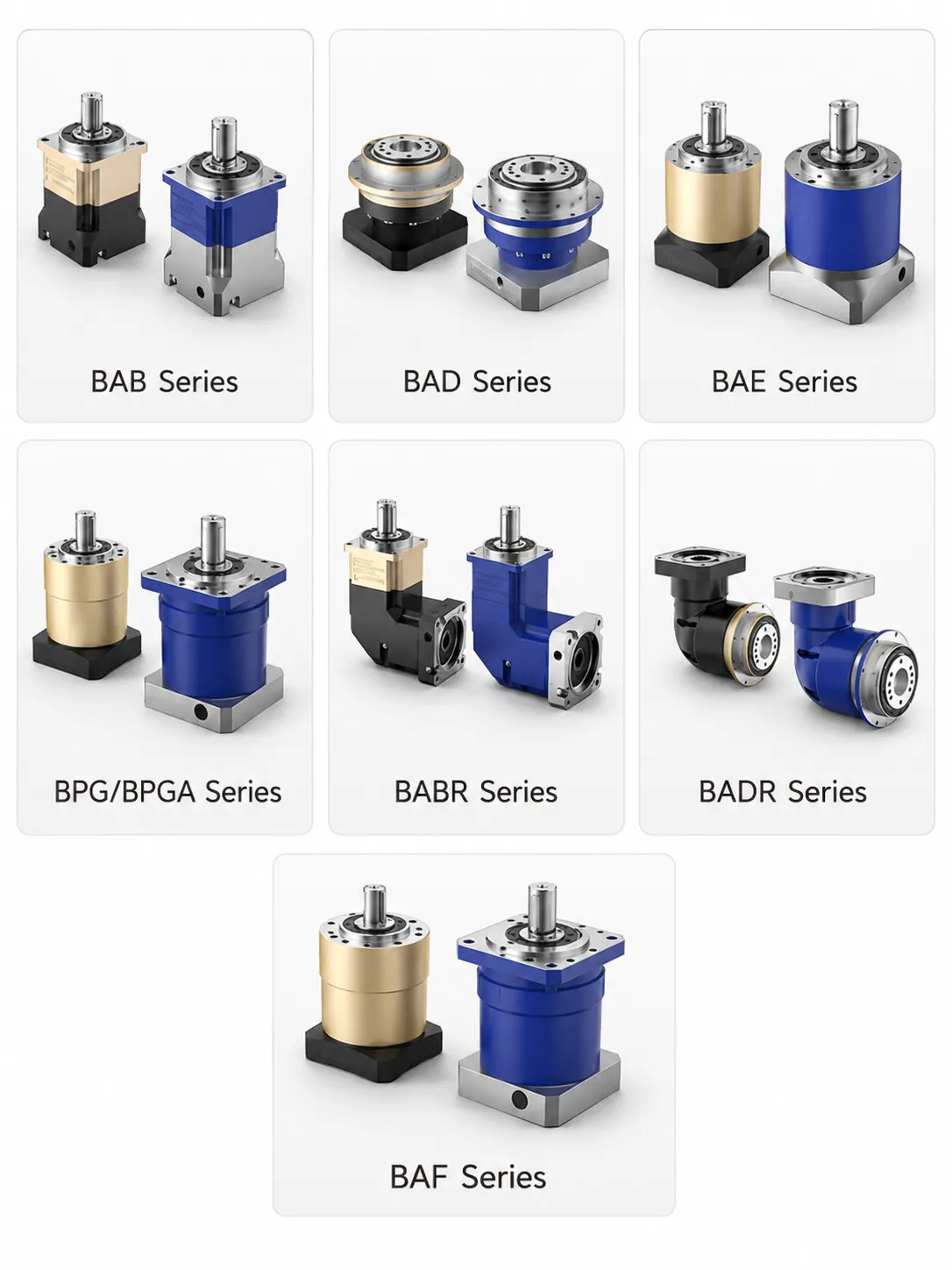
Он EP-BPG energy-saving planetary gearbox series from Korea Ever-Power was specifically developed for Korean conveyor and agitator replacement applications where worm reducers are currently installed. The EP-BPG delivers ≥97% single-stage efficiency in the same physical footprint as many worm reducer installations, eliminating the motor upsizing penalty while improving positioning capability.
3-Year Energy Cost Premium vs ≥97% Planetary (per 10 units, 6,000 hrs/yr, ₩120/kWh)
| Worm Efficiency | Annual Extra kWh (per unit) |
Annual Cost Premium |
3-Year Total (10 units) |
|---|---|---|---|
| ≥97% (planetary) | — (baseline) | — | ₩0 |
| 85% (low ratio) | 792 | ₩95,040 | ₩2,851,200 |
| 70% (medium ratio) | 2,343 | ₩281,160 | ₩8,434,800 |
| 55% (high ratio) | 4,557 | ₩546,840 | ₩16,405,200 |
Basis: 1 kW rated output per unit, 6,000 operating hours/year (3-shift), ₩120/kWh Korean industrial rate
The EP-BPGA A-flange variant allows direct drop-in replacement of IEC-flange worm reducers with a ≥97%-efficient planetary unit — same bolt pattern, same output shaft dimensions, no machine redesign required.
EP-BPG Series
Reduction Ratio Range — Who Wins at Which Ratio
Worm reducers are often specified because they achieve high single-stage reduction ratios — 40:1, 60:1, even 100:1 — in a very compact envelope. At these ratios, a single worm stage is structurally simpler than a two-stage planetary unit. This is a legitimate advantage for specific applications, but it is narrower than commonly assumed.
Standard single-stage planetary gearboxes cover ratios from 3:1 to 10:1. Two-stage planetary units reach 12:1 to 100:1 — matching the worm’s full ratio range while delivering dramatically higher efficiency. For ratios above 100:1, multi-stage planetary configurations extend to 10,000:1 in a single sealed unit, a range no worm reducer catalogue covers in a compact standard product.
At 40:1 to 80:1 in a very compact single-stage unit, the worm reducer is genuinely competitive on size and simplicity. Outside this window — for ratios below 40:1 or above 100:1 — the planetary gearbox is the more capable product in every dimension except upfront unit cost.

Он EP-AH/AHK New Line four-stage series covers ratios up to 10,000:1 in a single sealed unit at up to 9,585 N·m — a combination no worm reducer product addresses. For solar tracker azimuth drives, wind turbine yaw, and heavy industrial slewing drives requiring both extreme ratio and high torque, multi-stage planetary is the only practical specification.
Ratio Range Coverage by Technology
Self-Locking — The One Advantage the Worm Gear Has That Planetary Cannot Match
Self-locking is the property of a worm gear at sufficient lead angle: when motor torque is removed, the output shaft cannot drive the input shaft backwards. The worm and wheel are geometrically locked. A planetary gearbox is fully back-drivable — remove motor torque and a loaded output shaft will rotate the input. This is not a deficiency of the planetary design; it is a fundamental consequence of its rolling-contact, reversible gear geometry.
Self-locking matters in a specific and important set of applications: any vertical axis that must hold its position when the motor is de-energised. Hoists, elevator drives, vertical press table feeds, counterweightless theatre rigging, and vertical food mixer shafts all share this requirement. For these applications, the worm reducer provides a passive safety feature that no electromagnetic brake, software limit, or mechanical lock can fully replicate in terms of fail-safe simplicity.
Korean engineers who need both the efficiency and precision of a planetary gearbox и the position-holding of self-locking have two standard engineering solutions. The first is a planetary primary stage with a downstream worm stage — the planetary provides the efficiency and precision for the driven motion, and the worm stage contributes its self-locking for gravity load holding at any position. The second is a planetary gearbox with an integrated electromagnetic brake — more compact but requiring electrical power to hold (fail-open rather than fail-locked).
For vertical axis applications requiring gravity load holding without an electromagnetic brake, a worm gear reducer downstream of an EP planetary gearbox combines the planetary’s efficiency and backlash precision for motion with the worm stage’s passive position holding when power is removed — the practical hybrid solution for Korean press brake back gauges, vertical conveyor drives, and elevated platform actuators.
Self-Locking Need by Application — Decision Framework
| Приложение | Self-Lock Required? |
Recommended Approach |
|---|---|---|
| Horizontal conveyor | Нет | Planetary (efficiency first) |
| Vertical hoist (no counterweight) | Yes | Worm, or planetary + EM brake |
| Press brake back gauge | Yes | Planetary + EM brake (precision needed) |
| Solar tracker azimuth | No (motor locks) | Planetary multi-stage (high ratio) |
| Vertical food agitator shaft | Yes | Worm, or planetary + worm stage |
| CNC rotary table | No (servo holds) | Planetary (precision required) |
| Wind turbine yaw drive | No (motor brake) | Planetary multi-stage |
| Theatre rigging / stage lift | Yes (safety critical) | Worm (passive fail-safe) |
Self-locking in a worm gear occurs when the lead angle θ satisfies: tan(θ) < μ (friction coefficient). At μ=0.07 (lubricated bronze/steel), this requires θ < 4°, corresponding to ratios above approximately 15:1 for standard worm pitches. At lower ratios (5:1–12:1), worm reducers may NOT self-lock — always verify with the manufacturer’s self-locking specification before relying on it for safety-critical holding.
Backlash and Closed-Loop Positioning — Why Worm Reducers Are Excluded from Precision Servo Axes
A worm reducer’s backlash typically ranges from 15 to 30 arcminutes — an inherent consequence of the sliding-contact geometry that requires clearance between the worm thread and worm wheel tooth profile for lubrication and thermal expansion. This is not a quality deficiency; it is a fundamental property of the worm gear mechanism. Well-made, correctly preloaded worm reducers achieve backlash as low as 10 arcminutes. That is still 10× the P0 ≤1 arcmin specification of a precision planetary gearbox.
For a closed-loop servo axis with a motor encoder, 15 arcminutes of backlash at the output shaft means that when the servo reverses direction, the motor must rotate through 15 arcminutes of angular play before the load begins to move. During this lost motion, the encoder reports position change but the load does not move. The servo control loop interprets the following error and commands additional current — often overshooting — producing the position hunting that characterises servo axes with excessive backlash in the drive train.
At a 100 mm radius workpiece, 15 arcminutes of backlash translates to 0.44 mm of lost motion at the workpiece surface. No closed-loop servo system can compensate for this without a second encoder on the output side of the gearbox — adding cost and complexity that eliminates the worm reducer’s original price advantage.
Any closed-loop servo axis where the machine’s function depends on positioning accuracy in both directions of motion must use a planetary gearbox. Worm reducers are appropriate for unidirectional drives, speed reduction without precision, and open-loop applications where backlash is not a functional specification.
Backlash → Linear Positioning Error at Output
| Gearbox Type | Обратная реакция | Error at 50mm | Error at 100mm |
|---|---|---|---|
| Planetary P0 | ≤1 угловая минута | ≤0.015 mm | ≤0.029 mm |
| Planetary P1 | ≤3 угловых минут | ≤0.044 mm | ≤0.087 mm |
| Planetary P2 | ≤5 угловых минут | ≤0.073 mm | ≤0.145 mm |
| Worm (good quality) | ≥10 arcmin | ≥0.145 mm | ≥0.291 mm |
| Worm (standard) | 15–30 угловых минут | 0.218–0.436 mm | 0.436–0.873 mm |
Linear error = r × (backlash in radians). Values are reversal error — the lost motion when direction is changed.
Noise, Temperature, and the Hypoid Middle Ground
Three-Way Comparison Including Hypoid
| Критерий | Планетарный | Hypoid (KF/KH) |
Worm |
|---|---|---|---|
| Эффективность | ≥97% | ≥96% | 40–85% |
| Operating noise | Умеренный | Low ★ | Низкий |
| Min temperature | −10 °C | 0 °C ⚠ | Oil-dependent |
| Hollow shaft option | Limited | Yes (S3/S4/KH) | Common |
| Точность люфта | P0 ≤1 arcmin | ≤3 угловых минут | 15–30 угловых минут |
| Self-locking | Нет | Нет | Yes |
KF/KH: Korea Ever-Power hypoid series. Low-noise option for food/pharma above 0 °C. Not suitable for outdoor Korean winter or cold-room applications.
One genuine attribute of the worm reducer that does not appear in an efficiency table is its acoustic behaviour. The gradual sliding contact between worm thread and worm wheel produces a smoother, quieter mesh than the discrete rolling contact of spur or helical planetary gears. In enclosed food processing facilities, pharmaceutical production rooms, and Korean electronics assembly buildings where operators work adjacent to running equipment throughout multi-hour shifts, the lower noise of a worm drive can be a meaningful factor — enough to override the efficiency argument for low-duty-cycle applications where the energy cost is small.
For Korean applications that simultaneously require low noise and reasonable efficiency — food processing conveyors, pharmaceutical mixing drives, precision instrument drives — there is a third option that sits between standard planetary and worm gear in both noise and efficiency: the hypoid gear mechanism. The Korea Ever-Power EP-KF/KH hypoid gear series planetary gearbox uses a curved spiral-bevel gear pair whose face-contact geometry produces lower noise than standard planetary at equivalent torque, while achieving ≥96% single-stage efficiency — significantly better than a worm reducer at the same reduction ratio.

В гипоидных редукторах серии EP-KF/KH используется трансмиссионное масло с минимальная рабочая температура 0 °C — not the −10 °C of standard planetary series. Do not specify KF/KH for outdoor Korean winter installations, cold-room food storage drives, or any environment where temperature may drop below 0 °C. For those applications, a standard planetary series rated to −10 °C is required.
Total Cost of Ownership — The Complete Decision Matrix
Comparing these two technologies requires evaluating every dimension of total cost and functional fit — not just the catalogue price. The matrix below consolidates the complete comparison. For most Korean industrial applications, the planetary gearbox wins on total cost over any service life longer than 12–18 months at continuous-duty operation. The worm reducer wins in the specific circumstances where its unique properties — self-locking, extreme compact single-stage ratio, lower upfront cost for non-critical open-loop axes — directly address the application requirement.
| Evaluation Criterion | Planetary Gearbox ✓ | Worm Reducer ✓ |
|---|---|---|
| Continuous operating efficiency | ✓ ≥97% (rolling contact) | 40–85% (sliding friction) |
| Passive position holding (power off) | No — needs EM brake | ✓ Self-locking (high ratio) |
| Closed-loop servo backlash precision | ✓ P0 ≤1 arcmin | Unsuitable (15–30 arcmin) |
| Single-stage ratio 40:1–80:1 (compact) | Requires 2-stage | ✓ Compact single-stage |
| Multi-stage ratio (>100:1) | ✓ Up to 10,000:1 | Compound only (rare) |
| 3-year energy cost (3-shift continuous) | ✓ Lowest (≥97% baseline) | ₩2.8M–₩16.4M premium per 10 units |
| Motor sizing impact | ✓ Smallest motor adequate | Motor upsizing required at low efficiency |
| Operating noise level | Умеренный | ✓ Lower (sliding contact) |
| Sealed maintenance-free service life | ✓ Sealed grease, 20,000 h | Oil-bath (periodic change) |
| Upfront unit cost | Higher | ✓ Lower |
| Total 3-year cost of ownership | ✓ Lower (continuous operation) | Lower only for low-duty or intermittent |
Application Decision Guide for Korean Machine Engineers
The decision between a planetary gearbox and a worm gear reducer reduces to three primary diagnostic questions. Answer them in sequence — the first definitive “yes” determines the technology.
- Korean automotive welding robot (all 6 joints)
- PCB SMD placement machine axes
- Korean semiconductor wafer handler
- 3-shift plastic injection moulding conveyor
- Solar tracker azimuth/elevation (Jeju Island)
- Korean food filling machine carousel
- 3-shift cold-room conveyor (−10°C operation)
- Single-shift paint agitator (low duty cycle)
- Warehouse vertical pallet lift (no counterweight)
- Korean theatre stage rigging (safety-critical hold)
- Low-volume occasional-use gate actuator
- Indoor food mixer vertical shaft (self-lock needed)
- Simple speed reducer for low-precision rotating sign
- Korean bread cooling conveyor (operator noise concern)
- Pharmaceutical tablet coating drive (GMP keyway-free)
- High-cycle indoor packaging with adjacent operators
- Note: 0°C minimum — indoor only, no cold-room use
Часто задаваемые вопросы
Ready to Replace Your Worm Reducers with EP Energy-Saving Planetary Series?
Korea Ever-Power’s Korean application team calculates the energy payback period for your specific worm-to-planetary replacement — providing motor resizing recommendations, EP-BPG frame size confirmation, and flange compatibility check with same-working-day response.
Редактор: Cxm