Why Tracking Accuracy Is a Revenue Number — Not Just a Mechanical Specification
When specifying a planetary gearbox solar tracker azimuth drive, the first calculation is not a gearbox catalogue lookup — it is a revenue calculation. Solar tracker gearbox selection is unusual among industrial gearbox applications: the specification connects directly to energy revenue. Every degree of pointing error between the tracker panel and the sun reduces the incident irradiance by the cosine of the error angle. For small angles this is approximately linear — a 1° tracking error reduces the panel’s effective irradiance by approximately 1.5%, and a 2° error by approximately 3%. Over a full year at a Korean solar installation generating 4,000 peak sun-hours, the energy loss from sustained pointing inaccuracy is fully calculable.
TRACKING ERROR → ANNUAL REVENUE LOSS
Annual yield at 0° error: 8,000 MWh
Tracking error: 1° sustained
Cosine loss: 1 − cos(1°) ≈ 0.015 = 1.5%
Annual yield loss: 8,000 × 0.015 = 120 MWhKorean FIT rate (est. ₩150/kWh):
120 MWh × ₩150,000 = ₩18,000,000/yr lostOver 20-year plant life:
₩360,000,000 revenue loss from 1° error
This revenue calculation reframes the gearbox specification: a higher-precision gearbox that costs ₩500,000 more per tracker but prevents ₩18,000,000 per year in revenue loss pays back in 10 days. The relevant gearbox question is not “what is the minimum acceptable backlash?” but “what is the maximum allowable tracking error, and what backlash budget does that allow in the drive train?”
For a solar tracker azimuth axis, the total angular error budget is typically ±0.3° to ±0.5° — accounting for wind-induced panel oscillation, structural flex, sensor uncertainty, and control system lag. The gearbox backlash contribution should not exceed 30–40% of this budget, placing the gearbox specification at ≤5–10 arcmin for azimuth axes and ≤2–3 arcmin for CPV (concentrated photovoltaic) trackers where pointing accuracy directly determines concentration onto the cell.
Tracking Error → Energy Loss
−0.14% yield
−0.38% yield
−1.52% yield
−6.08% yield
Loss = 1−cos(θ). At 2° the cosine loss accelerates sharply. CPV trackers require ≤0.1° pointing, making gearbox backlash a primary design driver.
Gearbox share (40%): ±0.2°
= 12 arcmin maximum
→ Standard AH 1–2′ leaves
large margin — correctly
sized for this application
Calculating the Required Gearbox Torque and Ratio for Solar Tracker Drives
The azimuth drive torque requirement comes from two forces: the wind load on the panel array and the bearing friction at the slew ring. Of these, wind load is dominant at Korean coastal and highland solar installations where design wind speeds reach 40–60 m/s for typhoon-category storm events.
AZIMUTH DRIVE TORQUE CALCULATION
T_drive = F_wind × r_arm + T_friction
F_wind = Cd × ρ × V² × A / 2
where:
Cd = drag coefficient (≈1.3 for flat panel)
ρ = air density (1.225 kg/m³ at sea level)
V = design wind speed (m/s)
A = panel array area (m²)
Example — 2 MWp CPV array:
A = 4,000 m², V = 15 m/s (operating)
F_wind = 1.3×1.225×225×4000/2 = 717,750 N
r_arm = 8 m (tracker arm radius)
T_drive = 717,750 × 8 = 5,742,000 N·m
Note: this is total array torque, shared
across multiple drive units (typically 4–8).
Per-unit: 5,742,000 / 6 = 957,000 N·m
Reduction ratio requirement: A standard 1,450 rpm induction motor driving an azimuth output speed of 0.1 rpm requires a ratio of 14,500:1. A 3,000 rpm servo motor for the same output requires 30,000:1. These extreme ratios can only be achieved with multi-stage planetary configurations or a multi-stage planetary combined with a worm final stage.
Он EP-AH/AHK four-stage series reaches 10,000:1 in a single sealed unit. At 1,450 rpm input, this produces 0.145 rpm output — directly usable for most solar tracker slow-traverse requirements without a final worm stage, simplifying the drive system and improving overall efficiency.
Array Scale → Torque Requirement → Korea Ever-Power Series
| Array / Application | Drive Torque (per unit) |
Выход Скорость |
Рекомендуется Ряд |
|---|---|---|---|
| 500 kWp dual-axis CPV | 800–1,500 N·m | 0.3 rpm | EP-AFH 4-этапный |
| 2 MWp CPV azimuth | 2,000–4,000 N·m | 0.1 rpm | ЭП-АХ 4-этапный |
| 5 MWp heliostat field | 5,000–9,000 N·m | 0.05 rpm | EP-AH 355/450 |
| 4.5 MW wind turbine yaw | 4,000–6,000 N·m | 0.02 rpm | EP-AHKA 3-stage |
| Wind turbine pitch (per blade) | 200–1,000 N·m | 1–5 rpm | EP-AH 2-stage |
Per-unit torque assumes 4–8 drive units per tracker array sharing the total wind load torque. Confirm with full structural analysis for your specific array geometry and design wind speed.
How to Reach 10,000:1 in a Single Sealed Unit — Multi-Stage Configuration
The extreme reduction ratios required by solar and wind applications cannot be achieved in a single planetary stage — the physical limit is approximately 10:1 per stage. Reaching 10,000:1 requires four cascaded planetary stages within a single sealed housing. This is fundamentally different from a compound gearbox chain (two or three separate units coupled in series).
Why single-unit four-stage beats a compound chain: A four-unit compound chain at 10,000:1 requires four separate housings, four separate grease fills, four separate IP65 seal surfaces, and three intermediate shaft couplings — each an additional potential failure point and maintenance item in an outdoor renewable energy installation that may be 5 km from the nearest service team. A single-unit four-stage planetary has one housing, one sealed grease fill, one IP65 enclosure, and zero intermediate shaft couplings. For offshore wind turbine installations, single-unit simplicity is a reliability requirement, not merely a convenience.
RATIO MULTIPLICATION — 4 STAGES TO 10,000:1
Stage 2: i = 10 → 145 rpm ÷ 10 = 14.5 rpm
Stage 3: i = 10 → 14.5 rpm ÷ 10 = 1.45 rpm
Stage 4: i = 10 → 1.45 rpm ÷ 10 = 0.145 rpmTotal ratio: 10⁴ = 10,000:1 ✓
At 1,450 rpm input → 0.145 rpm output
→ Direct use for solar tracker slow traverse
Он EP-AFHK four-stage right-angle series delivers up to 10,000:1 at 1,975–3,800 N·m in a single sealed right-angle unit — the right-angle output directly drives the slew ring or azimuth rack without an additional bevel stage. Used in Korean CPV tracker azimuth drives on Jeju Island, where 48 units completed three full typhoon seasons without a single gearbox failure.
Single 4-Stage Unit vs Compound Chain
Seal surfaces: 1
Grease fills: 1
Shaft couplings: 0
IP65 enclosures: 1
Maintenance pts: 1
Seal surfaces: 4
Grease fills: 4
Shaft couplings: 3
IP65 enclosures: 4
Maintenance pts: 4+
For offshore wind and remote solar installations, each additional maintenance point adds cost and risk. Single-unit construction is a functional reliability requirement.
Korean Temperature Requirements — The 0 °C Specification Trap for Outdoor Drives
Korean solar and wind installation sites span a wide temperature range. Coastal sites in Jeju and the south coast see winter lows of −2 to −5°C. Inland and northern highland sites reach −8 to −15°C in January and February. Any gearbox installed at these sites must operate reliably at the local winter minimum without requiring heated enclosures or low-temperature oil changes.
Standard Korea Ever-Power EP planetary series (EP-AB, EP-AF, EP-AH, EP-AFHK, etc.) use sealed grease with a lower temperature limit of −10°C — covering every Korean outdoor renewable energy installation without modification. The sealed grease specification is rated for starting torque and viscosity at −10°C.
⚠ Critical: EP-KF/KH Hypoid Series — 0°C Minimum
Он EP-KF/KH hypoid gear series planetary gearbox uses gear oil (not grease) with a минимальная рабочая температура 0°C. At sub-zero temperatures, the hypoid gear oil viscosity becomes excessive, generating high starting torque that can stall the motor or damage the gearbox. Do not specify EP-KF/KH for any outdoor Korean solar or wind installation where temperatures may drop below 0°C — which includes virtually all Korean mainland sites in winter. The hypoid series is appropriate only for indoor Korean food/pharma applications where temperature is controlled above 0°C.
The practical result: for all Korean outdoor renewable energy gearbox specifications, use standard EP planetary series (EP-AH, EP-AFHK, etc.) and the −10°C lower limit is confirmed. No low-temperature modification, no heated gearbox enclosure, and no winter maintenance procedure is required.
Korean Solar/Wind Site Temperature vs Gearbox Specification
| Korean Site | Winter Low | EP Planetary ✓ | KF/KH ✗ |
|---|---|---|---|
| Jeju Island (coastal) | −2 to −5°C | ✓ (−10°C) | ✗ (0°C limit) |
| South coast (Yeosu) | −4 to −7°C | ✓ | ✗ |
| Central plain (Chungnam) | −8 to −12°C | ✓ | ✗ |
| Northern highland (Gangwon) | −12 to −18°C | ✓ | ✗✗ |
| EP Planetary lower limit | −10°C | All sites ✓ | No outdoor sites ✗ |

IP65 for Outdoor Korean Solar and Wind — What the Rating Actually Covers
IP65 per IEC 60529 specifies complete dust exclusion (6) and protection against water jets from any direction at up to 12.5 L/min at 30 kPa (5). This directly addresses the three primary ingress threats at Korean outdoor renewable energy sites:
Typhoon-force rain and spray (Korean coast)
Korean typhoon season (July–October) produces sustained rain at wind speeds above 40 m/s — equivalent to a pressure-washing action on exposed surfaces. IP65 jet protection (30 kPa) covers this condition. IP67 (1m submersion) is not needed for above-ground tracker installations.
Yellow dust (황사) season — fine particulate
Korean spring yellow dust events deposit fine particulate that infiltrates non-sealed enclosures. IP65’s complete dust exclusion (IEC 60529 Level 6) prevents particulate from entering the gearbox housing and contaminating the grease.
Coastal salt spray (Korea’s 3 coasts)
Korean offshore and near-shore sites deposit salt on all surfaces. IP65’s sealed construction prevents salt solution from entering through shaft seals or housing joints. The Korea Ever-Power EP housing surfaces use corrosion-resistant coating for coastal deployments.
All Korea Ever-Power standard EP planetary series are IP65 as their standard rating — no special order code required. The sealed grease construction that enables orientation-independent mounting also creates the IP65 geometry: no fill/drain ports, no vent plugs at risk of contamination, no oil-bath level windows that could leak.
Tracker gearboxes are typically mounted 2–5 m above ground level. Flood submersion is not a realistic scenario — IP65 is the appropriate and sufficient specification.
Wind Turbine Yaw and Pitch Drives — Different Torque, Different Precision Requirements
Yaw Drive — Nacelle Orientation
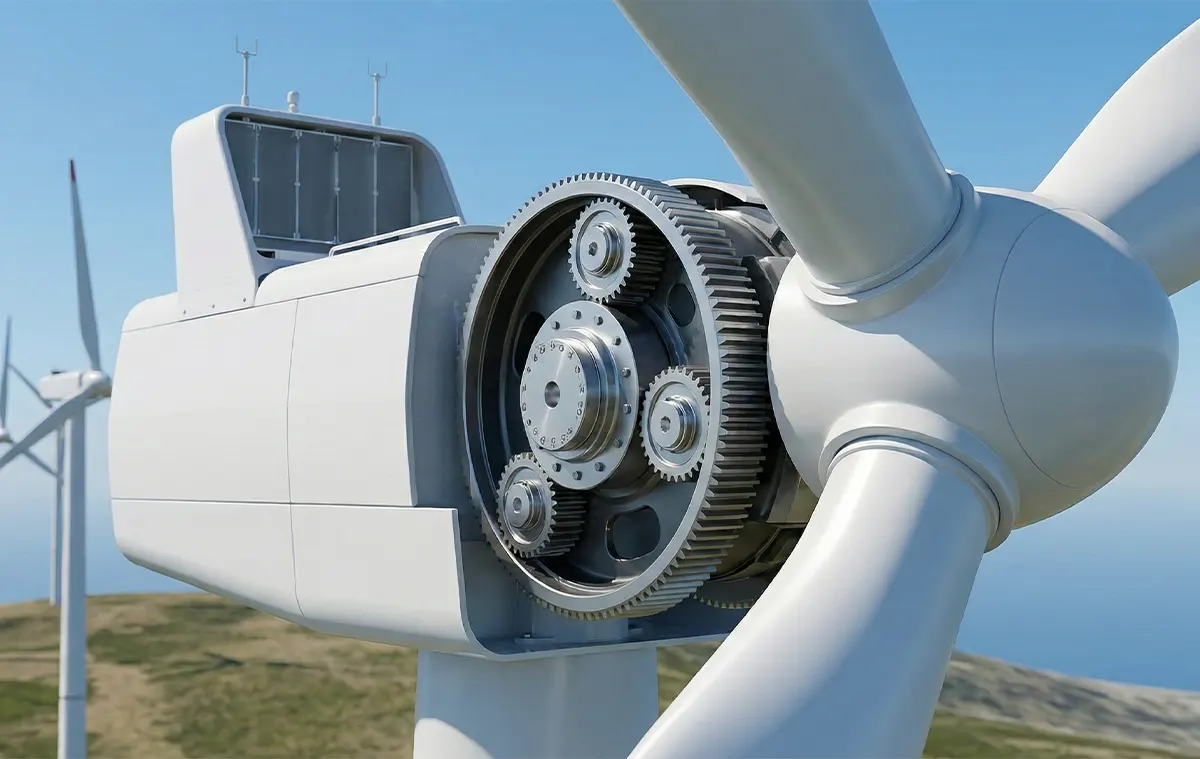
The yaw drive rotates the wind turbine nacelle horizontally to align the rotor with the wind direction. It operates at extremely low speed (0.02–0.1 rpm) against very high torque from the nacelle mass and gyroscopic loads. For a Korean 4.5 MW offshore turbine, the nacelle mass exceeds 300 tonnes — the yaw bearing friction and gyroscopic moment combine to produce yaw drive torques of 4,000–6,000 N·m per drive unit, with 4–8 drive units sharing the total yaw load.
Yaw accuracy requirement: ±5° misalignment between rotor and wind produces less than 0.4% power loss — the yaw precision specification is therefore much looser than solar tracker azimuth. The dominant gearbox requirements for yaw drives are torque capacity, structural stiffness (resistance to nacelle oscillation under wind gusts), sealed weatherproof construction, and −10°C operation. The EP-AHKA three-stage right-angle series addresses all four: up to 9,585 N·m at 1,800:1 in a single sealed right-angle unit, rated to −10°C, with the New Line structural housing designed for the sustained load cycling of wind turbine yaw operation.
Pitch Drive — Blade Angle Control
The pitch drive rotates each wind turbine blade around its long axis to control the angle of attack — the primary power regulation mechanism above rated wind speed. Pitch requires faster response than yaw (0.5–2°/second) and higher positioning accuracy (±0.5° pitch angle directly affects power output and structural loading). This combination of higher speed, moderate precision, and moderate torque (200–1,000 N·m per blade) points to a two-stage EP-AH or EP-AFHK configuration rather than the four-stage used for yaw.
Korean offshore turbine pitch drives are specified with emergency feather capability — the ability to rotate blades to the feather (0° attack) position even if electrical power is interrupted. This requires either spring-stored energy or battery backup. The gearbox must accommodate the emergency back-drive torque from the spring/battery without damage — verified in the EP-AH series emergency stop torque specification.

| Водить машину | крутящий момент | Скорость | Ряд |
|---|---|---|---|
| Yaw | 4,000–6,000 N·m | 0.02 rpm | EP-AHKA 3-stage |
| Pitch | 200–1,000 N·m | 1–5 rpm | EP-AH 2-stage |
EP-AHKA255 three-stage, 5,800 N·m output, right-angle, i=1,800:1. West Sea offshore installation, 28 months operation, minimum recorded temperature −8°C. Zero ingress events, zero gearbox failures across 12-unit wind farm.
Renewable Energy Manufacturing — Gantry Drives for Blade and Module Production
Korean wind turbine blade manufacturing and solar panel frame fabrication facilities use large-format gantry systems with rack-and-pinion linear drives for fibre layup, adhesive application, and welding operations. These manufacturing gantries are themselves part of the renewable energy supply chain — and they face the same pinion wear problem described for CNC gantry machine tools.
A Korean wind turbine blade manufacturing facility in Jeollabuk-do operates a 50 m rack-driven fibre layup gantry at 60 m/min traverse speed. At this speed in three-shift operation, pinion tooth flank wear reaches the replacement threshold every 6–8 months. With a conventional splined gearbox, each replacement requires 4 hours including motor disconnect and gantry recalibration.
Он EP-APC140 Curvic Plate (compact inline, 14,010 N·m maximum) reduces each replacement to 30 minutes through the single-screw self-centring Curvic Plate interface. Confirmed case at this facility: 9 pinion replacements over 2 years with zero precision recertification required after any replacement — the Curvic Plate restored the gantry to within 0.012 mm of pre-change traverse accuracy on every event.
BLADE GANTRY PINION REPLACEMENT — ANNUAL IMPACT
Annual replacements: 2 eventsConventional spline gearbox:
2 × 4 hours = 8 hrs downtime/yrEP-APC Curvic Plate:
2 × 0.5 hours = 1 hr downtime/yr
Annual saving: 7 hours production
Over 10-year gantry life:
70 hours recovered production time
EP-APC140 Curvic Plate on 50 m wind blade fibre layup gantry. 9 pinion replacements, 2 years. Zero precision recertification required. Gantry traverse accuracy restored to within 0.012 mm pre-change on every replacement event.
Confirmed Korean Renewable Energy Case Summary
| Установка | Gearbox Model | Operating Period | Conditions | Key Result |
|---|---|---|---|---|
| 48-unit CPV tracker (Jeju) | EP-AFHK180 4-stage | 3 years | 3 typhoon seasons, coastal salt | 0 gearbox failures · 0 ingress events |
| 12-unit offshore wind yaw (West Sea) | EP-AHKA255 3-stage | 28 months | −8°C min, offshore salt spray | 0 ingress events · operation through rated winter |
| Wind blade gantry (Jeollabuk-do) | EP-APC140 Curvic Plate | 2 years | 60 m/min, 3-shift operation | 9 pinion replacements · 0 precision recertifications |
Selection Checklist and Frequently Asked Questions
Specify Your Renewable Energy Gearbox with Korea Ever-Power Engineering Support
Korea Ever-Power provides torque calculation from your array geometry and wind speed, ratio confirmation, IP65 certification, and temperature specification verification for all Korean solar and wind installations — in Korean, same working day.
Редактор: Cxm