The Tandem Rear Axle — A Wheel Drive Configuration Unique to Motor Graders
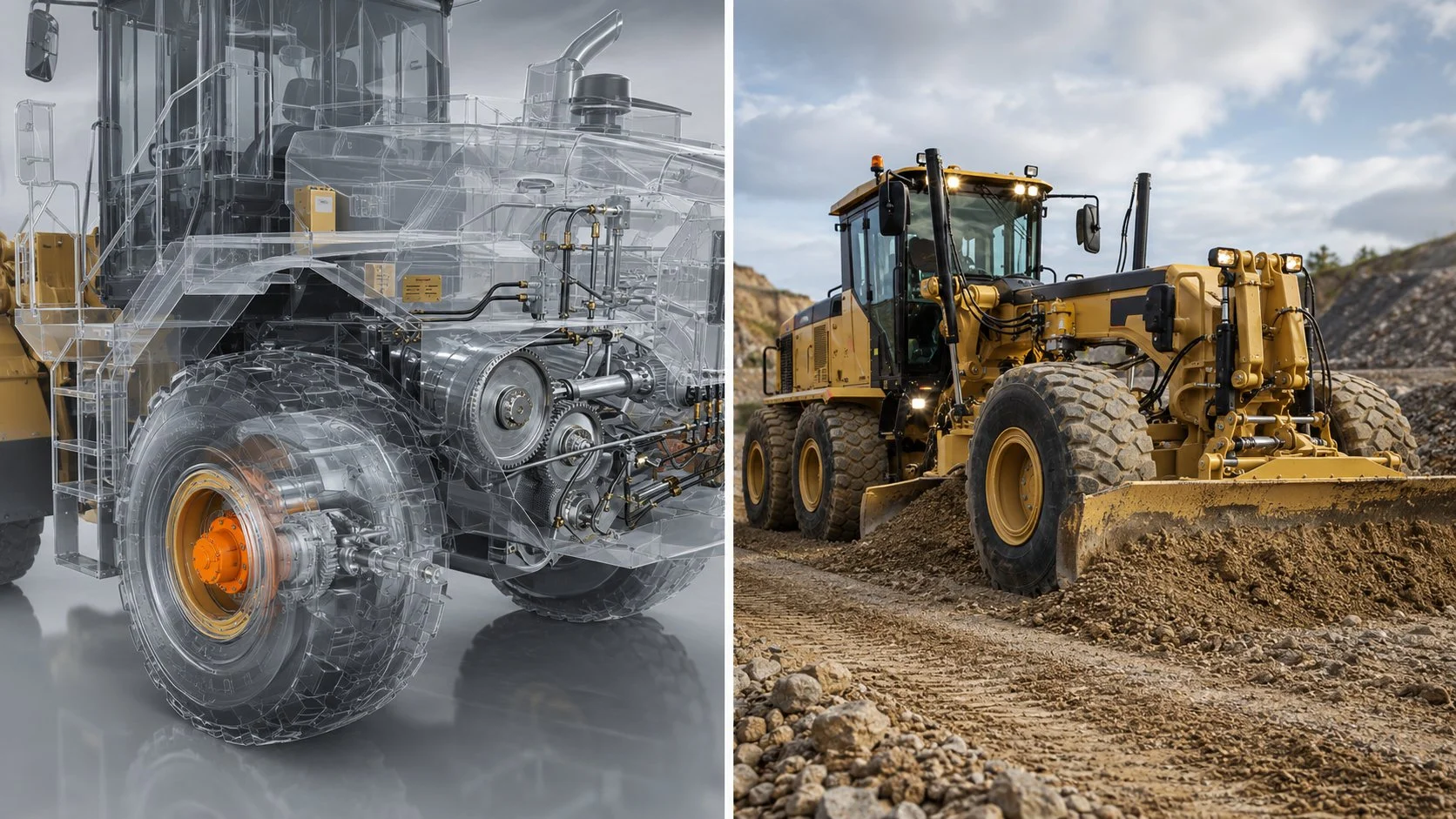
The motor grader is the only common construction machine with a tandem rear-axle arrangement: four rear wheels (two per side) mounted on a bogie assembly that allows the upper and lower wheels to articulate over terrain irregularities while maintaining ground contact. Each side of the tandem is driven through a single планетарный редуктор привода колес that feeds a chain-drive or gear-drive transfer case splitting torque between the upper and lower wheels.
This configuration provides three advantages over a single-rear-axle arrangement: (1) doubled ground contact area — reducing the ground pressure on the freshly graded surface by 50% and preventing the rear wheels from rutting the surface they just finished; (2) improved traction — four rear tyres provide approximately 80% more traction than two on loose material; and (3) terrain conformity — the bogie pivots up to ±15 degrees, keeping all four rear wheels in ground contact over humps and hollows that would lift one wheel on a rigid axle.
The planetary gearbox must therefore deliver torque to a transfer case that splits it between two wheels at potentially different rotational speeds (when the bogie articulates, the upper and lower wheels travel different path lengths around the pivot). The transfer case must accommodate this speed difference without binding — typically through a chain drive with sufficient slack, or through a gear differential. If the transfer case binds (from chain stretch, inadequate lubrication, or wear), the torque distribution becomes unequal — and the wheel with excess torque scuffs the graded surface while the wheel with insufficient torque contributes less traction.
The tandem bogie also subjects the planetary gearbox output bearing to a unique loading pattern. As the bogie pivots over terrain irregularities, the reaction force at the gearbox output flange oscillates between the upper and lower chain runs — producing a cyclic bending moment on the output shaft that is superimposed on the steady torsional load. This combined torsion-plus-bending fatigue case must be included in the shaft and bearing life calculation — a consideration that does not exist on single-axle wheel drive applications where the output shaft experiences pure torsion.
The tandem arrangement also affects the braking performance. Each side of the tandem has four brake surfaces (two wheels x two brake pads) sharing the total retarding force. The brake activation must be simultaneous across all four surfaces — because unequal braking between the upper and lower wheels produces a pitching moment that lifts one wheel off the ground and concentrates the full braking force on the remaining wheel. On wet or icy surfaces, this unequal braking can cause the lightly loaded wheel to lock — producing a skid that pulls the grader sideways. ABS systems on grader tandem axles must monitor all four wheel speeds independently and modulate the brake pressure to each wheel individually — a more complex control task than standard two-axle ABS.
GPS Fine Grading — How ±1% Speed Stability Produces ±3 mm Surface Tolerance
GPS-guided blade control is the defining technology on modern motor graders. The system reads the machine position from RTK-GPS receivers (accurate to ±10 to 20 mm), compares it to the 3D design surface model, and adjusts the blade elevation and cross-slope through hydraulic cylinders 10 to 20 times per second. The result is a finished surface that matches the design profile to within ±3 to 5 mm — eliminating the need for grade-checking survey crews and reducing the material overuse (placing too much base material to ensure the minimum thickness is met) by 15 to 30%.
The blade control system assumes a constant ground speed when calculating the blade adjustment rate. If the actual speed varies by ±5% from the assumed value (due to wheel drive cogging, traction variation, or hydraulic-system pressure fluctuation), the blade adjustment timing is wrong by ±5% — and the blade is in the wrong position for 5% of the grading pass. At a working speed of 5 km/h, a 5% speed error produces 83 mm of distance error per second — and the blade is either 83 mm ahead of or behind its calculated position for that speed. Over a 100-metre pass, this accumulates to 50 to 200 periodic surface undulations (at the cogging frequency) with amplitudes of 2 to 5 mm — visible as a washboard texture in the finished surface.
Он планетарный редуктор привода колес gear quality directly determines the achievable surface tolerance. DIN Class 6 gears produce cogging amplitudes below 2% — within the blade control compensation capacity. Class 8 gears produce cogging amplitudes of 5 to 8% — exceeding the compensation capacity and producing visible surface undulation. The cost difference between Class 6 and Class 8 gears is approximately 15 to 25% of the gearbox price — while the productivity difference (achieving specification-compliant surface in one pass versus requiring corrective passes) is 20 to 40% of the grading cost per kilometre. The return on the gear-quality investment is achieved within the first 2 to 5 km of GPS-guided fine grading.
The speed range during grading operations varies significantly with the task. Rough grading (initial shaping of the subgrade) operates at 3 to 5 km/h with heavy blade loading — high traction demand, moderate speed accuracy. Finish grading (final surface profiling) operates at 5 to 8 km/h with light blade loading — moderate traction, high speed accuracy. Ditching (cutting drainage channels along the road shoulder) operates at 2 to 4 km/h with the blade angled at 30 to 60 degrees — combining high side-force on the blade with precise depth control. Each task places a different demand on the wheel drive — and the transmission and gearbox must provide the correct torque-speed combination for all three without requiring the operator to switch mechanical ranges during the work.
Articulated-Frame Steering and Front-Wheel Drive
Motor graders use articulated-frame steering — the front section of the machine pivots relative to the rear section at a central articulation joint. This allows the front wheels to be offset from the rear wheels — essential for grading at an angle to the direction of travel (such as cutting a drainage ditch along the road shoulder). The articulation angle can reach ±20 to 25 degrees — and the wheel drive must maintain consistent traction and speed through the full articulation range.
The optional front-wheel drive engages the two front wheels through individual wheel motors and planetary gearboxes. Front-wheel drive adds 30 to 50% traction for rough grading on loose material — but introduces a speed-matching requirement between the front and rear drives. If the front wheels turn at a different speed than the rear wheels (due to different gear ratios, tyre sizes, or hydraulic flow rates), the driveline binds — producing tyre scrubbing, increased fuel consumption, and uneven traction that affects the blade position. The front wheel drive must match the rear drive speed to within ±1 to 2% across the full speed range — the same tolerance required for GPS blade-control accuracy.
During articulated grading (front wheels offset from the rear), the front wheels travel a different path length than the rear wheels — and the speed-matching requirement changes with the articulation angle. At ±20 degrees articulation, the front wheel path is approximately 5 to 8% longer or shorter than the rear path — and the front wheel drive must automatically compensate for this geometric difference without operator intervention. A front-wheel drive that does not compensate for the articulation-induced path-length difference produces asymmetric tyre wear and intermittent binding that degrades the blade control accuracy during articulated grading passes.
All-Season Duty — Road Maintenance, Snow Removal, and Airport Operations
Unlike most construction machines that work seasonally, motor graders operate year-round in road maintenance roles: summer grading (unpaved road reshaping, 500 to 1,500 hours/year), winter snow removal (ploughing roads and airport runways, 200 to 800 hours/year), and shoulder maintenance (drainage ditch reshaping, 200 to 500 hours/year). This year-round duty exposes the wheel drive to the full annual temperature range — from -30 degrees C winter starts to +45 degrees C summer operation — the same all-climate challenge faced by feed mixer wheel drives (WD-06).
Snow removal duty introduces specific wheel drive stresses. The grader pushes 1 to 3 tonnes of snow per blade pass at 20 to 40 km/h — significantly faster than the 3 to 8 km/h grading speed. At snow-ploughing speed, the wheel drive operates at higher output RPM with moderate torque — producing more bearing heat from high-speed rotation and more gear noise from the elevated mesh frequency. Road salt (sodium chloride and calcium chloride) splashes onto the wheel drive housing during and after ploughing — and the salt-water solution (which remains liquid to -20 degrees C) provides a continuous corrosion electrolyte throughout the winter season.
Airport runway maintenance is the highest-speed grader application. Airport graders operate at 30 to 50 km/h during runway snow clearing — removing snow between aircraft operations in time windows of 30 to 60 minutes. The wheel drive must deliver reliable traction at these speeds on icy runway surfaces (coefficient 0.1 to 0.2) — requiring ABS-compatible braking and traction control that prevents wheel lock or spin on the low-friction surface. A grader that spins its wheels on a runway not only fails to clear the snow but can also damage the runway surface — an outcome that closes the runway for repair and costs the airport USD 50,000 to 500,000 per hour in diverted flights. The airport grader wheel drive must therefore meet aviation-grade reliability standards — with redundant braking, traction-control diagnostics, and rapid-response maintenance support that exceeds the requirements of standard road-maintenance grader specifications.
Three Failure Modes Specific to Motor Grader Wheel Drives
At 5 km/h with a 40:1 gearbox and 30-tooth output gear, the cogging wavelength is approximately 55 mm — producing a washboard texture in the finished surface that is detectable by straightedge and may fail the IRI specification. The undulation originates entirely from the wheel drive speed pulsation — the GPS blade control is accurate, but it adjusts the blade based on a speed signal that includes the cogging error. DIN Class 8 gears produce undulation amplitudes of 2 to 5 mm; Class 6 gears reduce the amplitude to below 1 mm — within the GPS system noise floor and therefore invisible in the finished surface.
The chain or gear drive that connects the upper and lower tandem wheels develops wear over 3,000 to 5,000 hours — producing unequal torque distribution that scuffs the graded surface with the over-driven wheel while reducing traction at the under-driven wheel. A worn transfer case with 5% torque imbalance on a 15,000 Nm output produces a 750 Nm difference between wheels — enough to leave visible tyre marks in a freshly finished surface. The binding also increases the fuel consumption by 5 to 10% because the driveline friction absorbs power that should reach the ground as traction.
Road salt (NaCl and CaCl2) dissolves in snow melt and splashes onto the wheel drive housing at concentrations of 5 to 15% — comparable to seawater. The salt solution remains liquid at temperatures down to -20 degrees C — maintaining continuous corrosion contact throughout the winter season (4 to 6 months). Unprotected mild steel corrodes at 0.3 to 0.8 mm per year in road-salt environments — and the wheel drive housing, bolt heads, and seal retainer surfaces develop visible pitting within 2 to 3 winter seasons. The salt also attacks the shaft seal lip from the outside — accelerating the lip hardening and cracking that leads to oil leakage and water ingress. Winter-duty grader wheel drives accumulate more corrosion damage in a 6-month winter season than a typical construction-duty wheel drive accumulates in 3 to 5 years of non-salted operation.
Часто задаваемые вопросы
Korea Ever-Power provides motor grader wheel drives from 8,000 to 35,000 Nm with GPS-grade speed accuracy, tandem-axle torque distribution, and winter-salt corrosion protection.
Редактор: Cxm