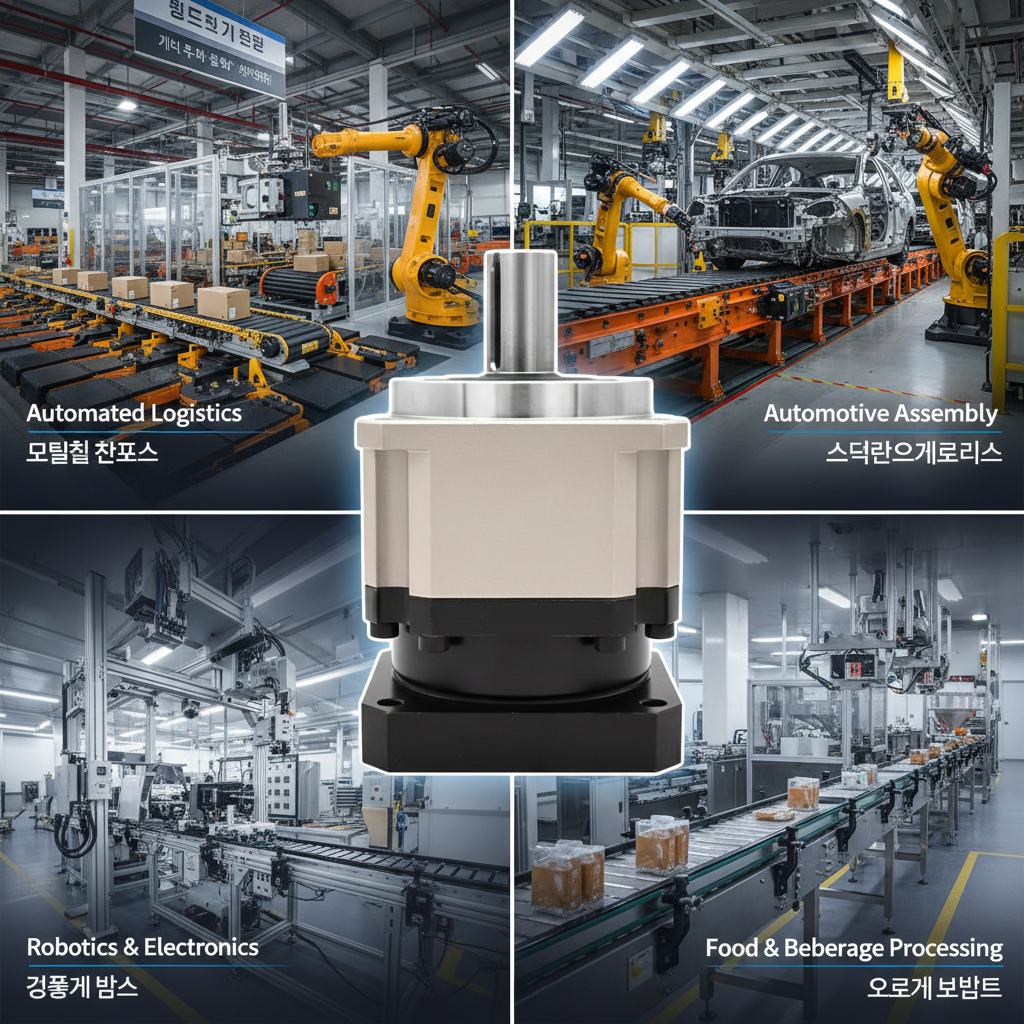
Why Robot Joints Demand More from a Planetary Gearbox Than Any Other Application
A servo axis on a CNC machine tool reverses direction a few thousand times per production shift. A robot joint performing a welding or pick-and-place cycle reverses direction millions of times per year. At 60 cycles per minute for a Korean automotive welding robot running three shifts, the shoulder joint executes over 95 million direction reversals per year. Every one of those reversals is a tooth-flank stress event that accumulates toward the backlash growth that ends the gearbox’s useful life.
The four simultaneous requirements that define robot joint gearbox selection are unique in their combination: sub-arcminute backlash for TCP positioning accuracy, compact body diameter to fit within the arm link cross-section, minimum weight to maximise the arm’s usable payload, and a service life measured in tens of millions of reversals rather than the thousands typical of other servo applications. No industrial application imposes all four constraints simultaneously with the same severity as a robot joint drive.
The Korean collaborative robot market has added a fifth constraint: overall arm compactness. Korean electronics and automotive assembly cobots are designed for deployment in existing assembly stations originally dimensioned for human operators — the robot arm must fit in the same physical envelope. Every millimetre of arm cross-section savings at each joint reduces the total arm width by that amount, affecting whether the robot fits in its assigned station. This has made the compact body diameter of Korea Ever-Power’s EP-ADS series and the right-angle J1 configuration with EP-ABR directly relevant to Korean cobot OEM design decisions.
4 Simultaneous Robot Joint Requirements
Joint-by-Joint Specification — J1 Through J6
Each robot joint has a different torque requirement, space envelope, and structural priority. The correct gearbox specification for J1 is not the same as for J6 — and applying a uniform specification across all six joints leads to either over-engineering the wrist joints (wasted cost and weight) or under-engineering the shoulder (immediate accuracy loss). The table below gives the engineering starting point for each joint in a typical Korean 6-axis collaborative robot at 10 kg payload.
| Gemensam | Function | Typical Vridmoment |
Glapp Needed |
Ram Priority |
Rekommenderad Serie |
Huvudorsak |
|---|---|---|---|---|---|---|
| J1 — Midja | Horizontal rotation | 50–200 N·m | ≤1 bågminut | Vertical output / base height | EP-ABR P0 | Horizontal motor in base → saves 40+ mm base height vs vertical layout |
| J2 — Shoulder | Upper arm lift | 80–300 N·m | ≤1 bågminut | Weight + compact OD | EP-AB P0 060–090 | Highest-impact joint on arm payload — every 100g here reduces usable TCP payload |
| J3 — Elbow | Forearm bend | 30–150 Nm | ≤1 bågminut | Compact OD, round flange | EP-ADS P0 | Compact body + non-std ratios 21/31/61/91 for exact arm speed matching |
| J4 — Wrist bend | Wrist tilt | 10–50 N·m | ≤1 bågminut | Minimum size | EP-AB P0 042 | 042 mm frame — smallest AB size — still P0 to keep total TCP error in budget |
| J5 — Wrist rotate | Wrist spin | 5–30 N·m | ≤3 arcmin | Ultra-compact | EP-ADS 047 | P1 sufficient at J5 — TCP contribution from J5 is small vs J1–J3 |
| J6 — Tool flange | Tool rotation | 5–20 Nm | ≤6 arcmin | Smallest possible | PN II 023–034 | 17–34 mm body — smallest planetary in Korea Ever-Power range. Tool rotation backlash rarely limits TCP |
J1: EP-ABR060 P0 i=80 · J2: EP-AB090 P0 i=80 · J3: EP-ADS060 P0 i=61 · J4: EP-AB042 P0 i=25 · J5: EP-ADS047 i=21 · J6: PN II 034 i=16. This configuration delivers P0 on all joints that contribute meaningfully to TCP error, uses compact ADS at J3/J5 to minimise arm cross-section, and reserves PN II micro gearboxes for J6 where backlash grade is irrelevant to TCP performance.
TCP Positioning Error — Why Every Joint’s Backlash Matters and How They Combine
The Tool Centre Point (TCP) is the end-effector tip — the physical location in space where the robot delivers its work. TCP positioning accuracy is the robot’s primary performance specification, and it is the aggregate result of backlash and positioning errors at every joint in the kinematic chain. Understanding how individual joint backlash values combine at the TCP is essential for specifying gearbox grades correctly: over-specifying wastes cost; under-specifying produces a robot that fails its accuracy specification from day one.
The basic relationship: each joint’s backlash creates an angular uncertainty at that joint. This angular uncertainty propagates through all subsequent links to produce a linear position uncertainty at the TCP. The contribution of each joint to TCP error depends on the distance from that joint to the TCP (the effective lever arm) and the joint’s angular backlash.
TCP ERROR CALCULATION — SINGLE JOINT CONTRIBUTION
θ (rad) = arcmin × π / (180 × 60)
θ for 1 arcmin = 0.000291 radJ1 (waist), L=1,000 mm, 1 arcmin:
ΔTCP = 1,000 × 0.000291 = 0,291 mm
J2 (shoulder), L=900 mm, 1 arcmin:
ΔTCP = 900 × 0.000291 = 0.262 mm
J6 (tool flange), L=60 mm, 6 arcmin:
ΔTCP = 60 × 0.001745 = 0.105 mm
Multi-joint combination (RSS method): When all six joints each contribute 1 arcmin P0 backlash, the worst-case linear combination would be 6 × 0.291 mm = 1.75 mm — but joints do not all act in the same direction simultaneously. The more accurate estimate uses Root Sum of Squares (RSS), assuming independent random joint errors:
= √(0.0847 + 0.0686 + 0.0475 + 0.0213 + 0.0053 + 0.0003)
= √0.2277 ≈ 0.477 mm ← within ±0.5 mm target for P0 all joints
Korean automotive welding robot target: ±0.1 mm TCP repeatability. This means the backlash contribution alone at RSS must stay well below ±0.1 mm — achievable only with P0 ≤1 arcmin on all joints J1 through J4, and with short lever-arm wrist joints J5–J6 contributing minimally even with slightly higher backlash.
Per-Joint TCP Contribution — 10 kg Cobot at 1 m Reach
| Gemensam | L_eff (mm) | Glapp | TCP Contrib. | Serie |
|---|---|---|---|---|
| J1 | 1,000 | ≤1′ | 0,291 mm | ABR P0 |
| J2 | 900 | ≤1′ | 0.262 mm | AB P0 090 |
| J3 | 750 | ≤1′ | 0,218 mm | ADS P0 |
| J4 | 500 | ≤1′ | 0.146 mm | AB P0 042 |
| J5 | 250 | ≤3′ | 0,218 mm | ADS 047 |
| J6 | 60 | ≤6′ | 0.105 mm | PN II 034 |
| RSS Total (all joints) | ≈0.477 mm | ≤0.5mm ✓ | ||
L_eff = distance from joint to TCP. RSS = Root Sum of Squares combination. Worst-case linear sum = 1.24 mm. Actual repeatability better due to systematic error cancellation.
J3 Elbow — Why Compact Body and Non-Standard Ratios Change the Robot Design
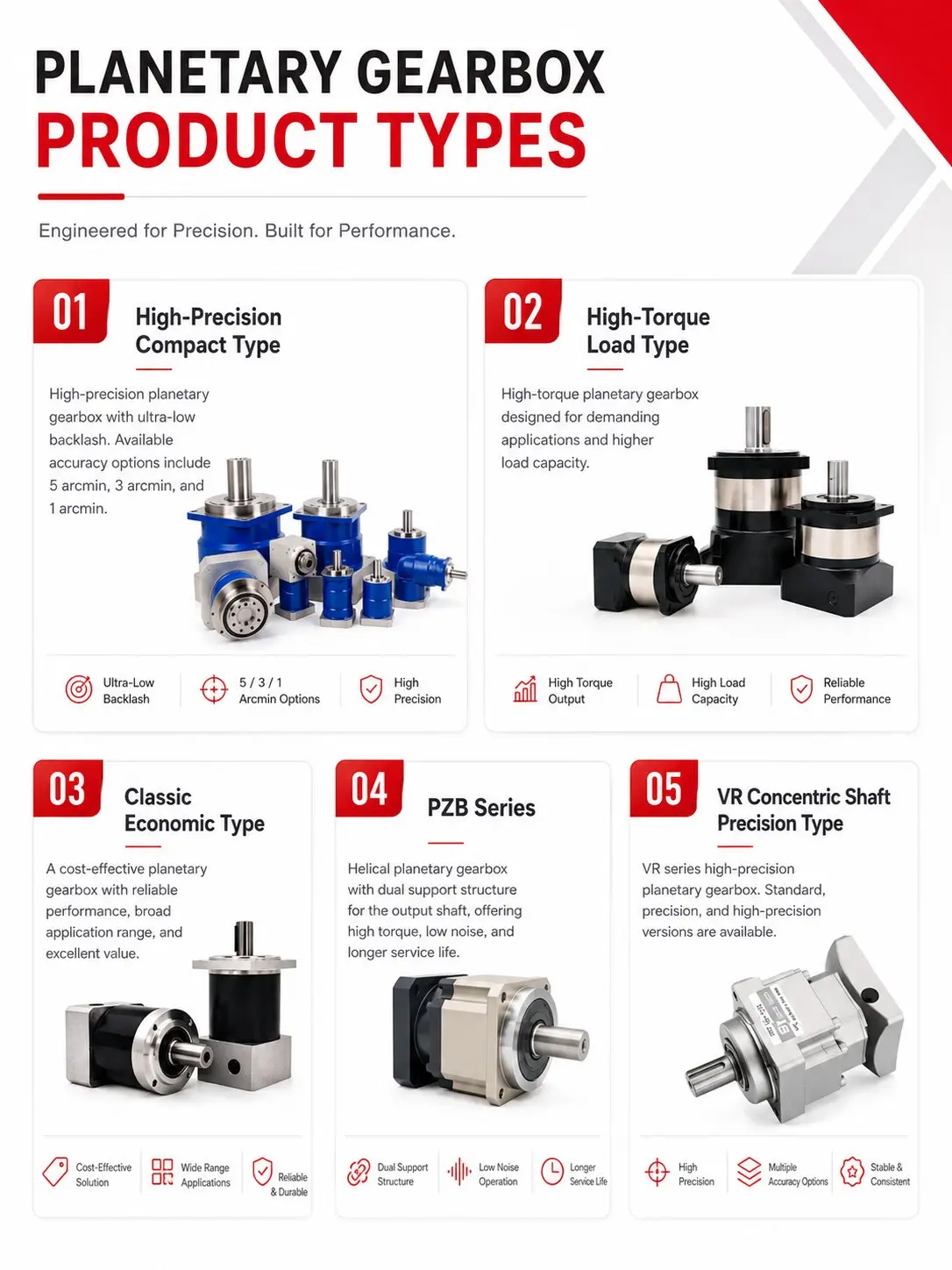
The elbow joint J3 is where Korean cobot OEMs most frequently encounter the body diameter constraint. The forearm link must accommodate the gearbox body, the motor, the motor encoder cable routing, and the structural shell — within a total envelope often set by the robot’s ISO 9283 arm diameter specification. Every millimetre of gearbox body diameter saved at J3 directly reduces the forearm cross-section, allowing the arm to reach deeper into jigs and fixtures.
De EP-ADS compact round flange series addresses this with a shorter body length than the standard EP-AD series at the same frame diameter — reducing the axial depth the gearbox occupies inside the forearm link. The round flange centres on the link bore, matching most Korean cobot J3 housing designs without a transition adapter. The non-standard ratios available in the ADS series — 16, 21, 31, 61, and 91 — solve a specific Korean cobot design problem that standard series ratios cannot.
The non-standard ratio problem: A Korean cobot J3 elbow servo motor running at 3,000 rpm must produce exactly 48.9 rpm at the output to achieve the designed joint speed profile without a VFD. The closest standard ratio is 60 (producing 50 rpm — close, but not exact) or 70 (42.9 rpm — too slow). The ADS series i=61 produces exactly 49.2 rpm — a 0.6% error, within the allowable variation for the motion profile. Without this non-standard ratio, the cobot OEM must either tolerate the speed error, add a VFD (cost and component count penalty), or redesign the joint geometry.
ADS NON-STANDARD RATIO ADVANTAGE — J3 EXAMPLE
Required J3 speed: 49 rpmStandard ratios available:
i=60 → 50.0 rpm (+2.0%) ✗
i=70 → 42.9 rpm (−12%) ✗✗
ADS non-standard ratio:
i=61 → 49.2 rpm (+0.4%) ✓
i=50 → 60.0 rpm (too fast) ✗
→ Only ADS i=61 meets spec
without VFD
J1 Waist Drive — How Right-Angle Layout Reduces Cobot Base Height
The waist joint J1 rotates the entire upper arm assembly in the horizontal plane. The conventional design places the servo motor vertically inside the robot base, with an inline gearbox driving the waist axis coaxially. This arrangement works mechanically but produces a tall, heavy base — the motor height plus gearbox length plus output bearing assembly stacks vertically, setting the minimum base height. For Korean cobots designed to mount on small-footprint pedestals or table-top stands in automotive assembly cells, this height is a competitive disadvantage.
The right-angle layout using EP-ABR060 P0 at i=80 repositions the motor horizontally within the base structure. The motor lies flat inside the base footprint rather than extending vertically above it. The right-angle gearbox changes direction 90° to drive the waist axis vertical output shaft. This configuration typically saves 40–50 mm of base height compared to the vertical motor inline layout — equivalent to a full standard motor frame length.
J1 BASE HEIGHT COMPARISON
┌──────────────┐ ← Top of motor
│ Servo motor │ 120 mm height
│ (vertical) │
├──────────────┤
│ Inline PGB │ 80 mm
│ (AB 060) │
├──────────────┤
│ Output brg │ 30 mm
└──────────────┘
Total: 230 mm base heightRight-angle EP-ABR060 P0 i=80:
┌───────────────────────┐
│ Motor (horizontal) │ 80 mm ↕
│──────────────┬────────┤
│ ABR gearbox │ output │ 65 mm ↕
└──────────────┘ │
Total: 145 mm base heightSaving: 85 mm (37% reduction)
Korean cobot OEM case: 60 robots delivered with this configuration, zero joint rework incidents. P0 ≤1 arcmin confirmed at delivery on all 60 units. The base height reduction allowed the robot to fit on a standard 300 mm table-top pedestal rather than a custom 400 mm machined column — a procurement and production line flexibility benefit beyond the height saving alone.
J5 and J6 Wrist Joints — Micro Planetary Gearboxes at 17 mm
The wrist joints J5 (wrist rotation) and J6 (tool flange) operate at low torques (5–30 N·m) and require the smallest possible body diameter to keep the wrist assembly within the arm’s distal envelope specification. For a Korean 10 kg cobot with a 70 mm wrist link diameter, the gearbox body can occupy no more than 40–45 mm of that 70 mm — leaving room for the motor, structural shell, and cable routing.
De Korea Ever-Power Economic Line PN II series covers J6 with body diameters starting at 17 mm (PN II 017) — the smallest planetary gearbox in the Korea Ever-Power catalogue. The 6–8 arcmin backlash of the PN II is acceptable for J6 tool flange rotation, because the TCP contribution from J6 backlash at a 60 mm lever arm is only 0.1 mm even at 6 arcmin — a negligible addition to the RSS error budget.
For J5 wrist bend where slightly higher precision is needed — Korean cobots performing screw-fastening or precision insertion at the wrist — the EP-ADS 047 (47 mm body) at P0 or P1 provides sub-3-arcmin backlash in a body small enough for the forearm wrist link. The ADS non-standard ratio availability (i=21) also helps match wrist speed profiles for precision assembly operations.
| Modell | Body Ø | Glapp | Ratios | Bäst för |
|---|---|---|---|---|
| PN II 017 | 17 mm | 6–8′ | 3–10 | Ultra-micro J6 |
| PN II 023 | 23 mm | 6–8′ | 3–10 | J6 standard |
| PN II 034 | 34 mm | 6–8′ | 3–10 | J6 higher torque |
| EP-ADS 047 | 47 mm | ≤3′ P1 | 3–100 + 21 | J5 precision |
PN II backlash = 6 arcmin
θ = 6 × 0.000291 = 0.00175 rad
ΔTCP = 60 × 0.00175 = 0.105 mmEven at 6′, J6 contributes only
0.105 mm to TCP error —
smaller than J1 at P0 (0.291 mm)
→ Specifying P0 at J6 gives
≤0.017 mm improvement at TCP
while costing 40% more per unit
Inertia Ratio for High-Speed Robot Joints — The Calculation That Prevents Oscillation
Backlash specification attracts most of the attention in robot gearbox selection — but inertia mismatch is responsible for more servo oscillation problems in Korean robot OEM commissioning than incorrect backlash grade. A robot axis with correct backlash but poor inertia ratio produces a servo loop that hunts, overshoots, and requires detuned gains — directly reducing the robot’s path accuracy and cycle speed.
The inertia ratio at a robot joint is: J_ratio = J_load_reflected / J_motor, where J_load_reflected = J_load / i². The gear ratio reduces the load inertia seen by the motor by the square of the ratio — which is why robot joint ratios are typically in the range i=20–100, even when the required speed reduction could be achieved with lower ratios. The high ratio is chosen primarily for inertia reduction, not speed.
J2 SHOULDER INERTIA CALCULATION — REAL EXAMPLE
J_upper_arm = 3,200 g·cm² (10kg cobot)At i = 80:
J_reflected = 3,200 / 80² = 0.5 g·cm²
J_ratio = 0.5 / 450 = 0.0011 ← excellent
(motor-dominated, fast settling)
At i = 20 (hypothetical):
J_reflected = 3,200 / 400 = 8 g·cm²
J_ratio = 8 / 450 = 0.018 ← still OK
At i = 5 (hypothetical):
J_reflected = 3,200 / 25 = 128 g·cm²
J_ratio = 128 / 450 = 0.28 ← borderline
→ servo tuning difficult at fast cycles
This is why i=80 is the standard ratio for the J2 shoulder in a Korean 10 kg cobot: the inertia ratio drops to less than 0.002:1 — the motor is overwhelmingly dominant and the servo loop can be tuned aggressively for fast cycle times. Reducing the ratio to i=20 to use a single-stage unit would increase the inertia ratio 45-fold, requiring much softer servo gains and a slower cycle time.
Inertia Ratio Impact on Robot Servo Performance
Service Life and Backlash Growth — What Korean Robot OEMs Monitor and When They Replace
Precision planetary gearboxes in robot joints do not fail suddenly. Backlash grows gradually over tens of millions of direction-reversal cycles as gear tooth flanks wear. The wear rate depends on the applied torque, the lubrication condition, and the impact severity at each reversal — aggressive deceleration followed immediately by acceleration in the opposite direction produces higher tooth flank contact stresses than smooth trapezoidal velocity profiles.
Korea Ever-Power P0 precision series are designed for ≤1 arcmin at delivery and a service target of ≤2 arcmin after 20,000 operating hours — approximately 8 years at standard three-shift Korean automotive production (2,500 operating hours/year). When backlash grows beyond 2× the original delivery specification, practical positioning accuracy is measurably degraded and joint replacement is warranted.
①
②
③
④
Korea Ever-Power EP-AB and EP-ADS series use permanently sealed grease that does not require periodic replacement — eliminating the periodic re-lubrication maintenance event that oil-bath gearboxes require. For Korean cobot OEMs who guarantee 5-year maintenance-free joint operation to end-customers, sealed-grease construction is a product specification requirement, not a feature option. All Korea Ever-Power precision series are sealed at manufacture for life-of-gearbox operation without re-greasing.
Joint Selection Quick Reference and FAQ
Complete joint-to-series mapping for a Korean 6-axis industrial robot or collaborative robot at 10 kg payload, 1 m reach. Adjust frame sizes up for heavier industrial robots (20–100 kg payload) and down for desktop cobots (3–5 kg payload).
| Gemensam | Serie | Ram | Förhållande | Glapp | Critical Selection Factor |
|---|---|---|---|---|---|
| J1 Midja | EP-ABR P0 | 060 | i=80 | ≤1′ | Horizontal motor in base → saves 40+ mm base height |
| J2 Shoulder | EP-AB P0 | 090 | i=80 | ≤1′ | Highest inertia impact joint — weight and compact body critical |
| J3 Elbow | EP-ADS P0 | 060 | i=61 | ≤1′ | Compact body + non-std ratio i=61 for exact speed matching |
| J4 Wrist bend | EP-AB P0 | 042 | i=25 | ≤1′ | Smallest AB frame — still P0 needed for TCP error budget |
| J5 Wrist rotate | EP-ADS | 047 | i=21 | ≤3′ | P1 sufficient — TCP lever arm only 250 mm at J5 |
| J6 Tool flange | PN II | 023–034 | i=16 | ≤6–8′ | 60 mm lever arm — 6 arcmin only adds 0.1 mm to TCP RSS total |
Complete Your Robot Arm Gearbox Specification with Korea Ever-Power
Korea Ever-Power’s application team provides joint-by-joint gearbox specification, TCP error analysis, inertia ratio calculation, and non-standard ratio confirmation for your specific robot arm design — in Korean, same working day. Provide your arm geometry and joint torque requirements to receive a full 6-joint recommendation.
Redaktör: Cxm