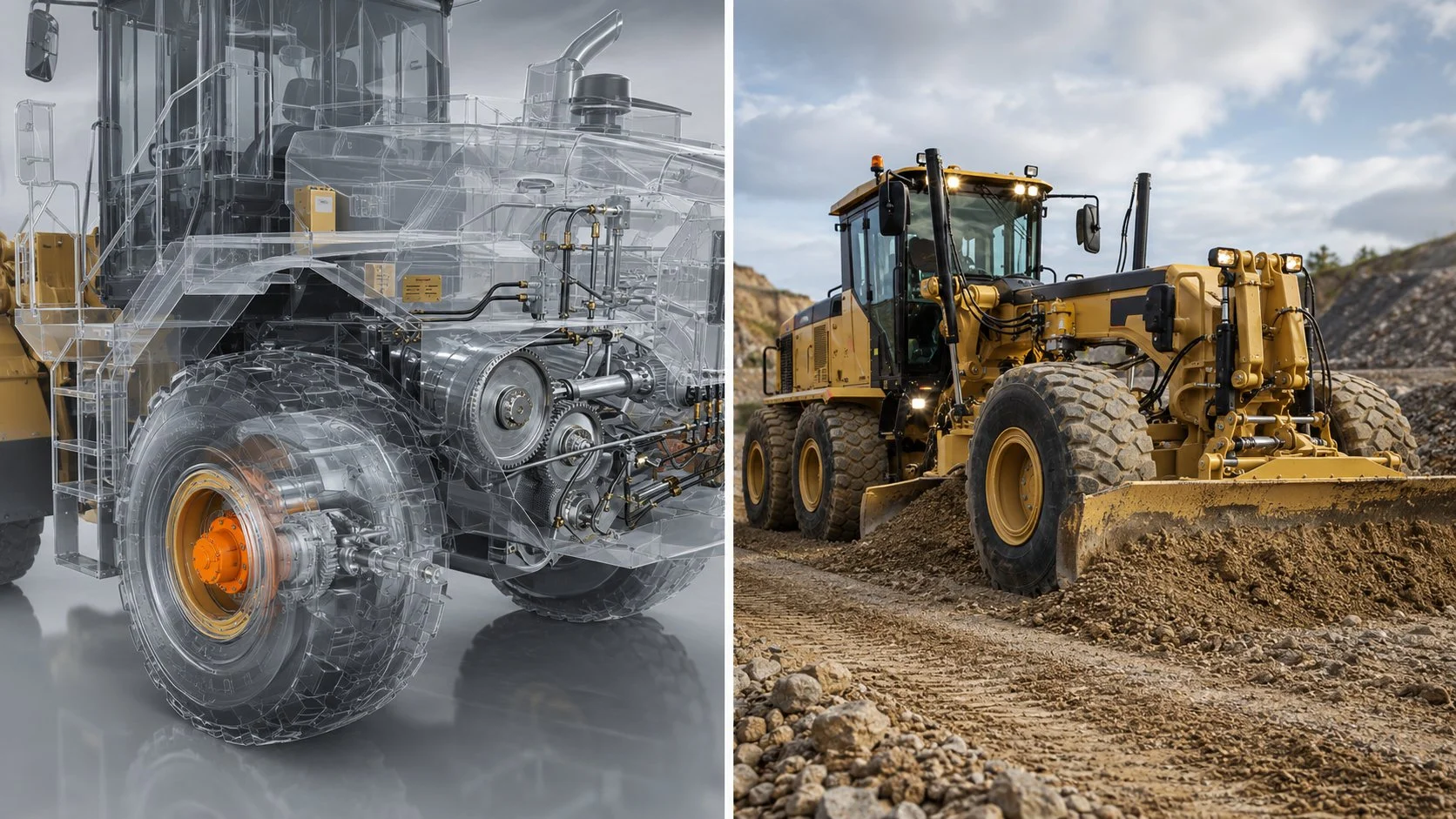
The Over-the-Row Configuration — A Machine Built Around Its Wheel Drives
Unlike every other harvester in this series — where the harvesting mechanism is mounted on a conventional chassis — the grape harvester is an over-the-row straddle machine. The vine row passes between the legs of the machine, and the harvesting mechanism (shaking rods, catching plates, conveyors, collection hoppers) is integrated into the upper structure that bridges the row. The wheel drives are at the bottom of the two straddle legs — as far below the centre of gravity as the geometry allows.
This configuration creates a hjuldriven planetväxellåda challenge unique to grape harvesters: the machine has a high centre of gravity (2.0 to 3.0 metres) relative to a narrow track width (2.5 to 3.2 metres between wheel centrelines). The static rollover angle is typically 25 to 35 degrees — but on a hillside vineyard with loose soil, dynamic wheel-drive torque variations can reduce the effective stability margin by 15 to 25%. Any sudden torque change from the wheel drive — a cogging pulse, a traction-control intervention, or a direction reversal — produces a lateral weight transfer that tilts the machine toward the rollover threshold.
The wheel drive smoothness requirement on a grape harvester is therefore a stability requirement, not just a crop-quality requirement. A torque spike that would be imperceptible on a low-CG potato harvester can produce a perceptible lurch on a high-CG grape harvester — and on a 25% slope, that lurch can bring the machine dangerously close to the rollover angle. The gear mesh quality, hydraulic valve response, and traction control tuning must all be optimised for the minimum possible torque variation — making DIN Class 6 gears a structural safety specification, not merely a performance preference.
The straddle-leg geometry also constrains the wheel drive packaging. The wheel drive must fit within the narrow straddle leg — typically 300 to 450 mm wide — while providing enough torque for hillside climbing with a full hopper. This dimensional constraint limits the planetary gear diameter and therefore the maximum torque that can be transmitted through a single reduction stage. Most grape harvester wheel drives use 2 to 3 stage planetary reductions to achieve the required torque from a compact radial envelope — trading axial length (acceptable, as the leg extends vertically) for radial diameter (constrained by the leg width). The compact radial requirement also limits the bearing size, which in turn limits the output bearing load capacity — making the bearing selection for high-CG hillside machines more critical than for conventional low-CG agricultural equipment.
Hillside Vineyard Operation — Slopes That Define the Wine, and the Drive Specification
The premium wine regions of the world are frequently hillside regions — the Douro Valley (30 to 50% slopes), the Mosel (30 to 65%), Cote-Rotie in the Northern Rhone (20 to 45%), and the Adelaide Hills (10 to 25%). These slopes produce superior wine because the drainage, sun exposure, and temperature moderation of hillside terroir concentrate the grape flavours. Mechanical harvesting on these slopes demands wheel drives that can operate reliably at angles where the gravitational component of the machine weight becomes a dominant force.
| Slope | Grade Force (8 t) | % of Traction | Stability Concern |
|---|---|---|---|
| 10% (6°) | 7.8 kN | 25% | Låg |
| 20% (11°) | 15.4 kN | 48% | Moderate — CG shift |
| 30% (17°) | 22.9 kN | 72% | High — near rollover margin |
At a 30% slope, the gravitational force consumes 72% of the available traction — leaving only 28% for rolling resistance and forward propulsion. The wheel drive must distribute this limited traction budget precisely between the uphill and downhill wheels. If the uphill wheel receives too much torque relative to its reduced traction (less weight due to CG shift), it spins — wasting the limited traction surplus and disturbing the vine roots. If the downhill wheel receives too little torque, the machine decelerates and the shaking mechanism over-processes the vine section — damaging berries and reducing wine quality.
Cross-slope operation (traversing the hillside rather than driving up or down) is common in contour-planted vineyards. On a cross-slope, the weight transfer from uphill to downhill wheels is constant — reducing the uphill wheel load by approximately 8 to 15% per 10% of slope gradient. The wheel drive must compensate by reducing the torque to the uphill wheel (preventing spin) and increasing the torque to the downhill wheel (maintaining speed) — a differential torque management task that requires either independent hydraulic motors per wheel or an electronic limited-slip function in the hydrostatic system.
The descending pass on a hillside vineyard is more dangerous than the ascending pass — because the gravitational force acts in the direction of travel and the wheel drive must provide continuous retarding torque to prevent the machine from accelerating beyond the target harvesting speed. On a 25% downhill slope, the gravitational acceleration component is approximately 2.4 m/s2 — meaning the machine would accelerate from 3.5 km/h to 12 km/h within 3 seconds if the wheel drive lost retarding torque. The hydrostatic drive provides natural retarding through the hydraulic motor back-pressure — but the retarding torque must be continuous and proportional. Any interruption (a hydraulic hose failure, a motor seal leak, or a loss of pump displacement control) results in a runaway machine on a steep vineyard slope with no mechanical braking intervention faster than the operator reaction time of 0.5 to 1.0 seconds.
Berry-Quality Speed Control — Ground Speed Determines Wine Grade
The shaking rods on a grape harvester oscillate at 350 to 500 cycles per minute — dislodging individual berries from the grape clusters while leaving the stems, leaves, and unripe berries attached to the vine. The effectiveness of this selective harvesting depends on the exposure time: how long each vine section is within the shaking zone as the machine passes. The exposure time is controlled by the ground speed — slower speed means longer exposure (more berries removed, but more leaf and stem contamination), faster speed means shorter exposure (fewer berries removed, but cleaner harvest).
The optimal ground speed is determined by the grape variety, the ripeness level, and the trellis system — and is typically set by the winemaker or vineyard manager for each harvest block. For thin-skinned varieties (Pinot Noir, Riesling), the speed is set higher (3.5 to 5.0 km/h) to minimise berry damage from over-shaking. For thick-skinned varieties (Cabernet Sauvignon, Shiraz), the speed can be lower (2.5 to 3.5 km/h) because the berries tolerate more agitation without splitting. The wheel drive must maintain this set speed to within ±0.1 to 0.2 km/h — a 3 to 5% accuracy band — across the full range of terrain slopes, soil conditions, and hopper fill levels.
The economic value of this speed accuracy is substantial. An independent study by the Australian Wine Research Institute found that berry damage rates increase by 8 to 12 percentage points for every 0.5 km/h increase above the optimal speed for the variety — and each percentage point of berry damage reduces the resulting wine quality score by approximately 0.3 to 0.5 points on a 100-point scale. For premium wine grapes valued at USD 1,500 to 5,000 per tonne, a 5-point quality-score reduction can decrease the grape value by 15 to 25% — or USD 225 to 1,250 per tonne. On a 50-hectare vineyard yielding 8 tonnes per hectare, this speed-control-related quality loss can reach USD 90,000 to 500,000 per harvest — far exceeding the total cost of a premium hjuldriven planetväxellåda with superior speed regulation.
Three Failure Modes Specific to Grape Harvester Wheel Drives
The high centre of gravity (2.0 to 3.0 m) and narrow track width (2.5 to 3.2 m) produce a static rollover angle of 25 to 35 degrees. On a 25% cross-slope, the machine is already consuming 70% of its static rollover margin. Any sudden wheel-drive torque change — a traction-control correction, a direction reversal at the end of a row, or a hydraulic valve sticking and releasing — produces a lateral acceleration that temporarily reduces the remaining rollover margin. A torque spike of 30% above the mean can reduce the effective stability margin to less than 5 degrees — within the range of ground surface irregularities (vine roots, irrigation ruts) that the machine routinely encounters.
Grape harvest occurs in September to November (northern hemisphere) or February to April (southern hemisphere) — often in wet conditions with morning dew, overnight rain, or irrigation moisture. The wheel drive tyres operate within 0.3 to 0.5 metres of the vine trunks — and any wheel spin on the wet inter-row soil can excavate ruts that sever shallow feeder roots. Vine feeder roots extend 0.5 to 1.5 metres from the trunk and are concentrated in the top 15 to 30 cm of soil — precisely the zone where a spinning tyre causes maximum damage. A single pass with wheel spin can reduce the vine yield by 5 to 10% for the following 1 to 2 seasons as the damaged root system recovers. In premium vineyards where established vines are 20 to 50 years old (and irreplaceable within the quality classification system), root damage from wheel spin is considered a permanent harm to the vineyard asset — not just a temporary yield reduction. Some premium-estate vineyard managers prohibit mechanical harvesting entirely if the wheel drive traction control cannot guarantee zero-slip operation — choosing the higher cost of manual picking over the risk of vine-root damage from an inadequately controlled wheel drive.
During harvesting, grape juice (pH 3.0 to 3.8, containing 15 to 25% sugar by weight) drips from the catching plates and conveyors onto the wheel drive housings and shaft seals. The sugar content makes the juice extremely sticky — it dries into a hard, hygroscopic residue that attracts moisture and promotes corrosion on unprotected steel surfaces. The tartaric and malic acid in the juice attacks standard NBR seal material, causing swelling and hardening that reduces seal flexibility within 200 to 400 hours of exposure. The combination of acid attack and sugar-residue moisture retention produces corrosion rates on unprotected mild steel that are 5 to 8 times higher than in clean water environments.
Seasonal Storage — The Same Challenge as Apple Harvesters, Compounded by Grape Juice Residue
Like apple harvesters, grape harvesters operate for a short annual window (15 to 35 days for most wine regions) and are stored for the remaining 330 to 350 days. The storage-related degradation mechanisms — bearing standstill corrosion, seal compression set, and condensation-driven internal moisture — are identical to those described for apple harvesters. However, grape harvesters face an additional storage risk: grape juice residue.
If the wheel drive surfaces are not thoroughly cleaned before storage, the dried grape juice forms a hard, sugar-rich crust that absorbs atmospheric moisture throughout the storage period — maintaining a continuously wet, acidic micro-environment on the steel surfaces. This persistent acid-moisture contact produces pitting corrosion on exposed shaft surfaces, housing faces, and seal contact zones at rates significantly higher than the clean-surface condensation corrosion that affects other seasonal machines. Pre-storage cleaning of all external wheel-drive surfaces — followed by a light coating of corrosion-inhibiting oil on unpainted steel surfaces — is the single most effective storage-preparation step for grape harvester wheel drives.
Vanliga frågor
Korea Ever-Power provides grape harvester wheel drives from 3,000 to 20,000 Nm with high-CG stability, hillside traction, and organic-acid seal protection.
Redaktör: Cxm