What a Stone Crusher Does — and Why Its Wheel Drive Endures the Worst Vibration in Agriculture
A land clearing stone crusher (also called a rock crusher, forestry mulcher-crusher, or surface preparation machine) is a self-propelled or tractor-drawn machine that drives across raw or agricultural land, crushing surface and embedded stones into gravel-sized particles that can be incorporated into the soil. The crushing rotor — a massive steel drum fitted with tungsten-carbide-tipped hammers or fixed teeth — rotates at 800 to 1,500 rpm and strikes boulders with impact energies of 5 to 50 kJ per hammer blow.
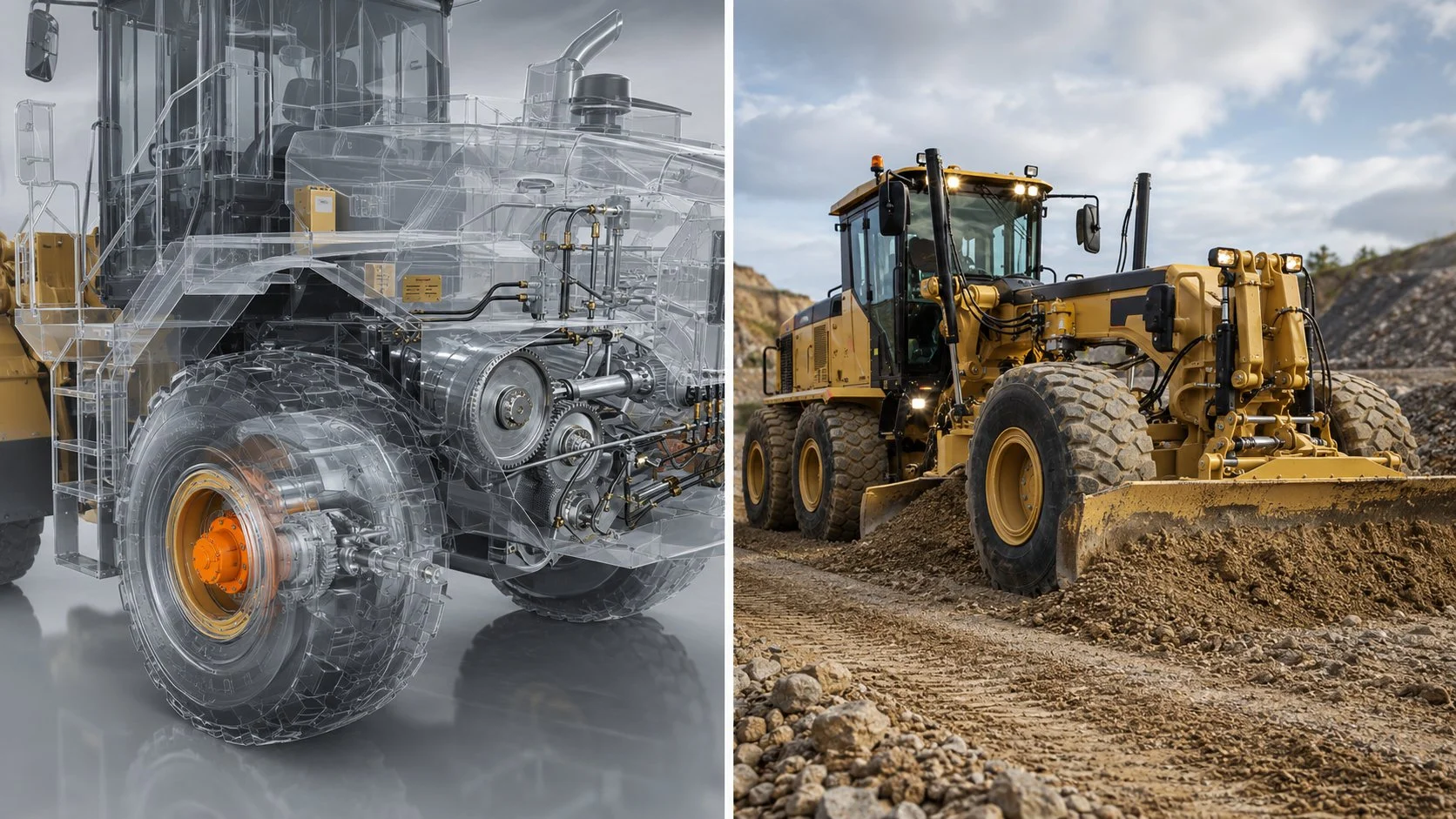
Each hammer impact produces a shock wave that propagates through the machine frame to every mounted component — including the เกียร์ทดรอบแบบเฟืองดาวเคราะห์ขับเคลื่อนล้อ. The vibration spectrum at the wheel drive mounting point is dominated by the hammer-impact frequency (rotor RPM x number of hammers = 100 to 500 impacts per second) superimposed on random boulder-strike events that produce transient acceleration peaks of 5 to 20 g at the mounting flange. This vibration environment is 3 to 10 times more severe than any other agricultural application — and is comparable to construction-equipment vibration levels on impact breakers and vibratory rollers.
The self-propelled stone crusher is the smaller, more manoeuvrable variant — weighing 8 to 25 tonnes with the crusher integrated into the chassis. The wheel drive provides both the travel propulsion and the ground speed regulation that determines the crushing depth and surface finish quality. The required ground speed is 0.5 to 3.0 km/h — ultra-low, similar to an apple harvester, but with vibration levels 50 to 100 times higher. The wheel drive must deliver the same low-speed precision as an orchard machine while withstanding the shock environment of a mining crusher.
Land clearing stone crushers are used in three primary applications: agricultural land reclamation (converting rocky pasture or forestry land into arable farmland), road and construction site preparation (reducing surface boulders to a compactable base layer), and pipeline and utility corridor clearing (preparing a stone-free strip for trenching). Each application subjects the wheel drive to the same vibration environment but different terrain conditions — from relatively flat pasture to steep hillsides with gradients of 20 to 40%. The machine must maintain the target ground speed regardless of the terrain slope, because the crushing depth and surface finish quality are directly proportional to the ground speed at a given rotor speed: faster travel produces a shallower, coarser finish; slower travel produces a deeper, finer finish.
The crushing process also generates enormous resistance forces. When the rotor engages a large boulder (300 to 500 mm), the machine must push forward against the crushing reaction force — which can reach 30 to 80 kN for hard igneous rock. This thrust demand is superimposed on the normal rolling resistance and grade-climbing force — producing total wheel drive torque demands that spike to 2 to 4 times the steady-state level for 1 to 5 seconds during boulder engagement. The wheel drive must deliver these torque spikes without wheel slip (which would change the crushing depth) and without speed hesitation (which would leave an unprocessed patch in the surface).
Vibration-Resistant Design — Construction-Grade Engineering in an Agricultural Package
Standard agricultural wheel drive planetary gearboxes are designed for vibration levels of 0.5 to 2 g at the mounting flange — adequate for harvesters, planters, and spreaders that operate on relatively smooth agricultural surfaces. A stone crusher wheel drive experiences 5 to 20 g peak accelerations — requiring construction-grade or mining-grade vibration resistance from an agricultural-sized package.
The vibration affects every component in the wheel drive. Gear teeth experience micro-oscillation at the mesh contact point — producing fretting damage similar to the transport-mode fretting on truck-mounted cranes, but at higher amplitude and frequency. Bearings experience vibration-induced micro-motion between the rolling elements and the raceways — producing false Brinelling marks that evolve into fatigue spalling within 500 to 1,500 hours if the bearing preload is insufficient to prevent the micro-motion. Fasteners (housing bolts, seal retainers, brake mounting bolts) experience vibration loosening — requiring thread-locking compounds or Nord-Lock washers on every critical joint.
The most effective design approach is to increase the bearing preload beyond the standard agricultural specification. A bearing preloaded to 5 to 8% of its dynamic load rating eliminates the micro-motion that causes false Brinelling — but increases the bearing friction and operating temperature by 10 to 20%. This trade-off (higher temperature for longer vibration life) is acceptable on a stone crusher because the operating speed is ultra-low (2 to 12 rpm at the output) and the bearing heat generation at these speeds is minimal even with elevated preload.
The housing mounting arrangement must also be vibration-hardened. Standard agricultural wheel drives are bolted to the axle housing with 4 to 8 bolts in a circular pattern. A stone crusher wheel drive should use 8 to 12 bolts with a combination of dowel pins (to prevent the housing from shifting under vibration) and Belleville washers (to maintain bolt tension despite the micro-displacement from repeated impacts). Without these reinforcements, the housing can shift 0.1 to 0.5 mm on its mounting — misaligning the output shaft relative to the tyre hub and producing uneven bearing loading that accelerates the vibration-related bearing damage.
The oil itself is affected by the vibration environment. Continuous high-amplitude vibration accelerates oil aeration — micro-bubbles of air are beaten into the oil by the vibrating gear mesh, reducing the effective oil volume and the oil film load-carrying capacity. Aerated oil compresses under gear-tooth contact pressure — producing a thinner film than non-aerated oil at the same viscosity. In severe cases, the aeration can reduce the effective film thickness by 20 to 40% — shifting the gear contact from full-film hydrodynamic lubrication to mixed or boundary lubrication, with the associated increase in wear rate. Anti-foam additives in the gear oil reduce the aeration tendency — but must be replenished at shorter intervals (every 500 hours versus 1,000 hours for non-vibration applications) because the vibration accelerates the additive depletion.
Stone Dust Sealing — Particles Finer Than Talcum Powder at 5 to 20 g Vibration
The crushing process generates enormous volumes of fine rock dust — particles of 1 to 100 microns that are smaller than the gap between a standard lip seal and its shaft. This dust is propelled at high velocity by the rotor — enveloping the entire machine in a cloud that penetrates every opening. The dust is also extremely abrasive: limestone dust has a Mohs hardness of 3; granite dust has a Mohs hardness of 6 to 7 — harder than the shaft steel (Mohs 5 to 6) and significantly harder than the seal lip material (Mohs 1 to 2).
The combination of ultra-fine abrasive dust and high vibration is the most severe sealing environment in agricultural equipment. The vibration causes the seal lip to micro-oscillate against the shaft — and the dust particles that have penetrated the labyrinth pre-seal are caught between the oscillating lip and the shaft, acting as a lapping compound. A standard agricultural seal that lasts 3,000 to 5,000 hours on a harvester may last only 300 to 800 hours on a stone crusher — because the vibration-amplified abrasion rate is 5 to 10 times higher.
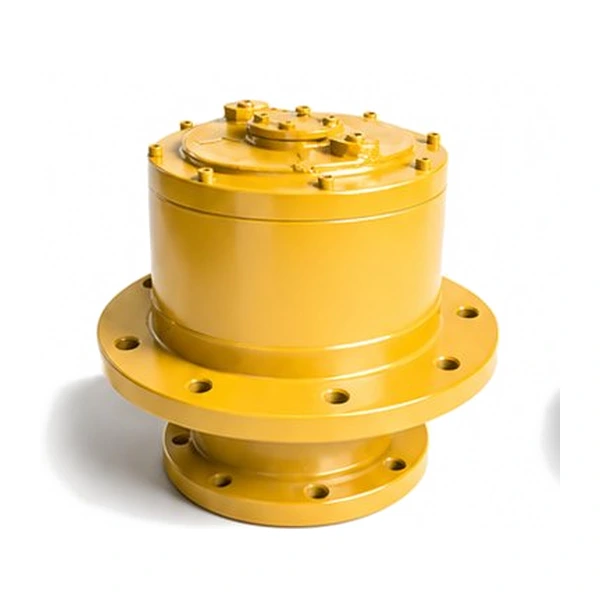
The sealing solution for stone crusher wheel drives borrows from the mining and construction industries: duo-cone metal face seals (two precision-lapped metal rings running against each other, with no elastomer contact on the shaft), positive-pressure air purge (a continuous air supply to the seal chamber that pressurises the cavity above the ambient dust pressure, preventing dust ingress), or combination labyrinth + face seal arrangements that provide 3 to 5 sequential barriers between the rock dust cloud and the เกียร์ทดรอบแบบเฟืองดาวเคราะห์ขับเคลื่อนล้อ oil.
Three Failure Modes Specific to Stone Crusher Wheel Drives
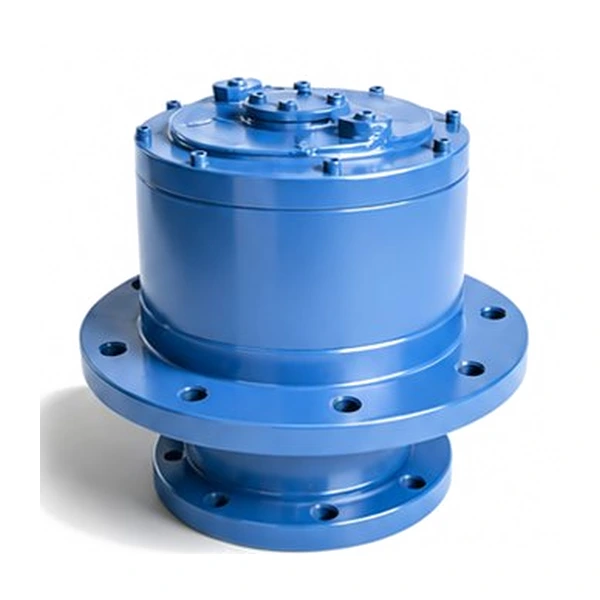
The 5 to 20 g vibration from the crusher rotor causes the bearing rolling elements to micro-oscillate against the raceways at the impact frequency. Each micro-oscillation displaces the lubricant film and produces a metal-to-metal contact mark. Over 500 to 1,500 hours, these marks deepen into visible false Brinelling indentations that increase the bearing noise, roughness, and play. Unlike true Brinelling (from a single overload event), false Brinelling develops gradually and is detectable only through vibration monitoring or bearing play measurement — by the time the operator hears the bearing, the raceway damage is already beyond recovery. The false Brinelling progression follows a predictable pattern: Phase 1 (0 to 500 hours) — micro-marks form but do not affect bearing function; Phase 2 (500 to 1,500 hours) — marks deepen to 5 to 15 microns, producing measurable increases in bearing play and vibration amplitude; Phase 3 (1,500 to 3,000 hours) — marks evolve into fatigue spalling initiation sites, producing audible noise and accelerating play growth; Phase 4 (beyond 3,000 hours) — spalling propagates around the raceway, producing rough running, excessive play, and risk of bearing seizure. The optimal replacement interval is during Phase 2, before the spalling initiation — detectable only through quantitative vibration analysis or bearing play measurement, not through subjective operator observation.
Granite dust (Mohs 6 to 7) is harder than the shaft steel (Mohs 5 to 6). When this dust penetrates the labyrinth pre-seal and reaches the primary seal lip, the vibration-induced micro-oscillation forces the hard particles against the softer shaft and seal surfaces — wearing both simultaneously. The seal lip wears through in 300 to 800 hours and the shaft surface develops a wear groove of 0.05 to 0.15 mm depth at the seal contact zone. Replacing the seal without resurfacing the shaft (or installing a shaft sleeve) produces an immediate re-leak because the new seal lip cannot conform to the worn groove profile.
The continuous 5 to 20 g vibration at the mounting flange systematically loosens every bolted joint on the wheel drive. Standard bolt-and-nut connections lose preload at a rate that depends on the vibration amplitude and frequency — and at stone-crusher vibration levels, an untreated M16 bolt can lose 30 to 50% of its initial preload within 200 to 500 hours. When the housing mounting bolts loosen, the housing shifts on its mounting — misaligning the output shaft, changing the bearing preload, and producing eccentric loading that accelerates all other failure modes simultaneously. A single loose housing bolt can initiate a cascade failure of bearings, seals, and gears within 100 to 200 hours of continued operation. The vibration-induced loosening is progressive and self-accelerating: as the bolt preload decreases, the joint stiffness decreases — allowing larger micro-displacements that further accelerate the preload loss. A bolt that loses 10% of its preload in the first 250 hours may lose 30% in the next 250 hours and 60% in the third 250 hours — following an exponential decay curve. This means the torque-check interval must be consistent (every 250 hours, not “when convenient”) — because a delayed check by 100 to 200 hours can miss the transition from recoverable preload loss to structural bolt failure.
Maintenance Economics — Why the Cheapest Wheel Drive Is the Most Expensive
A standard agricultural wheel drive costs 30 to 50% less than a vibration-hardened stone-crusher specification — but its service life in the crusher environment is 40 to 60% shorter. The total cost of ownership over 6,000 operating hours: a standard drive at USD 2,500 with 1,500-hour replacement interval = 4 replacements = USD 10,000 plus 4 days of machine downtime. A vibration-hardened drive at USD 4,000 with 3,500-hour replacement interval = 1.7 replacements = USD 6,800 plus 2 days of downtime. The higher initial cost saves USD 3,200 and 2 days of downtime over the machine life — making the specification upgrade one of the clearest return-on-investment decisions in the land clearing equipment industry.
คำถามที่พบบ่อย
Korea Ever-Power provides stone crusher wheel drives from 5,000 to 35,000 Nm with mining-grade vibration resistance, duo-cone sealing, and reinforced mounting.
บรรณาธิการ: Cxm