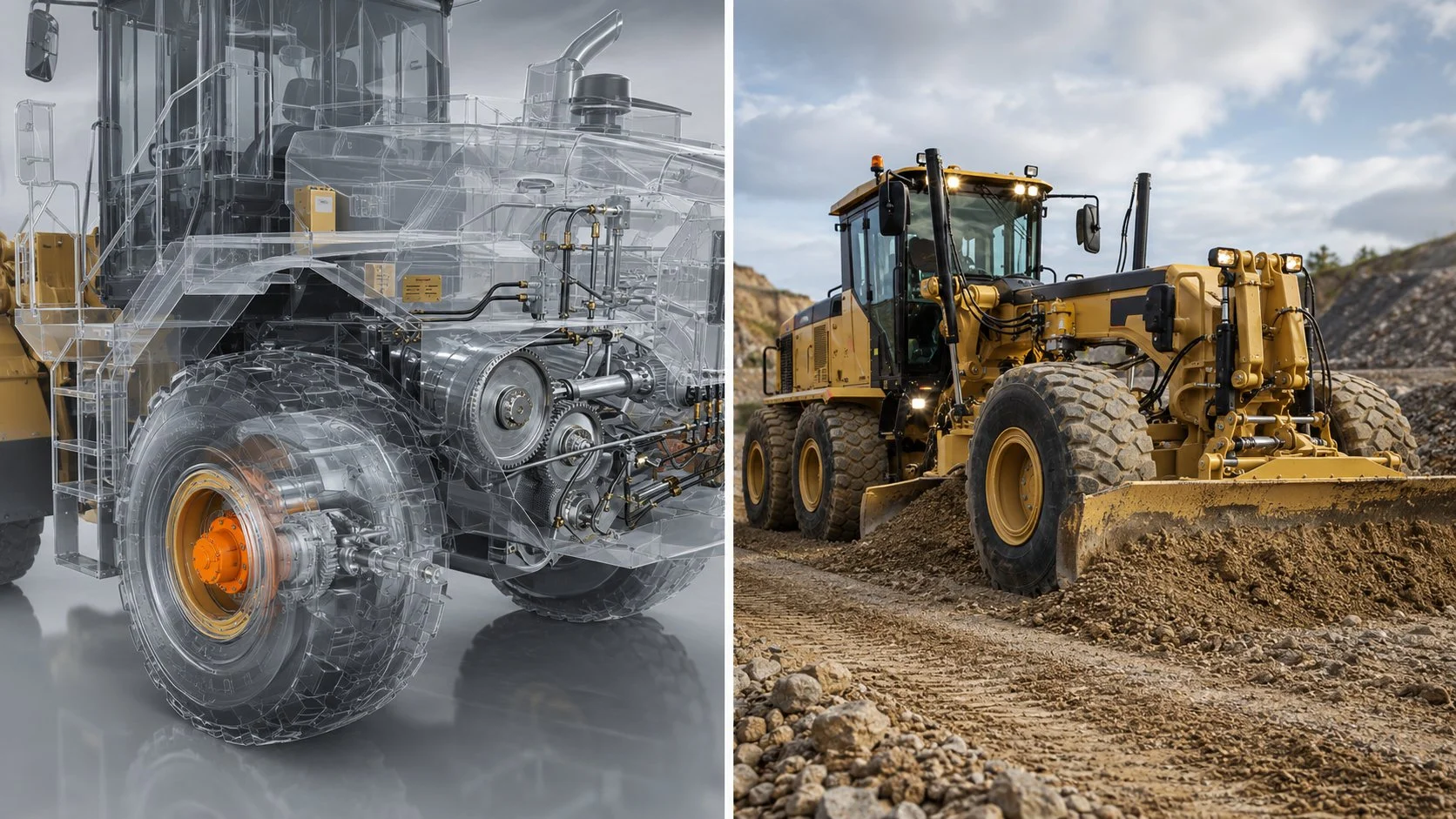
Variable Machine Weight — The Engineering Challenge Unique to Bunker Harvesters
No other self-propelled agricultural machine changes weight as dramatically during operation as a potato harvester with an onboard bunker. A combine harvester fills a grain tank that adds 5 to 8 tonnes — approximately 30 to 40% of the empty machine weight. A self-propelled potato harvester fills a bunker that adds 10 to 14 tonnes — approximately 55 to 80% of the empty weight. This weight change occurs within a single field pass of 200 to 500 metres, and the เกียร์ทดรอบแบบเฟืองดาวเคราะห์ขับเคลื่อนล้อ must accommodate it continuously.
The weight change affects the wheel drive in three simultaneous ways. First, the rolling resistance increases proportionally with weight — at a rolling resistance coefficient of 0.10 on tilled soil, the traction demand increases from 17.7 kN (empty) to 31.4 kN (full), an 80% increase. The wheel drive must provide this additional torque while maintaining the same ground speed — meaning the hydraulic system must increase the flow or pressure to the wheel motors as the bunker fills. Second, the axle load distribution shifts as the bunker fills — the rear axle (under the bunker) carries progressively more of the total weight, potentially exceeding the tyre load rating if the bunker is filled beyond the design capacity. Third, the ground pressure under each tyre increases with weight, eventually exceeding the soil bearing capacity and causing the machine to sink — creating ruts that increase the rolling resistance further in a self-reinforcing cycle.
The hydrostatic drive system compensates for the increasing weight automatically — the hydraulic pump maintains constant flow (speed) while the system pressure rises to match the increasing torque demand. But this compensation has a limit: when the system pressure reaches the pump relief valve setting (typically 350 to 420 bar), no additional torque is available — and the machine either slows down or the wheels spin. The wheel drive planetary gearbox ratio must be selected so that the maximum required traction force (at full bunker weight, on soft soil, on the steepest field slope) does not exceed the hydraulic system pressure limit at the target harvesting speed.
The bunker weight also affects the braking requirement. A full-bunker machine on a 5% downhill slope generates a gravitational force of approximately 15.7 kN — which the wheel drive brakes must absorb continuously during descent. If the operator simultaneously needs to reduce speed for a headland turn, the braking demand spikes to 25 to 40 kN. The wheel drive parking brake must hold the full-bunker machine on the maximum rated slope (typically 8 to 12%) — a holding force requirement that is 80% higher than the empty-bunker case. Brake systems sized for the empty machine will slip on slopes when the bunker is full — a particularly dangerous situation because the machine is heaviest at the moment of maximum gravitational force.
Digging-Speed Synchronisation — Why ±5% Speed Accuracy Determines Crop Quality
The potato harvester digging mechanism consists of a share (blade) that lifts the potato-containing soil onto a series of separation webs (agitating screens) that sift the soil away from the potatoes. The web speed, agitation frequency, and separation efficiency are all calibrated for a specific ground speed. If the wheel drive delivers a ground speed that deviates from the calibrated value, the potato quality suffers.
| Speed Error | Effect on Web | Crop Impact |
|---|---|---|
| Too fast (>+10%) | Web overloaded with soil | Incomplete separation — potatoes buried in soil clods in the bunker |
| Too slow (>-10%) | Web under-loaded | Over-agitation — skin damage, bruising, reduced storage life |
| Pulsation (±5%) | Uneven soil feed | Alternating pile-up and starvation — intermittent bruising |
The typical harvesting speed for potatoes is 3 to 6 km/h — slower than forage harvesting but faster than apple harvesting. At this speed, the wheel drive output shaft rotates at approximately 8 to 20 rpm. The speed accuracy must be within ±5% of the target — meaning the wheel drive and hydraulic system together must maintain speed to within ±0.15 to 0.30 km/h across the full range of bunker weights, soil conditions, and terrain slopes.
This speed accuracy must be maintained while the traction demand changes continuously — because the soil texture, moisture content, and stone population vary within the same field. A patch of clay soil increases the rolling resistance by 30 to 50% compared to sandy loam — and the speed control system must compensate within 1 to 2 seconds to prevent the web from overloading or starving. The เกียร์ทดรอบแบบเฟืองดาวเคราะห์ขับเคลื่อนล้อ must transmit these continuous torque variations without introducing its own speed errors from backlash, gear mesh pulsation, or bearing friction variations.
The relationship between ground speed and crop quality is measurable in the packhouse. Potatoes harvested at the correct speed (3 to 6 km/h depending on the variety, soil moisture, and stone content) show internal bruise rates of 5 to 10% at grading. Potatoes harvested 20% too fast show bruise rates of 15 to 25% — because the overloaded web produces higher impact forces during the soil separation process. Potatoes harvested 20% too slow show skin damage rates of 10 to 20% — because the under-loaded web exposes the tubers to excessive agitation time. These quality differences translate directly to market value: fresh-market potatoes with less than 10% internal bruising command a price premium of 20 to 40% over processing-grade potatoes with higher damage levels. The wheel drive speed accuracy therefore has a direct, quantifiable effect on the revenue per hectare of the potato crop.
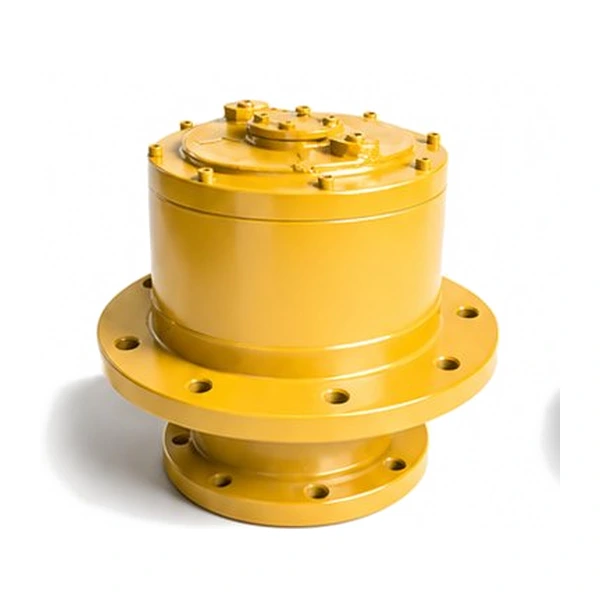
Tilled-Soil Traction — The Paradox of Ground Prepared for Easy Digging
Potato fields are cultivated specifically to make the soil loose and easy to lift — because the digging share must separate the tubers from the surrounding soil without cutting or bruising them. This cultivation (ploughing, destoning, bed formation) reduces the soil shear strength from 150 to 300 kPa (undisturbed soil) to 30 to 80 kPa (cultivated bed) — making the soil easy to dig but difficult to drive on.
The wheel drive must generate traction on soil that has been deliberately weakened. The maximum traction coefficient on a cultivated potato bed is approximately 0.25 to 0.40 — compared to 0.50 to 0.70 on undisturbed stubble. At 0.30 coefficient on a full-bunker rear axle load of 18 tonnes, the maximum traction per rear axle is approximately 53 kN — and the rolling resistance of the 32-tonne machine on the soft bed already consumes 25 to 35 kN of this, leaving only 18 to 28 kN for the digging draft force. If the digging share encounters a compacted zone (residual plough pan) or a stone concentration, the draft force spikes above the available traction surplus — and the wheels spin.
Four-wheel drive is therefore standard on self-propelled potato harvesters above 25 tonnes operating weight. The front axle carries approximately 40% of the machine weight with empty bunker — providing supplementary traction that increases the total available force by 60 to 80% compared to rear-wheel drive alone. Each wheel requires its own planetary gearbox — typically 4 units on a 4WD machine. The front wheel drives must accommodate a steering articulation of ±30 to 45 degrees while maintaining the drive connection — requiring either a constant-velocity joint between the drive and the steered hub, or a wheel-hub-integrated planetary gearbox that turns with the wheel.
The traction control system must also prevent the uphill-side wheels from spinning on cross-slope passes. On a 5% cross-slope, the weight transfer from the uphill to the downhill side reduces the uphill wheel traction by 8 to 12% — and the soft, cultivated soil provides no progressive grip recovery (unlike hard soil where the tyre digs in and finds grip). The wheel drive must include a traction-limiting function (either hydraulic pressure limiting per wheel or electronic slip control) that prevents the uphill wheel from spinning while directing the available torque to the downhill wheel. The traction control response time must be faster than the wheel-slip development time — typically less than 200 milliseconds from the first detection of slip to the torque reduction at the spinning wheel. On soft cultivated soil, a spinning wheel can excavate a 50 to 100 mm deep rut within 1 to 2 seconds of continuous slip — destroying the potato bed structure and potentially damaging the tubers in the adjacent rows. Fast-reacting electronic traction control with individual wheel-motor pressure limiting is therefore not just a traction optimization feature — it is a crop-protection requirement.
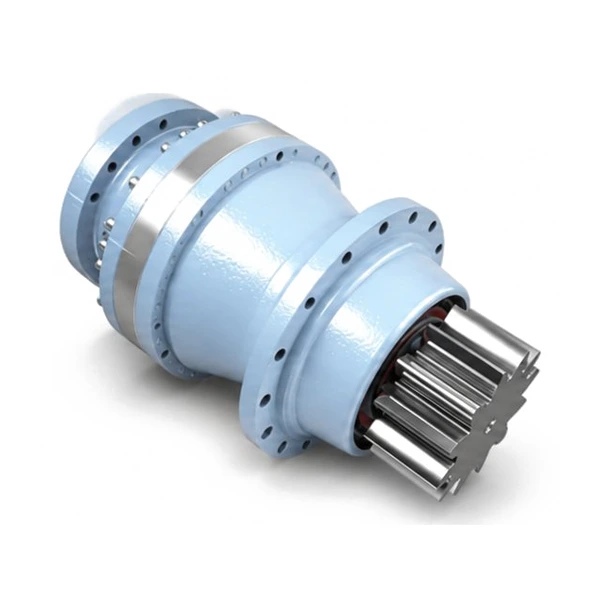
Three Failure Modes Specific to Potato Harvester Wheel Drives
The wheel drive output bearing carries the full axle load — which increases by 80% as the bunker fills. On soft tilled soil, each wheel encounter with a rut, furrow ridge, or stone produces an impact load that is superimposed on the static weight. The dynamic bearing load during full-bunker operation on rough tilled soil can reach 1.8 to 2.5 times the static empty-bunker load — a peak that the bearing must withstand without surface damage. Bearings sized for the empty-bunker static load will develop fatigue spalling at the full-bunker dynamic load within 1,000 to 2,000 hours — less than half the expected service life. The bearing must be sized for the full-bunker dynamic load with a minimum safety factor of 1.5.
Potato field soil is deliberately cultivated to a fine, loose texture — producing particles of 0.05 to 2 mm that penetrate every crevice of the wheel drive assembly. The soil collects at the tyre-to-hub interface and is drawn into the shaft seal contact by capillary action and vibration. Unlike the coarse sand and gravel that construction-equipment seals encounter (which is deflected by labyrinth pre-seals), the fine potato-field soil passes through standard labyrinth gaps and reaches the primary seal lip. Once between the lip and shaft, these particles act as a 0.05 to 2 mm grinding compound — wearing through the seal lip at 3 to 5 times the rate experienced on coarser soils.
Potato fields contain stones ranging from gravel to boulders — despite destoning operations that remove the largest stones before planting. When the digging share strikes a buried stone, the resulting draft-force spike is transmitted through the machine frame to the wheel drives as a momentary traction surge (the share pushes back, the wheels push forward). Simultaneously, the wheels may run over stones ejected from the digging web, producing impact loads at the wheel-to-ground interface. These stone-induced shock loads can reach 2 to 4 times the mean running torque — and occur at rates of 5 to 50 per minute in stony fields. The cumulative shock loading over a 400-hour harvest season can exceed the fatigue budget of standard industrial gears by 200 to 300%.
คำถามที่พบบ่อย
Korea Ever-Power provides potato harvester wheel drives from 5,000 to 40,000 Nm with full-bunker bearing ratings, fine-soil seal protection, and stone-impact gear resilience.
บรรณาธิการ: Cxm