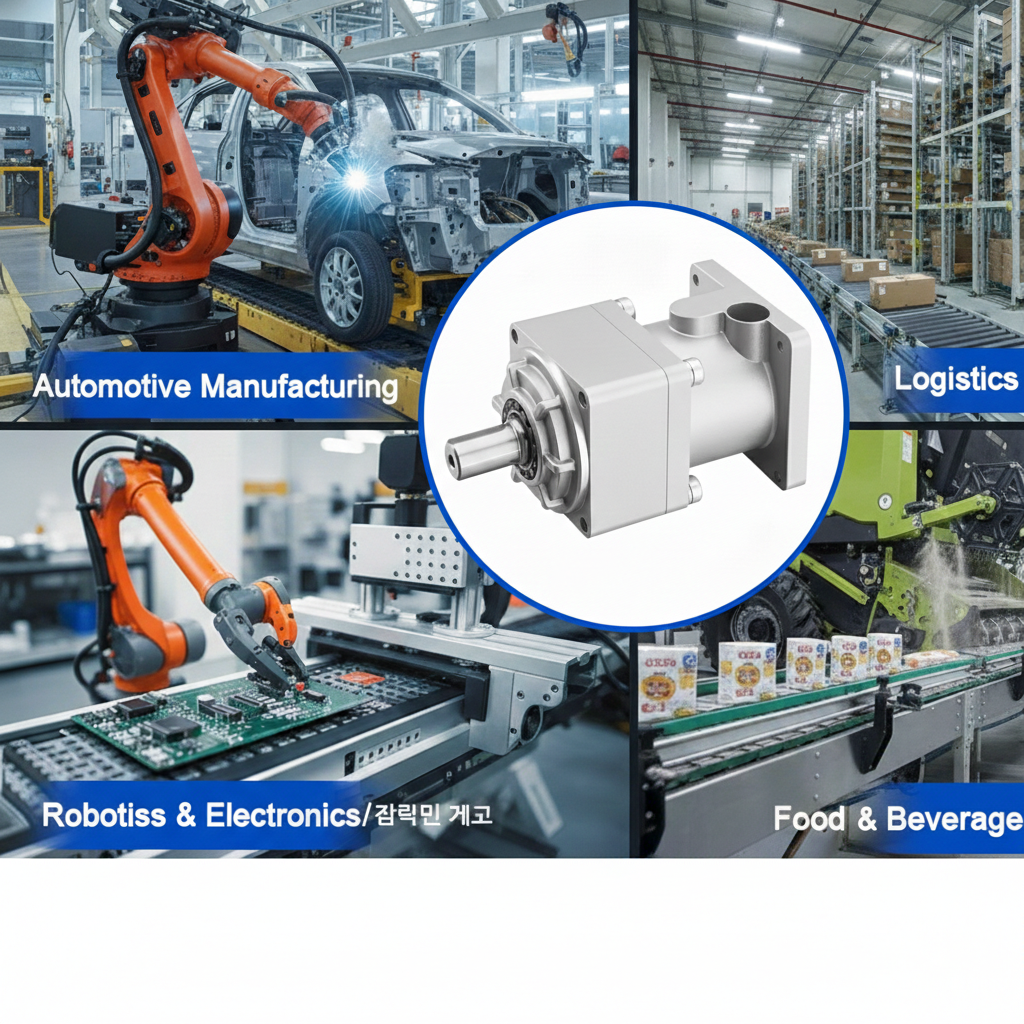
Why AGV Drive Gearboxes Are Fundamentally Different from Industrial Robot Joints
A planetary gearbox AGV drive application differs from industrial robot joints in five critical ways that Korean engineers often overlook when first specifying mobile robot drives. Engineers coming from their experience with industrial robot joint gearboxes — and arrive at the wrong specifications. The surface similarity (both are compact, precision, servo-driven gearboxes) conceals five fundamental specification differences that produce incorrect selections if robot joint criteria are applied directly to AGV drives.
| Özellikler | Industrial Robot Joint | AGV Drive Wheel |
|---|---|---|
| Primary accuracy need | Backlash ≤1 arcmin (TCP) | Speed ratio matched ±0.01% |
| Reversal frequency | Millions/year (welding) | Occasional (path corners) |
| Noise sensitivity | Moderate (factory noise) | Critical — human-sharing space |
| Maintenance access | Annual inspection OK | Zero — no stop, sealed for life |
| Radial load source | Arm weight / tool force | Floor irregularities + AGV weight |
| Key failure consequence | Weld miss / part reject | Collision / production halt |
The most important insight in this comparison: backlash grade is Olumsuz the primary specification for AGV drive wheel gearboxes. An AGV drive wheel gearbox with P0 ≤1 arcmin backlash will still derail the AGV if the two drive wheels have different gear ratios — even a 0.01% ratio difference accumulates visible trajectory drift over a 10-metre travel segment. Ratio matching accuracy between the two drive gearboxes matters far more than individual backlash grade for AGV trajectory control.
Korean AGV/AMR Market Context
AGV Drive Wheel Torque Calculation — Load, Incline, and Acceleration Components
The drive wheel gearbox output torque for an AGV combines three components: rolling resistance torque, incline torque, and acceleration torque. Unlike industrial robot joints where arm weight and cutting forces dominate, AGV drive torque is primarily determined by the total vehicle weight (AGV chassis + payload) and the floor surface condition.
AGV DRIVE WHEEL TORQUE CALCULATION
T_drive = T_rolling + T_incline + T_accel
T_rolling = μ_r × M_total × g × r_wheel / N_wheels
μ_r = rolling resistance coeff (0.01–0.03)
M_total = AGV mass + payload (kg)
r_wheel = drive wheel radius (m)
N_wheels = number of drive wheels
T_incline = M_total × g × sin(θ) × r_wheel / N_wheels
T_accel = (M_total / N_wheels) × a × r_wheel
a = max acceleration (m/s²)
Example — 500 kg e-comm AMR:
M = 200 kg AGV + 500 kg payload = 700 kg
r = 0.10 m, N=2, μ_r=0.015, a=0.5 m/s²
T_roll = 0.015×700×9.81×0.1/2 = 5.15 N·m
T_incl = 700×9.81×sin(2°)×0.1/2 = 1.20 N·m
T_accel = (700/2)×0.5×0.1 = 17.5 N·m
T_total = 5.15+1.20+17.5 = 23.9 N·m/wheel
With SF=1.5: T_rated = 35.8 N·m
Note that the acceleration torque (17.5 N·m) dominates over rolling resistance (5.15 N·m) in this example — because e-commerce AMRs accelerate aggressively (0.5 m/s²) to maintain throughput. For automotive assembly AGVs that accelerate gently (0.1 m/s²) but carry heavier payloads, the rolling resistance and incline terms dominate. Always calculate all three components; never estimate from a single term.
AGV Type → Drive Torque and Series Selection
| AGV Type | Payload | T/wheel | Seri |
|---|---|---|---|
| Hospital AMR (drug delivery) | 30–80 kg | 5–12 N·m | EP-ADS 047 |
| E-commerce AMR | 200–500 kg | 20–50 N·m | EP-AB 060 |
| Semiconductor fab AGV | 50–200 kg | 10–30 N·m | EP-KF (indoor) |
| Auto assembly floor AGV | 500–2,000 kg | 80–250 N·m | EP-AB 090/115 |
| Heavy industrial tow AGV | 2,000–10,000 kg | 200–800 N·m | EP-AH Yeni Seri |
Differential Drive Synchronisation — How 0.01% Speed Error Causes 100 mm Drift per Kilometre
For any planetary gearbox AGV with differential drive architecture — the most common Korean AGV navigation configuration — the dominant navigation consideration is: two independently driven wheels on either side of the vehicle centreline, with speed difference between the two wheels producing turning. Straight-line travel requires both wheels to rotate at exactly the same speed. Any permanent speed difference between the two drive wheels — caused by a gear ratio mismatch between the two gearboxes — produces a systematic trajectory curve that the navigation system must continuously correct.
The quantitative relationship between gearbox ratio mismatch and trajectory drift is derived geometrically. If the left wheel travels at speed v_L and the right wheel at v_R, the AGV traces an arc of radius R = W × v_mean / (v_L – v_R), where W is the wheel track width. Over a distance D of straight-line travel, the lateral deviation Δy from the commanded straight path is:
RATIO MISMATCH → TRAJECTORY DRIFT
Δi = ratio mismatch (fraction)Arc radius: R = W × v / δv
= W / (Δi/i) = W × i / ΔiDrift over D metres:
Δy ≈ D² / (2R) for small anglesExample: W=0.5m, i=20, v=1m/s
Δi/i = 0.01% = 0.0001
R = 0.5 / 0.0001 = 5,000 m
Over D=10m: Δy = 100/(2×5000)
= 0.010 m = 10 mm driftOver D=100m (1 km): Δy ≈ 1,000 mm = 1 metre!
This calculation shows why Korea Ever-Power recommends ordering AGV drive gearbox pairs from the same production batch. Units from the same production batch have consistent gear grinding that produces ratio variation of ±0.005% or less — orders of magnitude better than the worst-case catalogue tolerance of ±0.1–0.5%. When the two drive gearboxes come from different batches, the batch-to-batch ratio variation can reach 0.05–0.1%, producing drift of 50–100 mm per 10 metres — enough to cause repeated navigation corrections and eventual lane departure at longer travel distances.
Specify in the purchase order: “Matched pair — both units from same production batch, ratio variation ≤0.01%.” Korea Ever-Power EP-AB and EP-KF series can be supplied as matched pairs with measured ratio certificates for both units, confirming the ratio difference between the pair. This eliminates the most common source of AGV differential drive trajectory error at the gearbox level.
≤0.5 mm
1 mm
5 mm
10 mm
Magnetic tape lane width: typically ±20–40 mm. Even 10 mm drift requires frequent correction that limits maximum AGV speed.
Low Noise — Why AGV Gearbox Sound Level Is a Safety and Regulatory Requirement
Unlike traditional industrial robots operating behind safety fences, Korean AGVs and AMRs share workspace with human operators — this is the defining architectural difference that makes noise a safety issue rather than a comfort preference. When an AGV approaches a human operator from behind, the ambient warning is its operating sound. A quiet AGV gives the operator more time to notice and step aside; a noisy AGV’s approach signal is masked by surrounding machinery noise.
Korean occupational safety regulations require collaborative mobile robots to emit an audible warning when approaching humans — but the regulations also set workplace noise limits at 85 dB(A). The effective warning sound from an AGV drive system must be detectable above ambient but must not itself contribute to the cumulative workplace noise exposure that approaches the regulatory limit. This creates a design band: the AGV drive gearbox noise should be low enough to not contribute to ambient noise accumulation, while the AGV’s separate audible warning system provides the detectable approach signal.
For Korean hospital AMRs, pharmaceutical cleanroom AGVs, and electronics assembly AMRs, drive noise directly affects operator environment quality in sustained work settings. The EP-KF/KH hypoid gear series produces measurably lower operating noise than standard planetary at equivalent torque — the curved spiral contact geometry distributes tooth engagement load over a larger face area, reducing the peak mesh impact and the resulting acoustic radiation. Measured at 1 m, EP-KF at equivalent torque and speed is typically 6–8 dB(A) lower than a standard EP-AB planetary unit.
⚠ KF/KH temperature limit — indoor AGV only:
EP-KF/KH hipoid serisi şunlara sahiptir: Minimum çalışma sıcaklığı 0°C. This restriction confines its AGV use to indoor facilities where the ambient temperature is reliably above 0°C year-round: Korean semiconductor fabs (typically 20–22°C constant), Korean e-commerce fulfilment centres (5–20°C), hospital corridors (18–24°C). Do not specify EP-KF/KH for outdoor yard AGVs, dock-level AGVs that cross outdoor weather exposure, or any facility where temperatures may drop below 0°C. For those environments, use standard EP-AB series (−10°C rated) with a sound dampening enclosure if noise reduction is also needed.
Drive Noise at 1 m — Same Speed/Torque
~66 dB(A) ★
~73 dB(A)
85 dB(A)
7 dB(A) difference = roughly half perceived loudness. In a Korean hospital/pharma setting, this directly affects patient and worker environment quality. KF/KH: indoor 0°C+ only.
| AGV Environment | Min Temp | Vites kutusu |
|---|---|---|
| Semiconductor fab | 20°C | KF/KH ✓ |
| E-comm fulfilment | 5°C | KF/KH ✓ |
| Cold store AGV | −5°C | EP-AB ✓ NOT KF |
| Outdoor yard AGV | −10°C | EP-AB ✓ NOT KF |
Zero-Maintenance Operation — Why AGV Gearboxes Cannot Require Scheduled Service
Industrial robot joints and CNC machine tool gearboxes can be accessed for annual inspection during planned maintenance shutdowns. AGVs and AMRs in Korean operations typically run 24 hours a day, 365 days a year, with the only scheduled stops being battery charging cycles (for battery-powered AGVs) or wire-guided charging pauses. These charging pauses (typically 15–30 minutes every 4–8 hours) are the only available maintenance windows — and they are not long enough, nor are they appropriately equipped for gearbox maintenance.
This operational reality transforms sealed-grease gearbox construction from a convenience feature to a functional requirement. A gearbox that requires periodic re-lubrication, oil level checks, or seal inspection is simply incompatible with 24/7 AGV operation unless the entire fleet is scheduled for maintenance shutdowns — which defeats the economic case for AGV automation.
All Korea Ever-Power EP planetary series use permanently sealed grease that does not require periodic replacement — the factory fill is designed to last the full gearbox service life (20,000 operating hours) under normal conditions. At 8,760 operating hours per year for a 24/7 AGV, this provides approximately 2.3 years of maintenance-free operation per gearbox. At 6,000 hours per year (accounting for charging and downtime), the gearbox life extends to 3.3 years before replacement is warranted.
The practical trigger for AGV gearbox replacement is not a fixed calendar date but a functional symptom: increasing trajectory drift that requires more frequent navigation corrections (visible as more frequent servo correction events in the fleet management system log), or audible change in drive noise characteristic. For proactive planning: schedule gearbox replacement at 18,000–20,000 operating hours, coordinated with battery replacement cycles when available, to avoid unplanned downtime.
8,760 h/yr → replace 2.3 yr
6,300 h/yr → replace 3.2 yr
4,200 h/yr → replace 4.8 yr
2,500 h/yr → replace 8.0 yr
Based on EP-AB 20,000h design life. Sealed grease — no periodic maintenance required during service life.
AGV Steering Axis — Right-Angle Output for Compact Turntable Design
Omnidirectional AGVs and Mecanum wheel AMRs use a dedicated steering axis that rotates the entire drive module (motor + gearbox + wheel) around a vertical axis, allowing the AGV to navigate in any direction without turning the vehicle body. This steering turntable drive has different requirements from the drive wheel gearbox: very low output speed (full rotation in 2–5 seconds, or 0.2–0.5 rpm), high torque to overcome the friction of the loaded drive wheel against the floor, and a compact axial depth to minimise the turntable height within the AGV chassis.
The right-angle planetary gearbox is the standard solution for omnidirectional AGV steering: the motor mounts horizontally inside the AGV chassis, and the right-angle output shaft drives the turntable vertically. This eliminates the vertical motor height that would be required by an inline gearbox — a critical dimension reduction in flat AGVs designed to slide under shelving units.
O EP-ABR right-angle series at i=80–100 covers the typical steering turntable requirement: 0.3–0.8 rpm output from a 3,000 rpm servo motor at the ratio. P1 backlash is adequate for steering — the angular positioning of the drive module direction requires ±2–5 arcmin repeatability to achieve the target heading, well within P1 capability. The right-angle output positions the motor outside the turntable footprint, maintaining the minimum AGV body height.
AGV Steering Turntable — Layout Comparison
[Motor] ↑ tall
[Inline PGB] ↑ adds height
[Turntable] AGV body high ←
[Drive wheel]Right-angle EP-ABR (motor horizontal):
━[Motor]━[EP-ABR]
↓ R/A output
[Turntable] AGV body low ✓
[Drive wheel]Height saving: 80–150 mm depending on
motor frame size. Critical for under-
shelving AGV (chassis height ≤220 mm).
EP-ABR060 P1 i=80 on all four steering turntables of a Korean e-commerce under-shelf AMR. Horizontal motor placement reduced turntable assembly height by 95 mm vs inline layout — enabling the AMR to navigate under 250 mm shelf clearance that would have been inaccessible with vertical motor layout.
Semiconductor Fab and Cleanroom AGV — Particle, Outgassing, and Non-Magnetic Requirements
Korean semiconductor wafer fab AGVs operating in ISO Class 4–6 cleanrooms impose the most stringent gearbox environmental specifications in Korean industry. The cleanroom AGV gearbox must be designed and documented to demonstrate three properties beyond normal industrial specifications: low particle generation, low outgassing, and non-magnetic construction where required for MRAM or magnetic storage layer fab environments.
Particle generation: A standard planetary gearbox uses greases containing compounds that can migrate as aerosol particles when the gearbox temperature cycles. Cleanroom gearboxes use PFPE (perfluoropolyether) or equivalent cleanroom-certified lubricants with ultra-low particle generation rates, combined with sealed housings that prevent any lubricant migration to the external surfaces. Korea Ever-Power can specify cleanroom-compatible lubricant in lieu of standard EP grease for semiconductor fab AGV orders — request “semiconductor cleanroom grease” at order time.
Outgassing: Standard plastics used in gearbox seals and coatings can outgas volatile organic compounds (VOCs) in cleanroom environments, contaminating the controlled atmosphere. Cleanroom-specified EP gearboxes use low-outgassing seal materials (FFKM fluoroelastomer) and coating systems with measured outgassing rates within fab facility specifications.
Non-magnetic materials: Advanced MRAM (Magnetic Random Access Memory) and spin-torque device fabrication lines require a magnetic-field-free environment in the wafer transport zone. Standard steel gear components are ferromagnetic — in sensitive fab zones, non-magnetic stainless steel variants or aluminium housing configurations may be required. Discuss this requirement explicitly with Korea Ever-Power for any semiconductor fab AGV order where magnetic contamination is a process concern.
Korea Ever-Power AGV/AMR Series Quick Reference
| AGV / Drive Type | Seri | Temel Özellikler | Seçim Nedeni |
|---|---|---|---|
| Semiconductor fab / hospital (indoor, low noise) | EP-KF ⚠0°C min | ~66 dB(A) | Lowest noise; cleanroom grease option; hollow shaft available |
| E-commerce AMR drive wheel | EP-AB 060 (matched pair) | Ratio ≤0.01% | Same-batch matched pairs for differential sync; −10°C for unheated warehouse |
| Hospital/pharma AMR (ultra-quiet, compact) | EP-ADS 047 | 47mm body | Compact OD for small AMR; non-std ratio i=21 for speed matching without VFD |
| Auto assembly floor AGV (heavy payload) | EP-AB 090/115 | P1–P2 | 500–2,000 kg payload; no precision needed for speed drive; sealed grease |
| AGV steering turntable (omnidirectional) | EP-ABR 060 P1 i=80 | R/A output | Horizontal motor saves 80–150mm chassis height for under-shelf AGV |
| Cold store AGV (−5 to −10°C) | EP-AB (NOT KF/KH) | −10°C rated | KF/KH 0°C limit excluded for cold store; standard EP-AB −10°C covers Korean cold chain |
Frequently Asked Questions — Planetary Gearbox for AGV and AMR Drives
Specify Your AGV Drive Gearboxes with Korea Ever-Power
Korea Ever-Power supplies matched drive wheel pairs with ratio variation certificates, cleanroom lubricant specification for semiconductor fab AGV, and steering turntable right-angle configurations — in Korean, same working day.
Editör: Cxm