ZR95 Winch Drive Planetary Gearbox — Right-Angle
PEAK ≈ 417W3 MEGA-CLASS
ZR95 — 115,000 Nm
The 2-stage threshold. Beyond here, minimum stages rise.
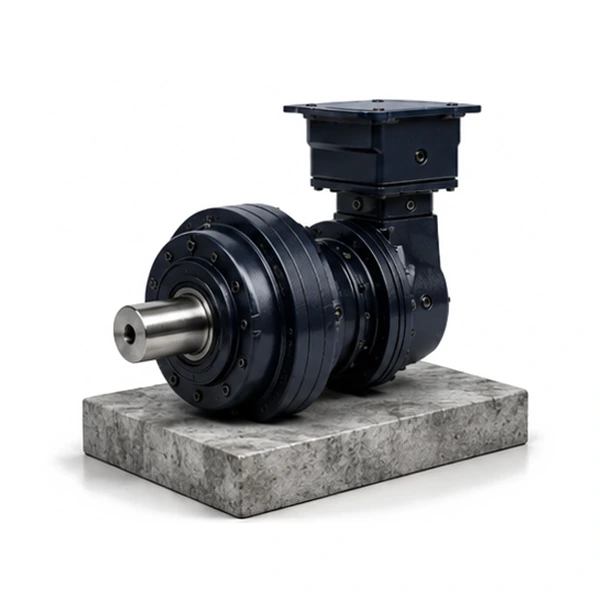
The EP-ZR95 is the fourth model in the right-angle vinç tahrik planet dişli kutusu series — and the last to offer the compact 2-stage configuration (1 bevel + 1 planetary). After the ZR95, the bevel gear at higher torques becomes too heavily loaded at 2-stage ratios, and the minimum rises to 3 stages.
The ZR95 occupies a pivotal position in the ZR right-angle catalogue. It is the largest model that still accommodates 2-stage configurations (bevel + 1 planetary) — offering the most compact axial length for applications where the installation depth behind the drum is severely constrained. Beyond 115,000 Nm, the bevel gear tooth loading at 2-stage ratios exceeds the tooth bending endurance limit at the 100,000-hour design life, and the catalogue mandates a minimum of 3 stages (ZR120, ZR150) or 4 stages (ZR200) to distribute the torque across more gear meshes. For winch system designers who need the highest torque from the shortest right-angle gearbox, the ZR95 at 2-stage is the catalogue maximum.
ZR95 Right-Angle Winch Drive Planetary Gearbox — Technical Parameters
| Continuous torque (N2xh=100,000) | 115,000 Nm |
| Peak torque | 245,000 Nm (2.13x continuous) |
| Input configuration | Right-angle (90 deg helical bevel + planetary) |
| Maksimum giriş hızı | 3,100 rpm (last ZR model at 3,100) |
| Available stages | 2-5 (last ZR model with 2-stage option) |
| Thermal power (Pt) | 26 - 90 kW |
| Gear type | Helical bevel + helical planetary, DIN 5-6 |
| Integrated brake / Sealing | None / IP67+ FKM |
| Housing / Gear material | QT600-3 / 20CrMnTi HRC 58-62 |
The Last 2-Stage Right-Angle — Why 115,000 Nm Is the Boundary
The ZR series minimum stage count is not arbitrary — it follows directly from the bevel gear tooth loading at each torque level.
At 2-Stage (Bevel + 1 Planetary)
The bevel gear pair carries the full input torque from the motor, and the single planetary stage carries the full output torque to the drum. The bevel tooth bending stress at 115,000 Nm output through a typical 2-stage ratio (15-50) is at approximately 85-90% of the 100,000-hour endurance limit. This is acceptable — but at 133,000 Nm (ZR120), the same 2-stage configuration would push the bevel tooth stress to 98-103% of the endurance limit, which is structurally marginal. The ZR95 is the last model where 2-stage stays below the 90% threshold.
At 3-Stage and Beyond (Bevel + 2+ Planetary)
Adding a second planetary stage (making 3 total) splits the torque path into a lower-ratio-per-stage cascade. The bevel stage now carries lower input torque (because the first planetary stage provides additional reduction before the bevel reaches its full load), and the bevel tooth stress drops to 70-75% of the endurance limit at ZR120 torque. For the ZR120, ZR150, and ZR200, 3-stage minimum (or 4-stage for ZR200) keeps all components within the 85% stress ceiling. The result: the compact 2-stage option disappears above 115,000 Nm, and the gearbox gets approximately 80-100 mm longer.
If the installation needs the shortest possible right-angle gearbox at the highest possible torque, the ZR95 at 2-stage is the catalogue answer — 115,000 Nm in approximately 350-400 mm of axial depth behind the drum. No other right-angle winch drive in the catalogue delivers more torque in less space. Contact Kore'nin Daimi Gücü for exact 2-stage dimensional data at your specific ratio.
245,000 Nm Peak — Engineering the Bevel Turn at Near-Mega-Class Transients
At 245,000 Nm peak, the ZR95 bevel gear pair transmits a torque that approaches the 4xxW 417W3 mega-class continuous (250,000 Nm) — through a 90-degree turn that the coaxial 417W3 never encounters. The bevel stage engineering at this load level is a decisive factor in the ZR95 design.
At 245,000 Nm peak through a 2-stage ratio of 30 (typical for heavy crane duty): the bevel input torque is approximately 8,167 Nm at 3,100 rpm. The bevel tooth contact stress reaches approximately 93% of the material endurance limit for a sub-10-second transient duration. The 20CrMnTi case-hardened bevel gears withstand this stress without surface pitting because the transient duration is shorter than the minimum stress-cycle count needed to initiate a fatigue crack. Between peaks, the stress returns to the continuous level (approximately 70%), and the gear surface recovers.
The bevel gear pair at 245,000 Nm generates approximately 8,000-12,000 N of axial thrust on the bevel shaft. The heavy-series tapered roller bearings in the ZR95 are rated for 15,000 N continuous axial load at 100,000 hours — providing a 25-88% margin above the peak thrust. The bearing design life is not reduced by peak events because the transient duration is negligible compared to the L10 fatigue cycle count. The bearings are the most conservatively loaded components in the ZR95 at peak torque.
The bevel tooth peripheral velocity at 3,100 rpm is at the upper limit for reliable hydrodynamic lubrication. At peak torque, the tooth contact zone heats locally by 5-10 deg C above the bulk oil temperature — reducing the oil viscosity and thinning the lubricant film. The DIN 5-6 surface finish (Ra less than 0.4 microns) ensures the film thickness remains above the surface roughness even at the peak temperature excursion. This is why DIN 5-6 accuracy is not optional for the ZR series — it is a lubrication engineering requirement.
115,000 Nm Right-Angle — The Most Compact High-Torque Right-Angle Winch Drive Available
Heavy Electric Cranes in Tight Machinery Rooms (60-100 t)
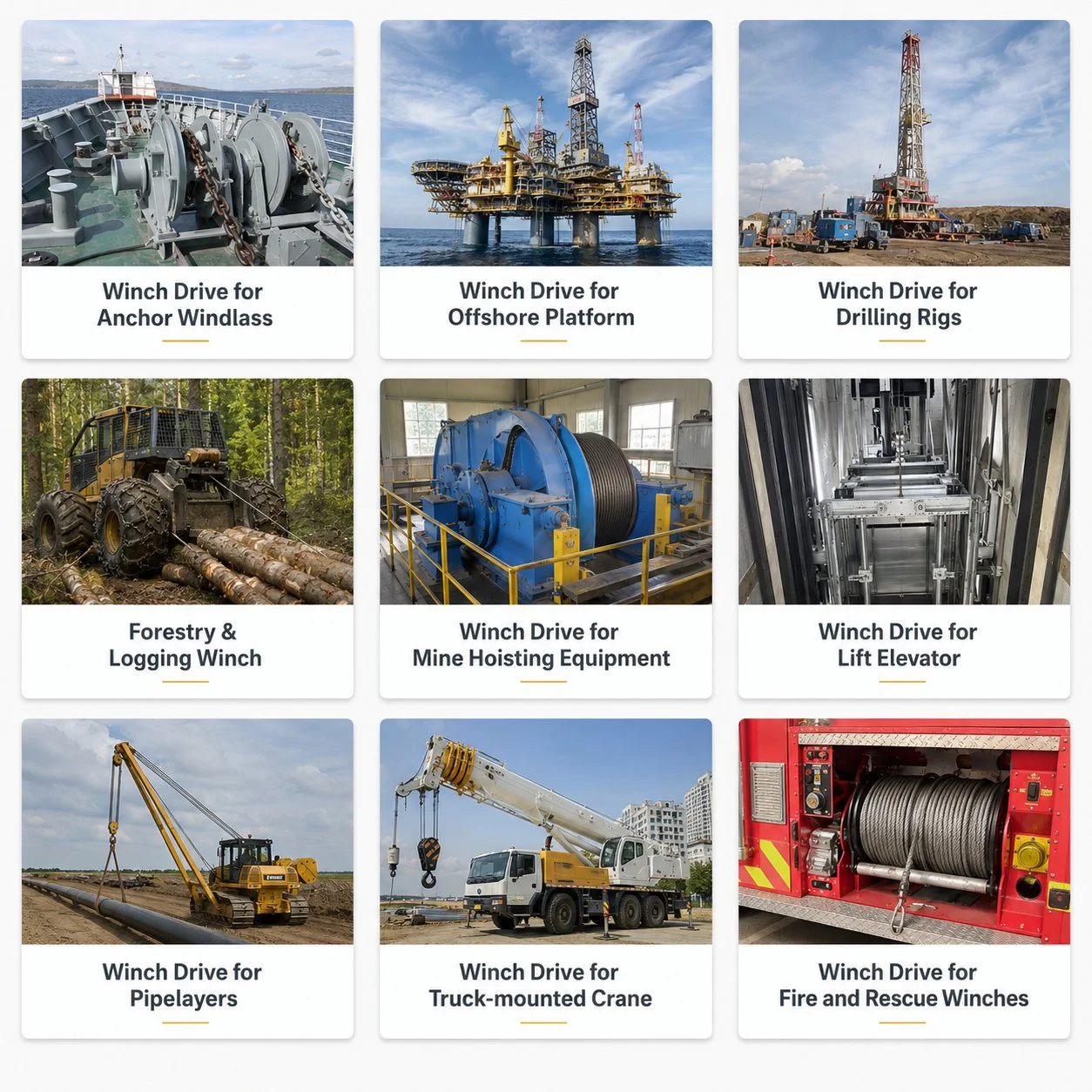
Electric cranes at 60-100 tonne SWL where the machinery room depth behind the drum is limited to 400-600 mm. The ZR95 at 2-stage delivers 115,000 Nm in approximately 350-400 mm of axial depth — the most torque from the shortest right-angle gearbox in the catalogue. The slewing drive Ve tekerlekten çekiş complete the all-electric crane system.
Electric Marine AHTS and Towing Winches
Main towing and anchor handling winches on electric AHTS vessels and large tugs where the drum runs athwartship and the sustained towing load stays below 115,000 Nm. The 245,000 Nm peak absorbs the anchor chain snatch and towline snap loads that define AHTS operations. The 2-stage compact option minimises the winch footprint on the aft deck — critical on medium-sized AHTS vessels where deck space is shared with anchor racks and chain lockers.
Electric Mining Main Production Winders
Main production winders at mines with 400-700 metre shaft depths where the headframe winder house design requires perpendicular motor mounting. The ZR95 at ratio 150-400, 3-5 stage, with 500-800 kW motors provides the winding torque with regen recovery of 20-35%. The 2-stage option at ratio 15-50 serves fast-cycle auxiliary hoists where the hoist speed is the priority and the compact gearbox length is essential.
The ZR Right-Angle Winch Drive Family
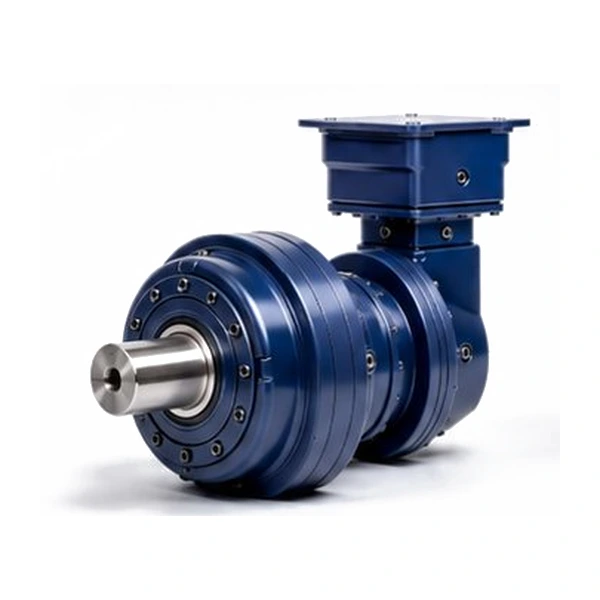
Right-Angle Winch Drive Planetary Gearbox — ZR95 2-Stage Threshold FAQ
Saha Raporları
80 t offshore platform crane, hydraulic-to-electric conversion. The machinery room survey showed 380 mm of clear depth behind the drum — well below the minimum for any coaxial gearbox at this torque. The ZR95 at 2-stage, ratio 40, with 600 kW motor delivered 115,000 Nm in 365 mm of axial depth. This was the only product in the catalogue that could deliver the required torque within the available space. The crane has completed its classification survey and 8 months of operation. The 245,000 Nm peak handled a 72-tonne proof-load test (80 t x 1.25 x 0.72 dynamic amplification factor) without any VFD protection event. We are now surveying 4 additional platform cranes — 2 will require ZR95 (tight spaces) and 2 will accept ZL95 (open spaces). Same torque, same performance, different geometry.
Main towing winch on an all-electric 80 m AHTS vessel, ZR95 at ratio 120, 3-stage, dual 350 kW AC motors (one per drum end, torque-sharing through the ZR95 bevel input). The 2-stage option was evaluated but rejected — at towing duty (sustained 80,000 Nm, 72% of continuous), the 2-stage thermal load exceeded the Pt without a cooler. The 3-stage at 65 kW Pt with cooler provides the thermal margin. The ZR95 245,000 Nm peak absorbed the towline snap-back during a heavy-weather emergency disconnect test — measured at 2.3x steady-state by the load cell. The vessel electrical system recovered 17% of the towing energy through regen during the trial.
Main production winder at a 600-metre platinum mine, ZR95 at ratio 250, 4-stage, 550 kW AC motor mounted vertically on the headframe column. The headframe winder house is a 1970s design with 450 mm between the drum and the back wall — the ZR95 2-stage would have fit, but the mine engineer selected 4-stage for the ratio requirement (250 exceeds the 2-stage maximum ratio). The 4-star is a commissioning observation: the vertical motor mount produces a gravitational pre-load on the bevel shaft thrust bearings that is not present in horizontal mounting. The pre-load is within the bearing capacity but changes the vibration baseline — the commissioning vibration survey should be performed with the motor running in the actual installed orientation, not extrapolated from horizontal test-bench data. The mine inspector initially flagged the elevated vibration as a concern; we resolved it by providing the vertical-mount vibration baseline from the Korea Ever-Power factory acceptance test.
Ek bilgi
| Editör | Cxm |
|---|
İlgili ürünler
-
ZL200 Vinç Tahrik Planet Dişli Kutusu
-
ZL85 Winch Drive Planetary Gearbox
-
ZL35 Winch Drive Planetary Gearbox — 1-4 Stage
-

415W3 Vinç Tahrik Planet Dişli Kutusu Redüktörü
-
407W3 Vinç Tahrik Planet Dişli Kutusu Redüktörü
-

406BW3 Vinç Tahrik Planet Dişli Kutusu Redüktörü
-
406AW Vinç Tahrik Planet Dişli Kutusu Redüktörü
-

401W1 Vinç Tahrik Planet Dişli Kutusu Redüktörü — Tek Kademeli