Apple Harvester Types and Their Wheel Drive Requirements
Mechanical apple harvesting has evolved from simple trunk shakers to sophisticated over-the-row machines. Each harvester type places different demands on the tekerlek tahrikli planet dişli kutusu, but all share the fundamental requirement: ultra-precise, ultra-low speed ground travel through narrow orchard rows on variable terrain.
The dominant type for processing-grade apples. A trunk or limb shaker vibrates the tree at 5 to 20 Hz, dislodging the fruit onto a catching frame or conveyor belt that surrounds the tree trunk. The machine advances from tree to tree at 0.5 to 2.0 km/h, pausing 3 to 8 seconds per tree for the shaking cycle. The wheel drive must provide precise start-stop positioning to align the shaker head with each trunk — typically within ±50 mm of the target position. Any overshoot or undershoot requires the operator to reverse and re-approach, losing 5 to 10 seconds per tree and reducing daily throughput by 10 to 15%.
Straddle-type machines that drive over the entire tree row, harvesting continuously as they move. Internal shaking rods, air blasters, or rotating fingers dislodge the fruit onto integrated conveyors. The machine must maintain a constant ground speed of 1.5 to 3.0 km/h — because the harvesting mechanism is calibrated for a specific travel speed. If the wheel drive speed varies by more than ±5%, the harvesting efficiency decreases: too fast and the mechanism misses fruit; too slow and it damages branches from over-exposure to the shaking energy.
Self-propelled platforms that carry 8 to 16 workers for hand-picking fresh-market apples. The machine moves continuously at 0.3 to 1.0 km/h — matched to the picking speed of the workers. The wheel drive must provide infinitely variable speed with no perceptible cogging or speed pulsation — because the workers are standing on an elevated platform (1.5 to 3 metres high) and any jerky motion creates a fall hazard. Worker-safety regulations in major apple-producing regions require the platform motion to be smooth enough that a standing worker does not need to hold onto the structure for balance.
All three types share a common wheel drive engineering challenge: the required ground speed range (0.3 to 3.0 km/h harvesting, plus 10 to 20 km/h road/field transfer) spans a 7:1 to 67:1 speed ratio. The harvesting speeds are in the range where hydraulic motor efficiency decreases sharply (below 5% of maximum speed, most hydraulic motors exhibit torque pulsation) — making the planetary gearbox reduction ratio and gear quality critical to achieving smooth, pulsation-free low-speed operation.
Orchard Terrain — Why Apple Harvester Wheel Drives Face Conditions That Field Crop Machines Never Encounter
A combine harvester operates on open, relatively flat grain fields. An apple harvester operates in narrow orchard rows — 3 to 5 metres wide between tree trunks — on terrain that is frequently sloped, always uneven, and often wet from irrigation. The wheel drive must handle these conditions at the ultra-low harvesting speeds where traction management is most difficult.
| Terrain Factor | Grain Field | Apple Orchard | Drive Impact |
|---|---|---|---|
| Row width | Open field | 3–5 m | Tight turning required |
| Slope | 0–5% | 5–30% | Brake holding on slope |
| Ground moisture | Seasonal | Irrigation = wet | Traction at low speed |
| Root zone | No restriction | Under tree canopy | Low ground pressure needed |
Hillside orchards present the most challenging wheel drive environment. Many premium apple-growing regions (Washington State, South Tyrol, Central Otago, Shimano) use hillside terrain for the superior drainage, air flow, and sun exposure that produce high-quality fruit. Slopes of 10 to 30% (6 to 17 degrees) are common — steep enough that the machine must climb under load while maintaining the precise harvesting speed.
On a 15% slope with a 12-tonne apple harvester, the gravitational component requires approximately 17.6 kN of continuous traction force — before adding the rolling resistance. If the wheel drive cannot provide this force at 0.5 km/h without speed pulsation, the machine surges and hesitates on the slope — misaligning the shaker head with the tree trunks and damaging fruit through erratic shaking. The tekerlek tahrikli planet dişli kutusu must deliver smooth, continuous torque at the lowest operating speed on the steepest orchard slope — the most demanding combination of any agricultural wheel drive application.
Seasonal Use and Storage — The Hidden Engineering Challenge
An apple harvester operates for 10 to 42 days per year — the harvest window for the apple varieties on the farm. For the remaining 323 to 355 days, the machine is stored. This extreme seasonal-use pattern creates engineering challenges that no year-round machine faces.
During the storage period, the wheel drive experiences: (1) condensation cycling — temperature variations between day and night cause moisture to condense inside the gearbox housing, accumulating on the gear and bearing surfaces; (2) seal relaxation — the lip seals that prevent oil leakage and contaminant ingress are compressed against the shaft in the same position for 8 to 10 months, developing a permanent compression set that reduces sealing effectiveness at the start of the next season; and (3) static corrosion — the moisture from condensation combines with oil degradation products to form a mildly acidic environment that pits the bearing raceways and gear tooth surfaces at the contact positions where they were parked.
The most damaging of these is the bearing standstill corrosion (also called false Brinelling). The bearing balls or rollers rest in a fixed position for months — and the condensation moisture attacks the raceway surface at the load-bearing contact zone. When the machine starts the next harvest season, the corroded contact patches act as stress concentrations that initiate spalling under the first few hours of operation. A wheel drive that operated flawlessly for the entire previous harvest season can fail within the first week of the new season — not from operating damage, but from 10 months of standing still.
Pre-storage and pre-season protocols: Before storage, the wheel drives should be run for 15 to 20 minutes at operating temperature to evaporate internal moisture, then topped up with fresh oil containing corrosion-inhibitor additives. Before the next harvest season, rotate each wheel by hand through at least 3 full revolutions to redistribute the oil film on the bearing raceways and break any static corrosion bonds. Check the oil for water contamination (milky appearance) and replace if contaminated. These two procedures — taking less than 30 minutes per machine — can extend the effective wheel drive life by 30 to 50% compared to machines that are simply parked and forgotten between seasons.
Low-Speed Torque Smoothness — Why Gear Quality Determines Fruit Quality
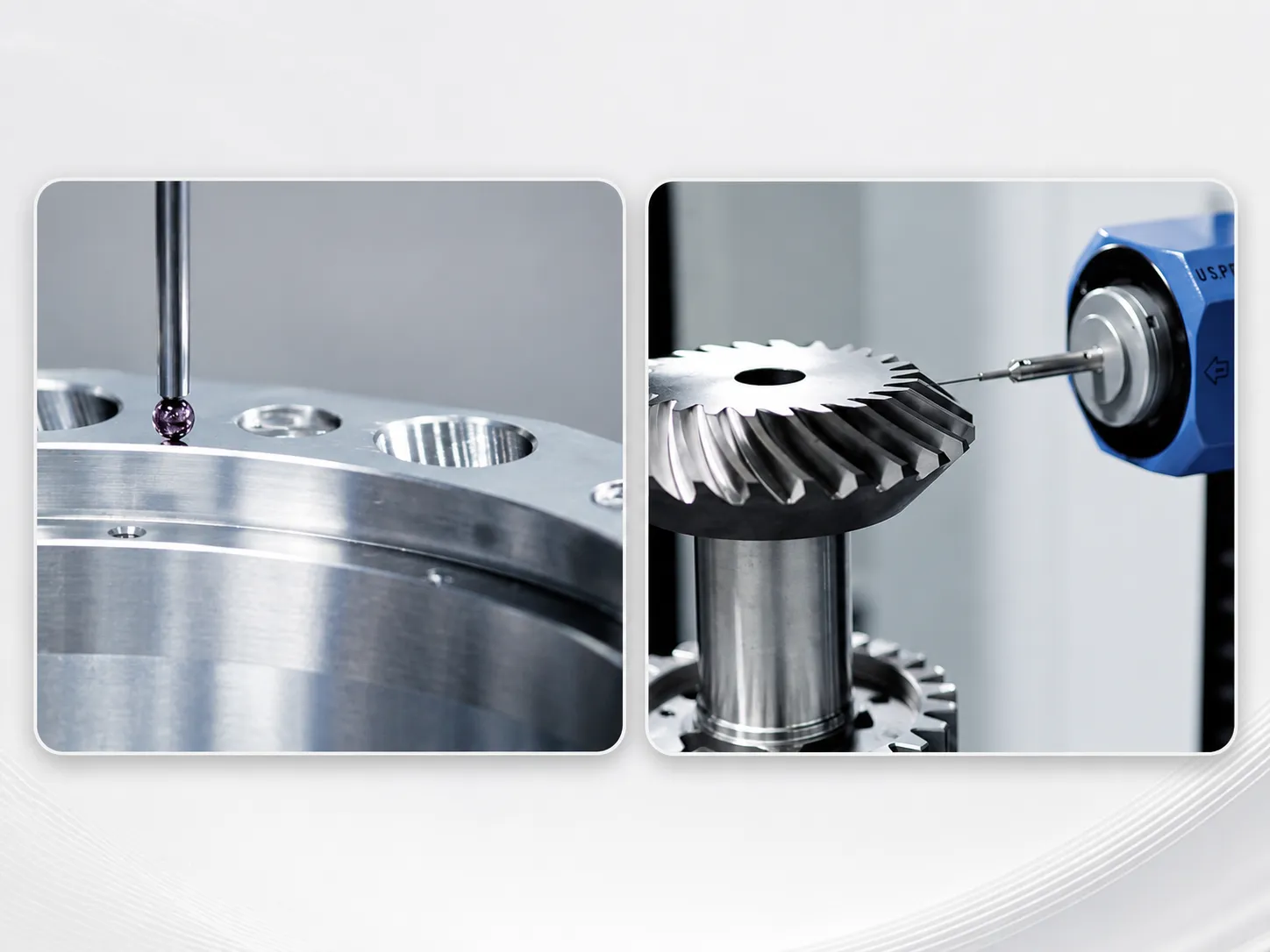
At harvesting speeds of 0.5 to 3.0 km/h, the wheel drive output shaft rotates at approximately 2 to 12 rpm (depending on the tyre diameter and gear ratio). At these speeds, every individual gear tooth engagement is perceptible as a discrete torque pulse — and the sum of these pulses produces a periodic speed variation called cogging. On a wheel drive with DIN Class 8 gears (standard industrial quality), the cogging amplitude at 5 rpm can reach 3 to 5% of the mean speed — producing a rhythmic surge-and-hesitate pattern that is visible in the ground track as a sinusoidal speed variation.
For shake-and-catch harvesters, this speed variation displaces the tree-to-tree position alignment by 30 to 80 mm per tree — enough to misalign the shaker head and require operator correction. For over-the-row continuous harvesters, the speed variation causes the harvesting mechanism to over-shake some trees (too slow — branch damage) and under-shake others (too fast — missed fruit). For platform harvesters, the speed variation produces a rhythmic lurching that fatigues the workers and violates the platform-motion smoothness requirements.
DIN Class 6 gears reduce the cogging amplitude to 0.5 to 1.5% — below the threshold where the speed variation is perceptible to the operator or measurable in the fruit quality. The gear quality specification for apple harvester wheel drives is therefore set by the fruit-quality and worker-safety requirements, not by the mechanical strength or durability requirements — an unusual situation where the gear surface finish is the primary specification parameter and the gear strength is secondary.
The planetary gearbox ratio also affects the low-speed smoothness. A higher ratio means the motor runs faster for the same wheel speed — moving the motor operating point away from its low-speed ripple zone. A 100:1 ratio with a motor at 300 rpm produces smoother wheel output than a 50:1 ratio with a motor at 150 rpm, even though the ground speed is identical, because the motor torque ripple is divided by the higher gear ratio and the inertia of the faster-spinning motor components acts as a mechanical flywheel that damps the per-revolution pulsation.
Three Failure Modes Specific to Apple Harvester Wheel Drives
During 8 to 10 months of storage, condensation moisture accumulates on the bearing raceways at the static contact zones. The moisture combines with oil degradation products to form a mildly corrosive environment that pits the hardened raceway surface. When the machine restarts for the next season, these corrosion pits act as fatigue stress concentrations — initiating spalling within the first 20 to 100 operating hours. The failure presents as sudden bearing noise and vibration at the start of the harvest season, often attributed to “bad luck” rather than to the storage conditions that caused it.
During harvesting, fallen apples are crushed under the machine wheels, releasing apple juice containing malic acid (pH 3.0 to 3.5). This acidic juice is splashed onto the wheel drive housing, shaft seals, and breather vent — and can penetrate through worn seals or improperly tightened drain plugs. Inside the gearbox, the acid attacks the oil additives and accelerates corrosion of the steel gear and bearing surfaces. The damage is not immediate — it develops over the storage period as the acid continues to react with the steel surfaces in the absence of the protective oil circulation that operating conditions would provide. Machines that harvest windfall apples (apples already on the ground) are particularly exposed because the wheels run directly through layers of fermenting, acidic fruit residue.
The ultra-low harvesting speed (0.5 to 3.0 km/h) is achieved through a combination of the hydraulic motor displacement and the planetary gearbox reduction ratio. As the hydraulic motor wears (increasing internal clearances), the volumetric efficiency decreases — and the speed pulsation (ripple) at low output speed increases. A new motor may deliver smooth output at 2 rpm; after 3,000 to 5,000 hours of accumulated operation, the same motor produces perceptible cogging at the same speed because the internal leakage varies with angular position. The operator perceives this as “the machine started jerking” — and the usual response is to increase the hydraulic flow (compensating with higher speed), which reduces the harvesting quality.
Wheel Drive Planetary Gearbox for Apple Harvesters — Frequently Asked Questions
Korea Ever-Power provides apple harvester wheel drive planetary gearboxes from 3,000 to 25,000 Nm with ultra-low-speed smoothness, hillside braking, and seasonal storage durability.
Editör: Cxm