how a planetary gearbox works sun gear planet carrier ring gear mechanism explained

Engineering Deep-Dive · Mechanism · Formula · Efficiency Physics

How a Planetary Gearbox Works —
Sun Gear, Planet Carrier and Ring Gear Explained

The planetary gear arrangement achieves what no parallel-shaft gearbox can match: maximum torque density in minimum space, through the physics of distributing load across multiple simultaneous contact points. This engineering explainer covers the mechanism, the gear ratio formula, the efficiency physics, and the design decisions that make planetary the standard for precision servo drives worldwide.

Browse Korea Ever-Power EP Series →

The Four Components That Make a Planetary Gearbox Work

Planetary Gear System — Cross-Section View

RING GEAR (fixed)

PLANET
P1

PLANET
P2

PLANET
P3

SUN
GEAR
INPUT

PLANET CARRIER → OUTPUT
Sun gear — motor input shaft
Planet gears (3×) — orbit + rotate
Ring gear — fixed to housing
Planet carrier — output shaft

Understanding how a planetary gearbox works starts with its four mechanical components. A planetary gearbox — also called an epicyclic gearbox — consists of four mechanical components arranged in a concentric geometry that gives the design its exceptional torque density. Understanding how each component functions makes every selection, troubleshooting, and maintenance decision faster and more reliable.

☀ Sun Gear — The Input Element

Mounted on the input shaft and driven directly by the motor. The sun gear meshes with all three planet gears simultaneously, transmitting motor torque outward to the planet gear set. Its tooth count (Z_sun) is the primary variable that sets the gear ratio alongside the ring gear tooth count.

⚙ Planet Gears — The Load-Sharing Elements

Three planet gears (standard configuration) mesh simultaneously with the sun gear on their inner radius and with the ring gear on their outer radius. Each planet gear rotates about its own axis while also orbiting the sun gear — this dual motion (rotation + revolution) is the kinematic source of the gear ratio. Critically: all three planets share the applied torque equally, so each planet tooth carries only one-third of the total load at any instant.

⬡ Ring Gear — The Fixed Outer Reaction Element

The ring gear is the largest component, with internal teeth that mesh with the planet gears’ outer radius. In a standard planetary gearbox, the ring gear is fixed to the housing — it does not rotate. The planet gears roll against the inside of the ring gear as they orbit. The ring gear’s tooth count (Z_ring) sets the maximum possible gear ratio for a given sun gear size.

↻ Planet Carrier — The Output Element

The planet carrier is the structural frame that holds all three planet gear axles. It rotates at the output speed as the planet gears orbit the sun gear. The output shaft is attached to the carrier. In a right-angle gearbox, the carrier shaft connects to a bevel stage that changes the output direction; in an inline gearbox, the carrier shaft is the direct output.

POWER FLOW — INPUT TO OUTPUT

Motor → [Sun Gear rotates] → [Planet Gears: rotate on own axis + orbit sun] → [Planet Carrier moves] → Output Shaft

The ring gear is stationary (fixed to housing). The sun gear input drives the planets, which are constrained by the ring gear. The only remaining degree of freedom is the carrier’s orbital motion — which becomes the output. This constraint geometry is what produces the gear ratio.

How the Gear Ratio Is Calculated — The Willis Equation for Planetary Gearboxes

The gear ratio of a planetary gearbox with a fixed ring gear is given by the Willis equation — named after Robert Willis who systematised epicyclic gear analysis in 1841. For the standard configuration (ring gear fixed, sun gear input, carrier output):

WILLIS EQUATION — FIXED RING GEAR

i = 1 + (Z_ring / Z_sun)
Z_ring = number of teeth on the ring gear
Z_sun = number of teeth on the sun gear
Planet tooth count does not appear in the ratio formula — planets are intermediate elements only

Worked example: A Korea Ever-Power EP-AB series gearbox at i=5:1 has a ring gear with Z_ring=96 teeth and a sun gear with Z_sun=24 teeth. Applying the formula: i = 1 + (96/24) = 1 + 4 = 5:1. The planet gear count (typically Z_planet=36) does not affect the ratio — it affects load sharing and structural balance but not kinematics.

Why single-stage maximum is approximately 10:1: The minimum practical sun gear has Z_sun=12 teeth (limited by tooth undercut). A ring gear cannot exceed approximately Z_ring=108 teeth at the same modulus without exceeding the housing diameter constraint. This gives a maximum single-stage ratio of approximately 1 + (108/12) = 10:1 for standard-modulus precision planetary gearboxes.

Multi-stage ratio multiplication:
Two planetary stages in series multiply their individual ratios: i_total = i₁ × i₂. A two-stage unit with i₁=5 and i₂=5 produces i_total=25:1. This is why Korea Ever-Power precision series cover 3:1 to 100:1 within the same product family — single-stage for i=3–10, two-stage for i=12–100.

Common Gear Ratios — Sun and Ring Gear Tooth Counts

Ratio (i) Z_sun Z_ring Note
3:1 36 72 Lowest practical single-stage. High output speed.
4:1 32 96 Common for high-speed spindle drives.
5:1 24 96 Most common single-stage ratio worldwide.
7:1 18 108 Higher ratio with good tooth geometry.
10:1 12 108 Near single-stage maximum. Small sun gear.
25:1 Two-stage: 5×5. Most common two-stage ratio.
100:1 Two-stage: 10×10. Upper limit of 2-stage range.
10,000:1 Four-stage planetary (AH/AHK series) — single sealed unit
Planet tooth count: why it matters for load sharing, not ratio

Planet gear tooth count must satisfy the assembly condition: (Z_ring + Z_sun) must be divisible by the number of planet gears (usually 3). For Z_ring=96 and Z_sun=24: (96+24)/3 = 40 — integer, so 3 planets can be equally spaced. If this condition is not met, equal planet spacing is impossible and unequal load sharing results, reducing gearbox life.

Why Planetary Gearboxes Achieve ≥97% Efficiency — The Contact Mechanics Explained

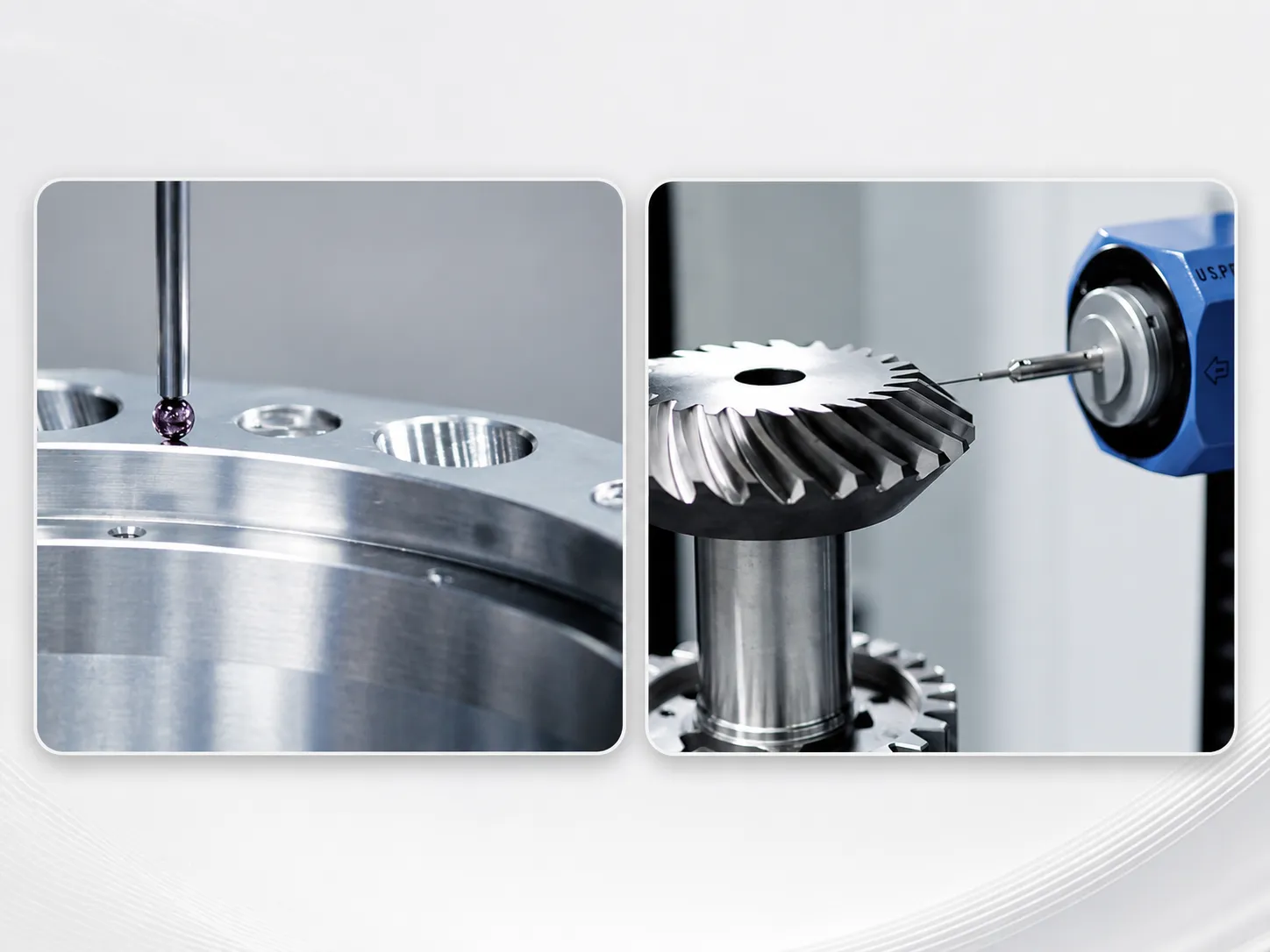
planetary gearbox processing details

One of the most searched questions — how does a planetary gearbox work with such high efficiency — has a direct answer in contact mechanics. The ≥97% single-stage efficiency of a precision planetary gearbox is not a design target achieved through optimisation — it is a consequence of the gear mesh contact mechanics. Understanding why efficiency is this high (and where the remaining 3% goes) explains the performance gap versus worm reducers, the slight efficiency drop from single to two-stage, and why hypoid gears sit between the two.

Hertz Contact Stress and Rolling Friction

When two gear teeth mesh, they make contact along a line (for spur gears) or a small elliptical area (for helical gears). At the contact point, the teeth undergo elastic deformation — this is Hertzian contact. The power lost in this contact equals the friction force multiplied by the sliding velocity at the contact point.

In a planetary gear mesh, the dominant contact is rolling — the gear teeth roll across each other with minimal sliding. Rolling friction coefficients for hardened steel on steel with gear oil are in the range 0.001–0.003. Compare this to the sliding friction in a worm gear (0.05–0.12) — 20 to 40 times higher. This contact mechanics difference, not design cleverness, is why planetary gearboxes are fundamentally more efficient than worm reducers regardless of manufacturing quality.

The remaining 2–3% loss in a planetary gearbox comes from: bearing drag (~1.5%), churning loss from the lubricant (~0.5%), and residual sliding at the tip and root of each gear tooth (~0.5–1%). All three losses scale with speed, temperature, and lubricant viscosity — which is why the efficiency specification is given for nominal operating conditions.

WHY 3 PLANETS = HIGHER EFFICIENCY THAN 1

Single parallel-shaft gear pair:
Contact force = Full torque / pitch radius
Hertz stress ∝ √(Contact force)3-planet planetary at same output torque:
Each planet contact force = 1/3 of total
Hertz stress per contact ∝ √(1/3) = 0.577×Lower stress → less deformation → less heat
→ 3 planets achieve same torque at
lower stress per tooth = longer life + less loss

Efficiency Comparison Across Gear Types

齿轮类型 效率 Contact μ (friction)
Planetary (≥97%) ≥97% Rolling 0.001–0.003
Parallel-shaft helical 95–98% Rolling 0.003–0.006
Bevel (spiral) 93–97% Rolling 0.005–0.010
Hypoid (KF/KH series) 94–96% Roll+slide 0.01–0.04
Worm (high ratio) 40–65% Sliding 0.05–0.12

\

Why two-stage efficiency drops to ≥94%:
Each gear stage multiplies the slight efficiency loss of the previous. Stage 1 at 97% passes 97% of input power to stage 2. Stage 2 at 97% passes 97% of that: 0.97 × 0.97 = 0.941 = 94.1% total. The additional bearing set between stages adds ~0.5% further bearing drag. This compounding explains exactly why Korea Ever-Power specifications show ≥97% single-stage and ≥94% two-stage — the mathematics of loss compounding, not a design limitation.

Why Planetary Gearboxes Achieve 3–5× Higher Torque Density Than Parallel-Shaft Designs

Torque density — the maximum output torque achievable per unit of gearbox volume or mass — is the property that makes planetary gearboxes the standard for robot joints, CNC machine tools, and any application where the drive must fit within a constrained envelope. The source of the high torque density is the multi-path power transmission geometry, and it is straightforward to derive from first principles.

The first principles argument: Torque equals force multiplied by the lever arm radius (T = F × r). For a given output torque requirement and a given pitch circle radius, the required tangential tooth force is fixed: F = T/r. In a parallel-shaft gearbox, this full force is carried by a single tooth mesh contact. In a planetary gearbox, the same total torque is shared across three (or more) planet gear contacts simultaneously. Each contact carries only T/(3r) of force — one-third of the parallel-shaft contact force.

Gear tooth strength scales with the square of the tooth cross-sectional dimensions. If each tooth carries one-third the force, the tooth can be one-third the size at the same safety factor — or equivalently, a standard tooth can carry three times the force at the same stress level. This is why a planetary gearbox with a 220 mm body diameter can deliver 2,000 N·m output torque where a parallel-shaft helical gearbox of the same outer diameter could only deliver 400–600 N·m.

EP-AB precision inline series planetary gearbox demonstrates this torque density directly: the EP-AB220 (220 mm body diameter) delivers up to 2,000 N·m output torque with P0 ≤1 arcmin backlash at i=3–100. A parallel-shaft unit at the same outer diameter in the same precision class would require a substantially heavier and larger housing to achieve the same torque rating.

Torque Density Comparison — Same 150 mm OD Housing
Planetary gearbox (EP-AB150)
800 N·m
Parallel-shaft helical (same OD)
~250 N·m
Spur gear pair (same OD)
~160 N·m

Approximate values — varies by design. Multi-path load sharing in planetary gearboxes delivers 3–5× torque density advantage over single-path parallel-shaft designs.

Coaxial output — the bonus advantage

Because the sun gear input and the carrier output share the same centreline, planetary gearboxes have an inline (coaxial) geometry. The motor, gearbox, and driven machine can all align on one axis — eliminating the shaft offset of parallel-shaft designs and enabling the compact cylindrical assemblies used in robot arm joints, servo actuators, and electric vehicle axles.

Single-Stage vs Multi-Stage — When to Add Planetary Stages and What Each Costs

Every additional planetary stage adds reduction ratio, reduces output speed, and increases output torque — but comes at the cost of housing length, additional bearing drag, and a small efficiency reduction. Understanding the trade-offs of each stage count helps in deciding whether a single-stage, two-stage, or multi-stage configuration is appropriate for a given application.

Single Stage
i = 3:1 to 10:1
  • Highest efficiency (≥97%)
  • Shortest axial housing
  • Highest allowable input speed
  • Lowest reflected inertia penalty
Best: robot joints, high-cycle packaging
Two Stage
i = 12:1 to 100:1
  • Efficiency ≥94%
  • Wider ratio range
  • Longer housing depth
  • More stages: lower backlash accumulates
Best: CNC tables, positioners, AGVs
Multi-Stage
i up to 10,000:1
  • Efficiency ≥90–92%
  • Extreme ratio in single unit
  • Heavy industrial torque
  • Larger frame sizes (AH series)
Best: solar trackers, wind yaw, cranes

EP-AH/AHK New Line four-stage series achieves 10,000:1 in a single sealed unit at up to 9,585 N·m — a combination available only through four cascaded planetary stages within a single housing. This avoids the need for a compound gearbox chain (two or three separate units coupled in series), with its associated intermediate shaft maintenance, multiple lubrication points, and alignment requirements.

EFFICIENCY COMPOUNDING ACROSS STAGES

Stage 1 alone: η = 0.97 → 97%
Stage 1 + 2: η = 0.97² = 0.9409 → 94.1%
Stage 1 + 2 + 3: η = 0.97³ = 0.9127 → 91.3%
Stage 1 + 2 + 3+4: η = 0.97⁴ = 0.8853 → 88.5%With bearing losses (+0.5% per added stage):
2-stage actual: ≥94% ✓
3-stage actual: ≥92% ✓
4-stage actual: ≥90% ✓Specs match predictions from first principles
Which variable do you sacrifice with more stages?

More stages sacrifice: efficiency (each stage ×0.97), axial length (each stage adds length), and slightly increases backlash (P0 single ≤1′ → P0 two-stage ≤3′). Each stage gains: ratio multiplication and output torque multiplication. The design trade-off is always ratio vs efficiency vs length vs backlash accumulation.

Where Backlash Comes From — and How Manufacturing Precision Controls It

Backlash — the angular play at the output shaft when input direction reverses — is not a manufacturing defect. It is an engineered clearance that serves two necessary functions: it provides space for the lubricant film that prevents metal-to-metal contact under load, and it accommodates the thermal expansion of gear teeth as the gearbox heats up during operation. A gearbox with zero tooth clearance would seize within minutes of reaching operating temperature.

The P0, P1, and P2 backlash grade system specifies how tightly the tooth clearance is controlled at manufacture. Tighter clearance (P0) requires more precise gear grinding, closer dimensional tolerance on housing bores and bearing seats, and more selective assembly to match tooth pairs — all of which add manufacturing cost. The specification is measured at the output shaft with the input locked, by applying a small torque in each direction and measuring the angular displacement.

Backlash grows in service because gear tooth flanks wear. Every direction reversal is a micro-impact between the previously unloaded tooth face and the driven tooth face — at high cycle counts, the cumulative micro-wear increases the inter-tooth clearance. This is why backlash grade selection matters for the full service life, not just delivery condition.

Korea Ever-Power backlash verification:
All Korea Ever-Power precision series are measured per unit at the output shaft before shipment. The delivery certification documents confirm the measured backlash value — not just the grade conformance. For the EP-BAF high-rigidity series planetary gearbox, the enlarged output shaft is verified independently for radial load capacity — demonstrating that output shaft geometry independently affects radial performance without altering the planetary gear backlash specification.

Backlash Grade System — What the Grades Mean Physically

P0
Single ≤1′ · Two-stage ≤3′
Tooth clearance ground to the minimum functional tolerance. Requires 100% selective assembly — gears are paired by measured deviation to ensure the total falls within ≤1′. Every unit verified.
P1
Single ≤3′ · Two-stage ≤5′
Slightly wider tooth clearance band. Achievable with close-tolerance gear grinding without full selective assembly. 20–30% cost reduction vs P0 — the practical grade for most servo axes.
P2
Single ≤5′ · Two-stage ≤7′
Standard-tolerance gear grinding, normal assembly. Correct specification for non-precision servo axes, general actuators, and applications where backlash does not affect functional accuracy.
Why AFH has no P grade code: EP-AFH delivers ≤1 arcmin as its standard — not as a P0 sub-selection. Every AFH unit, at every ratio and every frame, is manufactured to this tolerance. The absence of a grade code means there is no lower-grade option; the entire series is built to the precision equivalent of P0.

Inline vs Right-Angle Architecture — Adding a Bevel Stage for Direction Change

To fully understand how a planetary gearbox works in a right-angle configuration, we need to add one more stage to the picture. The basic planetary arrangement described so far produces an inline (coaxial) output: the sun gear input shaft and the carrier output shaft share the same centreline. This is the most efficient configuration — no direction-changing stage, minimum components, maximum power density.

A right-angle output requires a bevel gear stage after the planetary stages. A pair of precision spiral bevel gears redirects the carrier output through 90 degrees. This bevel stage adds approximately 3–5% efficiency loss (spiral bevel mesh efficiency 93–97%), adds housing length in the perpendicular direction, and contributes additional backlash — which is why Korea Ever-Power measures the P0/P1/P2 backlash of right-angle series (EP-ABR, EP-ADR, EP-AFR) at the final right-angle output shaft with the bevel stage active, not at the planetary carrier before the bevel.

EP-AFR right-angle high-rigidity series planetary gearbox demonstrates the design principle: the enlarged output shaft addresses the radial load capacity requirement of directly mounted belts, gears, and sprockets at 90 degrees, while the P0/P1/P2 backlash specification at the right-angle output shaft ensures the bevel stage contribution is engineered into the grade, not added on top of it.

POWER FLOW IN RIGHT-ANGLE CONFIGURATION

[Motor] ──→ [Sun Gear] ──→ [Planet Carrier]

[Spiral Bevel Gear Pair]
│ (90° direction change)

[Right-Angle Output Shaft]Total backlash = planetary stages + bevel stage
= measured at right-angle output shaft
= what Korea Ever-Power specifies as P0/P1/P2

Korea Ever-Power planetary gearbox inline right-angle series quality manufacturing EP

Configuration 效率 Backlash measured at
Inline (EP-AB, EP-AF) ≥97% Output shaft (inline)
Right-angle (EP-ABR, EP-AFR) ≥93–96% Right-angle output shaft (incl. bevel)
Multi-stage inline (EP-AH) ≥90–94% Final output shaft

Planetary vs Every Alternative — The Complete Performance Map

Engineers who understand how a planetary gearbox works can map it against every competing technology to find the correct tool for each application. The planetary gearbox does not win in every dimension against every alternative — it wins in the combination of dimensions that most industrial and servo applications require simultaneously. Understanding where each technology sits on the performance map enables correct specification when the trade-offs are non-trivial.

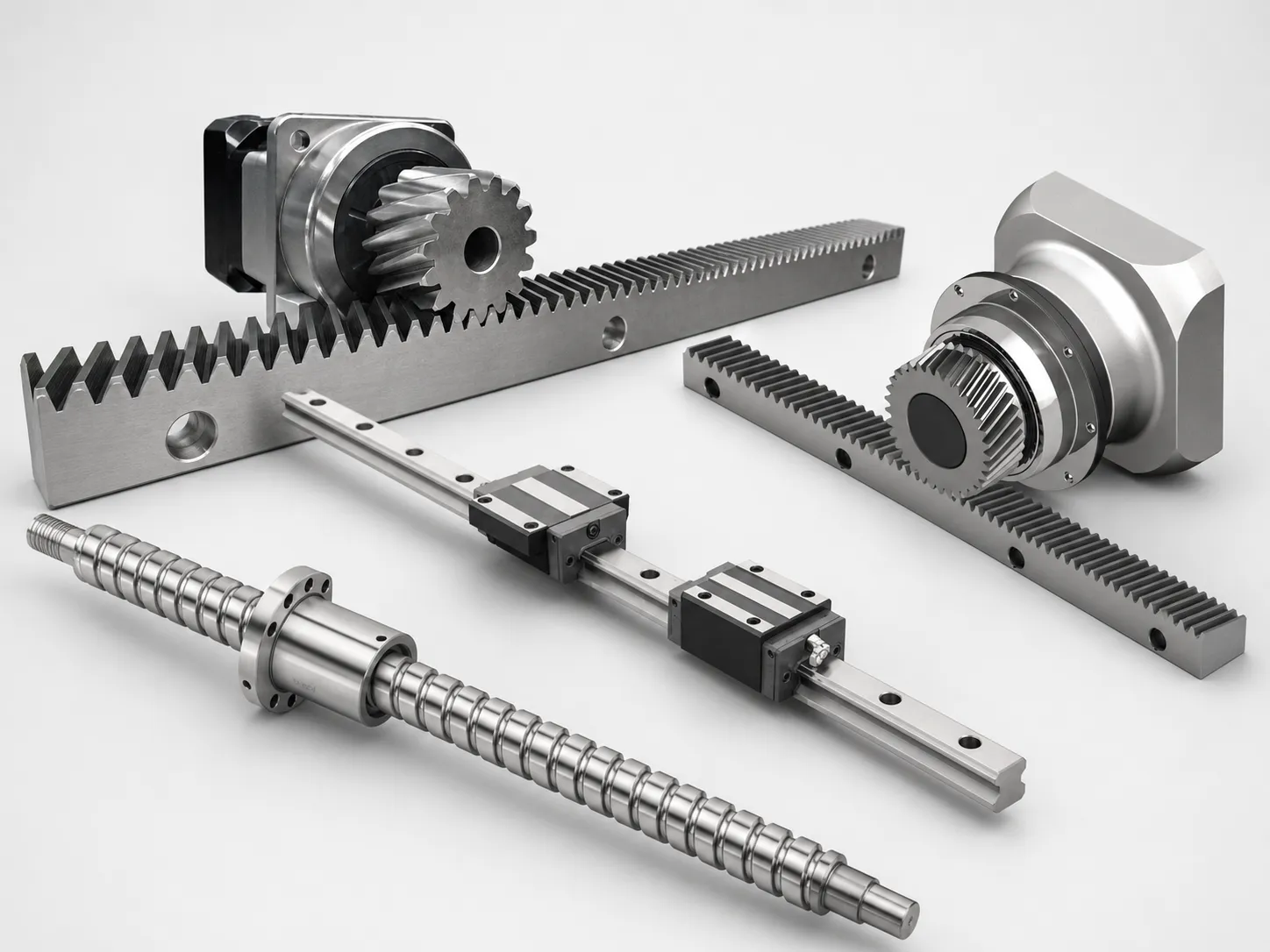
planetary gearbox processing details 2

Planetary vs Parallel-Shaft Helical

Helical achieves similar efficiency (95–98%) but requires a shaft offset — motor and output shafts are parallel, not coaxial. For the same torque, helical gearbox outer diameter is typically 1.5–2× the planetary equivalent. Helical wins on noise (quieter tooth engagement profile) and cost at high torque — planetary wins on compactness, coaxial geometry, and torque density. The EP-BPG energy-saving series addresses the space where compact planetary replaces larger parallel-shaft units in Korean conveyor and agitator drives.

Planetary vs Cycloidal (Cyclo Drive)

Cycloidal drives achieve very high single-stage ratios (up to 87:1) and extremely high shock load capacity (5–6× rated torque momentarily) — advantages for heavy industrial conveyor and mining applications. Cycloidal drives are also backlash-free by design (no tooth clearance). However, cycloidal units are more expensive, have lower efficiency at high speed, and are mechanically more complex to service. For precision servo drives at standard ratios, planetary gearboxes are the more cost-effective solution with comparable precision.

Planetary vs Hypoid (EP-KF/KH)

Hypoid gears (used in the EP-KF/KH series) use curved spiral-bevel geometry that produces lower operating noise than standard planetary at equivalent torque — because the face-contact pattern distributes tooth impact over a larger area. Hypoid achieves ≥94–96% efficiency. The key constraint: EP-KF/KH uses gear oil with a 0°C minimum — not suitable for outdoor Korean winter or cold-room applications. Planetary (standard series) operates to −10°C and is the correct choice for outdoor or cold environments.

Frequently Asked Questions — How a Planetary Gearbox Works


Can a planetary gearbox be back-driven — can the output shaft rotate the input?

Yes — a planetary gearbox is back-drivable under normal circumstances. If torque is applied to the output shaft, it will rotate the input shaft and the attached motor rotor. This is a consequence of the rolling-contact reversible gear geometry. Back-driveability is actually an advantage for servo drives, where the motor’s encoder feedback loop compensates for load disturbances in both directions. It becomes a disadvantage only for vertical load-holding applications where the output load would back-drive the mechanism under gravity when motor power is off — in those cases, an electromagnetic brake or downstream self-locking worm stage is required.


Why use sealed grease rather than an oil bath for planetary gearbox lubrication?

A planetary gearbox can be mounted in any orientation — input shaft up, down, horizontal, or at any angle — because it is used in robot joints, solar trackers, machine tool axes, and vehicle differentials in every possible attitude. Oil bath lubrication requires a specific orientation to maintain oil level at the gear mesh; in a wrong orientation, gears run dry or submerged. Sealed grease is orientation-independent, eliminates the fill/drain port and associated seal leak risk, requires no periodic oil change, and is compatible with IP67 sealing geometry. The viscosity of the grease is matched to the operating speed and temperature range — Korea Ever-Power EP series use grease rated for −10°C to +90°C (standard series) or 0°C to +90°C (KF/KH hypoid series).


What is the difference between a planetary gearbox and a cycloidal gearbox, and when does each apply?

A cycloidal gearbox achieves reduction through the eccentric motion of a cycloidal disc within a ring of pins, rather than through gear tooth mesh. This produces theoretically zero backlash (pin-in-hole contact rather than tooth clearance) and very high shock load tolerance — typically 5–6× rated torque momentarily without damage. Planetary gearboxes use gear tooth mesh, have a small controlled backlash (P0 ≤1 arcmin), and tolerate 2–3× rated torque peak. For Korean collaborative robot joint drives at 10 kg payload with low shock loading, planetary gearboxes provide adequate precision at lower unit cost. For heavy industrial robot joints, mining conveyor drives, and press line automation with severe shock loads, cycloidal drives offer a meaningful shock tolerance advantage. The selection is application-driven, not technology-driven.


How long does a precision planetary gearbox last, and what causes it to fail?

Korea Ever-Power precision series are designed for 20,000 operating hours at rated torque and rated speed. At 2,500 hours per year (three-shift Korean manufacturing), this equals 8 years. The primary failure mode is not sudden fracture — it is gradual backlash growth from gear tooth flank wear, particularly at the reversal point where unloaded teeth make contact with loaded teeth. This wear rate depends strongly on the ratio of applied torque to rated torque: running at 80% of rated torque produces significantly slower wear than running at 110% of rated torque (over-specification). The secondary failure mode is bearing fatigue — the rolling element bearings supporting the planet gear shafts accumulate fatigue cycles at high speed/load combinations. Sealed grease maintains adequate lubrication for both gear teeth and bearings for the designed life without field maintenance.


Are planetary gearboxes used in agricultural machinery, and how do they differ from industrial precision units?

Yes — planetary gearboxes are used extensively in agricultural machinery for wheel hub drives, harvester head drives, and power take-off distribution. Agricultural planetary units prioritise high continuous torque, shock load tolerance, and contamination resistance over precision backlash — they typically carry 15–30 arcmin backlash and are specified in torque tiers without P0/P1/P2 grade selection. Industrial precision units like the Korea Ever-Power EP series prioritise sub-arcminute backlash, sealed grease for any mounting orientation, and servo motor compatibility. For Korean agricultural machinery applications where the primary EP planetary gearbox output distributes to multiple field implements through 农业用锥齿轮箱, the planetary reduction stage reduces motor speed to the implement drive speed, and the downstream bevel gearboxes distribute that output to individual working heads.

Now That You Know How a Planetary Gearbox Works — Select the Right One

Korea Ever-Power manufactures the full range of planetary gearbox architectures covered in this article — from single-stage P0 precision to four-stage 10,000:1 heavy duty. The application engineering team provides series selection, torque calculation, and backlash grade confirmation in Korean, same working day.

编辑:Cxm