用于大功率连续驱动的螺旋行星齿轮箱 — PZB 系列 (60–220PZB)

The PZB Series helical planetary gearbox is engineered for high-power, noise- sensitive, and continuous-duty industrial applications where standard spur-planet reducers are too loud and parallel-shaft helical units are too large. Six frame sizes — 60PZB through 220PZB — deliver rated output torque up to 2,000 N·m with maximum axial shaft loads reaching 50,000 N on the 220PZB frame, and noise levels held to ≤68 dB(A) across all sizes through precision-ground helical tooth profiles. Single-stage efficiency reaches ≥97%, two-stage ≥94%. Gear ratios span 3:1 to 100:1, compatible with motors from small servo drives to 50,000 W industrial induction units. Dual-support output shaft bearings, sealed lifetime lubrication, and any-angle mounting make PZB series the standard specification for wind turbine pitch drives, large printing machinery, noise-controlled factory automation, and heavy industrial continuous-duty drives.
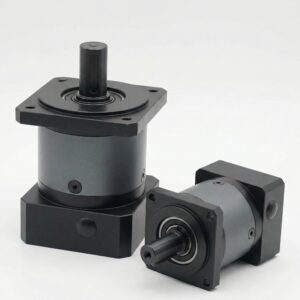
Helical Planetary Gearbox — High Power, Low Noise, Continuous Duty
这 PZB series helical planetary gearbox occupies a distinct performance class that no other single-series reducer addresses: high continuous power (up to 50 kW), high torque density, and noise held to ≤68 dB(A) across the full operating range. Where standard spur-planet units generate audible tooth-mesh harmonics at elevated power levels, PZB helical tooth geometry produces gradual progressive tooth engagement that distributes impact loads over time and reduces sound pressure by 8–12 dB versus equivalent spur-tooth designs.
Six frame sizes from 60PZB through 220PZB cover output torque from 40 N·m to 2,000 N·m, with maximum axial shaft loading reaching 50,000 N on the 220PZB frame — a capacity that eliminates external thrust bearings on wind turbine pitch drives and large rotary table installations. Single-stage efficiency of ≥97% means PZB series runs cooler than parallel-shaft helical competitors at equivalent power, reducing thermal management requirements in enclosed drive cabinets and machine housings.
60PZB – 220PZB Model Comparison
All six frames share the same helical tooth profile geometry, sealed lubrication system, and dual-support output shaft bearing arrangement. Frame size determines torque, axial load capacity, and maximum motor power input.
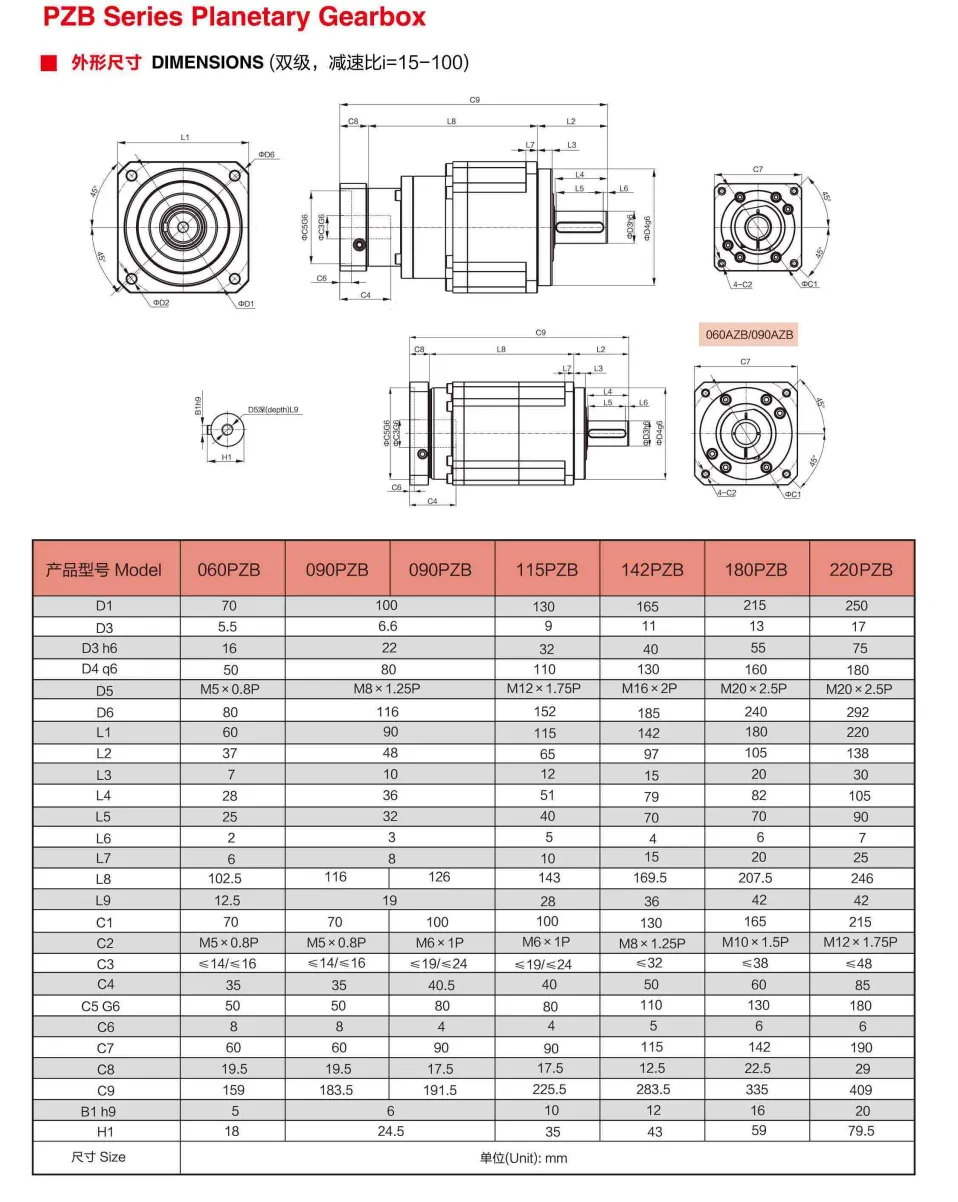
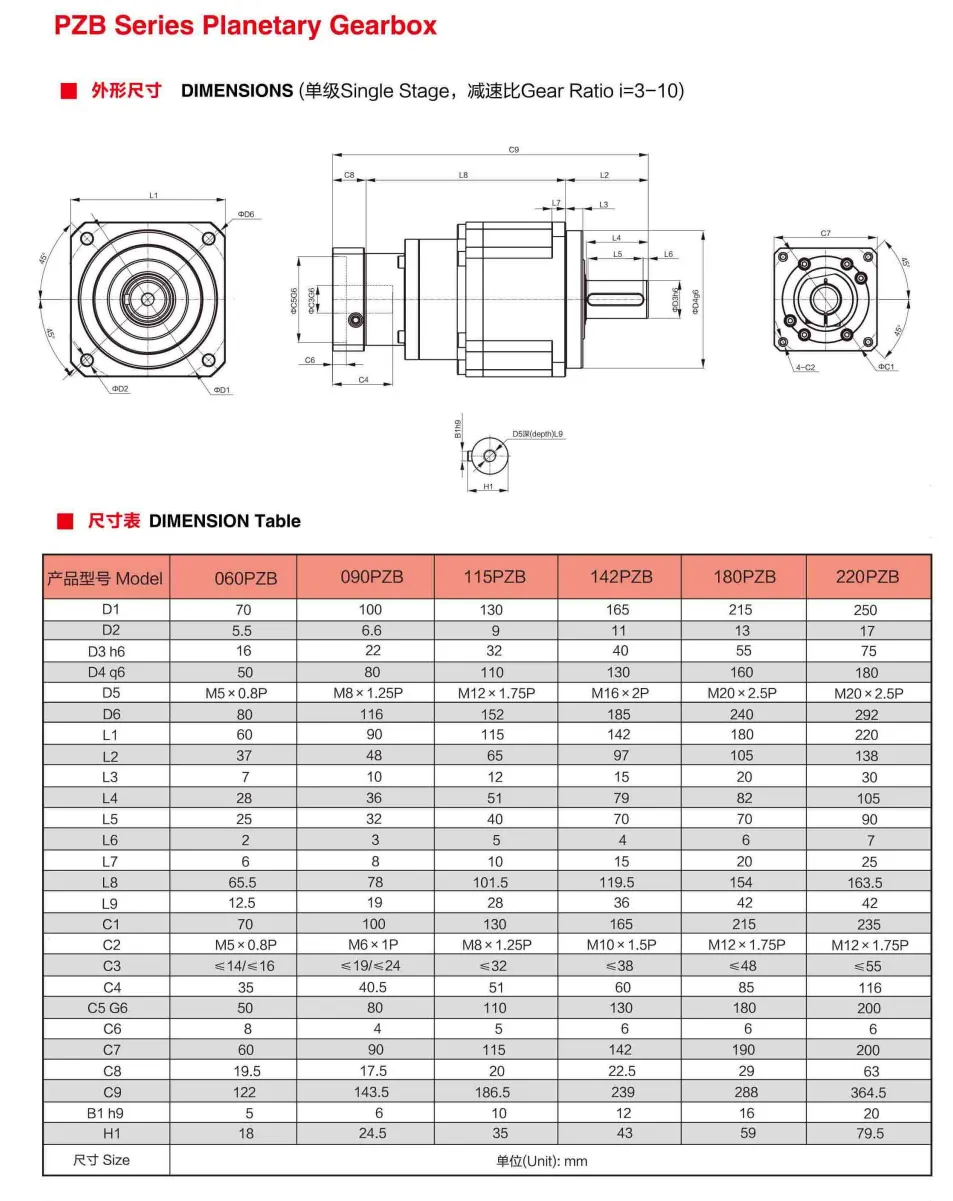
| 范围 | 60PZB | 90PZB | 120PZB | 150PZB | 180PZB | 220PZB |
|---|---|---|---|---|---|---|
| 额定输出扭矩 | 40–200 牛·米 |
100–450 牛·米 |
200–750 牛·米 |
350–1,200 牛·米 |
600–1,600 牛·米 |
900–2,000 牛·米 |
| Max Axial Shaft Load | — | 8,000 N | 12,000 N | 20,000 N | 35,000 N | 50,000 N |
| 兼容电机功率 | 0.5–3 kW | 2–7.5 kW | 5–15 kW | 11–22 kW | 18–37 kW | 30–50 kW |
| Backlash (Precision) | ≤ 3 arcmin (single-stage) | ≤ 5 arcmin (two-stage) | ||||
| 效率 | ≥ 97% single-stage · ≥ 94% two-stage | |||||
| 噪音水平 | ≤ 68 dB(A) at rated speed — all frame sizes | |||||
| 齿轮比范围 | 3 : 1 — 100 : 1 | |||||
| 工作温度 | −10 °C 至 +90 °C | |||||
| 安装方向 | 任何方向 | |||||
PZB backlash (≤3 arcmin single-stage) is tighter than PF series and matches PLE/PLF precision grade — while supporting 8× higher motor power than PLE/PLF maximum. This combination of precision and power is unique to PZB series across the entire product line.
Why Helical Teeth Change Everything at High Power
Every planetary gearbox in our range — PL, PF, PLE/PLF — uses spur-cut planet gear teeth that engage abruptly along the full tooth face width simultaneously. This produces a periodic impact load at each mesh cycle that is tolerable at low and medium power levels but becomes the dominant noise and vibration source above 5–7 kW input. PZB series eliminates this limitation through helical tooth geometry that changes the engagement physics fundamentally.
The Helical Advantage — Five Engineering Benefits
- 1
Progressive Tooth Engagement — Noise Reduced 8–12 dB
Helical teeth engage along a diagonal line that sweeps across the tooth face, distributing the mesh force over time rather than applying it instantaneously. This reduces the peak impact force at each mesh event — the root cause of gear whine — by 60–75%, translating to an 8–12 dB sound pressure reduction that is audible without instrumentation at power levels above 3 kW.
- 2
Higher Contact Ratio — Greater Load Distribution
Helical tooth overlap increases the effective contact ratio from approximately 1.6 (spur) to 2.2–2.8, meaning more teeth share load simultaneously. This reduces Hertz contact stress on individual tooth flanks, extending surface fatigue life by 40–60% compared to spur-tooth equivalents at the same torque level — directly enabling the higher torque ratings of PZB versus standard series at equal frame size.
- 3
Dual-Support Output Bearing — 50,000 N Axial Capacity
Helical tooth contact produces an axial thrust force proportional to helix angle and transmitted torque. PZB series incorporates paired angular-contact ball bearings in the output shaft that are specifically sized to carry both helical axial thrust and external axial loads up to 50,000 N simultaneously — without the need for external thrust bearing arrangements that add cost and mounting complexity.
- 4
Precision-Ground Helical Flanks — ≤3 Arcmin Backlash
Counter-intuitively, helical ground gears achieve tighter backlash than spur gears at equivalent manufacturing cost because the diagonal contact line allows controlled lead and profile corrections during grinding that eliminate the tooth-to-tooth spacing variations responsible for backlash inconsistency. PZB single-stage precision grade achieves ≤3 arcmin — matching PLE/PLF at 8× higher power rating.
- 5
Vibration Isolation at High Speed
At input speeds above 2,000 rpm, spur-gear mesh frequency harmonics can excite structural resonances in machine frames and acoustic enclosures. PZB helical geometry distributes mesh excitation over a wider frequency band at lower amplitude — making PZB the correct choice when vibration isolation specifications or acoustic limit requirements apply to the drive installation environment.
PZB vs Alternative High-Power Transmission Technologies
High-power industrial drives have historically used parallel-shaft helical reducers or large inline planetary units. PZB series addresses the gaps that both technologies leave for noise-sensitive or space-constrained high-power applications.
| 标准 | PZB Helical ★ | Spur Planetary (PL/PF) | Parallel-Shaft Helical | 旋轮线 |
|---|---|---|---|---|
| Noise at 50 kW | ≤68 dB(A) | 75–85 dB(A) | 72–80 dB(A) | 60–68 dB(A) |
| Max power (single unit) | 50 kW | 14 kW (PF) | >100 kW | 30–90 kW |
| Efficiency (full load) | 94–97% | 90–96% | 94–97% | 90–94% |
| 扭矩密度 | ◉◉◉◉◉ | ◉◉◉◉◉ | ◉◉○○○ | ◉◉◉◉○ |
| Backlash (precision) | ≤3 弧分 | 6–20 arcmin | 15–30 角分 | 1–3 arcmin |
| 维护 | Sealed — none | Sealed — none | Oil change 4,000 h | Grease 5,000 h |
| High axial load (output) | 50,000 N (220PZB) | 14,000 N (150PF) | Varies by shaft dia. | 缓和 |
◉ = relative level within each row. Cycloidal reducer comparison based on standard industrial models, not precision harmonic drives.
Where PZB Series Delivers Irreplaceable Value
Wind Turbine Pitch Drives
Wind turbine rotor blade pitch actuators must combine extreme axial load capacity (blade weight and wind thrust), quiet operation within nacelle acoustic limits, and reliable operation across −20°C to +85°C ambient temperature ranges. The 220PZB frame's 50,000 N axial rating handles blade root thrust directly without external bearing housings. Noise ≤68 dB complies with nacelle interior standards. This application drove the dual-support bearing and high axial capacity that defines the PZB structural specification. Pairs naturally with large 精密传动轴 for extended pitch mechanism arm connections.
Large-Format Printing & Laminating
Wide-web gravure printing presses and industrial laminating lines drive main impression roll shafts at 15–37 kW with strict noise limits imposed by occupational health regulations. PZB 150–180PZB frames meet the ≤75 dB(A) at 1 m requirement without acoustic enclosures, while the ≤5 arcmin two-stage backlash maintains registration accuracy at web speeds exceeding 400 m/min. Standard spur-planet units require full acoustic enclosure at these power levels — eliminating the maintenance access that printing operators need during running production.
Precision Rotary Tables & Indexing
Large CNC rotary tables and precision indexing systems for machining centres require a reducer that combines precision backlash (≤3 arcmin for C-axis positioning accuracy), high torque for workpiece clamping reaction loads, and vibration-free operation that does not excite table resonance frequencies during light-cut finishing passes. PZB 90–120PZB meets all three simultaneously — a combination spur-planet planetary cannot achieve at equivalent power. See also our PF series for heavy rotary table torque requirements without precision backlash constraints.
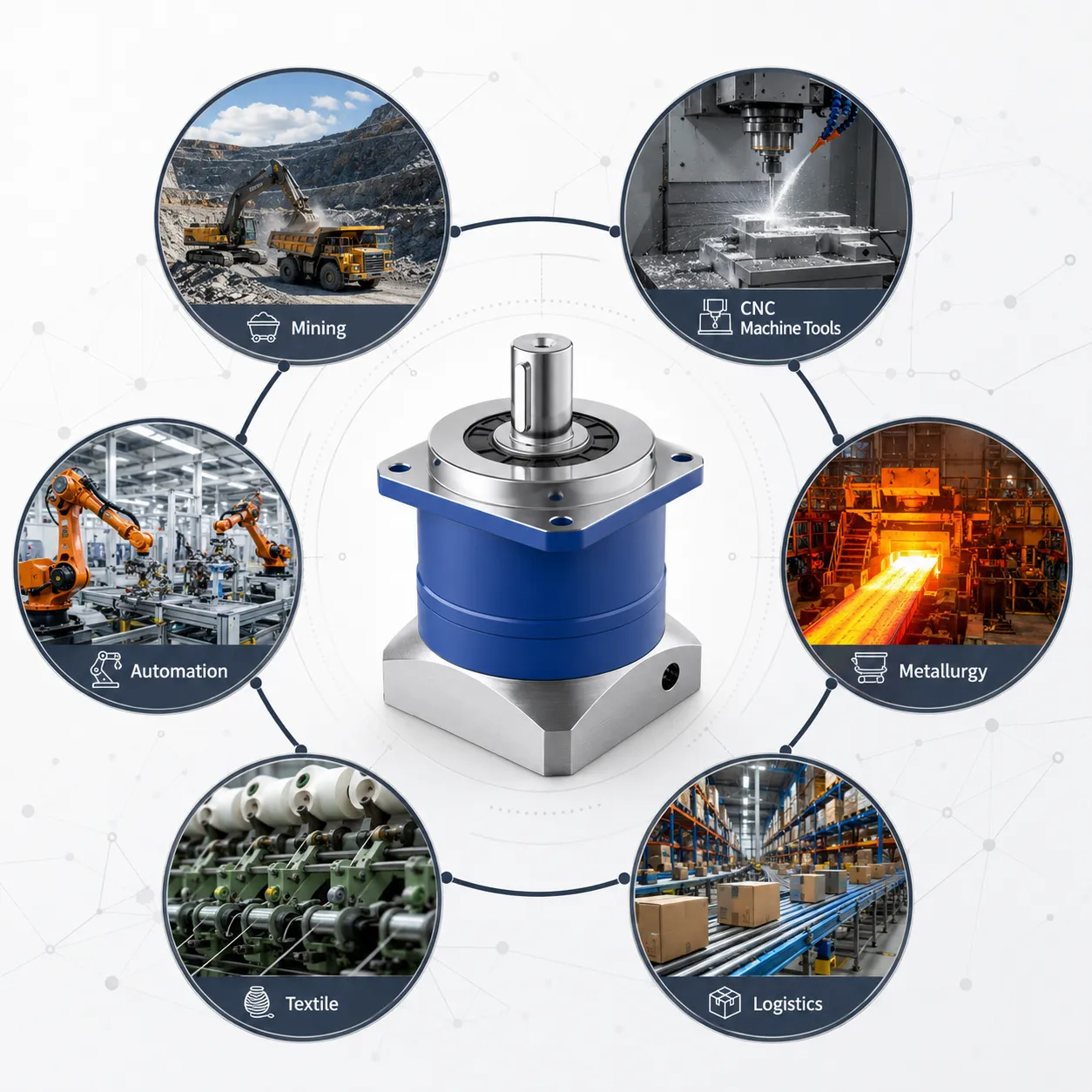
应用快速参考
- ✦ Wind Turbine Pitch Drives
- ✦ Large-Format Printing Presses
- ✦ Precision Rotary Tables
- ✦ Acoustic-Controlled Factory Lines
- ✦ Heavy Conveyor Main Drives
- ✦ Ship Loader & Port Equipment
- ✦ Slitter-Rewinder Drive Heads
- ✦ Pelletiser & Extruder Gearboxes
- ✦ Noise-Controlled Food Processing
Acoustic-Controlled Automation
Factory lines governed by ISO 11690 or EU Machinery Directive noise-at-work limits (≤80 dB(A) at operator position) typically require acoustic enclosures around spur-planet drives above 5 kW. PZB eliminates enclosure cost and maintenance access restrictions at power levels up to 50 kW.
Pelletiser & Extruder Drives
Polymer extrusion and pelletiser screw drives run continuously at maximum rated torque with peak overloads during startup and material transitions. PZB's 40–60% higher tooth fatigue life versus spur-planet equivalents translates to extended gearbox service intervals and lower total-cost-of-ownership on 24/7 process lines.
Slitter-Rewinder Heads
Film and foil slitting machines require synchronised multi-head drives at 7.5–22 kW with tight speed ratio accuracy. PZB ≤3 arcmin backlash prevents speed hunting between synchronised drive heads that causes winding tension variation and product defects on precision foil lines.
Frame Size Selection — 60PZB through 220PZB
Selection follows the same torque-and-axial-load methodology as other series, with the additional check of axial shaft load from helical thrust plus external application loads.
60PZB — Compact High-Speed (0.5–3 kW)
Smallest helical PZB frame for noise-sensitive servo drives and small printing auxiliaries where standard PLE/PLF reaches its power limit. Rated torque 40–200 N·m at 0.5–3 kW. Primary advantage versus PL series at equivalent torque: 8 dB lower noise and 40% longer surface fatigue life.
90PZB — Light Industrial (2–7.5 kW)
Rated torque 100–450 N·m covers printing press colour unit main drives, light pelletiser pre-stage gearboxes, and slitter head drives at 2–7.5 kW. The 8,000 N axial capacity handles practical sprocket and coupling side loads without external support bearings.
120PZB — Mid Industrial ★ Most Specified (5–15 kW)
The most commonly specified PZB frame for precision rotary tables, medium web-press main drives, and high-power conveyor automation in acoustic-controlled environments. Rated torque 200–750 N·m, 12,000 N axial capacity. Covers 5–15 kW motors with a single frame selection process.
150PZB — Heavy Printing & Extrusion (11–22 kW)
Wide-web printing impression roll drives, large-format laminating line main rolls, and extrusion screw final stages specify 150PZB at rated torque 350–1,200 N·m. The 20,000 N axial capacity accommodates large impression cylinder side loads without external bearing frames.
180PZB — High-Power Industrial (18–37 kW)
Port ship-loader belt head drives, large slitter-rewinder main drives, and industrial mixer main gearboxes. Rated torque 600–1,600 N·m at 18–37 kW. The 35,000 N axial capacity supports large-diameter drum arrangements in mining and marine applications. Pairs with agricultural-class bevel stages for multi-output power splitting.
220PZB — Maximum Frame (30–50 kW, 50,000 N Axial)
The flagship PZB frame for wind turbine pitch actuators, large rotary kilns, and heavy industrial conveyor main drives where 30–50 kW motor power is standard. Rated torque 900–2,000 N·m. The 50,000 N axial shaft load capacity is unmatched in any other series — directly handling wind turbine blade root thrust loads that previously required external thrust bearing arrangements adding cost and maintenance complexity to nacelle pitch drive systems.
质量认证与测试标准
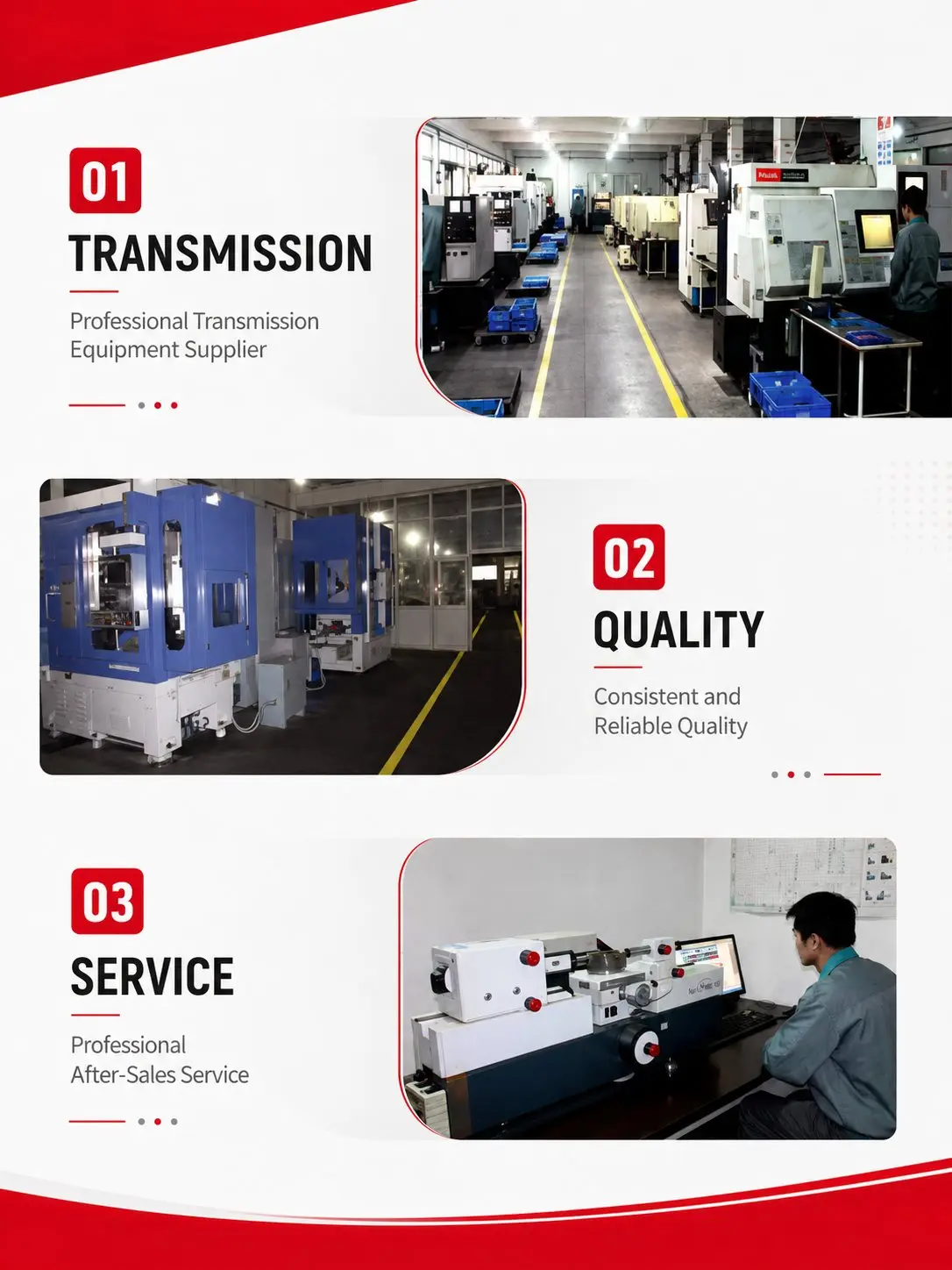
PZB series undergoes helical tooth profile verification using gear metrology equipment in addition to the standard 行星齿轮箱 acceptance protocol. Helix angle, lead error, and profile form error are measured on every unit to confirm the noise specification before shipment.
工厂验收测试——每台设备
- ✔ Helical tooth profile & helix error measurement
- ✔ Backlash measurement — ≤3 arcmin verified per unit
- ✔ Full-load noise test in anechoic chamber ≤68 dB(A)
- ✔ Axial load deflection test at rated axial capacity
- ✔ Efficiency measurement at 50%, 75%, 100% rated torque

Why Engineers Specify PZB Series
🔇
No Acoustic Enclosure Required
Eliminates the €800–3,000 per-gearbox acoustic enclosure cost and maintenance access restriction that spur-planet alternatives impose at power levels above 5 kW in noise-controlled factory environments.
🎯
≤3 Arcmin at 50 kW — Unique Combination
No other single series in our range delivers ≤3 arcmin precision backlash above 6 kW motor power. PZB fills the gap between precision servo reducers (max 6 kW) and high-power industrial reducers (typically >10 arcmin).
🏋️
50,000 N Axial — Eliminates Thrust Bearings
The 220PZB axial load rating eliminates the external thrust bearing housing and alignment procedure that adds 4–8 hours of installation labour and long-term maintenance overhead on wind turbine and heavy industrial shaft arrangements.
⚙️
40–60% Longer Surface Fatigue Life
Helical tooth contact ratio advantage reduces per-tooth Hertz stress at equivalent torque, extending L10 gear surface fatigue life by 40–60% versus spur-planet equivalents — translating to lower lifetime gearbox replacement costs on continuous 24/7 drives.
🔧
Sealed Lifetime — No Oil Changes
Unlike parallel-shaft helical reducers requiring oil changes at 4,000-hour intervals, PZB sealed grease fill eliminates all lubrication maintenance across the full service life — a significant operational advantage in nacelle-top wind turbine installations.
🛡️
2-Year Warranty, Noise Spec Guaranteed
24-month warranty covering tooth surface fatigue, bearing failure, and seal integrity. Noise specification ≤68 dB(A) is contractually warranted — not merely a nominal design target — and verified per-unit on the anechoic test bench before shipment.
系统集成:互补产品
High-power helical planetary drives operate at the centre of complex drivetrain systems. These products are most frequently integrated alongside PZB series.
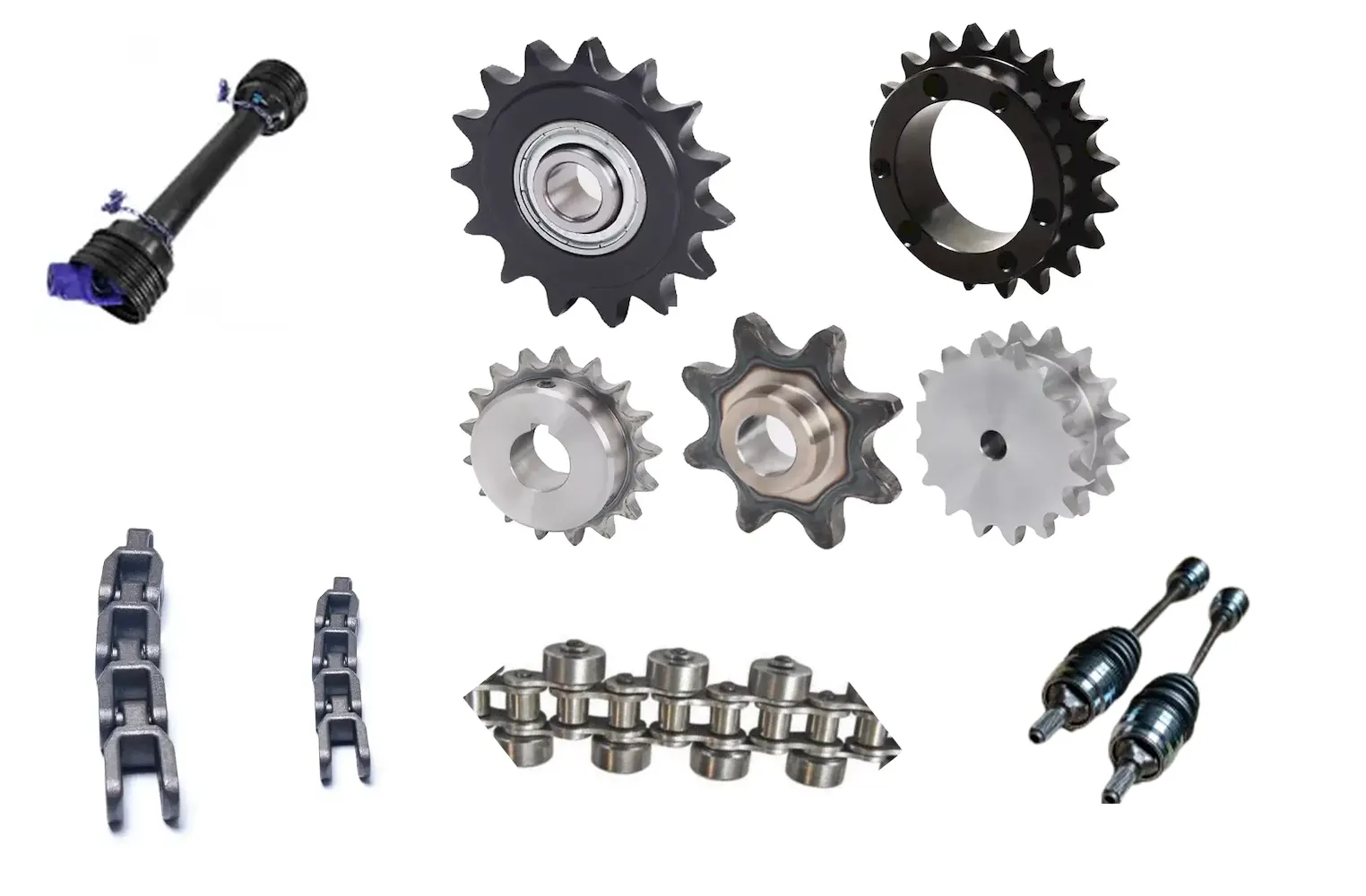
→ Heavy-Duty CV Drive Shafts
For wind turbine pitch arm extensions, large rotary table output connections, and ship-loader conveyor shaft spans, heavy CV drive shafts absorb structural misalignment without transmitting bending forces into the PZB output bearing — critical when 50,000 N axial loads are present simultaneously.
- ▸ Torque capacity to 5,000 N·m
- ▸ Angular misalignment ±8° continuous
→ Worm Gearbox (Self-Locking Stage)
For applications requiring fail-safe back-drive prevention — such as vertical-shaft kiln drives or gate actuators — a worm stage downstream of PZB provides self-locking holding torque while PZB handles the efficiency-critical high-speed stage upstream.
- ▸ Self-locking at ratios ≥40:1
- ▸ Combined system ratios to 10,000:1
→ Bevel Gearbox Power Split Stage
Ship-loader booms and multi-drive conveyor systems split a single PZB output to multiple drive points using high-efficiency bevel stages. Agricultural-class bevel gearboxes provide the rugged multi-output right-angle splitting at 96–98% efficiency per stage.
- ▸ 斜面效率 96–98%
- ▸ IP67 outdoor rated
客户评价和现场表现
5星
87%
4星
11%
≤3 ★
2%
220PZB units on our 2 MW turbine pitch drives — 18 months of operation across 12 turbines with zero gearbox failures. The 50,000 N axial rating was the deciding factor; every other series required external thrust bearing housings that added complexity and failure points to the pitch mechanism. Noise levels inside the nacelle measurably reduced by 7 dB versus the previous spur-planet units.
150PZB on our 8-colour gravure press main drives. Noise level at the operator station dropped below 75 dB(A) — first time we've met the French factory noise regulation without acoustic panels. The ≤5 arcmin two-stage backlash maintains registration accuracy at 320 m/min web speed. Ordered a second press with the same specification immediately after commissioning.
120PZB for a large-bore CNC rotary table C-axis drive. We needed ≤3 arcmin backlash and 750 N·m torque simultaneously — no other manufacturer offered both in a sealed planetary at 11 kW motor input. 10 months of 3-shift operation in a titanium machining cell, zero backlash drift, surface finish maintained to Ra 0.4 µm specification throughout.
Replaced parallel-shaft helical gearboxes on our PE film extrusion line with 180PZB units. Electricity saving of 4.2% confirmed by power metering — the efficiency difference is real and measurable. Oil change interval eliminated entirely. Noise at the line operator position reduced by 9 dB. ROI on the gearbox premium recovered within 14 months.
常见问题解答
其他信息
| 编辑 | CXM |
|---|
相关产品
-
EP-ABR系列直角方法兰精密行星齿轮箱(EP-ABR042至EP-ABR220)
-
EP-ADS系列圆法兰直列式行星齿轮箱——五种目标传动比(EP-ADS047至EP-ADS255)
-
EP-AD系列圆形法兰高精度直列行星齿轮箱(EP-AD047至EP-AD255)
-
EP-BPG系列节能行星齿轮箱——标准工业驱动(EP-BPG040至EP-BPG160)
-
EP-BAF系列高精度行星齿轮箱——高刚性输出轴(EP-BAF042至EP-BAF220)
-
BABR系列高精度行星齿轮箱——圆形法兰型(EP-BABR042至EP-BABR220)
-
用于伺服电机的高精度行星齿轮箱 — PLE/PLF 系列
-
EPL双轴行星齿轮箱,适用于链传动系统