Decreasing Weight — The Reverse of the Potato Harvester Problem
A potato harvester gains weight as the bunker fills. A fertilizer applicator loses weight as the tank empties. Both face the same fundamental 轮驱动行星齿轮箱 challenge: the machine weight changes dramatically during a single field pass, and the wheel drive must maintain constant ground speed regardless of the weight change. But the direction of the change produces different engineering consequences.
On a potato harvester (gaining weight), the traction demand increases and the risk is bogging or wheel spin. On a fertilizer applicator (losing weight), the traction demand decreases — but the risk shifts to the opposite problem: as the machine lightens, the tyre contact pressure decreases, the rolling resistance decreases, and the hydrostatic drive system (which was set to push a 28-tonne machine) suddenly has excess flow for a 14-tonne machine. Without automatic compensation, the ground speed increases as the tank empties — by 5 to 15% on a typical hydrostatic system — and the application rate (kg or litres per hectare) decreases proportionally.
| Tank Level | 重量(吨) | Rolling Resist. | Speed Drift | Rate Error |
|---|---|---|---|---|
| Full (100%) | 28 | Baseline | 0% | 0% |
| Half (50%) | 21 | -25% | +5–8% | -5–8% |
| Empty (5%) | 14.7 | -47% | +10–15% | -10–15% |
A 10% under-application of nitrogen fertilizer across the final third of a field pass reduces the yield in that zone by 5 to 10% — while the first third of the pass (at full weight, correct speed) receives the correct rate and produces full yield. This creates a visible striping pattern in the crop that persists throughout the growing season and is clearly attributable to the applicator speed drift. The agronomic and reputational cost of visible striping is significant — particularly for contract applicators whose customers can see the evidence of imprecise work from the road.
Modern self-propelled applicators use GPS ground speed feedback to compensate for the weight-change effect. The hydrostatic pump displacement is adjusted continuously to maintain constant GPS-measured speed regardless of the changing rolling resistance. The wheel drive must respond to these continuous displacement adjustments with proportional, lag-free speed changes — because any response delay produces a temporary speed error that translates to a temporary application rate error. A wheel drive with 0.5 seconds of response lag at a 15 km/h application speed produces a 2-metre strip of incorrect rate at every adjustment — cumulating to 50 to 200 incorrect strips per field pass on variable terrain.
The weight change also affects the machine stability during operation. A fully loaded applicator (28 tonnes) has a lower CG relative to its weight — the heavy tank contents act as ballast. An empty applicator (14 tonnes) has a higher CG relative to its reduced weight — because the empty tank is a tall, light structure that raises the effective CG. This means the machine is most stable when full (at the start of the pass, when the terrain is unknown) and least stable when nearly empty (at the end of the pass, when the operator may be less cautious because the job is nearly complete). The wheel drive braking and speed control must account for this counter-intuitive stability profile — applying more conservative speed limits as the tank empties, not less.
The liquid sloshing in a partially filled tank adds a dynamic stability risk that does not exist at full or empty states. At approximately 30 to 70% tank fill, the liquid has enough free surface area to develop a resonant sloshing mode — typically at 0.3 to 1.0 Hz depending on the tank geometry. If the wheel drive produces a speed change at a frequency near the sloshing resonance (from terrain-induced traction variations or operator joystick inputs), the liquid amplifies the lateral motion — potentially doubling the effective CG shift compared to the same manoeuvre with a full or empty tank. Internal baffles reduce the sloshing amplitude by 60 to 80% — and are mandatory on high-clearance applicators that operate on fields with any measurable cross-slope.
High-Clearance Chassis — Why the Wheel Drive Must Be Compact and Lightweight
Self-propelled fertilizer applicators operate in standing crops — applying nitrogen, fungicide, or micronutrients during the growing season when the crop is 0.3 to 1.5 metres tall. The machine must straddle the crop rows without damaging the plants — requiring a ground clearance of 1.0 to 1.8 metres and a tyre track width that aligns with the crop row spacing (typically 750 to 900 mm between tyre and crop row).
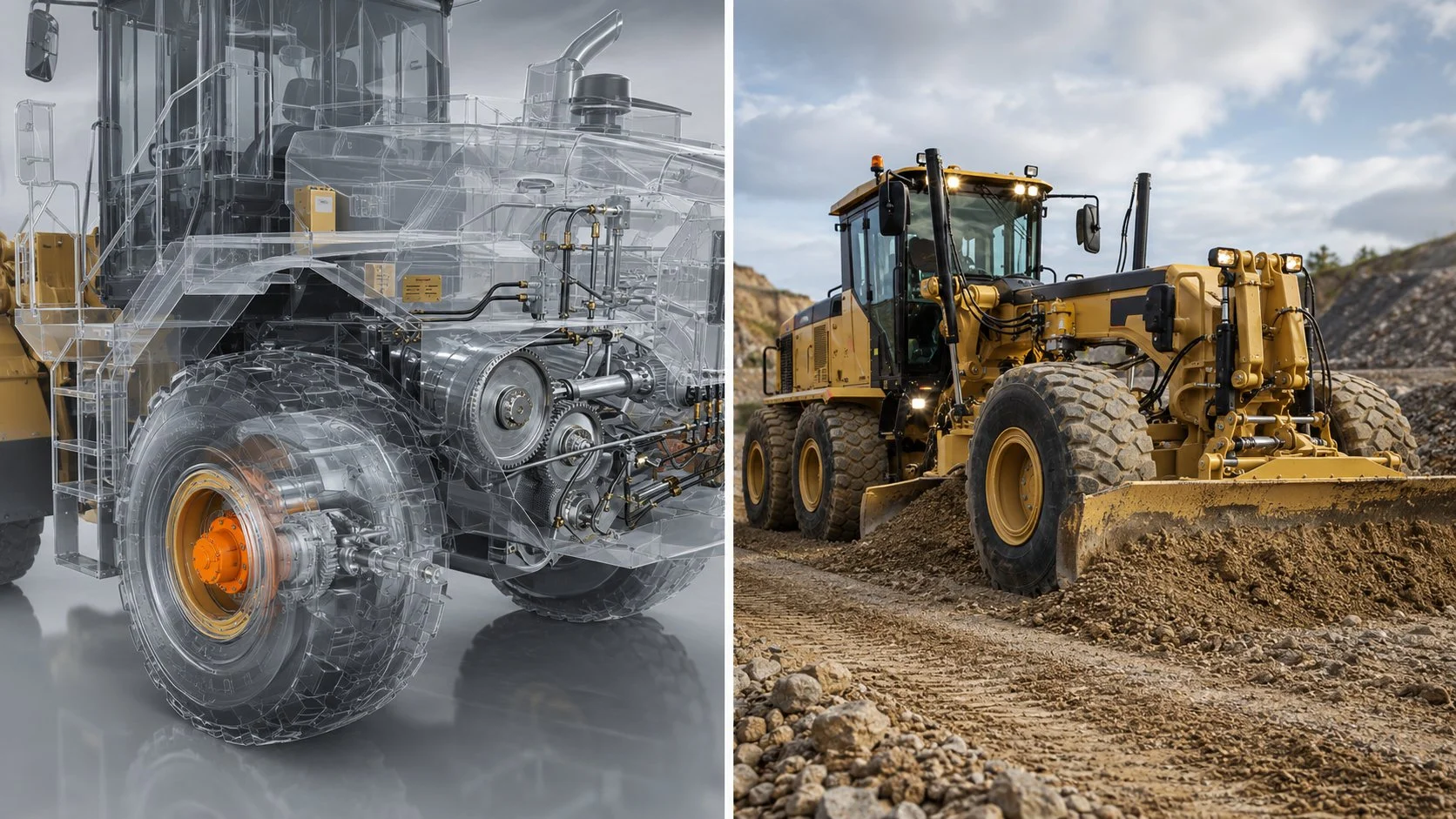
This high-clearance requirement places the wheel drive in an unusual geometric position: mounted at the bottom of a long, slender leg that extends from the chassis down to the wheel — similar to the grape harvester straddle configuration but with 50 to 100% more ground clearance. The wheel drive must fit within the leg width (250 to 400 mm) while handling the full axle load of a 28-tonne machine. The radial dimension of the 行星齿轮箱 is therefore a critical constraint — every additional 10 mm of diameter reduces the crop clearance or increases the leg width, potentially damaging the crop canopy.
The high centre of gravity (2.0 to 3.0 metres when fully loaded) creates the same stability concern as on grape harvesters — but at 2 to 3 times the machine weight. The rollover angle for a loaded high-clearance applicator is typically 20 to 30 degrees — adequate for flat cropland but marginal on sloping fields. Any wheel drive torque pulsation that produces a lateral acceleration component reduces the effective stability margin. DIN Class 6 gears are specified for the same stability reason as on grape harvesters — the cogging-induced lurch at the high CG can bring the machine unacceptably close to the rollover threshold on cross-slopes above 10%.
Chemical Corrosion — The Most Aggressive Chemical Environment in Agricultural Equipment
Fertilizer applicators handle three categories of chemically aggressive material: nitrogen solutions (UAN 28 to 32%, ammonium nitrate, urea — pH 5 to 7 but highly corrosive to copper alloys and zinc coatings), phosphate products (MAP, DAP — acidic at pH 3.5 to 4.5 in solution, abrasive as dry granules), and potash (potassium chloride — a chloride salt that accelerates steel corrosion at the same rate as road salt). The combination of these three chemical categories produces a corrosion environment more aggressive than any single-product exposure.
The UAN (urea-ammonium nitrate) liquid fertilizer is the most damaging to wheel drive components. UAN solution is hygroscopic (absorbs atmospheric moisture), mildly acidic, and attacks zinc, copper, brass, and aluminium — all materials commonly found in standard industrial gearbox housings, fittings, and breather vents. A zinc-plated bolt exposed to UAN spray corrodes visibly within 48 hours. A brass breather vent dissolves within a single application season. Standard aluminium housing covers develop pitting that can penetrate a 3 mm wall within 2 to 3 seasons. Every metallic component on the wheel drive that may contact UAN spray or drift must be selected for UAN compatibility: stainless steel (316 grade), glass-filled nylon, or epoxy-coated ductile iron.
Dry granular fertilizer (MAP, DAP, potash) produces a different damage mechanism: abrasion. The granules are 2 to 4 mm hard particles (Mohs 2 to 3) that bounce off the spinner disc at 20 to 40 m/s — impacting every surface within the spray pattern, including the wheel drive housing. Over a season of broadcasting (200 to 400 hours), the granule impacts erode the paint coating and expose the base metal to the corrosive granule dust. The combined effect of impact erosion and chemical corrosion is more severe than either mechanism alone — and is most intense on the wheel drive housing surfaces that face the spinner disc direction.
The post-season cleaning procedure is critical for wheel drive longevity. Fertilizer residue left on the housing over the storage period (typically 6 to 9 months between spring and autumn application seasons) continues to corrode throughout the idle period — especially in humid climates where the hygroscopic fertilizer residue absorbs atmospheric moisture and maintains a wet corrosive film on the steel surfaces. A thorough power-wash with fresh water within 24 hours of the last application removes 90 to 95% of the residue. A follow-up application of corrosion-inhibiting spray (lanolin-based or wax-based) on unpainted surfaces provides additional protection during storage. Machines that are cleaned and protected before storage consistently show 40 to 60% less housing corrosion at the next seasonal inspection than machines that are parked unwashed.
Three Failure Modes Specific to Fertilizer Applicator Wheel Drives
UAN liquid fertilizer attacks zinc, copper, brass, and aluminium — dissolving standard plated fasteners, brass breather vents, and aluminium covers within 1 to 3 seasons. The corrosion products (zinc hydroxide, copper oxide) contaminate the gearbox oil through the corroded breather vent — introducing metallic particles that accelerate bearing and gear wear. A single corroded-through breather allows rainwater and UAN spray to enter the gearbox directly — leading to oil emulsification and lubrication failure within 100 to 300 operating hours. This failure mode is entirely preventable through material specification — but is the most common cause of premature wheel drive replacement on fertilizer applicators because operators do not recognise the material incompatibility until the damage is visible. The failure sequence is predictable: Season 1 — zinc plating on fasteners develops white corrosion; Season 2 — brass breather vent shows green patina and begins to pit; Season 3 — breather perforates, allowing moisture ingress; Season 4 — oil emulsification detected (if the operator checks), bearing noise develops; Season 5 — bearing failure, gearbox replacement required. The total cost of the failure (gearbox + labour + downtime) is USD 3,000 to 8,000 — versus USD 50 to 150 for the UAN-compatible breather and stainless fasteners that would have prevented the entire sequence.
As the tank empties during application, the machine weight decreases by up to 50% — reducing the rolling resistance and allowing the ground speed to increase by 10 to 15% on an uncompensated hydrostatic system. This speed increase directly reduces the application rate by the same percentage — creating a systematic under-application pattern across the final third of every field pass. The under-application stripe is visible in the crop canopy (lighter green colour from nitrogen deficiency) and produces a measurable yield reduction of 5 to 10% in the affected zone. On a contract application basis, visible striping can result in customer complaints, rate disputes, and loss of future business.
A fully loaded high-clearance applicator (28 tonnes, CG at 2.5 metres) has a static rollover angle of approximately 22 to 28 degrees. On a 10% cross-slope (6 degrees), the machine consumes 20 to 25% of its rollover margin — and the liquid tank contents (if not baffled) can slosh toward the downhill side during a turn, shifting the CG further and reducing the margin by an additional 5 to 10%. A wheel drive torque spike during a turn on a 10% slope with a sloshing tank can push the combined tilt angle beyond the stability limit — causing the machine to roll over into the growing crop and destroying 0.5 to 2.0 hectares of crop worth USD 2,000 to 10,000, plus the USD 50,000 to 200,000 cost of the damaged machine.
常见问题解答
Korea Ever-Power provides fertilizer applicator wheel drives from 5,000 to 30,000 Nm with UAN-resistant materials, weight-change speed compensation, and high-clearance compact packaging.
编辑:Cxm