Four Requirements That Separate AGV Drive Selection from General Servo Applications
Automated guided vehicles and autonomous mobile robots use precision planetary gearboxes in configurations that standard servo automation selection guides are not written for. The parameters that dominate AGV drive selection — vehicle weight, chassis height target, navigation accuracy, deployment environment — are largely absent from general servo gearbox literature. These four differences define the AGV selection problem:
The gearbox output shaft is the wheel axle — or is directly coupled to it. Vehicle weight loads the output bearing axially with every kilogram of vehicle and payload. A 500kg AGV on two drive wheels applies 2,452N of axial force per gearbox output bearing — exceeding the EP-ZDE-80 axial limit of 450N by 445%. This is the most commonly violated specification in Korean AGV drive design, and it produces the seal weeping and bearing fatigue described in the failure causes guide.
Low-profile AGV designs target chassis heights of 100–200mm between the floor and the cargo carrying surface. An inline EP-ZDE-80 plus 400W motor stacked vertically above the wheel axle adds 264mm of height — more than most low-profile target chassis heights. The right-angle input EP-ZDWF-80, with the motor routing horizontally into the chassis body, reduces this to 119.5mm at the drive axle — a 144.5mm saving that often makes the difference between a feasible and infeasible chassis design.
Differential-drive AGVs steer by running left and right wheels at different speeds — no separate steering axis. Navigation accuracy depends on both wheels having identical gear ratios and, critically, identical backlash. A backlash difference of 1 arcmin between left and right drive gearboxes on a 500mm wheelbase AGV produces 0.7mm of lateral position error for every 10m of travel — accumulating to 7mm per 100m, which causes failure of narrow-aisle docking at ±5mm tolerance.
AGV and AMR deployment environments range from clean semiconductor fabs (controlled air, no liquids) to automotive body shops (welding spatter, cooling water, floor washing) to food processing facilities (daily HACCP pressure-wash at 2–8 bar). These three environments require completely different IP ratings: IP54 for clean indoor, IP65 for automotive and food. Using IP54 in a daily-washdown environment reduces gearbox service life from 20,000 hours to 2,000–4,000 hours through lubricant contamination.
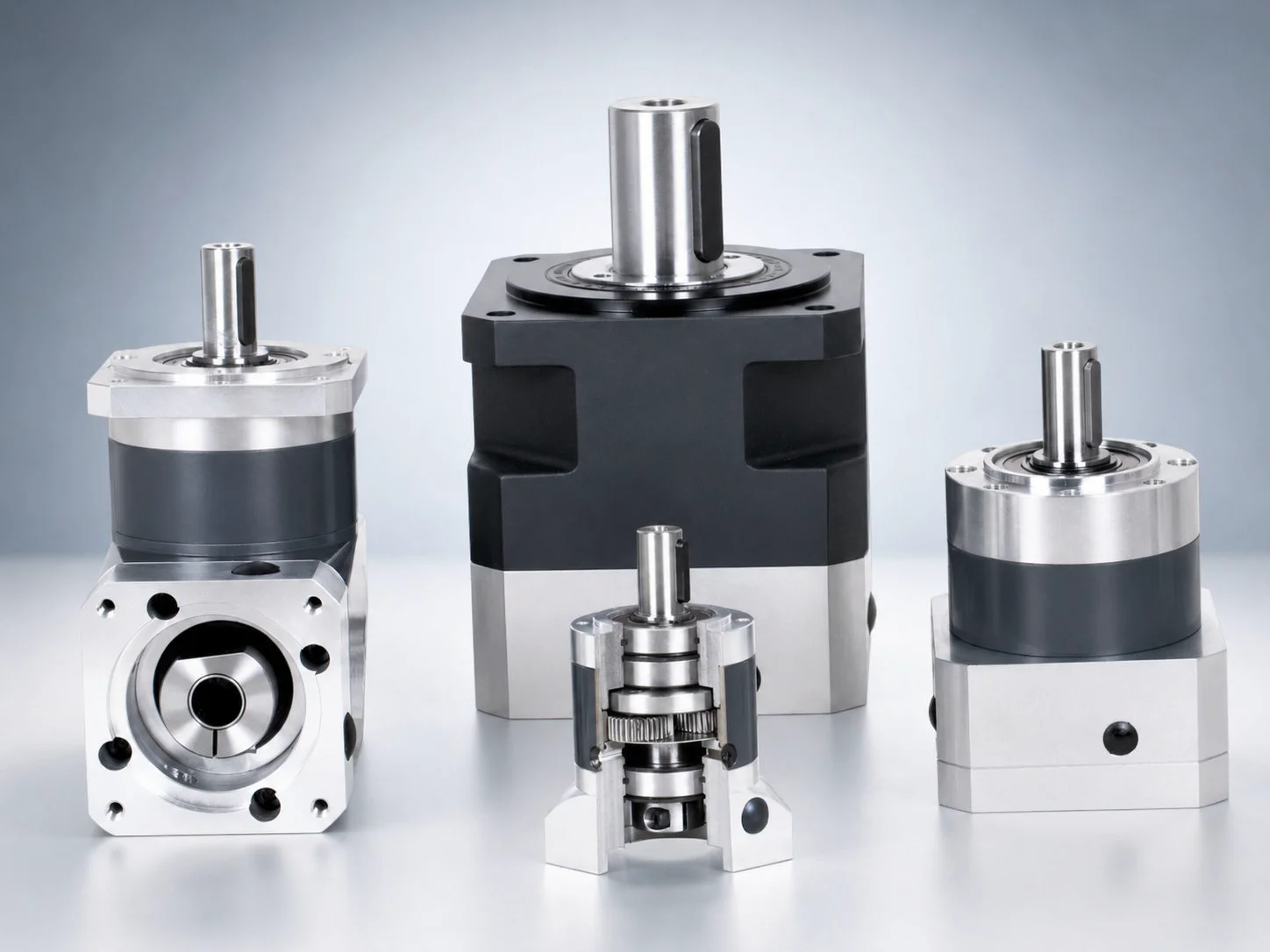
Axial Force from Vehicle Weight — The Most Commonly Violated AGV Gearbox Specification
When the gearbox output shaft is the drive axle — either directly or through a short coupling — the total vehicle weight (vehicle body plus maximum payload) is distributed across the drive wheels. Each drive wheel gearbox output bearing carries the static weight of its portion of the vehicle as a sustained axial load. This is in addition to any dynamic axial forces from acceleration and deceleration, incline climbing, or wheel impacts from floor irregularities.
The static calculation is: F_axial_per_wheel = (m_vehicle + m_payload) × g / n_drive_wheels. Add a dynamic factor of 1.3–1.5 for floor irregularities and acceleration transients before comparing to the gearbox rated axial force limit.
| Vehicle Class | Total Mass (vehicle + payload) |
Drive Wheels |
Static Axial Force / Wheel |
With Dynamic Factor ×1.4 |
EP-ZDE Limit | Correct Series |
|---|---|---|---|---|---|---|
| Light AMR / cobot | 80–120 kg | 2 | 390–590 N | 546–826 N | ZDE-80: 450N ⚠ borderline |
EP-ZDE-120 (1,050N limit) |
| Flatbed AGV (medium) | 400–600 kg | 2 | 1,960–2,940 N | 2,744–4,116 N | ZDE-160: 3,000N ❌ exceeded at 600kg |
EP-ZDS-115 (12,000N limit) |
| Flatbed AGV (heavy) | 800–1,500 kg | 2–4 | 1,960–7,350 N | 2,744–10,290 N | All ZDE exceeded | EP-ZDS-115 (12,000N limit) |
| Forklift AGV | 2,000–3,500 kg | 4 | 4,900–8,580 N | 6,860–12,012 N | All ZDE exceeded | EP-ZDS-115/142 (12,000–19,000N) |
| Heavy towing AGV | >3,500 kg | 4 | >8,575 N | >12,005 N | Exceeds ZDS-115 | EP-ZDS-190 (28,000N limit) |
Dynamic factor of 1.4 accounts for floor irregularities (bumps, threshold strips), hard stops, and emergency braking. For outdoor AGVs on uneven surfaces, use dynamic factor 1.5–2.0. EP-ZDE axial force limits: 80N (40-frame), 225N (60-frame), 450N (80-frame), 1,050N (120-frame), 3,000N (160-frame). EP-ZDS: 12,000N (115-frame), 19,000N (142-frame), 28,000N (190-frame).
An EP-ZDE-80 is correctly sized for the drive torque of a 200kg flatbed AGV at 8:1 ratio. The output torque of 120 N·m is within the rated 50 N·m × 8 × 0.96 = 384 N·m limit. The engineer selects EP-ZDE-80 — and the axial force violation is missed entirely. The 200kg vehicle static axial force per wheel is 981N — more than double the EP-ZDE-80’s 450N axial limit. Within 2,000 hours, the output bearing race fatigues and the output shaft seal begins weeping grease. The correct unit is EP-ZDE-120 (1,050N axial limit) or EP-ZDS-115 (12,000N) if the vehicle is in a washdown environment.
Chassis Height Analysis — Why EP-ZDWF Square-Flange Right-Angle Input Is the AGV Designer’s First Choice
The chassis height of an AGV determines how it interacts with the loading infrastructure — pallet heights, conveyor levels, and underpassing clearance. Korean logistics facilities operating European pallets (150mm height) require AGV chassis heights of 80–120mm for underpallet operation. Korean automotive plant line-side AGVs target body heights of 200–300mm for assembly ergonomics. Each millimetre of chassis height reduction typically represents hours of design iteration on structural elements that must clear the drive assembly.
Motor stacks vertically above gearbox. Chassis floor must be ≥264mm above axle centreline.
Motor routes horizontally inside chassis. Chassis floor height above axle: only 119.5mm.
AGV cargo floor can sit 144.5mm lower
Enables underpallet operation for most standard pallet heights
EP-ZDWF-80: L1=184.5mm (axial depth), L12=119.5mm (height perpendicular to output shaft). Motor exits 90° from output axis into the horizontal chassis plane. L12 values: ZDWF-60=93mm, ZDWF-80=119.5mm, ZDWF-120=167.5mm, ZDWF-160=229mm.
AGV chassis plates are typically laser-cut steel or aluminium sheet. Laser cutting produces flat plates with precise bolt hole patterns — but cannot produce precision circular bores for round-flange mounting without an additional machining operation. The EP-ZDWF square-flange mounts directly to a flat plate with four bolts, eliminating the bore machining step. In production AGV manufacturing where the same chassis design is built in quantities of 50–500 units per year, eliminating one machining operation per unit delivers significant cost reduction.
If the AGV chassis design allows vertical motor stacking (sufficient height clearance), the inline EP-ZDE delivers better efficiency (96% vs 94% for ZDWF), tighter backlash (<8 vs <25–30 arcmin), and a more straightforward mechanical layout. For outdoor AGVs, large heavy-duty AGVs, and any application where the chassis height is not the binding design constraint, the inline EP-ZDE-120 or EP-ZDS-115 (with IP65) is the preferred and more cost-effective specification.
AGV Inertia Ratios — Why the Standard 3:1 Target Cannot Be Achieved and What to Do Instead
For most servo automation applications, the goal of the inertia matching calculation is to select a gear ratio that brings the reflected inertia ratio below 3:1. For AGV and AMR drive wheels, this target is structurally unachievable for any vehicle heavier than approximately 30–40kg, regardless of which gear ratio is selected. The vehicle mass dominates the total reflected inertia by 50:1 to 300:1 or more.
Because the inertia ratio target cannot be met through ratio selection alone, the AGV drivetrain must be tuned to function correctly at high inertia ratios. Four engineering responses make this feasible:
Replace linear acceleration ramps with smooth S-curve (jerk-limited) profiles in the AGV motion controller. S-curve acceleration reduces peak torque demand during velocity transitions by 30–50%, effectively lowering the dynamic inertia load on the gearbox bearing during acceleration transients.
Set servo velocity loop gain (Kv) to approximately 0.5–0.7× the value that would be used at 3:1 inertia ratio. This reduces servo bandwidth and slows response, but prevents excitation of the low resonant frequency that results from high inertia mismatch. AGV applications do not require the bandwidth of CNC servo axes.
For the same inertia ratio and load, a gearbox with higher Ct has a higher mechanical resonant frequency. EP-ZDS-190 (Ct=130 N·m/arcmin) raises the resonant frequency by 1.8× compared to EP-ZDE-160 (Ct=38) at the same load. This allows a higher Kv before resonance is excited — partially compensating for the high inertia ratio.
AGV acceleration rates are typically 0.3–0.8 m/s² — far below industrial robot or machine tool acceleration requirements. At these moderate acceleration rates, the dynamic torque from high inertia is manageable within the gearbox service factor without requiring inertia ratio optimisation. The service factor (SF=2.0) must still account for these dynamic loads.
Differential Steering Navigation Accuracy — Why Left and Right Backlash Must Match
Differential-drive AGVs — the dominant architecture in Korean logistics facilities — have no separate steering wheel. They steer by commanding different speeds to left and right drive motors. The navigation system assumes identical gear ratios and backlash characteristics for both drives. Any difference in backlash between the two units creates a systematic heading error on direction reversal — the classic symptom being an AGV that drifts gradually left or right when commanded to travel straight after a direction change.
| Backlash Specification | Typical L–R BL Difference |
Heading Error (500mm wheelbase) |
Lateral Position Error / 10m |
Lateral Position Error / 100m |
Narrow-Aisle Docking ±5mm |
|---|---|---|---|---|---|
| <8 arcmin (EP-ZDE/ZDS) | 0.8 arcmin | 0.16′ | 0.5 mm | 5 mm | ✅ Meets spec |
| <12 arcmin (ZDE-40 2-stage) | 1.2 arcmin | 0.24′ | 0.7 mm | 7 mm | ⚠ Marginal |
| <25 arcmin (ZDWE/ZDWF) | 2.5 arcmin | 0.50′ | 1.5 mm | 15 mm | ❌ Fails |
| <30 arcmin (ZDWE-60) | 3.0 arcmin | 0.60′ | 1.8 mm | 18 mm | ❌ Fails badly |
BL difference assumed at 10% of specified maximum — typical manufacturing tolerance variation within a batch. Wheelbase = 500mm. Position error is cumulative drift from backlash difference at each direction change event. Narrow-aisle docking specification ±5mm typical for automated rack storage systems.
The EP-ZDWE and ZDWF series have <25–30 arcmin backlash due to the bevel gear input stage. At this backlash level, even a 10% unit-to-unit variation produces 15mm of lateral drift per 100m — which fails narrow-aisle docking requirements. EP-ZDWF is appropriate as a chassis-height-saving solution only when navigation is provided by external localisation (LIDAR, QR codes, magnetic tape) that corrects heading independent of drivetrain backlash, and the AGV operates in wide aisles where ±15–20mm navigation tolerance is acceptable. For any application requiring ±10mm or better docking accuracy with differential steering, specify the inline EP-ZDE or EP-ZDS series with <8 arcmin backlash.
AGV Deployment Environment and IP Rating — Seven Scenarios Resolved
The IP rating decision for an AGV drive gearbox is determined by the worst-case environmental exposure the gearbox will experience during its service life — not the typical daily operating condition. A warehouse AGV that spends 99% of its operating time in clean aisles but receives monthly floor scrubbing with pressure washers needs IP65, not IP54.
Complete AGV and AMR EP Series Selection Matrix
| Vehicle Class | Total Mass |
Drive Config |
Съотношение аз |
ИП | Axial Check |
Recommended EP Series |
Key Spec Driver |
|---|---|---|---|---|---|---|---|
| Light cobot AMR | <80 kg | 2WD diff | 16:1 | IP54 | ZDE-80 ✅ | EP-ZDE-80 | Mass & accuracy |
| AMR 80–200kg, clean | 80–200 kg | 2WD diff | 16:1 | IP54 | ZDE-120 ✅ | EP-ZDE-120 | Axial limit upgrade |
| Low-profile flat AGV, clean | 200–600 kg | 2WD, flat | 16:1 | IP54 | ZDS-115 ✅ | EP-ZDWF-80 + ZDS-115 | Height + axial |
| Standard flatbed AGV, clean | 400–800 kg | 2WD diff | 20:1 | IP54 | ZDS-115 ✅ | EP-ZDS-115 | Axial force primary |
| AGV, auto/food (washdown) | Всякакви | 2WD diff | 16–20:1 | IP65 | ZDS ✅ | EP-ZDS-115/142 | IP65 overrides all |
| Forklift AGV | 1,500–3,000 kg | 4WD | 25:1 | IP65 | ZDS-142 ✅ | EP-ZDS-142 | High axial + torque |
| Heavy towing AGV | >3,000 kg | 4WD | 25–40:1 | IP65 | ZDS-190 ✅ | EP-ZDS-190 | 28,000N axial |

AGV Drive Gearbox Specification Checklist — Six Parameters to Verify Before Ordering
Calculate F_axial = (m_vehicle + m_payload) × g / n_drive_wheels × 1.4 (dynamic factor). Verify against EP series axial limit. If F_axial > EP-ZDE-160 limit (3,000N), specify EP-ZDS series.
Compare chassis height target to inline (ZDE L1 + motor) vs right-angle (ZDWF L12). If target < 150mm and wheel diameter ≤ 200mm: EP-ZDWF is mandatory for the height budget. If target ≥ 200mm: inline EP-ZDE is preferred (better BL and efficiency).
For narrow-aisle docking ≤ ±10mm: specify EP-ZDE/ZDS (<8 arcmin) for differential drive main wheels. EP-ZDWF (<25–30 arcmin) acceptable only for wide-aisle applications with external localisation correction.
Identify worst-case liquid exposure in the full operating environment including maintenance scenarios. Any pressure washing = IP65 (EP-ZDS). Indoor clean operation only = IP54 acceptable (EP-ZDE/ZDF/ZDWF). When in doubt, specify IP65.
T_required = (F_drive + F_grade + F_accel) × r_wheel × SF. Use SF=2.0 for standard AGV duty. Verify T_available = T_motor × i × η ≥ T_required. Match to EP series rated torque at the selected ratio.
For differential-drive AGVs requiring ≤ ±10mm navigation accuracy: specify “matched pair” — Korea Ever-Power selects left and right drive units from the same production batch with measured backlash within 0.5 arcmin of each other. State this requirement explicitly in the order specification.
Provide your AGV vehicle mass, payload, wheel diameter, chassis height target, maximum speed, deployment environment, and navigation accuracy requirement. Korea Ever-Power application engineering will return a complete EP series specification — including axial force verification, chassis height analysis, IP rating recommendation, and matched-pair availability — in Korean and English at no charge for qualified OEM enquiries.
Редактор: Cxm