Slewing Drive Series — Wind Energy Generation Equipment
Slewing Drive Planetary Gearbox for Wind Turbine Yaw Systems
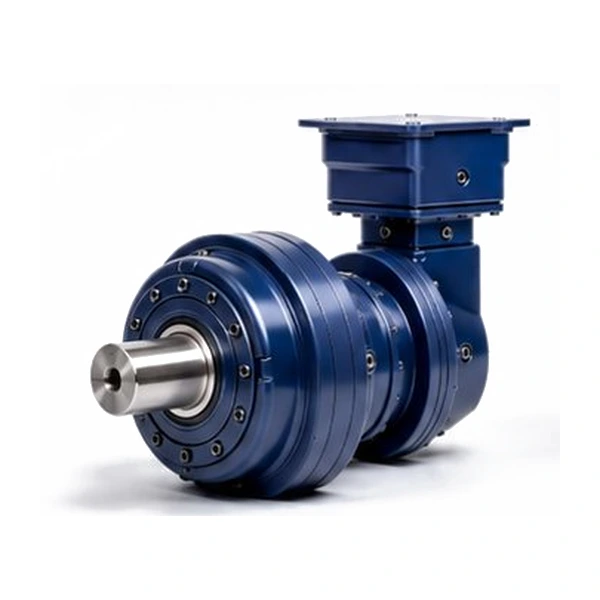
Eight to twelve yaw drives mounted around the nacelle base must rotate a 150 to 400 tonne nacelle and rotor assembly to face the wind direction precisely, then hold that position against gust loads generating overturning moments of millions of newton-metres — for 25 years without a single drive falling out of synchronisation with its neighbours. The планетарна скоростна кутия с въртящо се задвижване at each yaw position is one of the few wind turbine components that must perform in perfect mechanical agreement with seven to eleven identical units mounted around the same ring gear, simultaneously.
8–12 synchronised drives per turbine
25-year design life, 50,000 yaw cycles
-40°C to +50°C nacelle operation
The yaw system is the mechanism that keeps a wind turbine rotor facing into the wind as wind direction changes throughout the day and across seasons — a function distinct from the pitch system that adjusts blade angle and the main gearbox that converts rotor speed to generator speed. A modern utility-scale wind turbine uses 8 to 12 individual yaw drive units, each consisting of a slewing drive planetary gearbox driven by an electric motor, with the output pinion meshing into a large-diameter internal ring gear bolted to the tower top flange. All yaw drives on a single turbine must operate in perfect synchronisation — driving the nacelle at exactly the same rotational rate, holding exactly the same static position when not actively yawing, and sharing wind load torque equally rather than concentrating stress on a subset of drives. Korea Ever-Power supplies slewing drive gearboxes specifically engineered for the multi-drive synchronisation, wind load holding, and 25-year fatigue life requirements that distinguish yaw system applications from the broader slewing drive product range used in excavators, cranes, and other single-drive rotation applications.
The distinction between the yaw drive and the better-known main gearbox and pitch system is worth clarifying for procurement teams new to wind turbine drivetrain terminology. The main gearbox, mounted within the nacelle on the rotor shaft, steps up the slow rotor speed (typically 8 to 20 rpm) to the higher speed required by the generator — a high-power, continuously rotating application entirely different in duty profile from the yaw system. The pitch system, mounted at the root of each individual blade, rotates the blade about its own longitudinal axis to control aerodynamic loading and power output — a precision positioning application operating at the blade root rather than at the nacelle-to-tower interface. The yaw system is the only one of these three rotational systems where the entire nacelle and rotor assembly — the single heaviest rotating mass in the turbine — is the load being positioned, and where multiple gearboxes must act in concert rather than as a single drivetrain element.
Multi-Drive Synchronisation: Why Eight Gearboxes Must Behave as One
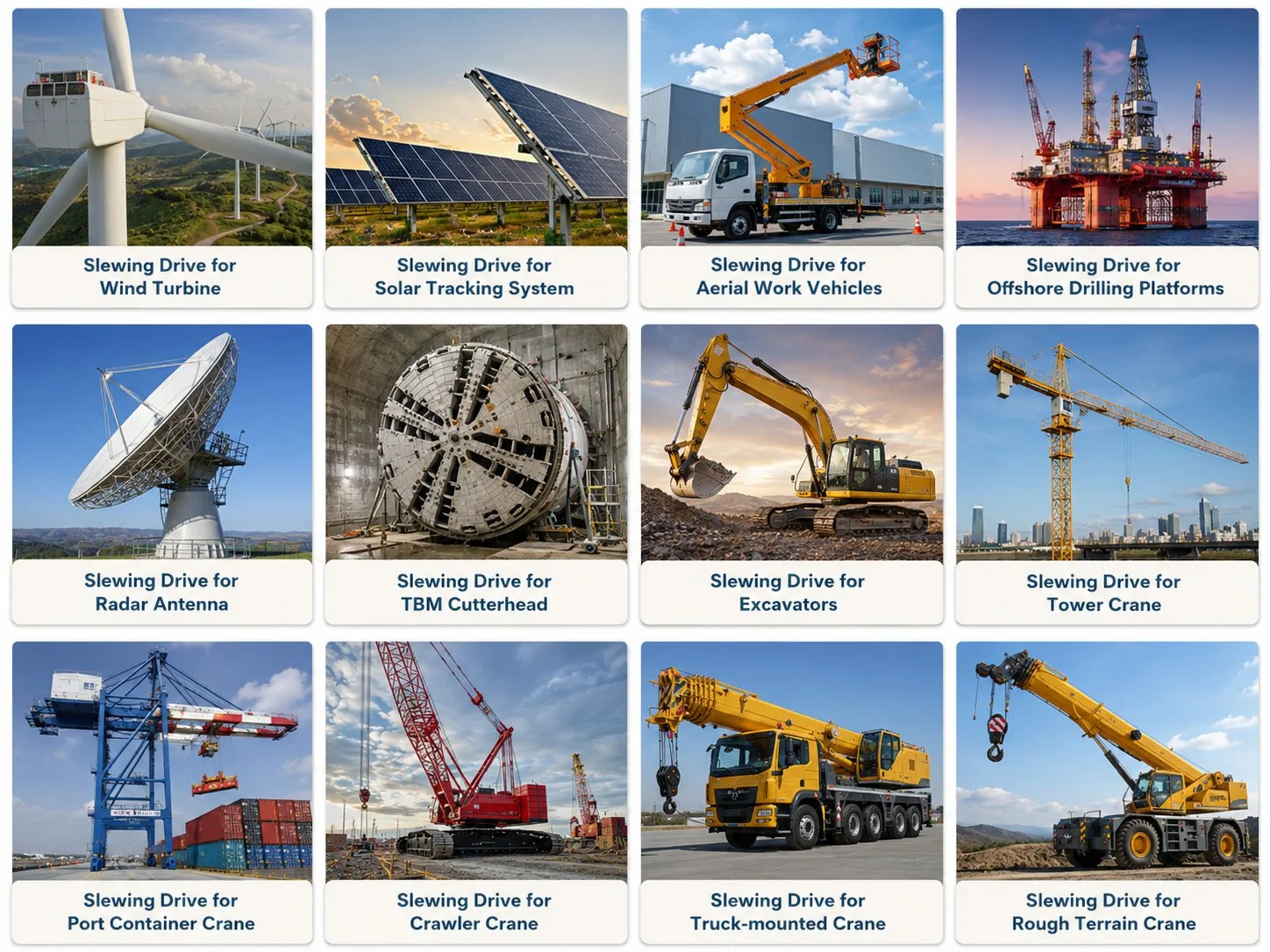
A nacelle yaw bearing — the large-diameter ring gear and slewing ring assembly between the tower top flange and the nacelle base — is driven by multiple gearboxes operating around its circumference, typically spaced at 30 to 45 degree intervals. This multi-drive arrangement is necessary because the torque required to rotate a 150 to 400 tonne nacelle, and more critically the torque required to hold the nacelle stationary against wind load, exceeds what a single gearbox of practical size could deliver. Distributing the load across 8 to 12 gearboxes keeps each individual unit within a manageable torque and size envelope, but introduces the requirement that all units share the load equally:
Ratio Matching Across the Drive Set: If one yaw drive in a set of eight has a gear ratio even 0.1% different from its neighbours, that drive will attempt to rotate its pinion at a slightly different rate during active yawing, generating a circulating force around the ring gear that does not contribute to useful yaw motion but instead loads the gear teeth and bearing of every drive in the set. Korea Ever-Power yaw drive gearboxes for a single turbine order are manufactured from a matched gear batch with ratio tolerance held to ±0.05%, verified by precision rotation bench testing before shipment, eliminating this circulating load condition.
Equal Wind Load Sharing: When the nacelle is stationary and a wind gust generates an overturning moment on the rotor, this moment is reacted by the yaw bearing and transmitted through the yaw drive pinions into the ring gear teeth. If the gearboxes are not equally stiff and equally backlash-free, the drives nearest the load direction carry disproportionately more of the reaction torque than those further away, leading to accelerated wear concentrated on a subset of drives rather than even wear distribution across the full set. Korea Ever-Power yaw drive gearboxes are matched not only on ratio but on torsional stiffness, achieved through consistent gear tooth contact pattern verification across the production batch.
Brake Synchronisation: Each yaw drive includes an integrated brake that engages whenever the turbine is not actively yawing, providing the primary holding torque against wind load. If brake engagement timing or holding torque varies between drives in the same set, the drives that engage first or hold tighter absorb a disproportionate share of any residual load transfer during the brake engagement transient. Korea Ever-Power yaw drive brake assemblies are tested and matched within the same production batch to ensure consistent engagement timing and holding torque across the full drive set supplied for a single turbine.
Korea Ever-Power Yaw Drive Selection Guide by Turbine Class

| Модел | Изходен въртящ момент | Етапи | Turbine Class | Drives per Turbine | Ratio Match |
|---|---|---|---|---|---|
| ZR06 | 8 000 – 18 000 Нм | 2–4 | 1.5 – 2.5 MW onshore | 8 | ±0.05% |
| ZR10 | 15 000 – 30 000 Нм | 2–4 | 2.5 – 3.5 MW onshore | 8–10 | ±0.05% |
| ZR19 | 25,000 – 45,000 Nm | 2–4 | 3.5 – 5 MW onshore | 10 | ±0.05% |
| ZR45 | 40,000 – 80,000 Nm | 2–4 | 5 – 12 MW offshore | 10–12 | ±0.05% |
Wind Load Holding: Sizing the Yaw Brake for the 50-Year Extreme Gust
25-Year Fatigue Life: IEC 61400 Load Spectrum and Cycle Counting
IEC 61400-1 defines the design load cases and the methodology for calculating the fatigue load spectrum that wind turbine components, including the yaw system, must withstand across the certified design life — typically 20 or 25 years. The yaw system fatigue calculation is distinct from most other slewing drive applications because the loading is driven by wind variability rather than a repetitive operational cycle:
Yaw Activation Frequency: A turbine in a site with frequent wind direction changes may engage its yaw system 10 to 30 times per day, while a turbine in a site with steady prevailing wind direction may yaw only a few times per day. Over a 25-year design life, this corresponds to 90,000 to 270,000 yaw activation events — each event involving acceleration, constant-speed yaw motion, and deceleration to the new heading, with the gear mesh experiencing the corresponding torque variation through this cycle.
Wind-Induced Micro-Motion at Standby: Even when the yaw system is not actively commanded to yaw, turbulent wind loading on the rotor and nacelle generates small oscillating torques on the brake-held yaw drives, causing micro-motion within the brake friction tolerance and backlash of the gear mesh. This micro-motion, accumulated continuously over 25 years of standby periods between active yaw events, contributes a fretting fatigue damage mechanism distinct from the discrete-cycle fatigue of active yawing, and Korea Ever-Power yaw drive fatigue calculations account for both mechanisms in the cumulative damage assessment.
Gear Tooth Surface Durability: The combination of high cycle count from active yawing and continuous fretting exposure during standby periods places a premium on gear tooth surface hardness and residual stress state. Korea Ever-Power yaw drive gears are case-hardened to 58 to 62 HRC surface hardness with shot-peening applied to the tooth root fillet, providing the surface durability and fatigue resistance needed for the combined loading spectrum across the certified 25-year turbine design life.
Climate and Offshore Considerations for Yaw Drive Sealing and Lubrication
Nacelles are exposed to the full range of installation site climate conditions without the benefit of climate-controlled enclosures — onshore turbines in cold climates experience -40°C winter temperatures at hub height, while offshore turbines combine moderate temperature ranges with continuous salt-laden marine air exposure:
Cold Climate Onshore Yaw Drives: Korea Ever-Power yaw drive gearboxes for cold climate turbine sites are filled with PAO synthetic gear oil rated to -40°C pour point, ensuring adequate lubrication film at the planet bearings during the infrequent yaw activations that occur after extended cold standby periods in winter conditions.
Offshore Marine Sealing: Offshore wind turbine nacelles, while nominally sealed environments, experience condensation cycling from the temperature differential between the nacelle interior and the marine atmosphere outside, combined with salt-laden air infiltration through ventilation systems. Korea Ever-Power offshore yaw drive gearboxes use FKM seals and a C5-M equivalent corrosion protection system on external surfaces, consistent with the marine-grade specification developed for offshore platform winch applications, adapted to the yaw drive mounting configuration within the nacelle structure.
Service Access Constraints: Yaw drive maintenance at hub height — 80 to 150 metres above ground or sea level — requires technicians to access the nacelle via internal ladder or external climbing systems, making yaw drive service inherently more time-consuming and costly than ground-level equipment maintenance. Korea Ever-Power yaw drive gearboxes are designed with externally accessible oil drain and fill ports reachable from the standard nacelle internal walkway, minimising the access difficulty for routine oil sampling and service operations.
Common Yaw Drive Failures and Prevention
| Failure Mode | Root Cause | Detection | Prevention |
|---|---|---|---|
| Uneven gear wear across drive set | Ratio mismatch between drives in the same set generating circulating load concentrated on specific units | One or more drives showing accelerated wear or noise relative to others on the same nacelle at inspection | Specify matched-set ratio tolerance at order; never mix replacement units from different production batches without re-verification |
| Fretting corrosion at standby | Continuous wind-induced micro-motion at brake-held standby generating fretting wear at gear tooth contact surfaces over extended low-wind periods | Fine reddish-brown fretting debris found in oil sample; gear tooth surface discolouration at borescope inspection | Specify shot-peened gear teeth rated for combined fretting and active-cycle fatigue; periodic oil analysis to trend debris accumulation |
| Brake holding torque drift | Electromagnetic brake friction surface wear gradually reducing holding torque below the design margin against extreme gust loading | Nacelle creep detected by yaw position sensor during high wind events; brake holding test failure at scheduled inspection | Annual brake holding torque verification across the full drive set; replace friction surfaces as a matched set rather than individually |
| Seal degradation — offshore salt exposure | Standard NBR seal hardening from sustained marine air infiltration through nacelle ventilation over multiple seasons | Oil weeping at output shaft; visible seal cracking at access inspection | Specify FKM seals for offshore installations; inspect seal condition during scheduled annual nacelle access visits |
Why Wind Turbine OEMs Choose Korea Ever-Power for Yaw Drive Sets
±0.05%
Ratio match tolerance across the full yaw drive set for a single turbine — eliminating circulating load from ratio mismatch
270k cycles
Maximum 25-year yaw activation fatigue rating, with combined active-cycle and standby fretting damage analysis per IEC 61400-1
Dual lock
Self-locking planetary ratio plus electromagnetic brake — partial holding capability even with single-drive brake failure within the set
Batch ship
Complete matched drive sets manufactured and tested together, shipped with full ratio and brake torque documentation per turbine
Korea Ever-Power application engineers work with wind turbine OEMs and gearbox integrators to provide matched yaw drive sets sized against the specific ring gear module, nacelle weight, and site wind class of each turbine platform. Contact us with your turbine class, ring gear specification, and number of yaw drives per nacelle for a free application sizing review.
Source Your Wind Turbine Yaw Drive Slewing Gearbox Set
Whether you are specifying yaw drives for a new turbine platform, sourcing a matched replacement set for an operating wind farm, or upgrading a fleet to current IEC 61400 fatigue requirements — Korea Ever-Power delivers ratio-matched, fail-safe braked slewing drive sets built for the full 25-year turbine design life. Send us your turbine class, ring gear module, and number of yaw drives for a free matched-set sizing proposal within 48 hours.
Edit by Cxm