Platform Types and Their Wheel Drive Requirements
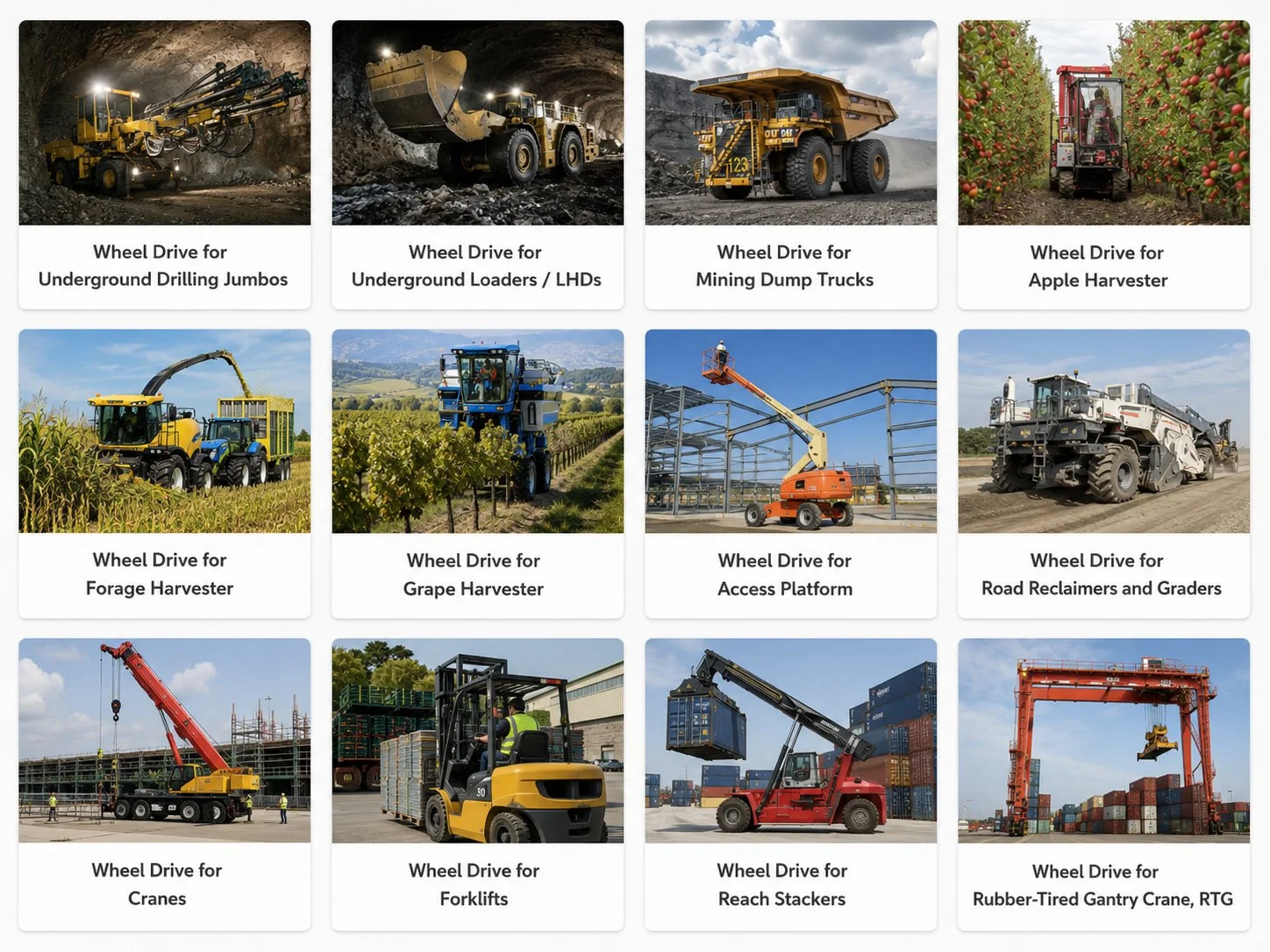
Self-propelled access platforms (also called aerial work platforms, MEWPs, or cherry pickers) fall into three categories — each with different планетарна скоростна кутия за задвижване на колелата demands based on the working height, the CG shift during operation, and the terrain on which they operate.
The most demanding wheel drive application. The telescopic boom extends to 40+ metres, shifting the CG from 1.5 metres (stowed) to 8 to 15 metres (extended with outreach). Machine weight: 12 to 28 tonnes. The wheel drive must handle rough terrain (construction sites, unpaved ground) at the stowed position and must be speed-limited or locked when the boom is extended. Four-wheel drive with individual wheel motors is standard on rough-terrain models.
The articulating boom allows up-and-over reach to access positions behind obstacles. Machine weight: 7 to 22 tonnes. The CG shift during articulation is less predictable than on a telescopic boom — because the boom can be positioned at multiple angles simultaneously. The wheel drive control system must calculate the CG position in real time from the boom angle sensors and adjust the maximum permitted drive speed accordingly.
Vertical-lift platforms that raise the entire work platform straight up. The CG rises with the platform but stays directly above the wheelbase — producing less rollover risk than boom lifts at the same height. Machine weight: 2 to 12 tonnes. Rough-terrain scissor lifts operate on construction sites and require 4WD wheel drives with off-road traction capability. Indoor scissor lifts operate on smooth, level floors and use smaller, non-marking wheel drives optimised for tight turning in confined spaces.
The common thread across all three types: the wheel drive is a safety-critical system. Unlike agricultural wheel drives — where a failure causes economic loss (crop damage, downtime) — an access platform wheel drive failure can cause worker injury or death. A wheel drive that suddenly accelerates, fails to brake, or produces a torque spike that tilts the machine while workers are 20 to 40 metres above the ground is a life-threatening event. This safety criticality elevates the wheel drive specification from an engineering optimisation exercise to a regulatory compliance requirement — governed by EN 280, ANSI A92, and ISO 16368 standards that mandate specific braking performance, speed limiting, and stability margins.
Height-Dependent Speed Limiting — The Drive Must Slow Down as the Platform Goes Up
The most critical wheel drive function on an access platform is automatic speed reduction as the boom extends. EN 280 and ANSI A92 standards require that the maximum drive speed decreases as the platform height increases — because the rollover risk increases with the CG height and the dynamic forces from driving on uneven ground are amplified at the elevated platform.
| Boom Position | CG Height | Max Drive Speed | Stability Margin |
|---|---|---|---|
| Stowed (travel) | 1.5 m | 6–8 km/h | High |
| Partial extension | 4–8 m | 2–4 km/h | Умерено |
| Full extension | 8–15 m | 0.5–1.5 km/h or locked | Minimum |
The speed limiting is implemented through the hydrostatic pump displacement control — the machine control system reads the boom angle and extension sensors, calculates the effective CG height, and limits the maximum pump displacement (and therefore the maximum wheel drive speed) to the value permitted for that CG configuration. The wheel drive must respond accurately to these variable speed limits — any overshoot beyond the permitted speed violates the stability calculation and can trigger the machine tilt alarm or, in the worst case, a rollover event.
The smoothness of the speed transition is also safety-critical. When the operator extends the boom while driving (permitted on some machines at low speed), the speed limit decreases progressively. The wheel drive must decelerate smoothly to the new lower limit — without a sudden speed reduction that could jolt the workers on the platform. A 0.5 km/h per second deceleration rate is typically the maximum permitted — slower rates are preferred because the workers standing on the platform experience the deceleration as a longitudinal force that can cause loss of balance.
The braking system must also be height-responsive. At full boom extension on a slope, the parking brake must hold the machine against the gravity component plus a wind load of up to 100 km/h (EN 280 requirement) — while the CG is 8 to 15 metres above the ground. The brake holding torque at full extension can be 3 to 5 times the stowed-position requirement because the high CG amplifies the overturning moment from slope and wind. The wheel drive brake must be rated for this worst-case combination — not just for the stowed-position holding torque.
The dual-control arrangement on most boom lifts adds another wheel drive consideration: the machine can be driven from the ground-level chassis controls OR from the platform controls at height. The ground-level operator has a clear view of the terrain ahead and can anticipate obstacles. The platform operator, 20 to 40 metres above, cannot see the ground surface detail — and relies entirely on the wheel drive speed limiting and tilt protection to prevent driving into a hazard. The wheel drive response to platform-level control inputs must be more conservative (slower acceleration, lower maximum speed, more sensitive tilt cutout) than to ground-level inputs — because the platform operator has less situational awareness of the ground conditions. This dual-control speed mapping is programmed into the machine control system and is enforced through the wheel drive speed-limiting function.
The terrain on construction sites varies dramatically within a single job. The machine may drive from a paved car park (smooth, level, high traction) onto a muddy excavation area (soft, sloped, low traction) within 50 metres. The wheel drive must handle both extremes: enough torque to climb a 25% muddy slope in 4WD low-range, and enough precision to navigate a finished building interior at 0.5 km/h without marking the floor. Some manufacturers offer switchable non-marking tyres and reduced-speed indoor mode — and the wheel drive must accommodate the tyre-change effect on rolling radius (which changes the effective gear ratio and ground speed) without requiring recalibration.
The functional safety requirements for access platform wheel drives are codified in EN 280:2022 (Europe) and ANSI A92.20 (North America). These standards require that the speed-limiting function achieves Performance Level c or d (per ISO 13849) — meaning the probability of a dangerous failure (speed limit not applied when required) must be less than 10⁻6 per hour. Achieving this performance level requires either redundant speed-limiting hardware (two independent controllers, each capable of limiting the drive) or a single controller with diagnostic coverage of 90%+ (self-monitoring that detects and responds to internal faults before they become dangerous). The wheel drive must be designed to interface with both architectures — providing dual speed-feedback signals, redundant brake-engagement circuits, and diagnostic-compatible sensor interfaces.
Indoor Versus Outdoor Wheel Drive Variants
Indoor access platforms (electric scissor lifts, small articulating booms) operate on smooth, level floors — warehouses, factories, shopping centres, exhibition halls. The wheel drive requirements differ fundamentally from outdoor rough-terrain models: (1) non-marking tyres that leave no black scuffs on polished floors — requiring softer rubber compounds that wear 2 to 3 times faster than standard tyres; (2) zero-emission electric drive — no hydraulic oil leaks permitted on food-grade or medical facility floors; (3) ultra-tight turning for navigating doorways, aisles, and between racking — requiring steering articulation of 70 to 90 degrees and wheel drive response at creep speeds as low as 0.1 km/h; and (4) low noise — gear mesh noise below 65 dBA at 1 metre to comply with indoor workplace noise regulations.
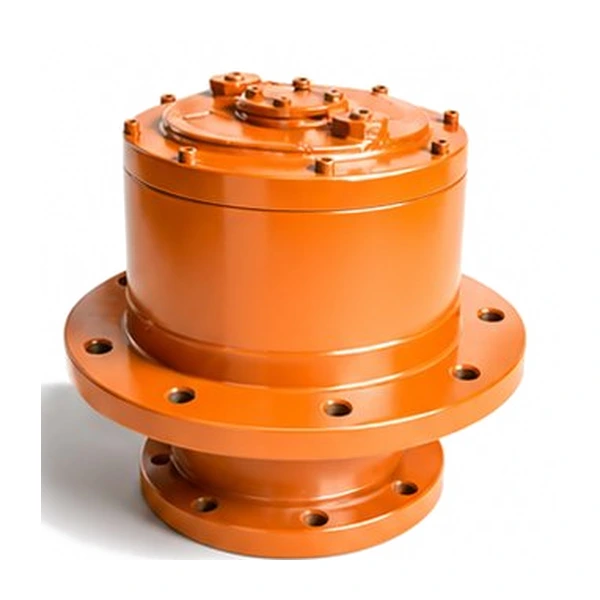
The indoor wheel drive планетарна скоростна кутия must be sealed against oil weepage — because a single oil spot on a supermarket floor or hospital corridor can cause a slip-and-fall liability event. The shaft seal, housing gasket, and breather must all achieve zero-visible-leak performance for the entire service life (5,000 to 8,000 hours). This is more stringent than any outdoor agricultural or construction seal specification — where minor weepage is tolerated if it does not affect the oil level or contaminate the product.
Outdoor rough-terrain models face the opposite challenge: maximum traction on unprepared ground, weather protection for year-round outdoor storage, and impact resistance from construction-site debris. The same manufacturer often offers both indoor and outdoor variants of the same platform model — using different wheel drive specifications (different tyres, different seals, different gear ratios) on the same basic gearbox platform. The wheel drive must therefore be available in both configurations from a common base design — minimising the manufacturer parts inventory while maximising the application coverage across indoor, outdoor, and dual-purpose platform models.
Three Failure Modes Specific to Access Platform Wheel Drives
If the boom-position sensor fails (sending a false stowed signal), or if the speed-limiting software malfunctions, the machine may permit full stowed-speed driving (6 to 8 km/h) with the boom fully extended. At this speed with a CG at 12+ metres, even a small ground irregularity (a 50 mm kerb edge, a pot hole, a slight slope change) can produce a lateral acceleration that exceeds the tipping threshold — resulting in machine rollover with workers at height. This is a single-point-of-failure scenario that the EN 280 standard addresses through redundant sensor requirements (two independent boom sensors, each capable of independently limiting the drive speed).
The parking brake must hold the fully loaded machine on the maximum rated slope (typically 5 to 25% depending on the machine class) with the boom extended and a wind load of up to 100 km/h. If the brake pad wears below the minimum thickness, the holding torque decreases below the required level — and the machine may creep downhill when parked on a slope with extended boom. This creep may be imperceptible at first (1 to 2 mm per minute) but accelerates as the slope-holding equilibrium is lost. By the time the operator or the workers on the platform notice the movement, the machine may have reached a speed that is difficult to arrest — especially if the engine is off and the hydraulic braking is unavailable.
Construction-site surfaces contain potholes, ruts, debris, and uneven compaction. When a wheel drive propels the machine over a pothole at even low speed (2 to 3 km/h), the wheel descent produces a sudden tilt of 2 to 5 degrees — amplified at the platform height by the moment arm. At 30 metres platform height, a 3-degree base tilt displaces the platform by 1.6 metres laterally — enough to throw an unrestrained worker against the guardrail or, in extreme cases, over it. The wheel drive must provide smooth, jerk-free propulsion with active tilt monitoring — automatically stopping the drive if the chassis tilt exceeds the EN 280 limit (typically 3 to 5 degrees depending on the boom configuration).
Често задавани въпроси
Korea Ever-Power provides access platform wheel drives from 3,000 to 25,000 Nm with EN 280 compliance, failsafe braking, and height-dependent speed control.
Редактор: Cxm