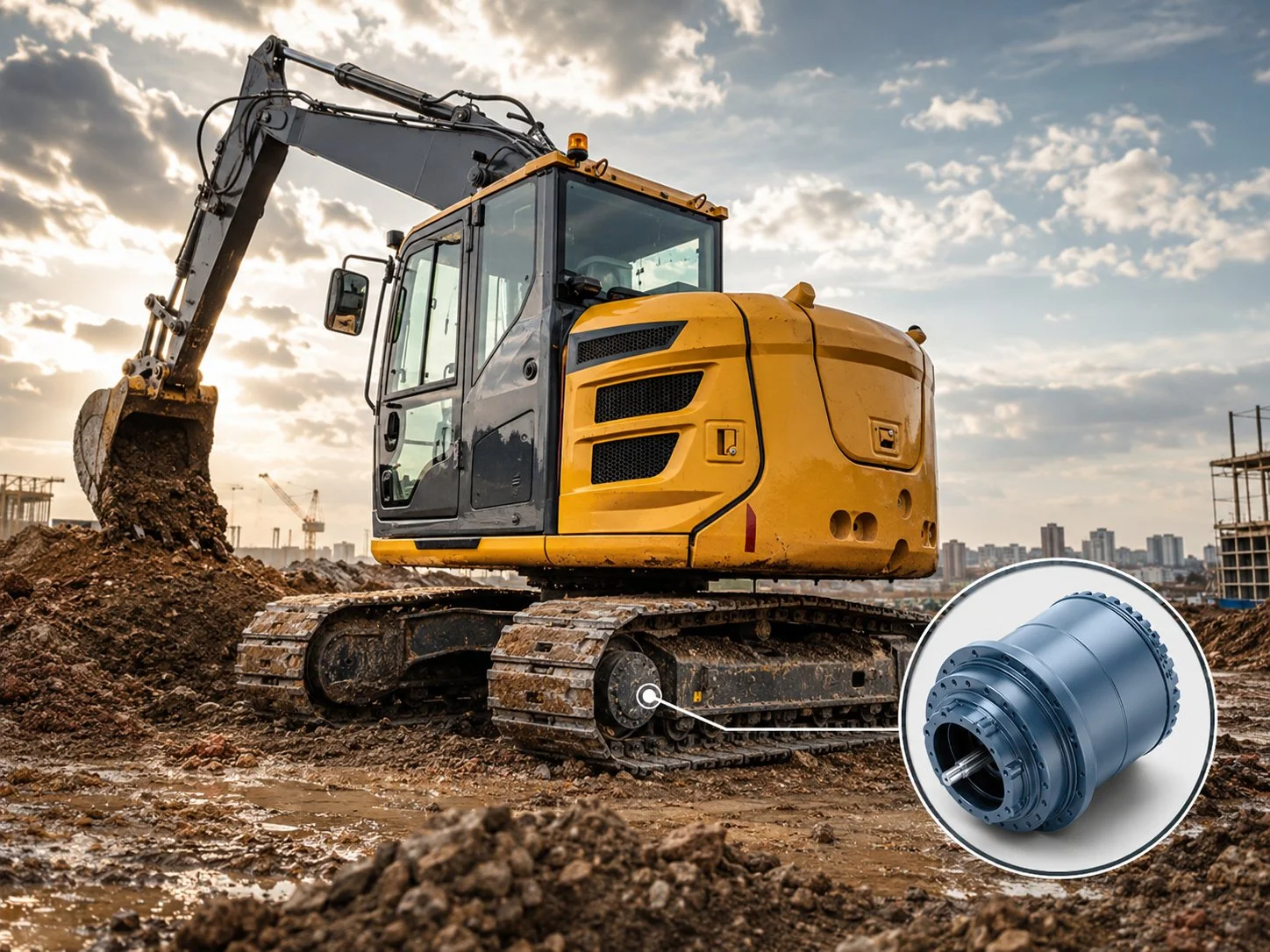
From Hydraulic Motor to Sprocket — How a Track Drive Planetary Gearbox Propels an Excavator
The power path in every hydraulic excavator follows the same sequence: diesel engine turns a variable-displacement hydraulic pump, the pump delivers flow through a directional control valve, the valve routes oil to a travel motor mounted on the undercarriage frame, and the travel motor spins at 2,000 to 3,500 rpm with 200 to 800 Nm of torque. That motor torque is nowhere near enough to move a multi-tonne machine through mud. The track drive planetary gearbox fills the gap.
Mounted inside the sprocket hub — a cavity typically 400 to 600 mm in diameter — the planetary gear train reduces the motor speed by a factor of 40:1 to 120:1 while multiplying the torque by the same ratio. A 500 Nm motor output at 3,000 rpm becomes 40,000 Nm at 37 rpm through an 80:1 two-stage planetary reduction. That 40,000 Nm rotates the drive sprocket, which engages the track chain, and the track chain pushes against the ground to move the entire machine forward.
Why planetary gears instead of spur gears or worm gears? Space. The track drive must fit inside the sprocket hub. A planetary arrangement distributes the load across three or four planet gears meshing simultaneously, providing the highest torque density — newton-metres per kilogram — of any gear architecture. A spur gear train at 80:1 would require four stages and occupy 3 to 4 times the volume. A worm gear at 80:1 would lose 40% of the input power as heat. The planetary arrangement delivers the ratio in two or three stages at 94 to 97% efficiency, inside a housing that bolts directly to the undercarriage frame.
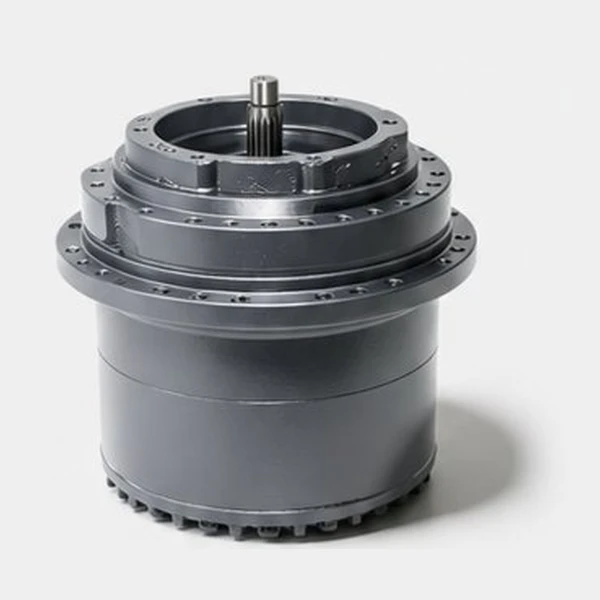
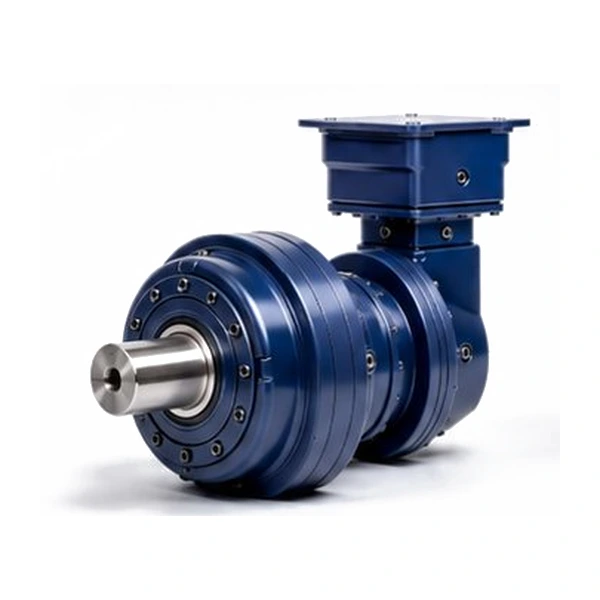
Typical excavator track drive: hydraulic motor bolts to the top; planetary reduction stages sit inside the housing; the output carrier drives the sprocket hub.
Counter-Rotation — The Load Case That Defines Excavator Track Drive Engineering
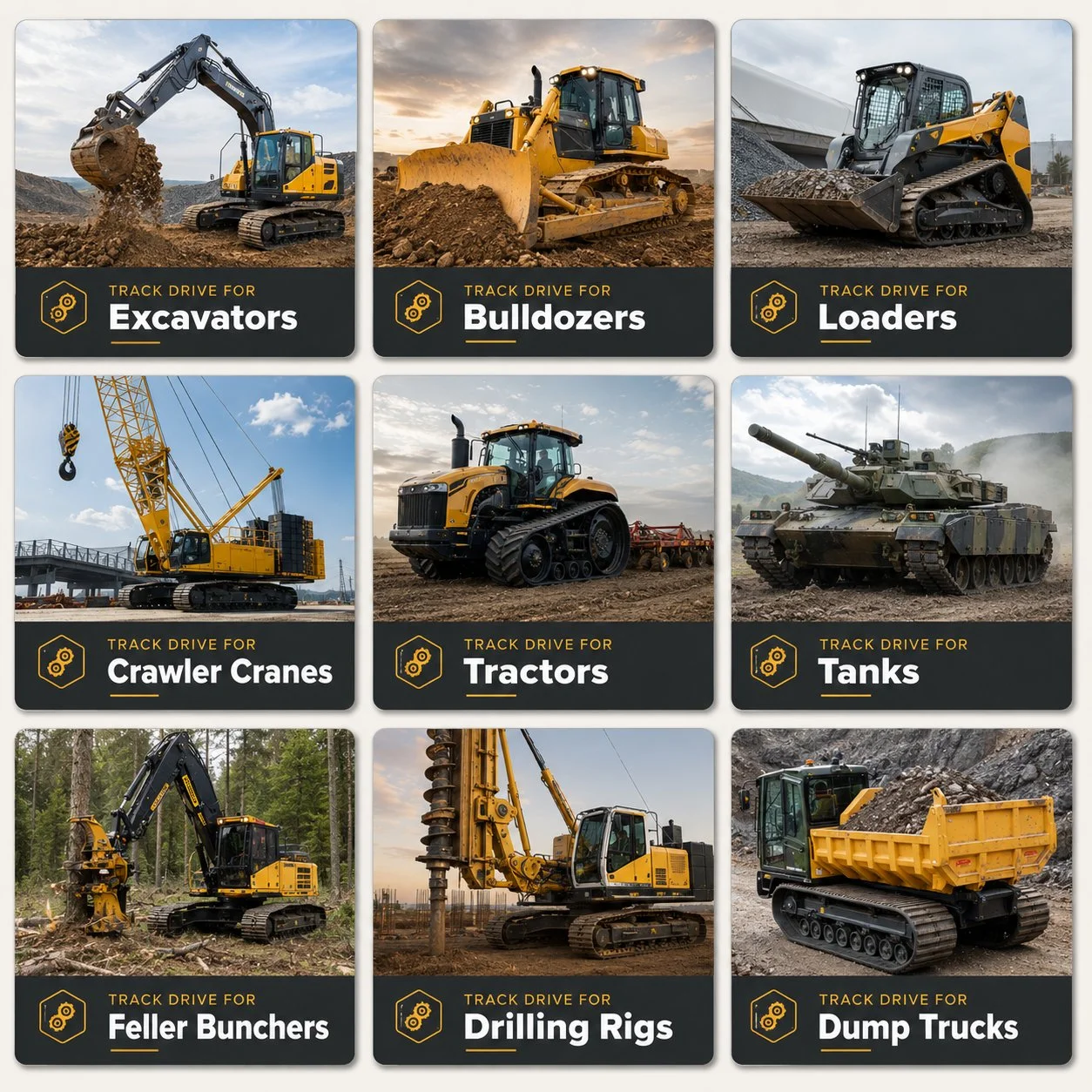
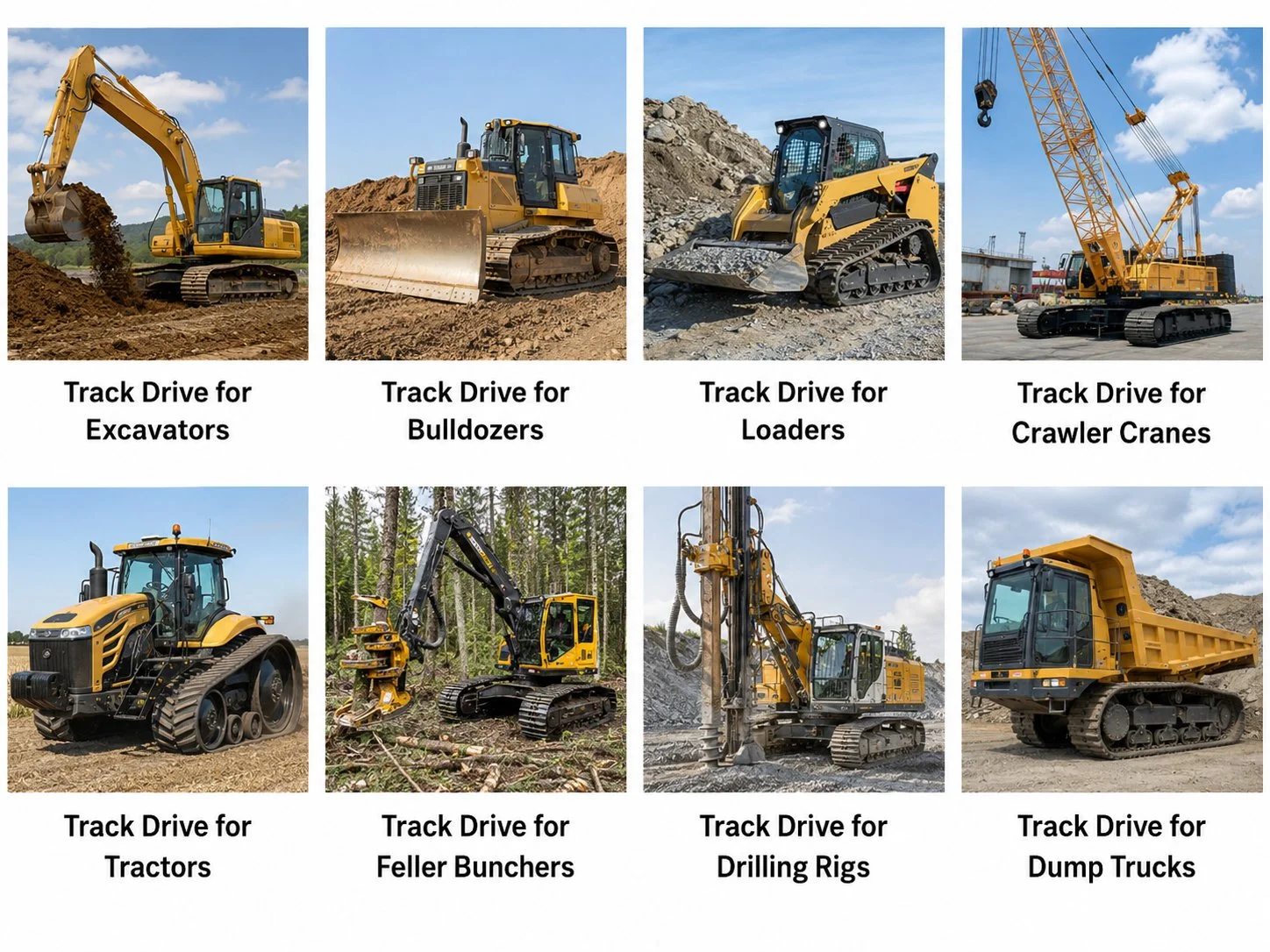
Every tracked machine — bulldozers, crawler cranes, compact loaders — uses track drives. But only excavators routinely demand both drives to operate at full torque in opposite directions simultaneously. This counter-rotation manoeuvre pivots the machine on the spot: the operator commands the left track forward and the right track reverse, and the excavator spins within its own track footprint.
Mechanically, counter-rotation imposes the most severe loading condition any track drive planetary gearbox can experience:
The machine is stationary during the pivot — there is no momentum to assist the rotation. Each travel motor reaches its maximum pressure (stall torque), and the planetary gearbox transmits this peak load to the sprocket continuously throughout the turn.
Each planet gear tooth is loaded on one flank during forward drive and on the opposite flank during reverse. Over a 15-year machine life at 300 pivots per shift and 300 shifts per year, the teeth endure 1.35 million full bidirectional load reversals.
The planet pin bearings see the full radial load direction reverse at every pivot. The bearing rollers must re-establish their contact zone on the opposite side of the raceway — a fatigue condition that needle bearings in unidirectional drives never encounter.
The abrupt torque reversal pressurises the internal oil volume against one seal lip, then reverses the pressure to the other side within milliseconds. A seal designed for unidirectional rotation will weep oil within months of excavator service.
Engineering implication: A track drive rated for 40,000 Nm in unidirectional continuous duty — suitable for a conveyor, a winch, or a wheel drive — will fail prematurely in excavator service if its planet gear bending analysis has not been validated for bidirectional fatigue at the same torque. The excavator counter-rotation case imposes loading that no other tracked machine application demands at this frequency.
Choosing a Track Drive by Excavator Weight Class — Torque, Speed, Ratio, and Gradeability
The track drive specification for an excavator is driven primarily by the machine operating weight — which determines both the torque required for grade climbing and the torque generated during counter-rotation. The table below maps the five standard excavator weight classes to the corresponding track drive parameters.
| Weight Class | Machine (t) | Output Torque (Nm) | Travel Speed | Rozsah poměrů | Fáze | Gradeability |
|---|---|---|---|---|---|---|
| Mini | 1.5 – 8 | 5,000 – 15,000 | 2.5 – 4.5 km/h | 40 – 65:1 | 2 | 30 – 35% |
| Small | 8 – 15 | 15,000 – 28,000 | 3.0 – 5.0 km/h | 55 – 80:1 | 2 – 3 | 30 – 35% |
| Střední | 15 – 30 | 28,000 – 50,000 | 3.5 – 5.5 km/h | 65 – 90:1 | 2 – 3 | 30 – 35% |
| Large | 30 – 50 | 50,000 – 80,000 | 3.5 – 5.5 km/h | 75 – 100:1 | 3 | 25 – 30% |
| Mining | 50 – 90 | 80,000 – 140,000 | 3.0 – 4.5 km/h | 90 – 120:1 | 3 | 20 – 25% |
Gradeability is the maximum slope the excavator can climb at operating weight without track slip. Actual gradeability is limited by the lower of two constraints: available gearbox torque or track-to-ground friction coefficient (typically 0.5 – 0.7 on clay, 0.8 – 1.0 on crushed rock).
Gradeability Calculation — Sizing the Track Drive for a 35-Tonne Excavator
The worked example below demonstrates the full torque sizing process for a medium-class excavator. This is the calculation that every OEM design engineer and fleet manager should verify before specifying a replacement track drive — and it is the calculation most often skipped in favour of simply matching the OEM part number.
Without the SF = 2.0 multiplier, the engineer specifies a gearbox rated for 17,365 Nm — a unit in the 20,000 Nm class. During the first shift of counter-rotation work, the actual torque spikes to 35,000 Nm (full motor stall torque in both directions). The gearbox operates at 175% of its rated capacity on every pivot. After several thousand such events, planet gear surface fatigue initiates on both tooth flanks, backlash grows, and the machine begins pulling to one side during straight travel. This failure pattern typically manifests between 3,000 and 5,000 hours — far short of the 10,000-hour target life.
Two-Speed Travel — Why Most Excavators Above 8 Tonnes Carry a High/Low Gear in the Track Drive
A single-speed track drive faces a fundamental trade-off: a high reduction ratio delivers maximum torque for climbing and counter-rotation but limits top travel speed, while a low ratio provides faster travel but cannot generate the torque needed for grade work. Most excavators above 8 tonnes resolve this with a two-speed mechanism built directly into the planetary gearbox housing.
Ratio 80 – 120:1. Maximum output torque. Used for climbing grades, counter-rotation pivots, and working on soft or loose ground. Travel speed typically 2.5 – 3.5 km/h. This is the gear the excavator uses during digging operations — short, low-speed repositioning movements between bucket cycles.
Ratio 40 – 60:1. Reduced torque but higher sprocket speed. Used for flat-ground travel between work positions — roading from one end of a construction site to the other. Travel speed typically 4.5 – 5.5 km/h. An automatic downshift valve reverts to low gear when travel motor pressure exceeds a threshold, protecting the gearbox from torque overload.
The two-speed mechanism works through a hydraulic piston inside the planetary housing that shifts a sun gear set — engaging either the high-ratio or low-ratio gear train. This integrated speed-change capability is unique to track drives. Unlike slewing drive planetary gearboxes for excavator upper-structure rotation, which operate at a single fixed ratio because the slew speed requirement does not change with terrain, the track drive must adapt to two fundamentally different operating modes within the same shift.
Sealed for the Undercarriage — Why Excavator Track Drive Seals Are More Critical Than Any Other Gearbox Application
The excavator track drive operates in the harshest environment of any planetary gearbox. The sprocket hub sits at ground level, partially or fully submerged in mud, water, sand, and abrasive slurry for the entire working life of the machine. No other gearbox application faces this combination of continuous submersion and high-torque bidirectional rotation.
The metal-to-metal face seal unique to track drives. Two hardened steel rings, lapped to optical flatness (0.3 – 0.9 light bands), pressed together by elastomeric O-rings. The seal rotates with the sprocket while maintaining contact pressure against the stationary housing face. This design handles complete submersion in abrasive slurry — something no elastomeric lip seal can survive for more than a few hundred hours.
Unlike sealed-grease precision gearboxes, excavator track drives use oil-bath lubrication — typically 1.5 to 4.0 litres of 75W-90 or 80W-90 GL-5 gear oil. The oil provides both lubrication and cooling. Oil change interval: 1,000 to 2,000 hours or annually. At every oil change, inspect the drained oil for water contamination (milky appearance) and metallic particles (bearing or gear wear indicator).
Thermal cycling — from cold start at dawn to 80 – 100 degrees C during heavy work — causes internal pressure changes. A breather or pressure compensation valve prevents seal blow-out during warm-up and vacuum-induced contamination ingress during cool-down. Position the breather above the maximum oil level in every mounting orientation to prevent oil weeping.
Three Failure Modes That Account for 80% of Excavator Track Drive Replacements
Worn or damaged seal faces, incorrect installation tension, or impact from rocks and debris allow ground water and mud into the oil bath. The water emulsifies the gear oil (milky appearance at the drain plug), destroys the lubricant film, and initiates corrosion on bearing surfaces. Bearing spalling follows within 500 – 1,500 hours of water ingress.
Undersized track drives — specified without the service factor for bidirectional loading — experience accelerated needle bearing fatigue on the planet pins. The bearings see full radial load reversal at every counter-rotation pivot. Symptoms include increasing travel noise, metallic particles in oil samples, and growing play at the sprocket hub.
Packed mud between track shoes increases the effective track tension by 20 – 40% above the designed value. The sprocket must pull harder to engage each shoe, producing a pulsating overload on the ring gear teeth at sprocket-tooth-mesh frequency. Over months of operation in clay conditions, visible pitting develops on the ring gear tooth flanks.
Korea Ever-Power Planetary Gearbox Product Lines for Excavator Applications

Track Drive Planetary Gearbox for Excavators — Frequently Asked Questions
Korea Ever-Power provides excavator track drive planetary gearboxes from 5,000 to 140,000 Nm — covering mini excavators through mining-class machines. Provide your machine model, operating weight, and current OEM part number for a cross-reference recommendation at no charge.
Střihač: Cxm