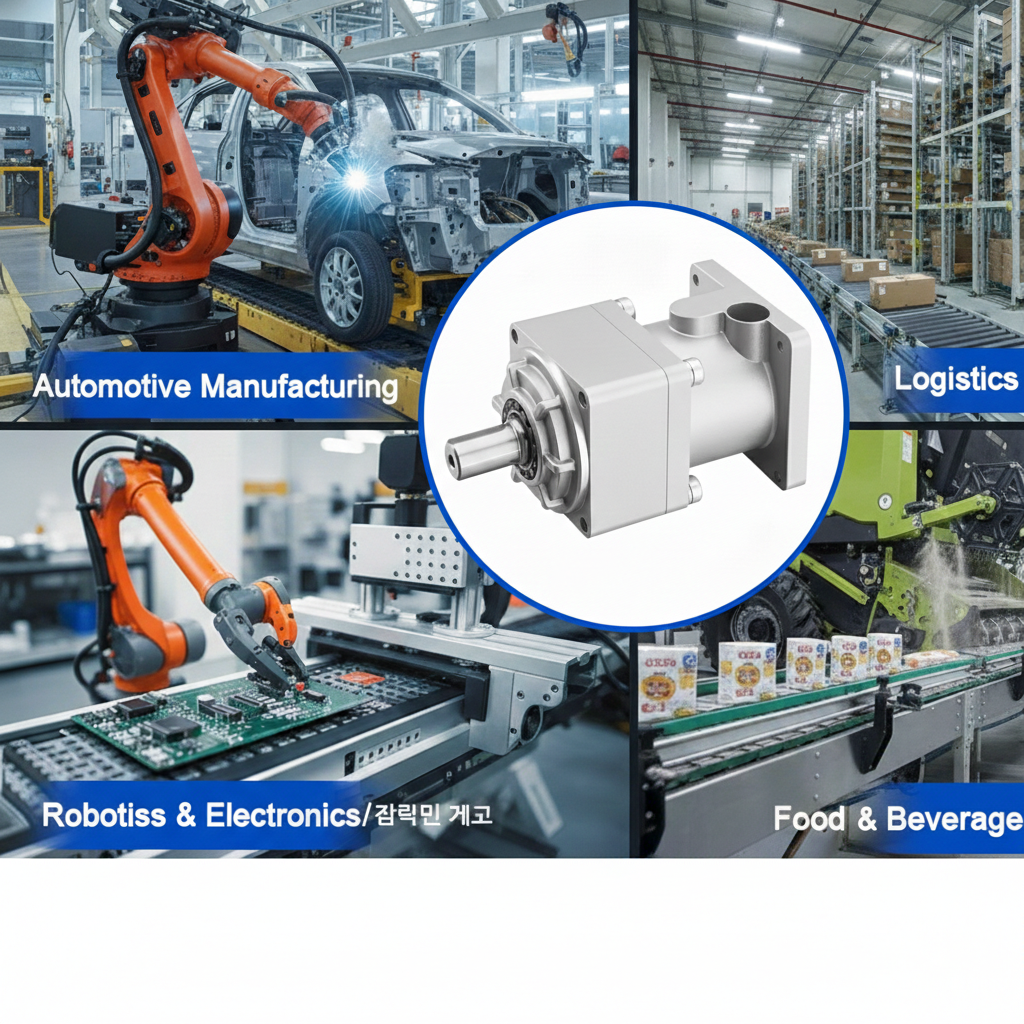
Three CNC Drive Types — Three Different Gearbox Priority Specifications
A CNC machining centre contains three fundamentally different types of servo drive that each place different demands on the planetary gearbox. Understanding which drive type you are specifying — and its dominant performance requirement — prevents the most common Korean CNC OEM selection error: applying the same P0 specification uniformly across all axes when P0 is only necessary on two or three of them, or conversely, tolerating accumulated backlash on a B-axis tilting head by choosing a compound external bevel configuration.
The three drive types and their governing specifications are:
Drives a workpiece-holding table through angular positioning. Backlash is the primary specification — it directly translates to a linear positioning error at the workpiece surface. Every arcminute of gearbox backlash produces a measurable dimensional error on the machined part proportional to the distance from the table rotation centre. This is the axis where P0 or ultra-precision specification has the greatest functional justification.
Rotates the spindle head through a 90° angle — motor horizontal inside the column, output driving the tilting mechanism perpendicular to the column axis. Backlash plus integrated right-angle geometry are the key specifications. An external bevel stage added after an inline gearbox accumulates backlash; an integrated right-angle unit measures total backlash at the output shaft. This is where the right-angle series selection from Article 3 directly applies to CNC context.
Drives the gantry carriage along a rack — unlimited travel, high feed rates. Pinion wear cycle and replacement downtime is the dominant operational concern, not backlash grade. At 120 m/min feed rates in Korean aerospace gantry machines, the pinion (a consumable wear component) may require replacement every 4–6 months. The gearbox-to-pinion interface design determines whether each replacement costs 30 minutes or 4 hours of machine downtime.

CNC AXIS TYPE → PRIORITY SPEC
B-axis head → R/A integrated
Gantry rack → Pinion replace
Chip conveyor → Cost (Econ.)
Tool magazine → Ratio match
Rotary Table Gearbox — Calculating the Backlash-to-Part-Error Relationship
For every planetary gearbox CNC machine tool rotary axis, the backlash specification must be derived from the part tolerance — not chosen from a catalogue default. The calculation chain is: gearbox backlash in arcminutes → angular play at the table surface → linear dimensional error at the workpiece cutting point. This chain must close within the part tolerance budget, accounting for all other sources of error in the machine.
BACKLASH → LINEAR PART ERROR
where θ (rad) = arcmin × π / (180 × 60)
θ for 1 arcmin = 0.000291 radiansAt r = 150 mm (workpiece edge):
1 arcmin → Δx = 150 × 0.000291 = 0,044 mm
3 arcmin → Δx = 150 × 0.000873 = 0.131 mm
5 arcmin → Δx = 150 × 0.001455 = 0,218 mm
ISO tolerance class mapping: For an ISO H7 bore with 50 mm diameter (tolerance ±0.025 mm total band), the backlash contribution from the rotary table gearbox should not exceed 30–40% of the total tolerance budget — leaving room for other error sources (spindle runout, thermal drift, feed axis positioning). This typically means the backlash contribution must stay below ±0.008 to ±0.010 mm — achievable only with P0 ≤1 arcmin at standard Korean CNC rotary table radii of 100–200 mm.
For heavy rotary tables handling large steel slabs or oversize workpieces — where clamping torque requirements exceed what the precision AFH/AB range covers — the EP-AH New Line series at 1–2 arcmin backlash covers up to 9,585 N·m output torque in frames to 450 mm body diameter. This 1–2 arcmin specification is adequate for heavy structural steel tolerances (IT9–IT10) where the workpiece geometry itself is rougher than the gearbox backlash contribution.
Workpiece Type → Required Backlash → Korea Ever-Power Series
| Workpiece / Operation | ISO Class | Required Vůle |
Série |
|---|---|---|---|
| Aerospace titanium (5-axis) | IT6–IT7 | ≤1 úhlová minuta | EP-AFH |
| Auto die / precision mould | IT7–IT8 | ≤1 úhlová minuta | EP-AFH / EP-AB P0 |
| Aluminium automotive parts | IT8–IT9 | ≤3 úhlových minut | EP-AB P1 |
| General structural steel | IT10–IT11 | ≤5 arcmin | EP-AB P2 |
| Heavy steel slab (flip table) | IT9–IT10 | 1–2 arcmin | EP-AH New Line |
EP-AFH delivers ≤1 arcmin as its standard specification without a grade code — not as a P0 sub-selection within a range. This means every EP-AFH unit, at every ratio and every frame, is verified at ≤1 arcmin at the factory. It also reaches 3,805 N·m maximum at frame 240 mm — sufficient for Korean bridge-type machining centre rotary table clamping torques that the AB P0 series cannot address.
B-Axis and Tilting Head Drives — Why Integrated Right-Angle Matters for CNC
The B-axis on a 5-axis CNC machining centre tilts the spindle head to achieve simultaneous 5-axis cutting. The servo motor is typically mounted horizontally inside the machine column; its output must drive the tilting mechanism at 90° to the column axis. This layout demands a right-angle gearbox — and the backlash specification of that right-angle gearbox directly determines the angular positioning accuracy of the spindle head, which feeds directly into workpiece dimensional accuracy.
Korean 5-axis machining centres for aerospace and automotive tooling supply specify B-axis angular positioning accuracy of ±0.005° to ±0.010° (0.3 to 0.6 arcmin). This means the gearbox backlash budget for the B-axis drive is ≤0.3–0.6 arcmin — requiring P0 or better. An external bevel pair added after an inline P0 gearbox introduces 3–5 arcmin additional backlash, producing a total of 4–6 arcmin — 10× over the specification. The 5-axis accuracy specification is simply not achievable with a compound external configuration.
Ten/Ta/To EP-ABR integrated right-angle series solves this by measuring P0/P1/P2 backlash at the right-angle output shaft with the bevel stage included. Confirmed Korean case: EP-ABR090 P1 i=25, five-axis machining centre B-axis tilting head. Backlash at delivery: 2.4 arcmin measured at the output shaft. 19 months continuous operation across 3 machines at an aerospace subcontractor in Siheung, zero backlash rework requests.
The machine’s B-axis uses a dual-drive pre-load arrangement — two EP-ABR090 units driving the same tilting axis from opposite sides with a small angular pre-load applied between them. The pre-load eliminates the effective backlash at the axis level regardless of the individual gearbox grade, making P1 at 2.4 arcmin in the individual unit deliver sub-0.5 arcmin system backlash through the pre-load compensation. Specifying P0 at 60% higher unit cost would have provided no functional improvement. This is a common engineering optimisation in 5-axis machine tool design.
B-AXIS BACKLASH CHAIN ANALYSIS
[Motor]
└─[Inline P0 AB090] ≤1.0′
└─[External bevel] +3–5′
└─ Total: 4–6 arcmin ❌Integrated right-angle:
[Motor]
└─[EP-ABR090 P1] ≤3.0′ total
└─ Measured at R/A shaft ✓With dual pre-load:
2× EP-ABR090 P1 + pre-load
→ System backlash ≤0.5′ ✓✓
Gantry Rack-and-Pinion Linear Axis — Why Maintenance Cost Is the Governing Factor
Rack-and-pinion linear axis gearbox selection — with the right planetary gearbox CNC configuration — determines machine uptime as much as precision grade. Rack-and-pinion is the dominant linear drive architecture for large-format Korean CNC machining centres, laser cutting systems, and gantry structures — because a rack can be extended to unlimited travel length, and feed rates of 60–150 m/min are achievable that ballscrew drives cannot match beyond approximately 6 m travel. What rack-driven gantry architects do not always build into their total cost of ownership model is the consequence of the pinion being a wear component.
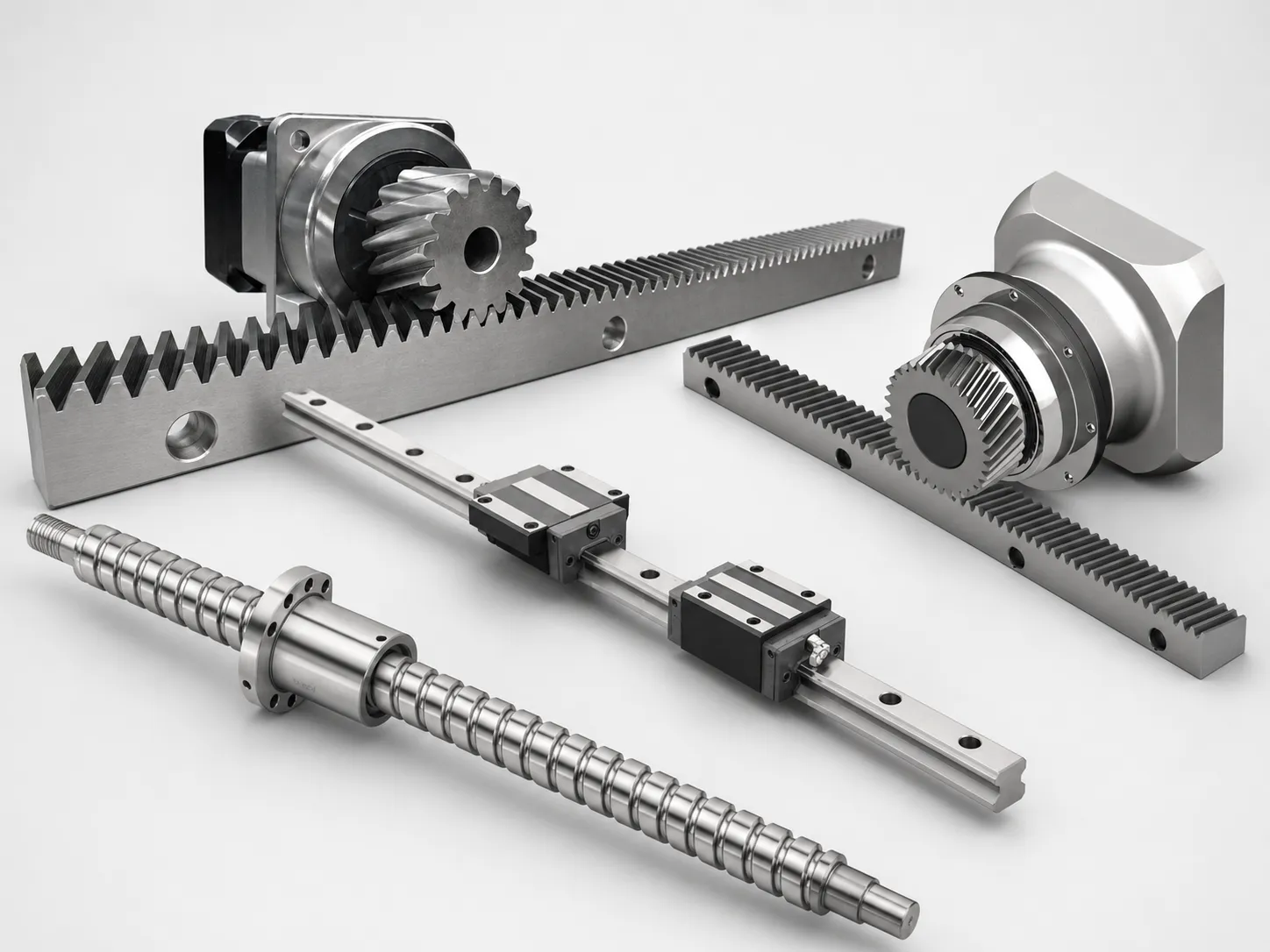
The Pinion Wear Problem
In a rack-and-pinion linear drive, the pinion tooth flanks wear against the rack over millions of engagement cycles. At Korean aerospace gantry machining centres running at 120 m/min maximum feed rate in three-shift operation, the pinion tooth flank wear reaches the replacement threshold in 4–6 months. This is not a product quality issue — it is an inherent tribological consequence of the rack-pinion contact geometry under high-cycle, high-force conditions.
The economic question is not whether the pinion wears — it will — but how long the replacement procedure takes and whether it requires machine recalibration after each event. With a conventional spline or key-shaft connection between the gearbox output and the pinion, pinion replacement requires: disconnecting the servo motor cables, removing the gearbox from the carriage assembly, extracting the worn pinion from the spline or key connection (requiring a dedicated extraction tool), pressing the new pinion onto the connection, re-installing the gearbox, reconnecting the servo motor, and performing a machine-axis recalibration run. Total elapsed time: 2–4 hours per gearbox, per replacement event.
On a typical Korean 5-axis gantry machining centre with two EP-AP units driving both sides of the gantry bridge, this procedure must be performed on both sides simultaneously to maintain gantry synchronisation — effectively doubling the downtime to 4–8 hours per maintenance event, occurring 2–3 times per year.
The Curvic Plate Solution
Ten/Ta/To EP-AP/APK Curvic Plate series replaces the spline/key connection with a patented curved-tooth face-gear disc (the Curvic Plate) that connects the pinion to the gearbox output shaft via a single clamping screw. The curved-tooth geometry is self-centring — when the screw is tightened, the Curvic teeth automatically force the pinion to the same centreline position regardless of installation sequence. Pinion replacement procedure: loosen one screw, slide off worn pinion, slide on new pinion, tighten one screw. No motor disconnect. No gearbox removal. No recalibration required.
EP-AP200 Curvic Plate on both X-axis sides of a 12 m × 5 m gantry machining centre. Previous spline-type gearbox: first pinion change on each side took 3.5 hours each, 7 hours total including gantry sync recalibration after both sides. With AP Curvic Plate: both sides completed in 55 minutes, no gantry sync recalibration required — Curvic Plate restored both sides to within 0.008 mm of pre-change gantry synchronisation without a calibration run.
| Parametr | Conventional Spline/Key | Curvic Plate — EP-AP/APK |
|---|---|---|
| Replacement steps | Motor disconnect → gearbox removal → spline extraction → press-fit new → reinstall → recalibrate | Loosen 1 screw → swap pinion → tighten 1 screw |
| Time per gearbox unit | 2–4 hours (incl. recalibration) | 15–30 minutes |
| Recalibration required | Yes — spline position varies each reinstallation | No — Curvic self-centring restores position |
| Motor cable disconnect | Yes (gearbox removal required) | No (pinion replaced from output side) |
| Specialist tool required | Yes — spline extraction press | No — standard hex key |
| Annual replacements (3-shift) | 2–3 | 2–3 |
| Annual downtime (dual gantry) | 14–24 hours baseline | 1–2 hours — saving 13–22 h/yr |
A Korean aerospace machining subcontractor operating 6 large gantry machines with dual-drive EP-AP200 Curvic Plate confirmed 55 minutes per full dual-side pinion replacement event, versus 7 hours for the previous spline-type gearboxes. Net saving: 6.08 hours per event × 2.5 events per year × 6 machines = 91 hours of recovered machine time per year. At a conservative Korean CNC machining hourly rate, this translates to significant annual productivity recovery — without changing the pinion wear rate itself, only the replacement procedure time.
Calculating the Required Gearbox Output Torque for a Rack-and-Pinion Axis
Specifying the correct EP-AP frame size for a rack drive requires calculating the output torque demand from the rack system parameters — not from a generic “heavy duty” classification. The formula is straightforward and provides a precise frame size starting point.
RACK DRIVE TORQUE CALCULATION
F_rack = F_cutting + F_acceleration
F_accel = m × a (moving mass × accel)Example — Korean aerospace gantry:
F_cutting (Inconel): 12,000 N
F_accel (3,000 kg, 2 m/s²): 6,000 N
F_rack total: 18,000 N
r_pinion (m=4, Z=20): 0.040 mT_output = 18,000 × 0.040
= 720 N·m per sideWith safety factor 1.5× → 1,080 N·m
→ EP-AP140 covers this (to 1,400 N·m)
For dual-drive gantry configurations where two EP-AP units drive opposite sides of the gantry bridge simultaneously, the force calculation applies per side — each gearbox handles half the total gantry cutting and acceleration force for symmetric gantry motion, but must handle full force during single-axis lead-axis corrections and skew corrections.
Korea Ever-Power provides a rack drive torque calculation worksheet in Korean on request — supply the rack module (m), pinion tooth count (Z), moving mass (kg), maximum acceleration (m/s²), and cutting force specification, and the Korea Ever-Power application team returns the recommended EP-AP frame size with safety factor applied.
EP-AP/APK Frame Selection by Rack System
| Aplikace | Rack Force | T_output | EP-AP Frame |
|---|---|---|---|
| Fibre laser cutting (6×20 m) | 3,000–6,000 N | 120–240 N·m | AP090 |
| Plasma cutting (heavy plate) | 5,000–10,000 N | 200–400 N·m | AP110 |
| Gantry mill (aluminium) | 8,000–15,000 N | 320–600 N·m | AP140 |
| Gantry mill (Inconel/titanium) | 15,000–25,000 N | 600–1,000 N·m | AP140–AP200 |
| Shipyard portal crane traversal | 80,000–200,000 N | 3,200–8,000 N·m | AP355–APK450 |
Basis: r_pinion = 40 mm (m=4, Z=20). Safety factor 1.5× applied. Actual specification requires full duty cycle analysis.
Auxiliary CNC Axes — Not Every Axis Needs P0, and the Interface Still Matters
A 5-axis machining centre with 12 servo axes does not need twelve P0 precision gearboxes. Chip conveyor drives, coolant pump actuators, tool magazine carousel rotation, pallet shuttle drives, and door actuators are open-loop or speed-controlled axes where backlash is irrelevant to machine accuracy. Specifying P0 on these axes is a direct cost penalty with zero functional return.
Ten/Ta/To Korea Ever-Power Economic Line PA II series is specifically designed for this CNC auxiliary axis application: the PA II body diameter matches the EP-AB inline series dimension-for-dimension, so a single mechanical drawing can specify both precision EP-AB P0/P1 on the critical axes and Economic Line PA II on the auxiliary axes, using the same motor adapter plate and mounting flange geometry throughout.
The PA II’s 6–8 arcmin single-stage backlash is entirely adequate for chip conveyor speed control, where the only positioning requirement is “running” versus “stopped.” The significant cost differential between PA II and AB P0 at the same frame size allows a CNC OEM to allocate the precision budget to the 3–4 axes that actually determine machine accuracy, rather than diffusing it across all 12.
PA II and EP-AB share the same motor adapter plate size — a single mechanical design supports all three tiers on the same machine.
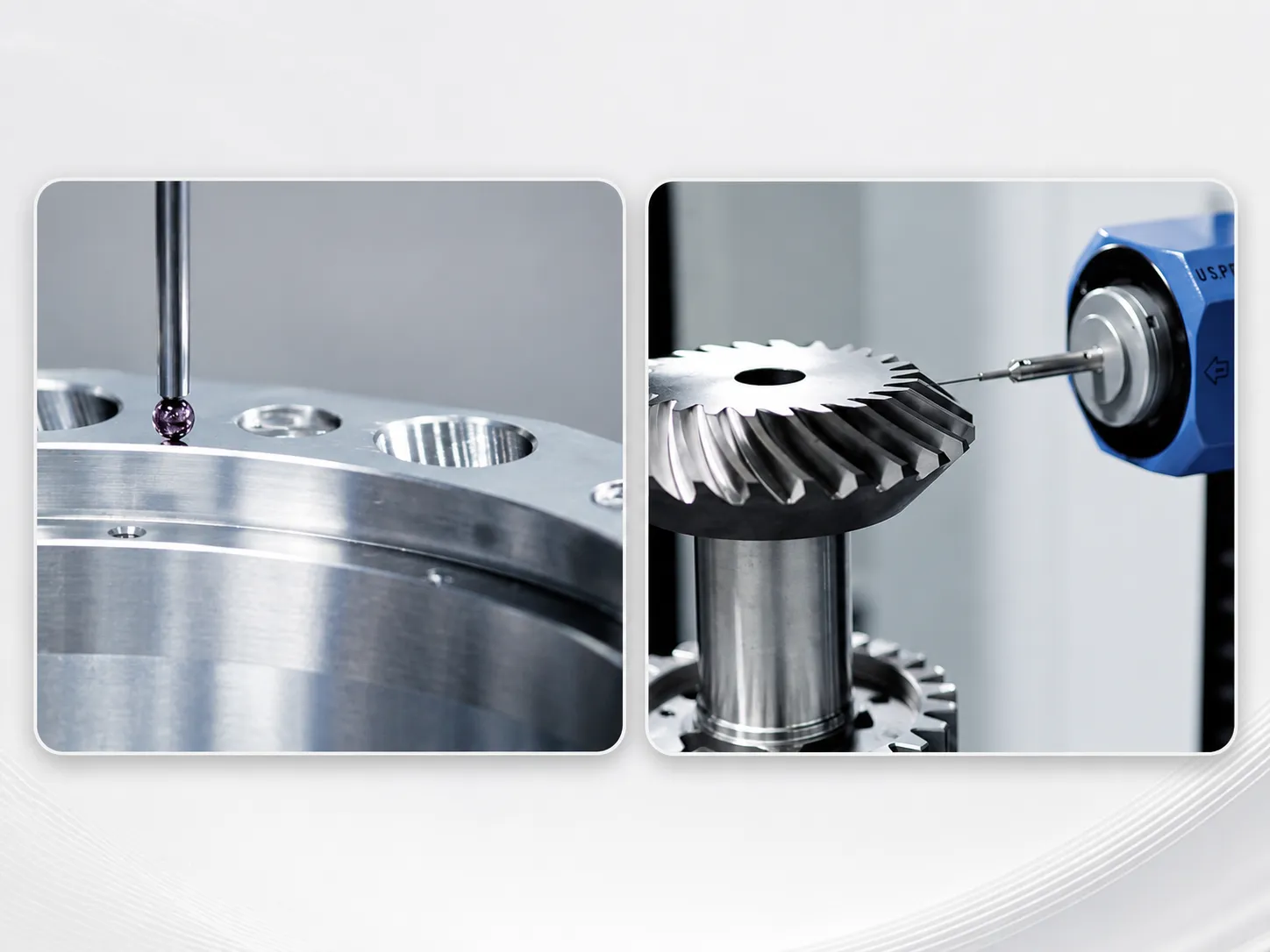
Tool Magazine and Indexer Drives — Round Flange and Non-Standard Ratios
CNC machining centre tool magazines, Hirth coupling indexers, and rotary pallet tables frequently require non-standard reduction ratios — the number of tools in a magazine carousel (typically 20, 30, or 40 positions) must match the motor revolution count per tool change without a variable-frequency drive, using only the gear ratio to produce the correct angular increment per motor step command.
Standard planetary series cover ratios of 3, 4, 5, 6, 7, 8, 9, 10, 12, 15, 20, 25… the set available depends on the series. For a 30-tool magazine where the tool-change servo must advance exactly 12° (360°/30) per tool position — requiring an exact integer number of motor revolutions per 12° tool increment — the ratio needed may be 21:1, 31:1, or 61:1, which are not available in the standard AB series.
Ten/Ta/To EP-AD round flange series and its compact variant EP-ADS offer the non-standard ratios 16, 21, 31, 61, and 91 in addition to the standard series — enabling exact tool magazine indexing without a VFD. The round flange also self-centres on the magazine housing bore, simplifying indexer alignment.

Non-std: 16 / 21 / 31 / 61 / 9130-tool mag (12° per step):
Motor 1,500 rpm, 0.5s per step
→ Need i=21 exactly → ADS available
Korea Ever-Power CNC Machine Tool Selection — Complete Quick Reference
The table below consolidates the selection logic from all modules — covering rotary table, B-axis, rack and pinion gantry, auxiliary, and indexer axes into a single CNC application reference. Use it as a starting point — always verify with the full torque calculation and backlash-to-part-tolerance analysis for your specific workpiece and cutting parameters.
| CNC aplikace | Korea Ever-Power Series | Klíčová specifikace | Důvod výběru |
|---|---|---|---|
| Rotary table — titanium/mould (precision) | EP-AFH 100–180 | Std ≤1′ · 3,805 N·m | ≤1 arcmin standard across all frames and ratios — no grade selection required |
| Rotary table — heavy steel slab | EP-AH 355/450 | 1–2′ · 9,585 N·m | Highest torque in Korea Ever-Power range for very large heavy rotary tables |
| B-axis tilting head (5-axis) | EP-ABR 090 P1 | ≤3′ total R/A | Bevel stage included in P1 specification — no external bevel needed |
| Gantry rack linear axis | EP-AP/APK Curvic Plate | 1-screw pinion · 14,010 N·m | Pinion replacement in 30 min vs 4 h — self-centring, no recalibration |
| Auxiliary axes (chip conveyor, door, pallet) | Economic Line PA II | 6–8′ · same mount | Identical flange to EP-AB — single mechanical drawing serves precision and economic tiers |
| Tool magazine / indexer | EP-AD / EP-ADS | i=21/31/61/91 | Non-standard ratios for exact tool-position indexing without VFD |
Frequently Asked Questions — Planetary Gearbox for CNC Machine Tools
Engineering Support for Your CNC Gearbox Specification
Korea Ever-Power provides backlash-to-part-tolerance calculation, rack drive torque analysis, Curvic Plate pinion module compatibility confirmation, and CNC axis tiering recommendations — in Korean, same working day. Provide your workpiece tolerance class, cutting forces, and drive type to receive a direct product recommendation.
Střihač: Cxm