Two Machines, One Road — How Reclaimers and Graders Use Wheel Drives Differently
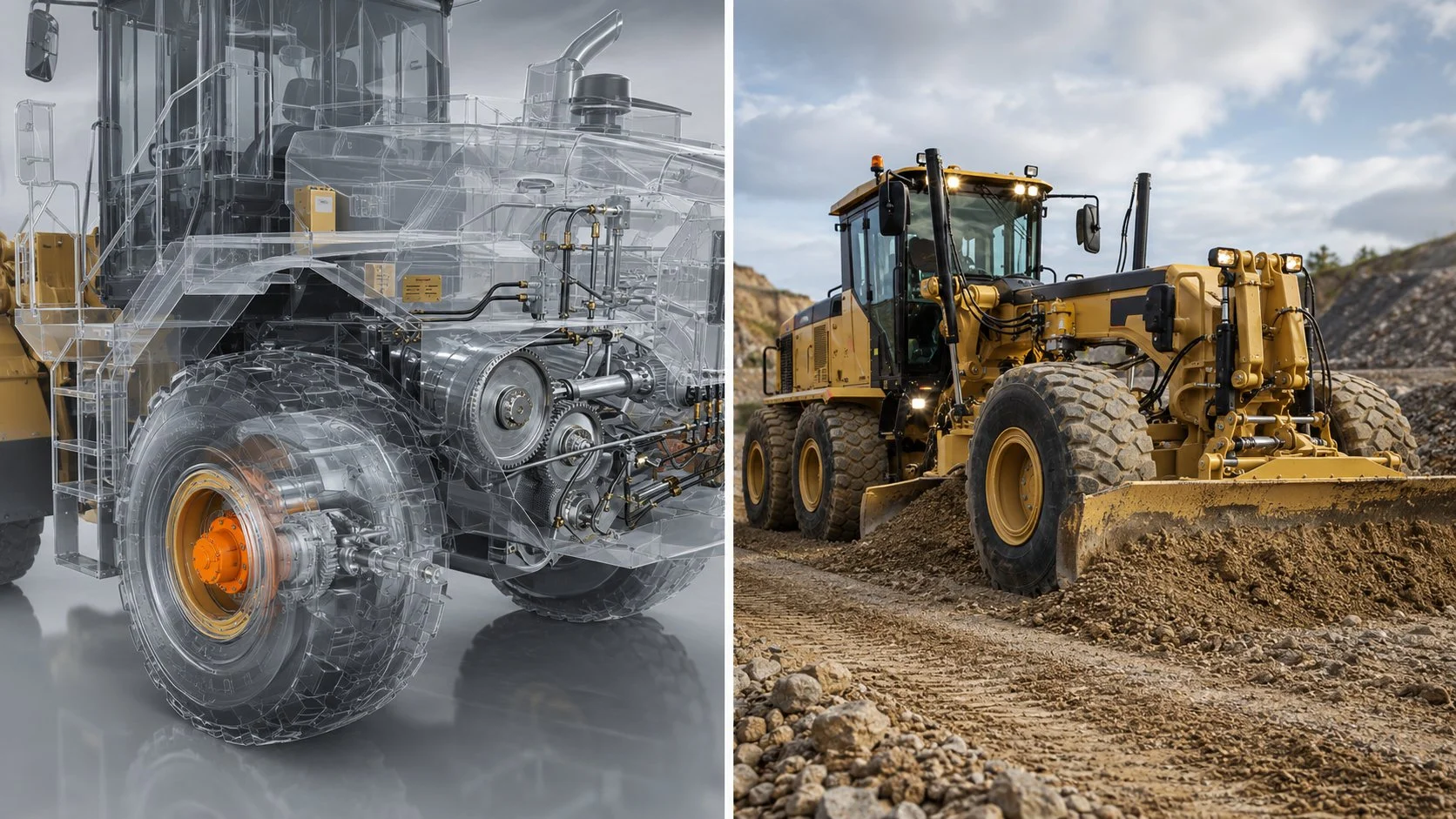
Road reclaimers and motor graders are different machines that often work on the same project — the reclaimer pulverises the existing road surface, and the grader reshapes the recycled material into the new road profile. Both use wheel drive planetary gearboxes, but with fundamentally different speed, torque, and precision requirements.
Self-propelled machine (20 to 35 tonnes) with a cutting rotor that pulverises asphalt, concrete, or stabilised soil to a depth of 150 to 500 mm. The rotor consumes 300 to 600 HP — 60 to 80% of engine power. Working speed: 2 to 8 km/h. The ground speed controls the cutting depth and the particle size of the recycled material: too fast produces coarse, poorly graded output; too slow produces over-processed fines that weaken the base. Speed accuracy: ±3 to 5% for consistent recycling quality.
Six-wheel articulated machine (14 to 25 tonnes) with a 3.7 to 7.3-metre blade (moldboard) mounted between the front and rear axles. The blade shapes, levels, and finishes the road surface. Working speed: 3 to 8 km/h for rough grading, 5 to 12 km/h for finish grading. GPS or laser-guided blade control adjusts the blade position 10 to 20 times per second based on the real-time grade signal — and the effectiveness of this adjustment depends on the ground speed being constant and predictable. Speed accuracy: ±1 to 2% for GPS-grade finish quality.
The motor grader has a unique wheel drive configuration: the rear axle is a tandem arrangement with four wheels (two per side) driven through a single planetary gearbox per side, and the front axle has two steered wheels that may or may not be driven. The tandem rear arrangement distributes the machine weight across four contact patches — reducing the ground pressure on the freshly graded surface and providing traction on loose material where a single-wheel arrangement would spin.
The reclaimer wheel drive faces a challenge similar to the forage harvester: the cutting rotor consumes most of the engine power, leaving limited power for propulsion. On a 500 HP reclaimer cutting 300 mm of hard asphalt, the rotor may consume 400 HP — leaving only 100 HP for the wheel drives to push 30 tonnes through the cutting resistance at 3 km/h. The wheel drive efficiency (ratio of traction power at the wheels to hydraulic power at the motor) directly determines whether the machine maintains the target speed or bogs against the cutting reaction force.
The motor grader tandem rear axle introduces a torque-distribution challenge unique to this machine type. The tandem drive transfers torque to four rear wheels through a chain-drive or gear-drive transfer case that connects the upper and lower wheels on each side. The planetary gearbox drives the tandem input shaft — and the transfer case distributes the torque approximately equally between the upper and lower wheels. If the transfer case chain stretches or the gear mesh wears, the torque distribution becomes unequal — the wheel with more torque pushes harder and the wheel with less torque contributes less traction. On a freshly graded surface, unequal torque can leave different tyre marks from the upper and lower wheels — visible as parallel scuff lines in the finished surface that the grader was supposed to smooth.
The grader front-wheel-drive option adds traction on loose surfaces — pulling the front axle through material that the rear tandem cannot push through alone. When engaged, the front wheel drive adds 30 to 50% additional traction — but also adds steering resistance (because the driven front wheels resist turning) and changes the machine handling characteristics. The operator must adjust the driving technique when front-wheel drive is engaged — and the wheel drive must provide smooth, progressive torque engagement without a sudden traction surge that could jerk the blade out of the GPS-controlled position.
GPS-Grade Precision — How Wheel Drive Speed Stability Determines Road Surface Quality
Modern motor graders use GPS or laser-guided blade control that adjusts the blade elevation and cross-slope 10 to 20 times per second. The control system calculates the required blade position based on the design surface model and the current machine position — and moves the blade hydraulic cylinders to match. The blade adjustment speed (how fast the blade can move to the correct position) is finite: typically 10 to 50 mm per second for fine grading. If the machine drives faster than the blade can adjust, the surface finish degrades — the blade cannot follow the design profile accurately because it is always catching up to the speed-of-travel-induced position changes.
De planetgearkasse med hjultræk must deliver constant speed to match the blade adjustment capability. If the ground speed varies by ±5% (from gear mesh cogging, traction variation, or hydraulic pressure fluctuation), the blade control system receives a continuously changing speed input — and must adjust the blade position to compensate for the speed variation in addition to the surface design changes. This speed-compensation demand consumes blade-adjustment bandwidth that should be available for surface-accuracy corrections — reducing the achievable surface tolerance from ±3 mm (at constant speed) to ±8 to 12 mm (at ±5% speed variation).
The economic value of this precision is substantial. A road surface finished to ±3 mm tolerance passes the International Roughness Index (IRI) specification for highway pavement without correction. A surface finished to ±10 mm requires milling and overlay — adding USD 2 to 5 per square metre of corrective work. On a 1 km x 7 m lane (7,000 m2), the cost difference between ±3 mm and ±10 mm surface tolerance is USD 14,000 to 35,000 — directly attributable to the wheel drive speed stability that the grader blade control depends on.
The speed consistency requirement also affects the reclaimer — but for different reasons. On a reclaimer, the ground speed controls the number of rotor impacts per linear metre of road surface. At 3 km/h with a rotor at 150 rpm and 20 cutting tools, the surface receives approximately 600 impacts per metre. At 4 km/h (33% faster), the impact density falls to approximately 450 per metre — producing a coarser, less uniformly graded output. The compressive strength of the recycled base material depends on the particle size distribution, which in turn depends on the impact density. A reclaimer that varies its speed by ±10% across the road width produces a base layer with variable strength — creating differential settlement patterns that appear as cracks and ruts in the finished pavement within 2 to 5 years of service.
Asphalt-Temperature Operation — Wheel Drives on Hot Recycled Material
Road reclaimers that perform hot in-place recycling (heating the existing asphalt before milling) produce recycled material at 100 to 160 degrees C. The reclaimer wheels drive through this hot material — and the tyre and wheel drive are exposed to surface temperatures that far exceed normal agricultural or construction-site conditions. The wheel drive housing temperature can reach 70 to 90 degrees C from radiant and conductive heat transfer from the hot recycled material — elevating the internal oil temperature to 100 to 120 degrees C even in temperate ambient conditions.
The seal material must withstand this elevated temperature continuously during the recycling pass — typically 2 to 4 hours per lane-kilometre. Standard NBR seals (rated to 100 degrees C) are marginal; FKM seals (rated to 200 degrees C) provide adequate margin. The tyre compound must also withstand the hot-material contact — standard construction tyres soften and accelerate wear at temperatures above 80 degrees C, and some hot-recycling reclaimers use heat-resistant tyre compounds or steel wheels for the rear axle that runs directly through the heated material.
Cold-recycling reclaimers (which add cement, lime, or bitumen emulsion to the pulverised material without heating) operate at ambient temperature — but the chemical additives present their own wheel drive challenges. Cement slurry (pH 12 to 13) splashes onto the wheel drive housing and attacks standard seals and paint. Bitumen emulsion coats the housing in a sticky, heat-retaining layer that reduces the convective cooling effectiveness — raising the oil temperature by 10 to 15 degrees C above the clean-housing baseline. Both chemical types require daily power-washing of the wheel drive surfaces to prevent cumulative coating build-up.
The tyre selection on reclaimers also affects the wheel drive specification. On hot in-place recycling, the rear tyres run through material at 100 to 160 degrees C — and standard rubber compounds soften, deform, and wear rapidly at these temperatures. Some hot-recycling reclaimers use steel wheels on the rear axle for the cutting pass, switching to rubber tyres for road transfer. The steel-wheel configuration changes the rolling radius by 5 to 15% compared to the rubber tyre — and the wheel drive gear ratio must account for this change to maintain the correct cutting speed. A two-speed gearbox or a variable-displacement motor provides the flexibility to optimise the speed for both steel-wheel cutting and rubber-tyre transfer modes.
Three Failure Modes for Road Reclaimer and Grader Wheel Drives
The cutting rotor on a road reclaimer generates vibration at 3 to 15 g at the wheel drive mounting point — comparable to a stone crusher. Each carbide-tipped tool that strikes the asphalt surface produces an impact that propagates through the machine frame to the wheel drive. The vibration causes the same false-Brinelling bearing damage and gear-tooth fretting described for stone crushers (WD-07) — but at a somewhat lower amplitude because the reclaimer frame is heavier and more rigid than a stone crusher frame, providing more vibration damping. The wheel drive must still be specified with elevated bearing preload and thread-locked fasteners — standard road-construction gearbox specifications are insufficient.
On a GPS-guided motor grader, wheel drive speed pulsation of ±3 to 5% consumes blade-adjustment bandwidth and degrades the achievable surface tolerance from ±3 mm to ±8 to 12 mm. The pulsation can originate from three sources: gear mesh cogging (periodic, at the tooth-engagement frequency), hydraulic pump ripple (periodic, at the pump piston frequency), and traction variation (random, from changing surface grip). Of these, the gear mesh cogging is the most problematic because it is continuous and cannot be compensated by the blade control system — the system treats it as a real speed change and adjusts the blade accordingly, producing a periodic surface undulation at the cogging wavelength. On a grader operating at 6 km/h with a 40:1 gearbox and a 30-tooth output gear, the cogging wavelength is approximately 55 mm — visible as a fine corrugation in the finished surface that is detectable by a straightedge but may pass the IRI measurement. Over time, traffic loading preferentially wears the corrugation peaks — producing a progressively rougher surface that eventually fails the IRI threshold and requires costly maintenance grinding.
On hot in-place recycling operations, the wheel drive housing absorbs radiant and conductive heat from the recycled material at 100 to 160 degrees C. The housing surface temperature can reach 70 to 90 degrees C — elevating the internal oil temperature to the point where standard mineral oil and NBR seals are at or beyond their thermal limits. A 4-hour hot-recycling pass on a summer day (35 degrees C ambient) can produce sustained oil temperatures of 115 to 130 degrees C — conditions that degrade mineral oil within 100 to 200 hours and harden NBR seals within a single season. The thermal damage accumulates with each hot-recycling job and is not reversible through oil changes alone — the seal material must be replaced once it has hardened.
Ofte stillede spørgsmål
Korea Ever-Power provides road construction wheel drives from 5,000 to 40,000 Nm for reclaimers, stabilisers, and motor graders with GPS-grade speed accuracy and hot-recycling thermal protection.
Redaktør: Cxm