Winch Drive Series — Pipeline Construction & Land Civil Equipment
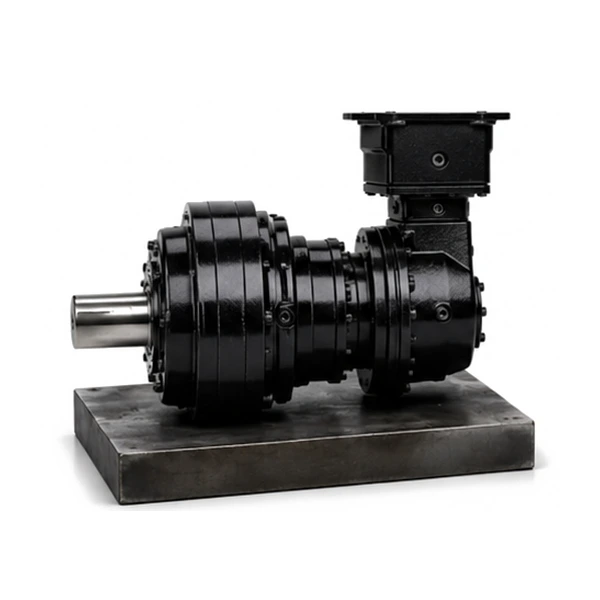
Winch Drive Planetary Gearbox for Pipelayers
A pipelayer — the sideboom tractor that lifts and positions large-diameter steel pipe into a trench during cross-country pipeline construction — imposes some of the most demanding combined radial and axial loads of any mobile lifting machine on its winch drive gearbox. Lifting a 30-inch diameter pipe section weighing 4 tonnes while traversing a 15-degree side slope through desert sand or frozen tundra generates a combination of suspended load torque and lateral overturning moment that standard crane winch gearboxes are not designed to withstand. The winch drive planetary gearbox for a pipelayer sideboom must handle this combination reliably across pipeline spreads that may lay 4 to 8 km of pipe per day for months on end in some of the most remote terrain on earth.
IP67 pipeline terrain sealing
3.0x combined load shock rating
-50°C to +55°C operating range
Pipeline construction is among the most geographically diverse and mechanically demanding of all civil engineering operations. A major cross-country gas or oil pipeline may cross 1,200 km of terrain in a single project — desert, agricultural plain, river crossings, mountain passes, permafrost, and swamp — with the same pipelayer machines required to operate effectively in all these environments. The sideboom winch that lifts the pipe from the stringing trucks and lowers it into the trench is the pipelayer mechanism most directly in contact with the pipeline load, and the planetary winch drive gearbox behind this winch must combine the shock load resilience of a forestry yarder, the temperature range capability of an arctic machine, and the high-cycle fatigue life of an industrial hoist — all in a self-contained unit that can go months between planned maintenance stops in terrain where the nearest spare part may be 500 km away. Korea Ever-Power supplies planetary winch drive gearboxes for pipelayer sideboom applications from compact track-dozers used on small-diameter distribution lines through the largest 75-tonne capacity sideboom pipelayers used on major trunkline projects.
Pipelayer Operations and Sideboom Winch Requirements
Small Pipelayers — 8 to 20 Tonne Lifting Capacity (2,000–8,000 Nm): Small and medium pipelayers based on D6 to D8 class crawler tractors handle pipe from 4-inch to 16-inch nominal diameter — the distribution pipelines and smaller trunklines that form the majority of pipeline construction projects by total length. The sideboom on a 20-tonne capacity pipelayer is a fixed-angle outrigger boom that projects to the side of the tractor, with the winch drum positioned at the tractor rear or mid-frame. Lift cycles involve raising the pipe section from ground level, the tractor walking sideways to position the pipe over the open trench, and the pipe being lowered to the trench bottom with 2 to 4 other pipelayers working in coordinated sequence along the pipe string. Each pipe section weighing 400 to 1,200 kg is lifted, walked, and lowered in approximately 8 to 15 minutes, giving 4 to 7 lift cycles per hour over a 10-hour working day — approximately 50,000 lift cycles per year on an active pipeline spread.
Large Pipelayers — 35 to 75 Tonne Lifting Capacity (8,000–30,000 Nm): Large pipelayers based on D9 to D11 class crawlers handle large-diameter pipe from 24-inch to 56-inch nominal diameter — the major trunkline and export pipeline projects where individual pipe sections weigh 3 to 12 tonnes and must be lowered precisely into the trench at joint spacing of 12 to 18 metres. A 56-inch large-diameter pipe section weighing 12 tonnes imposes a drum torque of up to 12,000 Nm on a winch with a 480 mm drum diameter at full load on the minimum wire wrap layer. The sideboom must hold this load statically while the tractor manoeuvres over rough terrain, generating the combined static suspension load and lateral side-slope component that defines the overturning moment on the pipelayer. The winch drive gearbox must transmit the full suspension torque while the entire machine tilts at up to 15 degrees from vertical — a combined axial and radial load condition that imposes mixed bearing forces not present in any standard vertical-shaft winch application.
River and Obstacle Crossing Winches (5,000–20,000 Nm): Where a pipeline crosses a river, highway, or railway, the pipe string must be pulled horizontally across the obstacle using a pulling winch rather than lifted and lowered by pipelayers. The horizontal pipe pull winch operates at low speed with very high sustained line pull — a river crossing pull may require 200 to 500 kN sustained line pull over a 200 to 800 metre pull distance, with the pull taking 2 to 6 hours. The winch drive gearbox for a pipeline pull winch must sustain this high torque at near-zero drum speed for extended periods, imposing continuous full-load operation that is the most thermally demanding condition in the pipeline construction winch family. Korea Ever-Power pull winch gearboxes for pipeline crossing operations include an integrated oil-to-air cooler port provision, enabling the connection of an external cooler if the thermal design calculation at the specified ambient temperature indicates that natural convection cooling from the gearbox housing surface is insufficient for the sustained pull duration.
Combined Load Engineering: Suspension Torque Plus Side-Slope Axial Load

The pipelayer sideboom winch gearbox faces a combined loading condition that is unique in the winch drive product family. Unlike a crane winch that lifts vertically from a level platform, a pipelayer winch drum is mounted with its shaft axis horizontal — parallel to the tractor centreline — and the pipe load hangs from the sideboom at an angle to the vertical that varies with the tractor side-slope inclination. When the tractor traverses a 15-degree side slope, the suspended pipe load generates both a torque load on the winch drum (the vertical component of the pipe weight times the drum radius) and an axial thrust load on the winch drum shaft (the lateral component of the pipe weight directed along the drum shaft axis).
Axial Load on Output Bearing: At 15 degrees of side slope and 10-tonne pipe load, the axial thrust component on the winch drum shaft is 10,000 x sin(15°) = 2,588 kg = 25,380 N. The output bearing of the winch gearbox must support this axial load simultaneously with the radial load from the drum weight and the wire tension. Korea Ever-Power pipelayer winch gearboxes use tapered roller bearing pairs at the output rather than the angular contact ball bearings used in standard industrial winch gearboxes — tapered roller bearings provide superior axial load capacity in both directions and superior robustness against the impact loads generated when the pipe swings laterally as the tractor traverses terrain irregularities.
Shock Load from Pipe Swing: A pipe section suspended on a sideboom is a pendulum — any lateral motion of the tractor during walking causes the pipe to swing outward from the boom centreline, and when the pipe motion is arrested by the boom structure, the resulting shock load can reach 2.5 to 3.0 times the static pipe weight. Combined with the side-slope axial load, this shock produces a combined equivalent load on the gearbox output bearing of 3.0 to 3.5 times the rated static suspension load. Korea Ever-Power pipelayer gearbox output bearings are selected for an L10h life at this combined equivalent load of not less than 10,000 hours — equivalent to 5 years of active pipeline construction at 2,000 hours per year.
Korea Ever-Power Pipelayer Winch Drive Selection Guide

| Modell | Ausgangsdrehmoment | Phasen | Verhältnisbereich | Pipelayer Application | Shock Rating | Output Bearing |
|---|---|---|---|---|---|---|
| 407AW | 2,000 – 10,000 Nm | 2–3 | 50 – 1,200 | Small pipelayer 8–20 t, 4″–16″ pipe | 3.0x | Tapered roller pair |
| 414W3 | 8,000 – 22,000 Nm | 3 | 100 – 2,500 | Large pipelayer 35–50 t, 24″–40″ pipe | 3.0x | Tapered roller pair |
| 417W3 | 15,000 – 30,000 Nm | 3 | 100 – 2,500 | Heavy pipelayer 60–75 t, 40″–56″ pipe | 3.0x | Tapered roller pair |
| 417W3 Pull | 15,000 – 30,000 Nm | 3 | 200 – 2,500 | River crossing pull winch, obstacle pull | 3.0x | Tapered roller + oil cooler port |
Wide Temperature Range: Arctic Permafrost to Desert Pipeline
Hydraulic System Integration: Pipelayer Sideboom Circuit Requirements
Load-Holding Counterbalance Valve Integration: Pipelayer sideboom winches use load-holding counterbalance valves in the hydraulic motor circuit — a hydraulically-piloted check valve that prevents the suspended pipe from free-falling if the hydraulic hose between the control valve and motor is severed by terrain impact or equipment damage. The counterbalance valve maintains hydraulic pressure in the motor circuit, preventing the motor from rotating in the lowering direction without an active lowering signal from the operator. This valve is part of the winch hydraulic circuit, not the gearbox, but the gearbox SAHR brake must be compatible with the counterbalance valve — the brake must release only when the operator commands motion, and must re-engage whenever the operator releases the control handle, preventing any coasting motion of the pipe between operator commands.
Dual-Motor Differential Circuit: Large pipelayers carrying very heavy pipe loads use a dual-motor hydraulic circuit — two hydraulic motors mounted on opposing sides of the winch drum gearbox input shaft, both driving the drum through a common differential input. This arrangement doubles the available motor torque at the drum input while keeping each individual motor within its rated displacement range. Korea Ever-Power pipelayer gearboxes for dual-motor applications are available with dual input shaft flanges — one SAE flange on each side of the input housing — enabling direct motor mounting on both sides without an external coupling or gearbox. The dual input housing is a standard product item, not a custom modification, and is available in SAE B, C, and D flange sizes to match the two motor sizes used by major pipelayer OEMs.
Free-Drum (Free-Spool) Provision: During night-time parking at the end of a working day, the pipelayer sideboom winch must be capable of being released to free-drum — allowing the pipe string to settle without any tension held in the wire — while maintaining the hydraulic circuit in a safe condition. Korea Ever-Power pipelayer gearboxes include a free-drum selector port on the SAHR brake release circuit, enabling the operator to place the brake in a manually-maintained partial release position that allows slow drum rotation under gravity while preventing free runaway. This feature is not available on standard marine or industrial winch configurations and is a pipeline-specific requirement of major pipelayer OEM specifications.
Remote Terrain Serviceability: Pipeline Spread Maintenance Reality
Testing and Manufacturing Quality for Pipeline Construction Service
Common Pipelayer Winch Gearbox Failures and Prevention
| Fehlermodus | Grundursache | Detection | Prevention |
|---|---|---|---|
| Output bearing failure — side-slope | Single tapered roller bearing without preload pair — inadequate axial load capacity for sustained side-slope pipe suspension | Hub heat during side-slope operation; audible bearing noise; drum end play detectable by hand | Specify tapered roller bearing pair with measured preload; verify preload at 2,000-hour interval; replace bearing set if end play exceeds 0.1 mm |
| Planet gear fracture — pipe swing shock | Pipe swing arrest generating 4x rated torque — no torque limiting coupling, non-shot-peened gear teeth | Sudden loss of drum drive during pipe swing arrest; metallic debris at drain plug | Fit hydraulic relief valve at 3.0x rated torque pressure setting; specify shot-peened gear teeth; train operators to control pipe swing speed |
| Oil viscosity loss — desert sustained pull | Standard VG 220 oil viscosity falling below EHL film minimum during 4-hour crossing pull at +50°C ambient — micro-pitting onset at gear flanks | Gear noise increase after long crossing pull; fine metallic particles in oil at next 500-hour change | Specify VG 320 PAO for desert and Middle East pipeline projects; fit external oil cooler for sustained crossing pull operations above 45°C ambient |
| Seal failure — terrain impact | Rock or stump impact on gearbox lower housing deforming the output shaft seal bore — losing IP67 sealing and ingesting terrain water and soil | Oil loss visible immediately after impact event; soil contamination in oil at next service | Inspect housing seal bore for deformation after any terrain impact event; FKM floating face seal provides self-seating after minor bore deformation that would permanently damage a rigid lip seal |
| Cold-start bearing damage — arctic | Standard VG 220 oil exceeding 5,000 cSt at -50°C — planet bearings starved of oil film during first 5 minutes of morning operation before any warm-up run | Elevated metallic debris after winter campaigns; bearing noise at partial load during first warm-up run | Specify VG 100 PAO with pour point below -60°C; enforce 3-minute no-load warm-up before any load at temperatures below -30°C |
Why Pipeline Contractors and Pipelayer OEMs Choose Korea Ever-Power
Source Your Pipelayer Winch Drive Planetary Gearbox
Whether you are specifying sideboom winch drives for a new pipelayer build programme, sourcing replacement gearboxes for a pipeline spread fleet, or engineering a crossing pull winch for a specific river or obstacle crossing — Korea Ever-Power delivers combined-load rated, arctic-to-desert range planetary winch drive gearboxes with the field serviceability and exchange stock support that cross-country pipeline construction demands. Send us your pipe size, pipelayer class, maximum terrain side slope, and climate range for a free combined load analysis, oil grade recommendation, and gearbox specification within 48 hours.
Edit by Cxm