Wheel Drive Series — Port & Logistics Equipment
Wheel Drive Planetary Gearbox for Container Cranes
Ship-to-shore gantry cranes, rubber-tyred gantry cranes, and rail-mounted gantry cranes are among the heaviest wheeled structures in any port terminal. Their travel bogies demand planetary wheel drive gearboxes engineered for continuous marine-environment operation, precise synchronised travel across multiple bogies, and a structural service life matching the 25-year crane design life without gearbox replacement.
Container handling cranes represent the highest-volume, highest-visibility equipment in any container terminal — and the travel bogie drive is the component that determines whether the crane can maintain its rated cycle rate across a 20-year service life in a salt-air marine environment. The πλανητικό κιβώτιο ταχυτήτων με κίνηση στους τροχούς mounted in each travel bogie must deliver precise speed control for gantry positioning, withstand the structural shock loads imposed by uneven rail joints and quayside surface irregularities, and operate for 8,000 hours between planned maintenance interventions in an environment where salt spray, condensation, and wind-driven rain are continuous rather than occasional. Korea Ever-Power supplies hub-mount planetary drive gearboxes for all three major container crane families — STS, RTG, and RMG — with output torques from 50,000 Nm to 280,000 Nm and marine-duty corrosion protection as standard.
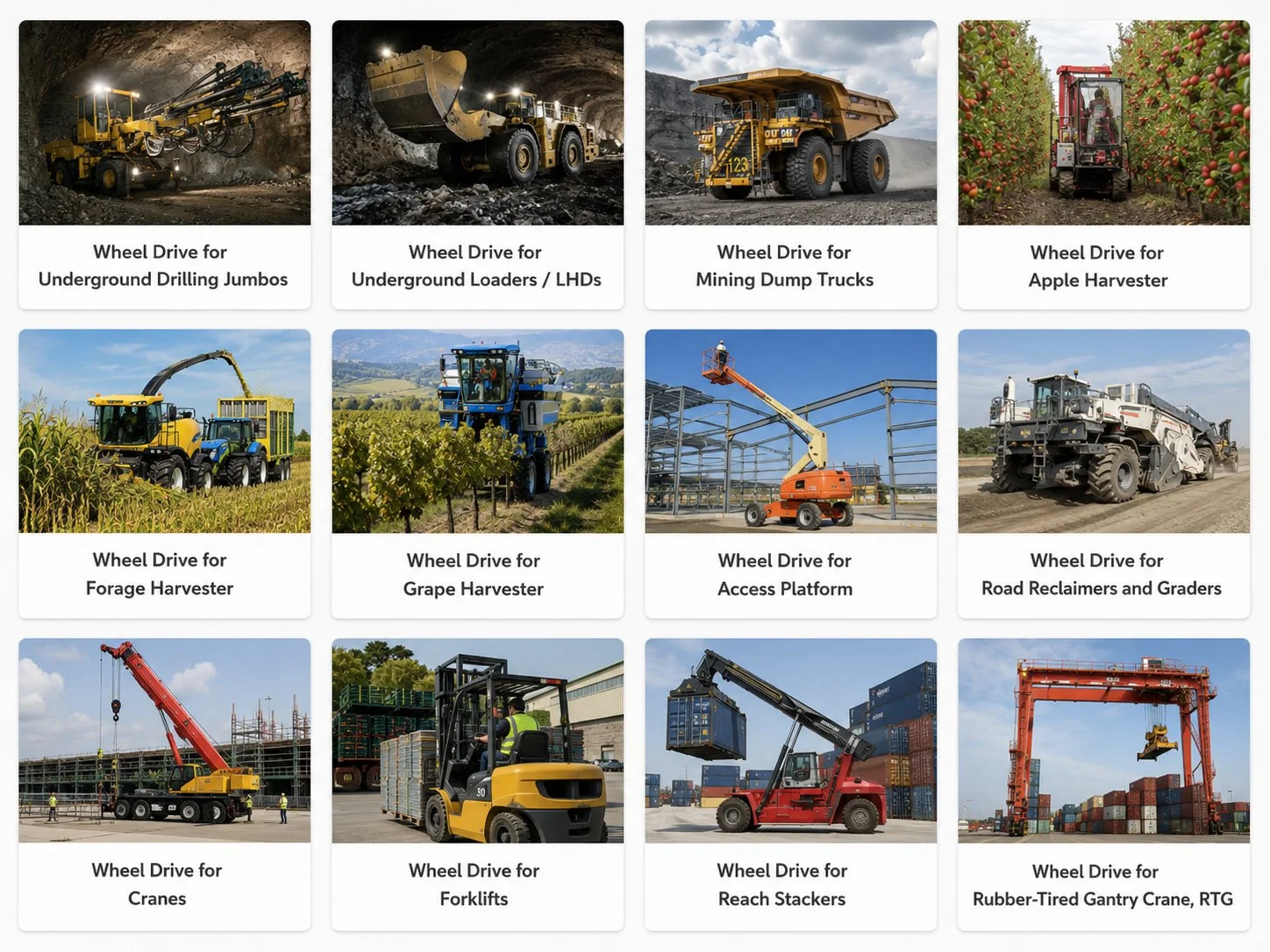
Three Container Crane Families — Drive Requirements and Differences

Ship-to-Shore Gantry Cranes (STS): The largest and most productive cranes in any terminal, with outreach spans of 50 to 72 metres and lift capacities of 50 to 100 tonnes under spreader. STS cranes travel on rail-mounted legs, with two travel bogies per leg — typically four bogies total per crane, each bogie carrying two to four driven wheels. The crane travels at up to 45 m/min (2.7 km/h) for gantry repositioning between vessel bays. Rail gauge widths of 15.24 m (50 ft) to 30.5 m (100 ft) are standard. Wheel loads per driven wheel reach 80 to 150 kN depending on crane class and load condition. The bogie drive gearbox output torque requirement ranges from 80,000 to 280,000 Nm per driven wheel.
Rubber-Tyred Gantry Cranes (RTG): The dominant yard crane type in most modern container terminals, RTG cranes travel on pneumatic tyres across paved yard surfaces — not on rails — which gives them the flexibility to reposition between yard blocks without infrastructure constraints. RTG cranes handle 20-foot and 40-foot containers stacked 4 to 6 high over 6 to 8 container rows. Travel speed for yard repositioning reaches 30 m/min (1.8 km/h). Each travel wheel is independently driven by a hub-mount planetary gearbox and AC motor — the most common drive configuration in modern terminals — with output torques of 50,000 to 120,000 Nm per driven wheel.
Rail-Mounted Gantry Cranes (RMG): Rail-mounted gantry cranes serve automated container terminals and high-density manual terminals where fixed rail infrastructure is justified by the operational benefits of precise positioning and lower tyre maintenance costs compared to RTG. RMG cranes run on rails at ground level or elevated on structural steel portal frames. Rail gauges range from 6 m (stacking crane spans) to 35 m (transhipment terminal spans). Travel speeds reach 150 m/min (9 km/h) in fully automated terminals where the crane must cover the full block length in under 40 seconds to maintain throughput targets. The higher travel speeds of RMG cranes require careful attention to gear ratio optimisation — a crane travelling at 9 km/h with 630 mm wheel diameter requires a gearbox output speed of approximately 75 rpm, imposing different ratio and motor selection requirements than the slower-speed RTG application.
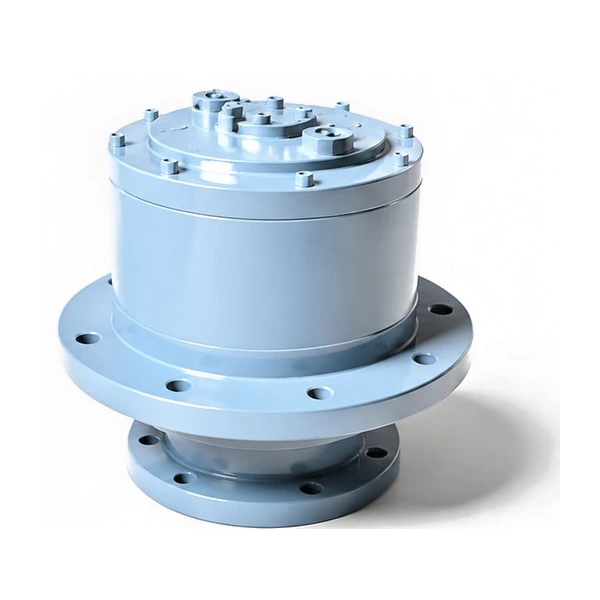
Marine Environment Engineering: Beyond Standard IP67
Standard IP67 ingress protection — the specification that suffices for inland port and construction yard applications — is a minimum threshold for container crane travel bogies, not an adequate specification in itself. The marine port environment imposes corrosion attack modes that are qualitatively different from the fresh-water and dust environments that IP67 was primarily designed to address:
🌊 Salt Spray Corrosion
Quayside container cranes operate within 10 to 50 metres of open water. Salt spray deposits chloride ions on all exposed surfaces continuously. Chloride-induced corrosion of mild steel proceeds at 5 to 10 times the rate of inland industrial environments. All Korea Ever-Power marine-duty gearbox housings use ductile iron or fabricated steel with a three-coat paint system: zinc-rich epoxy primer (60 microns minimum DFT), epoxy mid-coat (80 microns), and polyurethane topcoat (60 microns) — total system rated to 3,000 hours neutral salt spray per ISO 9227 Category C5-M.
💧 Seal System for Marine Duty
Standard nitrile rubber cassette seals degrade in sustained salt spray exposure — chloride attack on the elastomer compound causes hardening and cracking of the seal lip within 3 to 5 years in quayside service. Korea Ever-Power marine-duty gearboxes specify fluoroelastomer (FKM/Viton) primary seal lips as standard, with the cassette seal housing in stainless steel 316L rather than standard zinc-plated mild steel. FKM seals maintain flexibility and sealing contact force across the operating temperature range of -20°C to +120°C and resist chloride attack for the full 25-year crane design life.
🌐 Fastener and Hardware Specification
Standard zinc-plated steel fasteners used in standard-duty gearboxes corrode rapidly in marine service, becoming impossible to remove without damage within 3 to 5 years. All external fasteners on Korea Ever-Power marine-duty gearboxes are A4 stainless steel (316L) or hot-dip galvanised to ISO 1461, with stainless steel locking inserts in the housing tapped bores. Oil drain and fill plugs are magnetic stainless steel, sized to ISO metric thread standard, with PTFE thread sealant rather than anaerobic adhesive for easier field servicing without heat application.
🔌 Breather and Pressure Equalisation
Container crane travel bogies experience large thermal cycles as the crane alternates between operation (gearbox internal temperature 60–85°C) and overnight standby (ambient -10°C to +35°C). Without adequate pressure equalisation, this thermal cycling draws moist salt air through seal interfaces on every cool-down cycle, accelerating internal corrosion of gear and bearing surfaces. Korea Ever-Power marine-duty gearboxes are fitted as standard with a labyrinth-type IP66-rated breather-desiccant assembly that allows pressure equalisation while trapping moisture and particulate.

Synchronised Multi-Bogie Travel: Ratio Matching and Load Sharing
A container crane with four travel bogies and two driven wheels per bogie has eight independently driven wheel-gearbox-motor assemblies operating simultaneously. Gantry travel requires that all eight wheels maintain the same linear velocity within tight tolerances — any velocity mismatch generates a side-thrust force on the rail flange or tyre that causes accelerated wear, structural stress, and — in extreme cases — crane leg skew that triggers safety interlocks and halts operations.
Gear Ratio Tolerance: For a crane with rail gauge of 15.24 m, a rail flange clearance of 12 mm, and a bogie wheelbase of 2.4 m, the allowable velocity difference between the fastest and slowest driven wheel during gantry travel is approximately 0.15%. This corresponds to a gear ratio tolerance of ±0.08% across all eight gearboxes. Korea Ever-Power achieves this specification through matched-ratio manufacturing — all gearboxes supplied for a single crane are ground to a common ratio tolerance of ±0.05% using the same gear hobbing and grinding setup, with the ratio verified by precision rotation count test after assembly.
Load Sharing Between Bogies: On a level, well-maintained surface, load sharing between driven bogies is approximately equal. In practice, quayside surfaces develop irregularities — settlement cracks, joint steps, tyre rutting in the case of RTG — that cause individual bogies to carry significantly more than their theoretical share of the total tractive effort. Korea Ever-Power travel drive gearboxes are rated at 1.5 times the theoretical mean bogie load to provide margin against these dynamic load variations without operating above the gearbox rated capacity.
Automated Terminal Requirements: Fully automated RTG and RMG cranes in automated container terminals use absolute position encoders on the travel drive motor shaft — mounted on the gearbox input — to provide precise gantry position feedback to the terminal operating system. Korea Ever-Power gearboxes for automated terminal applications are supplied with pre-machined encoder mounting flanges on the motor input face, compatible with all major servo encoder types used in crane automation systems.
Korea Ever-Power Container Crane Drive Selection Guide
| Μοντέλο | Ροπή εξόδου | Crane Type | Travel Speed | Seal |
|---|---|---|---|---|
| ZL24 | 21,000 – 50,500 Nm | Small RTG / feeder terminal | Up to 30 m/min | IP67 FKM marine |
| EP-WD-80 | 80,000 Nm | Standard RTG 6+1 row | Up to 30 m/min | IP67 FKM marine |
| EP-WD-120 | 120,000 Nm | Wide-span RTG / RMG | Up to 90 m/min | IP67 FKM marine |
| EP-WD-200 | 200,000 Nm | STS gantry travel bogie | Up to 45 m/min | IP67 FKM marine |
| EP-WD-280 | 280,000 Nm | Post-Panamax STS heavy bogie | Up to 45 m/min | IP67 FKM marine |
Electrification and Energy Recovery: The Modern RTG Travel Drive
The conversion of diesel-powered RTG cranes to electric drive — either grid-connected via cable reel or hybrid with energy storage — has been the dominant capital upgrade programme in container terminal electrification for the past decade. The travel drive gearbox is unaffected by the power source change, but the motor interface and control requirements evolve significantly in the transition from hydraulic to electric drive:
Variable Frequency Drive Integration: Modern electric RTG travel drives use variable frequency AC motors controlled by VFD drives, providing stepless speed control from creep speed (for precise spotting under container stacks) to full repositioning speed. The VFD motor operates at speeds from 50 to 1,500 rpm across the travel speed range, requiring gearbox ratios of 15:1 to 40:1 depending on wheel diameter and maximum travel speed. Korea Ever-Power WD gearboxes for electric crane travel applications are supplied with motor adaptor flanges pre-matched to the motor frame size specified — IEC 200 through IEC 315 covers the full power range of RTG travel motors from 15 kW to 75 kW per wheel.
Regenerative Braking Energy Recovery: A fully loaded RTG crane decelerating from 30 m/min travel speed has significant kinetic energy available for recovery. VFD-driven travel motors operating in regenerative mode can recover 15 to 25% of travel energy during deceleration, returning it to the DC bus for immediate reuse by the hoist or trolley drives. This regenerative capability imposes a reverse-torque load on the travel drive gearbox — the gearbox must transmit torque from wheel to motor during deceleration just as efficiently as from motor to wheel during acceleration. Korea Ever-Power travel drive gearboxes are rated for equal forward and reverse torque application with no de-rating.
Anti-Skid Traction Control (RTG): RTG cranes operating on wet or contaminated yard surfaces — fuel spills, rain on smooth concrete, tyre rubber deposits — can experience wheel slip during acceleration from rest on uphill gradients. Modern terminal management systems implement per-wheel torque monitoring and anti-skid control, limiting individual wheel torque to maintain adhesion. The travel drive gearbox input shaft speed sensor provides the slip detection signal. Korea Ever-Power RTG travel drive gearboxes include a standard hall-effect sensor target on the motor adaptor flange, compatible with all major crane anti-skid control systems.
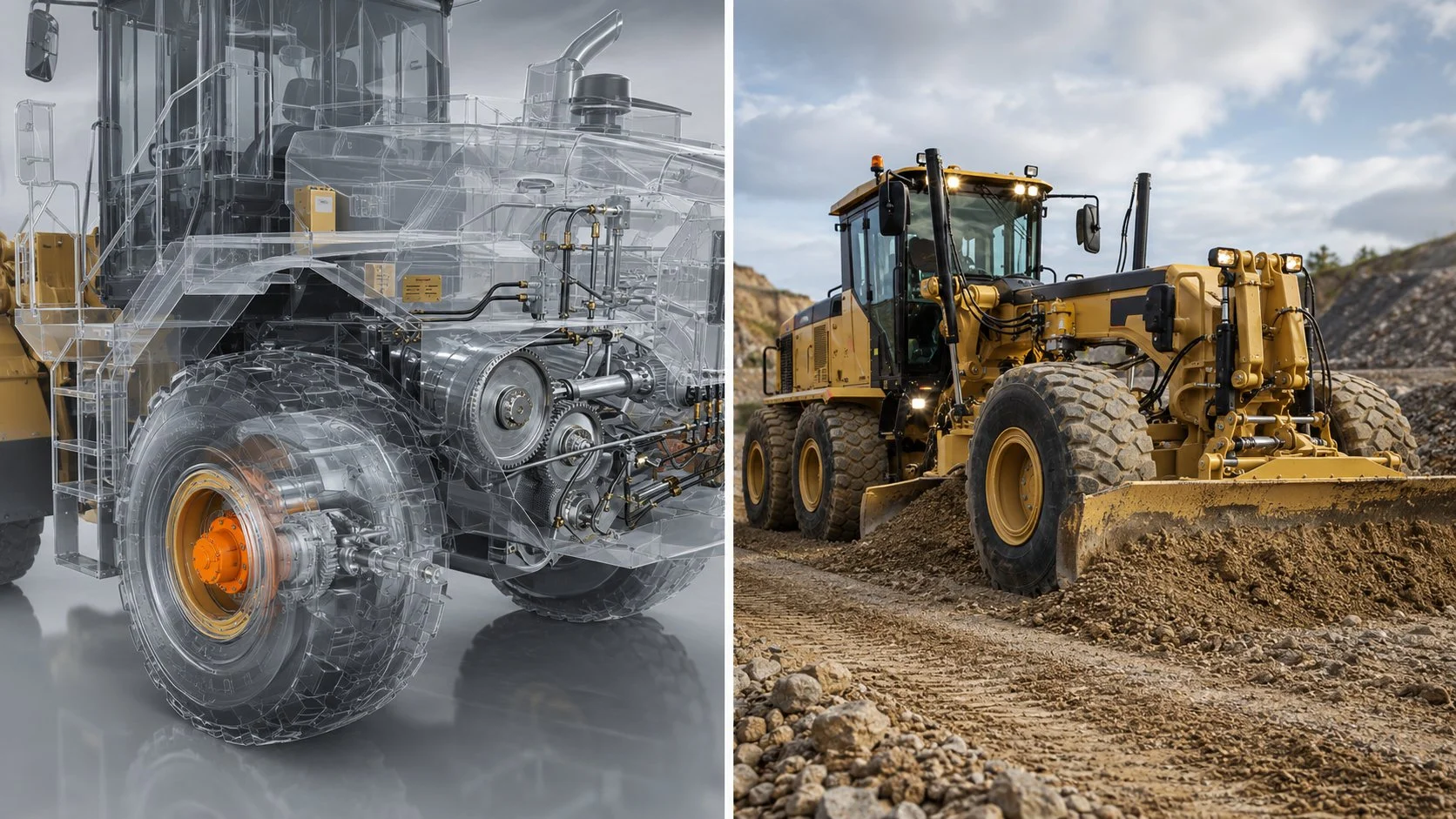
Maintenance Strategy: Maximising Availability of High-Utilisation Cranes
A container crane operating two shifts per day, 340 days per year accumulates approximately 5,000 operating hours per year. At this utilisation rate, the travel drive gearbox accumulates 25,000 hours over a standard 5-year major maintenance interval — a service life that places it in the category of industrial gearboxes rather than vehicle gearboxes, and demands a maintenance strategy matched to that service intensity.
Oil Analysis Programme: The most cost-effective maintenance tool for container crane travel drive gearboxes is a quarterly oil analysis programme. Spectrometric analysis of wear metal content — iron from gear teeth and bearing races, copper from planet pin bushings, chromium from bearing steels — provides early warning of developing internal wear before it reaches a stage requiring gearbox removal. Korea Ever-Power recommends oil sampling at 1,250-hour intervals, with sample ports on every WD gearbox supplied for crane applications sized and positioned to allow sampling without oil drainage.
In-Situ Oil Change: Travel drive gearboxes mounted in crane bogies are often in confined positions that make gearbox removal impractical during routine maintenance. Korea Ever-Power marine-duty WD gearboxes are designed for in-situ oil change — magnetic drain plug at the lowest point, fill plug at the side, vent at the top — without requiring gearbox extraction from the bogie frame. Magnetic drain plugs capture ferrous wear debris before the oil change and are inspected for debris quantity and particle morphology as part of each service interval.
Exchange Programme: For terminals operating large fleets of identical cranes, Korea Ever-Power offers a gearbox exchange programme — pre-built, tested replacement units available from regional distribution stock, enabling bogie gearbox replacement in a single maintenance shift rather than waiting for repair of the removed unit. Exchange units are supplied tested and filled with lubricant, ready to install.
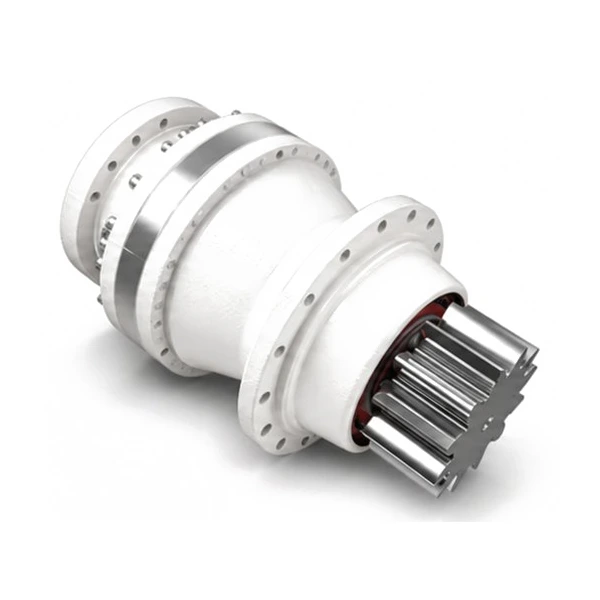
Why Crane OEMs and Terminal Operators Choose Korea Ever-Power
C5-M
Marine corrosivity category paint system standard on all container crane travel drive gearboxes — 3,000 hours neutral salt spray per ISO 9227
±0.05%
Matched gear ratio tolerance across all gearboxes supplied for a single crane — enabling synchronised bogie travel within rail flange clearance limits
25 yr
Design-life specification available for STS crane travel drive gearboxes — gear and bearing sizing to L10h life matching crane structural design life
FKM
Fluoroelastomer seals standard on all marine-duty units — resisting chloride attack, wide temperature cycles, and pressure-wash exposure in port terminal service
Korea Ever-Power also manufactures the complementary πλανητικό κιβώτιο ταχυτήτων με μετάδοση κίνησης σε τροχιά series used in rail-mounted stacking cranes and automated guided vehicle track drives in the same terminal environment — providing procurement teams with a single supplier for both wheel-drive and track-drive planetary gearboxes across the full terminal equipment fleet.
Common Failure Modes in Container Crane Travel Drives and How to Prevent Them
| Λειτουργία βλάβης | Βασική Αιτία | Detection | Prevention |
|---|---|---|---|
| Seal corrosion failure | Standard NBR seal degraded by sustained salt spray in marine environment | Oil loss visible at wheel; salt crust at seal interface | Specify FKM seal as standard; inspect at 1,250 h service intervals |
| Bogie skew — rail flange wear | Gear ratio mismatch between bogies; one bogie travelling faster than the other | Accelerated flange wear pattern; lateral force alarm from bogie load cells | Order matched-ratio gearbox sets; verify ratio at delivery with rotation count test |
| Water ingress — internal corrosion | Thermal cycling drawing moist air through worn breather or seal interface | Milky oil at drain plug; rust particles in oil sample spectrometry | Fit marine-duty desiccant breather; change oil at 1,250 h; quarterly oil analysis |
| Output bearing failure | Sustained dynamic overload at rail joints; fatigue from uneven load sharing between bogies | Vibration increase at travel speed; heat at bogie wheel hub | Maintain rail joint level within ±2 mm; specify 1.5x load factor in gearbox rating |
| Housing paint breakdown | Inadequate paint system DFT or surface preparation; impact damage from container handling near bogies | Rust blistering visible at housing; pit corrosion progressing to wall thinning | Specify C5-M three-coat system; inspect and touch up paint at each annual service |
Source Your Container Crane Travel Drive Gearbox
Whether you are specifying new STS, RTG, or RMG crane travel drive gearboxes for an OEM build programme, sourcing replacement units for an operating fleet, or upgrading a diesel RTG to electric drive — Korea Ever-Power has the marine-duty engineering and manufacturing capacity to deliver. Send us your crane specification and wheel load data for a free application sizing review and dimensional drawing within 48 hours.
Edit by Cxm