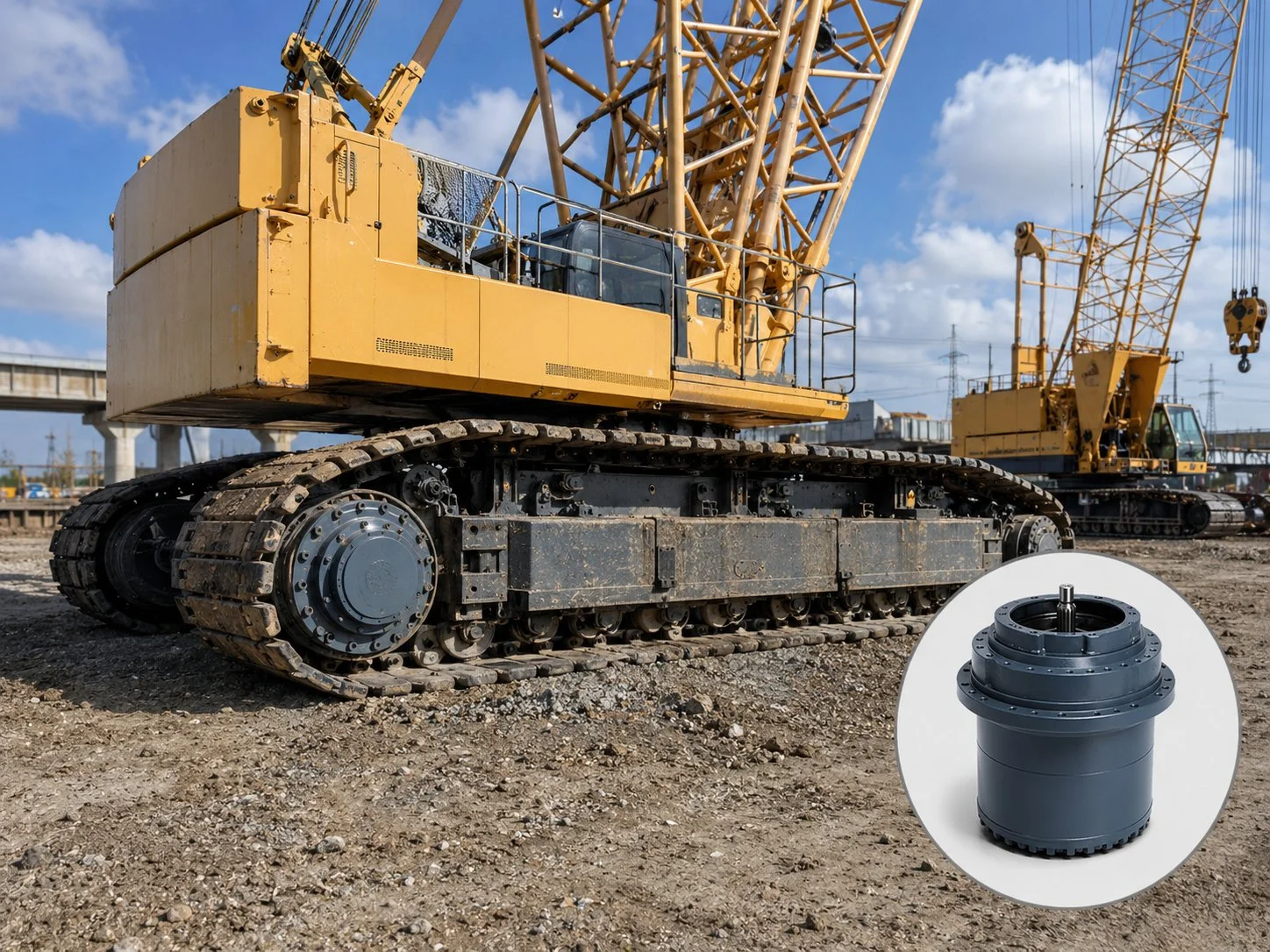
Why Crawler Crane Track Drives Are Engineered Differently from Every Other Final Drive
Le réducteur planétaire à chenilles on a crawler crane faces a unique combination of constraints that no excavator, bulldozer, or loader encounters. Understanding these constraints explains why crane track drives are not simply oversized versions of excavator final drives — they are a fundamentally different engineering package.
A 300-tonne crawler crane weighs 280 to 320 tonnes without a load. Add counterweight, boom, and a 100-tonne suspended load, and the track drives carry 400 to 500 tonnes across the ground. Yet the machine may travel only 50 to 200 metres per day — repositioning between lifts. The track drive duty cycle is 1 to 3%: the lowest of any tracked machine, but at the highest single-event load.
Crawler crane travel speed is typically 0.7 to 1.5 km/h — walking pace. Higher speed would compromise stability, exceed ground bearing pressure limits during acceleration, and risk pendulum swing of suspended loads. The track drive is deliberately geared for extremely low output speed at high torque — ratios of 150:1 to 300:1 are common, far exceeding the 40:1 to 120:1 range used in excavators.
On a slope — even a 2 to 3% gradient that looks flat to the eye — a 500-tonne crane will accelerate under gravity if the track drives cannot hold. The parking brake inside the track drive planetary gearbox must hold the full machine weight on the steepest expected gradient indefinitely. This braking requirement often determines the track drive specification before the driving torque calculation is even considered.
Ground Bearing Pressure — The Constraint That Governs Crawler Crane Track Drive Design
Before a crawler crane can travel, the ground must support it. Ground bearing pressure (GBP) — the force per unit area that the tracks exert on the ground surface — determines whether the crane sinks, tilts, or remains stable. The track drive gearbox contributes to GBP through its own weight and through the dynamic forces it generates during acceleration and braking.
| Crane Class | Total Weight (t) | Track Length (m) | Track Width (mm) | GBP (kPa) | Track Drive Torque (Nm) |
|---|---|---|---|---|---|
| 50 – 80 t lattice | 60 – 100 | 4.0 – 5.5 | 600 – 700 | 55 – 80 | 40,000 – 70,000 |
| 100 – 200 t lattice | 130 – 260 | 5.5 – 7.5 | 700 – 900 | 70 – 110 | 80,000 – 160,000 |
| 300 – 500 t lattice | 350 – 600 | 8.0 – 12.0 | 900 – 1,200 | 90 – 140 | 180,000 – 350,000 |
| 600 – 750 t lattice | 700 – 1,000 | 10.0 – 14.0 | 1,000 – 1,500 | 100 – 160 | 400,000 – 700,000 |
GBP is static (no dynamic amplification). Track drive torque is per-track for level travel at 1.0 km/h. Typical ground allowable bearing pressure: compacted gravel 150 – 200 kPa, timber mats on clay 80 – 120 kPa, unimproved soil 50 – 80 kPa. When GBP exceeds ground capacity, timber crane mats or steel plates are mandatory.
Travel Torque Calculation — Sizing the Track Drive for a 200-Tonne Crawler Crane
The worked example below demonstrates the complete torque sizing process for a medium-class lattice boom crawler crane. Note the differences from the excavator and bulldozer calculations: the speeds are much lower, the ratios are much higher, and the braking torque calculation appears as a separate mandatory check.
Neither bulldozers nor excavators require a separate brake sizing calculation — their track drives use spring-applied hydraulic-release brakes sized to the motor stall torque, which always exceeds the grade-holding requirement for these lighter machines. Crawler cranes, at 260 to 1,000 tonnes, generate grade-holding forces that can approach or exceed the motor stall torque — especially on uneven ground where one track bears a disproportionate share of the load. The brake must be independently verified against the worst-case gradient and asymmetric loading condition, not simply assumed adequate because it matches the motor torque.
Travel with Suspended Load — The Safety Constraint That Drives Track Drive Speed Control
Some crawler crane operations require the crane to travel while carrying a suspended load — moving a structural steel member from the laydown area to the erection point, or repositioning during a tandem lift. This “pick and carry” operation imposes the most severe stability constraint on the track drive system.
A suspended load acts as a pendulum. Any acceleration, deceleration, or change in direction of the crane causes the load to swing. The swinging load shifts the centre of gravity dynamically — and on a 300-tonne crane carrying a 50-tonne load at a 30-metre radius, the dynamic CG shift can approach the tipping boundary. The track drive must accelerate and decelerate so gradually that the pendulum amplitude never exceeds the stability margin. This translates to acceleration limits of 0.01 to 0.03 m/s2 — approximately 1/300th of the acceleration a car applies when pulling away from a traffic light.
Most crane manufacturers limit travel speed to 0.5 to 0.8 km/h during pick-and-carry — half the already-slow normal travel speed. The track drive must provide smooth, stepless speed control from zero to maximum at this reduced speed. Any jerky motion, torque pulsation, or speed hunting in the track drive hydraulic circuit translates directly into load swing. The planetary gearbox backlash specification is tighter for crane track drives than for excavator track drives because backlash produces a momentary speed discontinuity during direction change that initiates pendulum oscillation.
Le réducteur planétaire à entraînement de rotation that rotates the crane superstructure faces a similar pendulum constraint during slewing with a suspended load — but the track drive faces the additional complication of ground surface irregularities (bumps, ruts, soft spots) that introduce vertical perturbations into the pendulum system. The track drive and the slewing drive must be engineered as a coordinated pair, not as independent systems.
The Parking Brake — Why Crawler Crane Track Drives Require Spring-Applied Failsafe Braking
Every crawler crane track drive contains an integrated parking brake — typically a spring-applied, hydraulically released multi-disc brake positioned at the high-speed (motor) end of the planetary gear train. This brake is not optional. It is a safety-critical component governed by crane standards (EN 13000, ASME B30.5) that must hold the crane stationary on the maximum expected gradient with no hydraulic power applied.
The brake springs engage the brake discs when hydraulic pressure is released — including during engine failure, hydraulic line rupture, or power loss. The brake engages automatically upon loss of pressure. This is a failsafe design: the default state is “brakes on.” The operator must actively apply hydraulic pressure to release the brake before the crane can travel.
Positioning the brake at the motor (high-speed) end of the planetary reduction multiplies the brake holding torque by the gear ratio. A brake producing 400 Nm of holding torque at the motor shaft, through a 200:1 planetary reduction, provides 80,000 Nm of holding torque at the sprocket — sufficient for a 200-tonne crane on a 5% slope. This arrangement minimises the brake physical size.
Because the crane travels so infrequently (1 to 3% duty cycle), the brake discs experience minimal rotational wear. The primary wear mechanism is static holding — the brake discs can develop adhesion patterns from prolonged clamping in one position. Annual inspection should verify free release (no sticking), disc thickness measurement, and spring force verification.
Three Failure Modes Specific to Crawler Crane Track Drives
The crane sits stationary for 95 to 99% of its operating life with the parking brake engaged. Over months of continuous clamping at the same position, the brake disc friction material can bond to the reaction plate through a combination of moisture, heat cycling, and surface chemistry. When the operator commands travel, the brake does not release cleanly — the crane lurches or fails to move until the adhesion bond breaks. This sudden release produces a jolt that can initiate pendulum swing in any suspended rigging.
On unprepared or poorly compacted ground, one crawler can sink more than the other — shifting 55 to 70% of the total machine weight onto a single track drive. The overloaded drive carries up to 1.4 times its nominal share of the weight, while the other drive is underloaded. If the overloaded drive was sized for symmetric 50/50 weight distribution, it operates at 140% of its rated torque during travel. Over multiple travel events on poor ground, the overloaded drive accumulates fatigue damage while the opposite drive remains within limits.
A track drive that sits stationary for weeks or months — common on project sites between crane mobilisations — does not circulate its gear oil. Moisture condensation accumulates in the housing during day-night thermal cycling. The oil at the bottom of the housing absorbs water while the upper gears and bearings are dry. When the crane finally travels, the initial rotation distributes the water-contaminated oil to the bearings, accelerating corrosion. On cranes stored outdoors in humid climates, this condensation-corrosion cycle is the leading cause of track drive bearing failure that occurs within the first 100 hours of operation after a storage period.
Korea Ever-Power Track Drives for Crawler Crane Applications

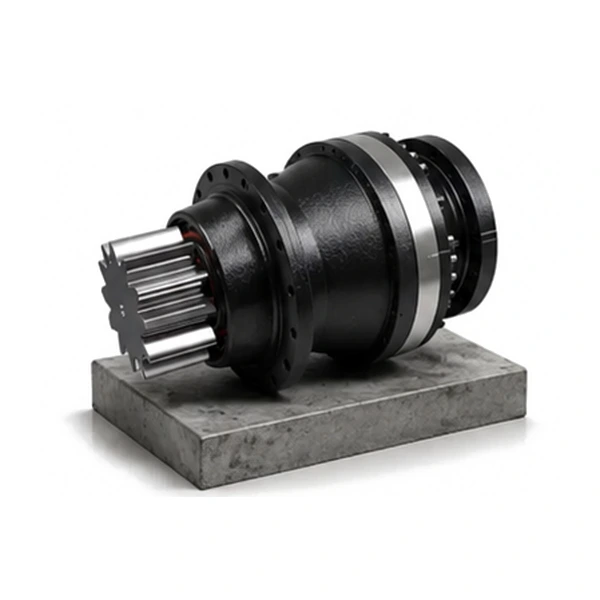
Track Drive Planetary Gearbox for Crawler Cranes — Frequently Asked Questions
Korea Ever-Power provides crawler crane track drive planetary gearboxes with integrated parking brakes from 40,000 to 700,000 Nm — covering 50-tonne lattice boom cranes through the largest 750-tonne heavy-lift machines. Provide your crane model and maximum travel gradient for a verified specification at no charge.
Éditeur : Cxm