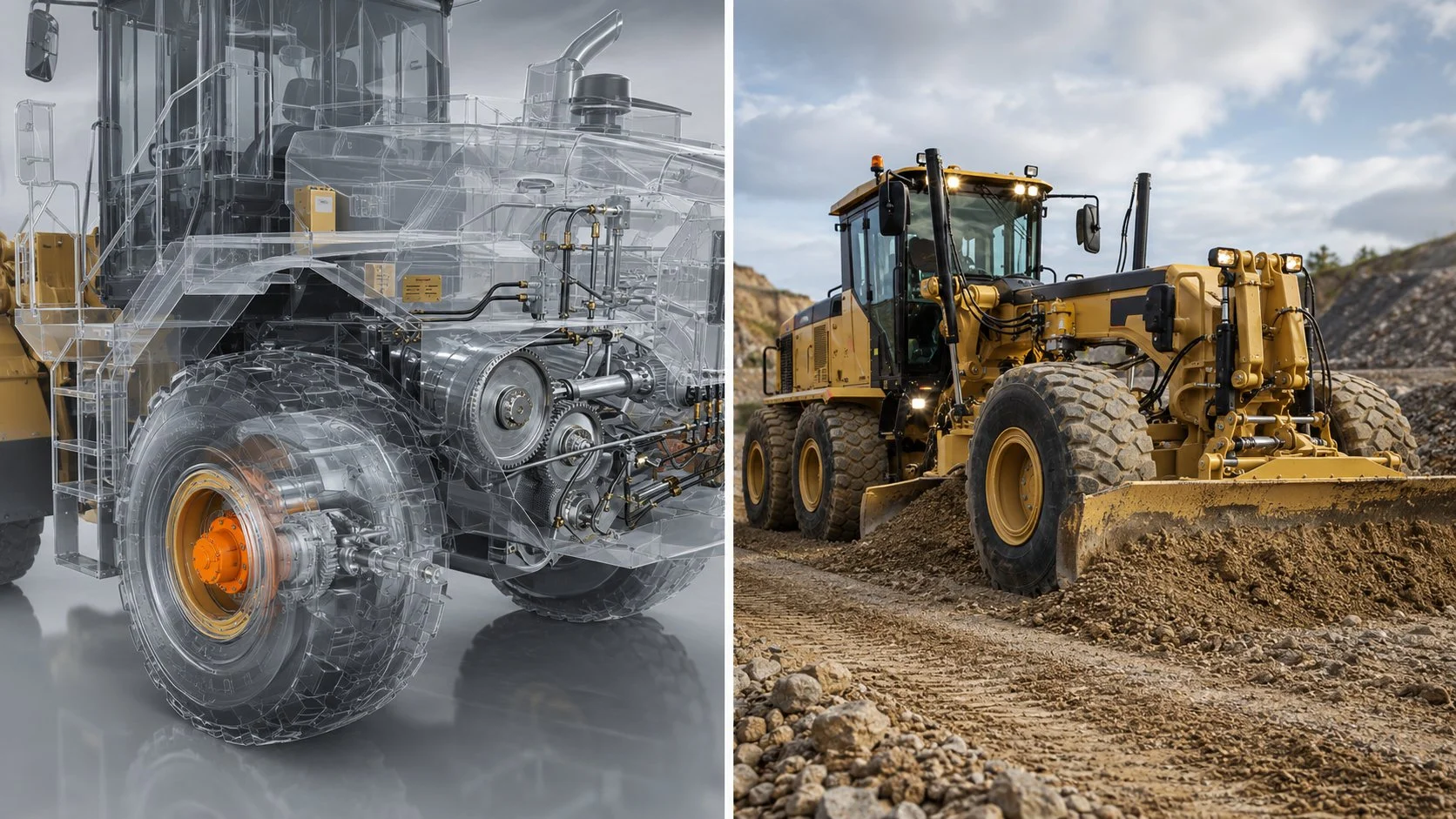
The Paradox — A Wheel Drive That Barely Drives but Must Never Fail
The mobile crushing and screening plant is unique in this Wheel Drive series: the व्हील ड्राइव प्लेनेटरी गियरबॉक्स operates for only 20 to 100 hours per year — repositioning the machine within the quarry or construction site when the feed-stock location changes. For the remaining 1,500 to 4,000 operating hours, the wheel drive is stationary — exposed to the crusher vibration, rock-dust fallout, and weather while the crushing and screening equipment processes material above it.
This infrequent-use, high-severity duty cycle is the opposite of every other application in this series. A wheel loader drives 3,000 hours per year with moderate environmental stress. A mobile crusher drives 50 hours per year with extreme environmental stress during the 1,950 hours of stationary exposure. The failure modes are dominated by the stationary phase — not the driving phase — making the mobile crusher wheel drive an exercise in standstill survival rather than running endurance.
| Phase | अवधि | Wheel Drive State | Primary Hazard |
|---|---|---|---|
| Repositioning | 20–100 h/year | Running (2–5 km/h) | Traction, cold-start |
| Crushing (stationary) | 1,500–4,000 h/year | Stationary, vibrating | Vibration, dust, corrosion |
| Idle / shutdown | 4,000–7,000 h/year | Stationary, idle | Standstill corrosion, UV, weather |
When the repositioning command finally arrives — after weeks or months of stationary exposure — the wheel drive must start immediately and propel 40 to 80 tonnes of machine across uneven quarry terrain at 2 to 5 km/h. A cold-start failure at this point is catastrophic for the quarry operation: the alternative to self-propelled repositioning is a large crane or multiple heavy-haul tractors to tow the machine — costing USD 5,000 to 20,000 per repositioning event and delaying the quarry operation by 4 to 8 hours.
The machine weight during repositioning can vary by 20 to 30% depending on the material remaining in the hopper, on the conveyors, and in the crusher chamber. The operator may choose to reposition with the hoppers partially loaded (to save the time of emptying and refilling) — adding 5 to 15 tonnes of rock to the travel weight. The wheel drive must accommodate this variable weight without prior knowledge of the actual load — sizing the torque capacity for the maximum possible travel weight (machine + full hopper + material on conveyors).
The quarry floor terrain during repositioning is the most demanding surface for a low-speed, high-weight move. The floor consists of compacted crushed rock (the product of the crusher itself), with ruts from haul-truck traffic, standing water in low spots, and loose material at the crusher discharge area. The traction coefficient varies from 0.3 (wet, loose fines) to 0.6 (dry, compacted aggregate) across the repositioning path. At 60 tonnes on a 5% grade in the quarry, the traction demand reaches 40 to 50 kN — which must be sustained for the entire 50 to 200-metre repositioning distance without wheel slip that would compromise the machine stability on the uneven surface.
The screening plant variant adds a different vibration profile. Screening decks vibrate at 15 to 25 Hz with 3 to 8 mm amplitude — producing a lower-frequency, higher-amplitude vibration than jaw or cone crushers (which vibrate at 5 to 15 Hz with 1 to 3 mm amplitude from intermittent rock-crushing impacts). The screening vibration is continuous and sinusoidal — similar to the compaction roller (WD-18) — and produces the same continuous false-Brinelling damage pattern. Combined crushing-and-screening plants expose the wheel drive to both vibration profiles simultaneously: the crusher impacts superimposed on the screen vibration — producing a complex vibration spectrum that is more damaging than either source alone.
Crusher-Transmitted Vibration — 2,000 Hours of Shaking Without Turning
During the crushing phase, the jaw crusher, cone crusher, or impact crusher generates vibration at 2 to 10 g at the machine frame — transmitted through the chassis to the stationary wheel drives. Unlike the compaction roller (WD-18) where the vibration and the driving occur simultaneously, the mobile crusher vibration occurs while the wheel drive is stationary — with the output bearing loaded by the machine weight but not rotating. This is the worst possible condition for bearing false Brinelling: the vibration micro-oscillates the rolling elements against the raceway at a fixed position, concentrating the damage at the contact point rather than distributing it around the circumference (as would occur if the bearing were rotating).
The standstill false-Brinelling rate is 3 to 5 times higher per vibration hour than the rotating false-Brinelling rate at the same amplitude — because the stationary bearing cannot redistribute the lubricant across the contact zone. After 2,000 hours of crusher operation (a typical period between repositioning moves), the output bearing may have accumulated enough standstill damage to produce audible roughness and measurable play increase — even though the bearing has rotated for only 20 to 50 hours of actual driving.
The व्हील ड्राइव प्लेनेटरी गियरबॉक्स internal gears are similarly affected. The gear teeth sit in mesh contact at a fixed position during the entire crushing phase — and the vibration produces fretting wear at the contact point. After 2,000 hours of crusher vibration, the gear teeth develop visible fretting marks at the mesh-contact position — producing a rough spot that generates a once-per-revolution noise when the wheel drive is finally engaged for repositioning. This fretting damage is cosmetic at first but progresses to micro-pitting and eventual spalling if the gears are not inspected and the machine is not rotated periodically.
The mitigation strategy is deceptively simple: move the machine periodically. A 5-minute wheel-drive engagement once per week — driving the machine 1 to 2 metres forward and back — rotates the bearing and gear contact positions to a new location, preventing the concentration of vibration damage at a single point. This weekly repositioning also circulates the oil (preventing stratification and additive settlement), exercises the seals (preventing compression set), and verifies that the wheel drive is functional (providing early warning of any developing problem). The cost of this 5-minute weekly engagement is negligible — but the benefit (50 to 80% extension of bearing and gear life) is substantial. Unfortunately, many quarry operators neglect this simple protocol because the mobile crusher is viewed as a stationary machine — and nobody thinks to drive a stationary machine every week.
Wheeled Versus Tracked — Why Wheeled Mobility Matters for Large Plants
Mobile crushing and screening plants are available in both tracked and wheeled configurations. Tracked units offer lower ground pressure and better traction on soft terrain — but wheeled units offer faster repositioning (5 km/h versus 1.5 km/h for tracks), lower transport costs (wheeled units can be towed on public roads with a prime mover — no low-loader required), and simpler maintenance (no track tension, no track-shoe replacement, no sprocket wear). For quarry applications where the repositioning terrain is compacted aggregate (firm, level, good traction), the wheeled configuration is the preferred choice — providing 3 to 5 times faster repositioning at 30 to 50% lower annual maintenance cost.
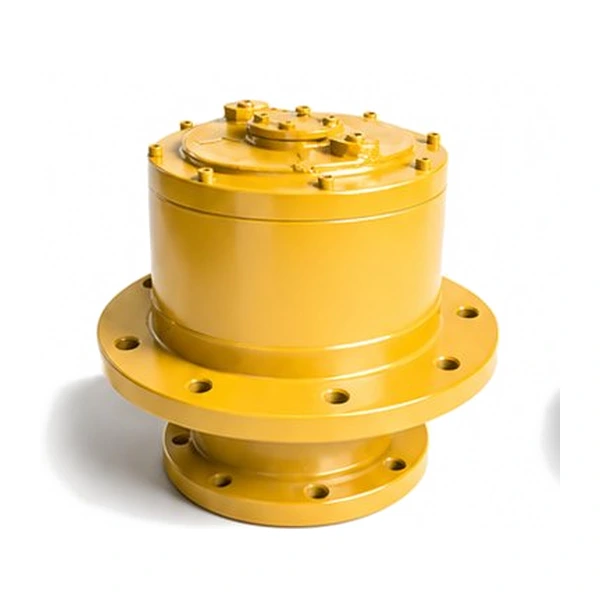
The largest wheeled mobile crushers reach 80 to 100 tonnes — requiring wheel drives with output torques of 40,000 to 80,000 Nm per axle. At these torque levels, the wheel drive is among the largest in the entire Wheel Drive series — comparable to the mining-class wheel dozer (WD-14) and larger than any agricultural or construction application. The tyre diameter reaches 1.2 to 1.8 metres — and the wheel drive must fit within the wheel hub or adjacent to it without increasing the machine width beyond the transport-legal limit (typically 3.0 to 3.5 metres for road-towed transport).
Road-towing capability adds a regulatory dimension. A wheeled mobile crusher towed on a public road must comply with the towing regulations of the jurisdiction — including braking (the towed machine must have its own braking system if the GVW exceeds 3.5 tonnes), lighting (rear lights, indicators, brake lights), and width limits (3.0 to 3.5 metres). The wheel drive brakes must function as trailer brakes during road towing — engaging automatically if the tow coupling separates (breakaway braking) and responding to the towing vehicle brake signal through a pneumatic or hydraulic line. This trailer-braking function is in addition to the self-propelled repositioning function — and the wheel drive must support both operational modes from the same brake hardware.
Three Failure Modes Specific to Mobile Crusher Wheel Drives
The output bearing sits at a fixed rotational position during the entire crushing campaign (200 to 2,000 hours between moves). Crusher vibration at 2 to 10 g micro-oscillates the rolling elements at this fixed position — concentrating the false-Brinelling damage at one point on the raceway. The standstill damage rate is 3 to 5 times higher than rotating damage at the same vibration level. After 1,000 to 2,000 hours of stationary vibration exposure, the bearing develops visible indentations that produce roughness and play when the drive is finally engaged — and the repositioning drive may be the first indication that the bearing is damaged.
The crushing and screening process generates enormous volumes of rock dust that settles on every horizontal surface — including the wheel drive housings. After a 2,000-hour crushing campaign, the dust accumulation can reach 50 to 200 mm depth on top of the wheel drive housing — burying the seal retainer, breather vent, and drain plug under a compacted layer of abrasive rock dust mixed with rainwater and crusher wash water. When the wheel drive is engaged for repositioning, the compacted dust layer resists the initial shaft rotation — and the dust particles at the seal interface are ground into the seal lip and shaft surface during the first few revolutions, producing immediate abrasive wear that may compromise the seal before the repositioning move is completed.
After 200 to 2,000 hours of standstill (during the crushing campaign or during winter shutdown), the gear oil settles, oxidises (from vibration-induced aeration), and thickens — especially in cold climates where the oil temperature during winter standstill can reach -15 to -25 degrees C. The seals lose elasticity from prolonged compression at a fixed position (compression set) and from UV degradation on exposed surfaces. When the repositioning command arrives, the wheel drive must overcome the cold, stiff oil resistance and the set-hardened seals — producing a starting torque 2 to 4 times higher than the warm-running torque. If the hydraulic system cannot deliver this elevated starting torque (because the hydraulic pump is also cold and inefficient), the wheel drive fails to turn — and the machine cannot reposition itself.
अक्सर पूछे जाने वाले प्रश्नों
Korea Ever-Power provides mobile crusher wheel drives from 10,000 to 80,000 Nm with standstill vibration resistance, rock-dust burial protection, and reliable cold-start repositioning.
संपादक: सीएक्सएम