व्हील ड्राइव सीरीज़ — बंदरगाह और लॉजिस्टिक्स उपकरण
Wheel Drive Planetary Gearbox for Rubber-Tired Gantry Crane, RTG
A rubber-tired gantry crane spanning eight container rows accumulates more than 5,000 operating hours per year traversing the same paved container yard block, lane by lane, with up to 16 driven wheels all required to travel at precisely the same speed to prevent tyre scrub and structural skew. The wheel drive planetary gearbox at each driven axle is the component that determines whether that precision is maintained across a 20-year machine life.
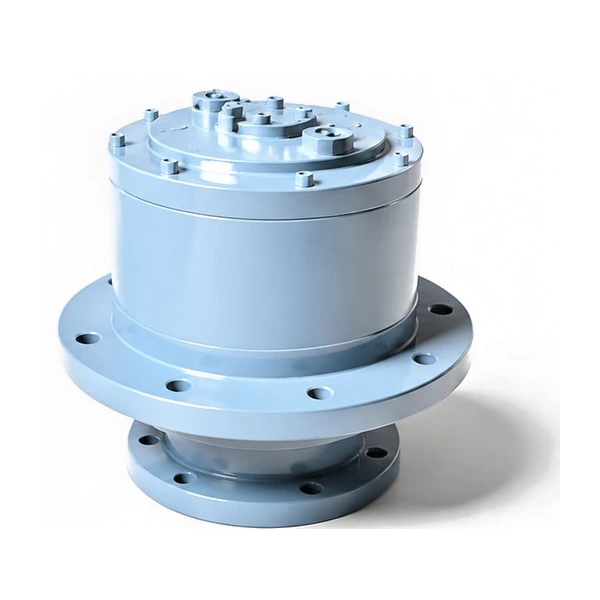
The rubber-tired gantry crane is the dominant yard crane type in the majority of container terminals worldwide, combining the flexibility of tyre-based mobility with the stacking productivity of a gantry structure. A typical RTG spans six to eight container rows plus a truck lane, stacks containers four to six high, and in a busy terminal executes 25 to 35 lift cycles per hour across a yard block that may be 350 to 500 metres long. The व्हील ड्राइव प्लेनेटरी गियरबॉक्स at each of the eight to sixteen driven wheels is the mechanical link between the drive motor and the tyre — a component whose precision, durability, and serviceability directly determine crane availability and yard throughput. Korea Ever-Power supplies matched-ratio hub-mount planetary drive gearboxes for RTG cranes across the full spectrum from small feeder-terminal cranes through the largest automated terminal RTGs, with output torques from 50,000 Nm to 160,000 Nm and marine-grade corrosion engineering as the baseline specification.
RTG Crane Configurations and Drive Architecture

RTG cranes are manufactured in a range of span and stack configurations, each resulting in different structural weights and therefore different drive axle loads per wheel. The most common configurations in service worldwide are:
6+1 Span, 4-High Stack: Spans six container rows plus one truck lane. Total machine weight approximately 180 to 220 tonnes. Eight driven wheels (two per corner leg), each carrying 22 to 27 tonnes static load. Output torque per wheel: 50,000 to 80,000 Nm. This configuration dominates smaller terminals and feeder port operations where crane weight and ground bearing pressure are constrained.
7+1 Span, 5-High Stack: The current standard for most new terminal projects. Total machine weight 240 to 290 tonnes. Eight to twelve driven wheels per crane depending on bogie configuration. Output torque per wheel: 65,000 to 100,000 Nm. The additional stack height increases the centre of gravity and the structural bending moment at the crane legs, increasing the vertical load variation between the windward and leeward legs during crosswind conditions.
8+1 Span, 6-High Stack: The largest RTG configuration, used in high-density automated terminals maximising yard storage per square metre. Total machine weight 320 to 380 tonnes. Twelve to sixteen driven wheels. Output torque per wheel: 80,000 to 160,000 Nm. These cranes impose the highest ground bearing pressures and require the most careful attention to gearbox output bearing design, as the wheel load variation between fully laden and empty conditions spans a 3:1 ratio.
Matched-Ratio Supply: The RTG Requirement That Standard Procurement Misses
The most consequential technical requirement for RTG wheel drive gearbox supply — and the one most frequently overlooked in standard industrial procurement — is matched gear ratio across all gearboxes fitted to a single crane. The requirement arises from the physics of a tyre-based crane traversing a container yard lane:
An RTG crane with eight driven wheels, all driven simultaneously at the same motor speed, will travel in a straight line only if all eight wheel-gearbox assemblies produce exactly the same wheel angular velocity. If the gear ratio of one gearbox is even 0.2% higher than the others, that wheel rotates 0.2% faster for every metre travelled — equivalent to a 2 mm linear advance per metre. Over a 400-metre yard block traverse, this wheel advances 800 mm relative to the other wheels. Since the wheel cannot physically advance independently of the crane structure, this mismatch generates a side thrust on the tyre — causing tyre scrub, accelerated tyre wear, and structural stress on the bogie frame. In severe cases, the cumulative side thrust causes crane skew that triggers safety sensors and halts crane operations.
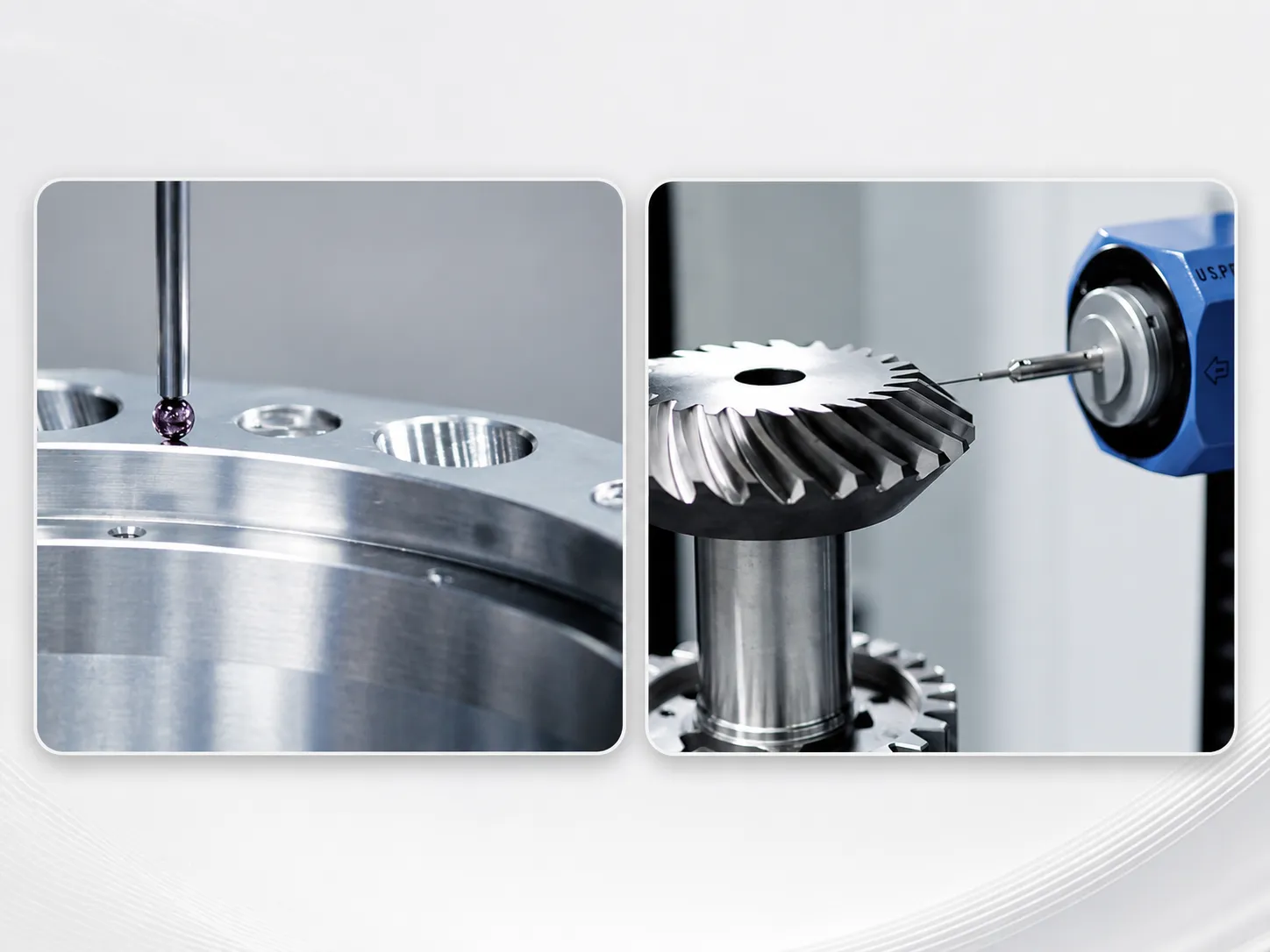
Korea Ever-Power Matched-Ratio Manufacturing Process: All gearboxes supplied for a single RTG crane are manufactured in a single matched batch. Sun gear and planet gear sets are ground on the same machine setup with the same dressing cycle, eliminating the between-batch tooth profile variation that causes ratio scatter. After assembly, every unit in the batch is tested on a precision input-output rotation bench — the output shaft is held stationary while the input is rotated a precise number of turns by a stepper motor, and the output angle is measured by a precision encoder. Units are sorted by measured ratio and paired — the two units for each bogie are the closest-matched pair in the batch, and the maximum ratio spread across the eight units for a single crane is held to ±0.05%.
Fleet Replacement Matching: When a single gearbox in an operating RTG fleet requires replacement, the replacement unit must be ratio-matched to the remaining seven units on the same crane. Korea Ever-Power maintains a ratio measurement record for every unit supplied, identified by serial number. When a replacement is ordered, we measure the existing units on the crane (or use the original delivery records) and manufacture the replacement to the same ratio band. This service eliminates the tyre scrub and skew problems that arise when replacement gearboxes are sourced from standard stock without ratio matching.
Korea Ever-Power RTG Drive Selection Guide
| नमूना | आउटपुट टॉर्क | RTG Configuration | यात्रा की गति | Ratio Match |
|---|---|---|---|---|
| जेडएल24 | 50,500 Nm | 5+1 feeder terminal | Up to 25 m/min | ±0.05% |
| ईपी-डब्ल्यूडी-80 | 80,000 एनएम | 6+1 standard RTG | 30 मीटर/मिनट तक | ±0.05% |
| ईपी-डब्ल्यूडी-120 | 120,000 एनएम | 7+1 high-stack RTG | 30 मीटर/मिनट तक | ±0.05% |
| EP-WD-160 | 160,000 Nm | 8+1 automated terminal | 30 मीटर/मिनट तक | ±0.05% |
Electric RTG Conversion: Gearbox Requirements for Cable Reel and Battery Drive
The conversion of diesel-generator RTG cranes to electric power — either via cable reel connected to grid supply or via on-board battery pack — has been the dominant capital upgrade programme in container terminal sustainability since 2018. The wheel drive gearbox itself requires no modification for the power source change, but the motor interface and control system evolve significantly between diesel-hydraulic and electric drive configurations:
Diesel-Hydraulic RTG: The original RTG drive architecture — diesel engine on the crane structure driving a hydraulic pump, with fixed-displacement hydraulic motors at each driven wheel. The wheel motor mounts to the gearbox via SAE B or C flange. Maximum travel speed is typically 25 to 30 m/min, limited by hydraulic motor speed at maximum pump flow. Korea Ever-Power WD gearboxes for diesel-hydraulic RTG applications are available with SAE B, C, and D input flanges and case drain isolation between the hydraulic motor and gearbox oil circuits.
Cable Reel Electric RTG: Grid power fed to the crane via a motorised cable reel trails behind the crane as it traverses the yard block. The cable reel limits the usable yard block length to approximately 300 to 350 metres — one reason cable reel RTGs are most common in terminals with shorter block configurations. Electric motors replace hydraulic wheel motors, connecting to the gearbox via IEC B5 flanges. VFD control allows continuous speed variation from creep to maximum travel speed. Korea Ever-Power WD gearboxes for cable reel electric RTGs are supplied with IEC B5 input flanges in the motor frame sizes specified by the major electric RTG OEMs — IEC 200 through IEC 280 covering the 22 kW to 90 kW per wheel range used in most configurations.
Battery Electric RTG: On-board lithium-ion battery packs power the electric drive system without cable reel constraints, enabling the crane to traverse the full length of any yard block. Battery capacity is sized for one to two full working shifts between charges, with fast charging at block ends during the brief repositioning stops between rows. The wheel drive gearbox specification for battery RTG is identical to cable reel electric, with the addition of regenerative braking compatibility — the gearbox must transmit torque equally in both directions without efficiency penalty, since the regenerative energy recovery from deceleration and lowering operations contributes significantly to overall battery energy management.
Tyre Management and the Wheel Drive Gearbox Connection
RTG tyre costs represent a significant portion of crane operating costs — a set of sixteen large-diameter pneumatic tyres for an 8+1 RTG costs in the range of USD 80,000 to 120,000, with tyre life typically 8,000 to 15,000 hours depending on yard surface condition, crane speed, and — critically — the degree of tyre scrub caused by wheel speed mismatch between the driven bogie wheels.
Tyre Scrub from Ratio Mismatch: As described in the matched-ratio section above, even small gear ratio differences between gearboxes on the same crane generate continuous tyre scrub during yard block traversal. Tyre scrub is a lateral sliding motion of the tyre contact patch across the yard surface — generating heat in the tyre, wearing the tread asymmetrically, and reducing tyre life. A 0.2% ratio mismatch between two wheels on the same bogie causes a tyre scrub rate of approximately 0.2 mm per metre of travel — equivalent to wearing 100 mm of lateral tread per 500 metres of block traversal. Over 5,000 hours of operation at 30 m/min average travel speed, this accumulates to approximately 9,000 metres of lateral scrub per wheel per year — enough to reduce tyre life by 30 to 50% compared to a perfectly ratio-matched set.
Tyre Pressure Variation and Load Sharing: RTG tyres operate at inflation pressures of 8 to 12 bar, and the effective rolling radius of a pneumatic tyre varies with inflation pressure, load, and temperature. A tyre that is 5% under-inflated has a rolling radius approximately 0.3% smaller than the specification radius — equivalent to a 0.3% effective gear ratio change. Korea Ever-Power recommends that RTG operators implement automated tyre pressure monitoring as part of their crane management system, using the tyre pressure as an input to the VFD speed compensation algorithm to maintain equal tyre speed across all driven wheels regardless of tyre condition variation.
Gearbox Oil Temperature as a Tyre Scrub Indicator: Continuous tyre scrub from ratio mismatch raises the operating temperature of the affected wheel drive gearbox — the side thrust force generates heat in the gear mesh proportional to the scrub force magnitude. A gearbox running systematically hotter than its matched partners on the same crane is a reliable indicator of ratio mismatch or a developing bearing defect. Korea Ever-Power WD units for RTG applications are supplied with oil temperature sensor ports as standard, enabling continuous temperature monitoring and early detection of both ratio mismatch and bearing problems.
Yard Surface Conditions and Environmental Engineering
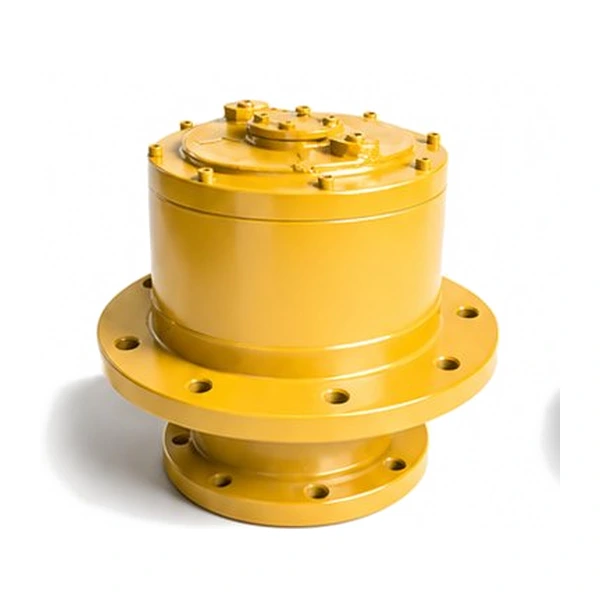
RTG cranes operate on paved container yard surfaces that, despite initial construction to high standards, develop significant irregularities over the 20-year crane service life. The wheel drive gearbox must tolerate the resulting dynamic load environment across the full service period:
Concrete Block and Joint Steps: Most container yard surfaces consist of interlocking concrete blocks rather than monolithic concrete, with inter-block joints that develop steps of 5 to 15 mm as the ground settles differentially under repeated heavy wheel loading. Each block joint crossing generates a vertical impact load on the RTG wheel — at 30 m/min travel speed and 200 mm block spacing, the RTG wheel crosses 2.5 joints per second, generating a continuous vibration at approximately 2.5 Hz that excites the natural frequencies of the crane structure and the gearbox internal components. Korea Ever-Power RTG gearbox housings are ribbed-cast designs with natural frequencies above 80 Hz to avoid resonance with this excitation range.
Pooled Water and Chemical Exposure: Container yard drainage is rarely perfect — pooled rainwater, fuel spillage from truck operations, and hydraulic oil contamination from crane maintenance activities all reach the yard surface and contact the wheel drive gearbox housing and seal interfaces. Pooled water presents a cyclic immersion risk every time the wheel travels through a low area after rain. Korea Ever-Power RTG gearboxes are rated IP67 for sustained immersion to 1 metre depth as the minimum standard, with the FKM seal cassette providing consistent sealing force during the pressure differential of immersion.
Temperature Range: RTG cranes operate year-round in climates ranging from sub-zero (Scandinavian and Canadian terminals, -30°C winter ambient) to extreme heat (Middle East and Southeast Asia terminals, +45°C summer ambient with heat-soaked yard surfaces reaching +65°C). The wheel drive gearbox lubricant must maintain adequate viscosity at -30°C for cold-start protection of gear teeth and bearings — ruling out mineral gear oils in favour of fully synthetic formulations with pour points below -40°C. At +65°C ambient, the fully synthetic oil maintains viscosity above the minimum film thickness requirement for the gear tooth EHL film at maximum load, preventing the thin-film scuffing that damages mineral oil lubricated gears operating in the same conditions.
Maintenance Strategy for High-Utilisation RTG Cranes
An RTG crane accumulating 5,000 operating hours per year must have its wheel drive gearboxes maintained on a programme that allows the maintenance to be completed within the crane scheduled maintenance windows without loss of productive shift time. Korea Ever-Power designs all RTG wheel drive gearboxes for in-situ maintenance — no gearbox removal from the crane bogie frame is required for routine service operations:
500-Hour Inspection: Visual check of floating face seal cassette for oil film; check of oil temperature sensor data trend from crane management system; tyre pressure verification and logging for rolling radius compensation. Estimated time on crane: 15 minutes per wheel.
1,000-Hour Oil Change: Oil drain via magnetic plug (inspect for debris), flush if debris elevated, refill with ISO VG 220 fully synthetic EP oil to specified level. Magnetic plug debris sample logged for trend analysis. Estimated time on crane: 30 minutes per wheel.
5,000-Hour Major Service: Oil change plus bearing preload measurement (tyre removed, dial indicator on hub), seal cassette replacement as cartridge unit, input shaft seal inspection, housing paint touch-up. Estimated time per wheel: 4 hours. For a crane with eight driven wheels, the complete 5,000-hour major service can be completed in a single 32-hour maintenance shutdown over two days.
Exchange Stock Programme: For terminal operators with five or more RTG cranes using the same gearbox model, Korea Ever-Power recommends maintaining two exchange units in terminal stock. These units are pre-built, tested, ratio-verified to match the fleet specification, and oil-filled — ready to install. An unplanned gearbox failure then becomes a 4-hour wheel changeout rather than a 3 to 5 week repair-and-return cycle that takes a crane out of service for extended periods.
Why RTG Crane OEMs and Terminal Operators Choose Korea Ever-Power
±0.05%
Matched-ratio batch tolerance across all gearboxes for a single crane — eliminates tyre scrub and structural skew from ratio mismatch
आईपी67
FKM marine-grade seal standard on all RTG units — sustained immersion, pressure washing, and chloride resistance for 20-year crane service life
SAE+IEC
Full input flange range covering diesel-hydraulic SAE B/C/D motors and electric IEC 200–280 motors — one gearbox platform for any RTG drivetrain
Serial
Per-unit ratio measurement record by serial number — enabling ratio-matched replacement of individual gearboxes in operating fleets without full crane re-commissioning
Korea Ever-Power supplies the complete family of planetary drive gearboxes for port terminal equipment — from compact ZL01 units for warehouse AGVs through EP-WD-280 units for 46-tonne heavy IC forklifts and STS crane travel bogies. The full range is documented in our wheel drive planetary gearbox catalogue, with dimensional drawings and selection data for every model. For track drive planetary gearboxes serving the RMG cranes and automated rail-guided vehicles in the same terminal, see our dedicated track drive range.
Source Your RTG Wheel Drive Planetary Gearbox
Whether you are specifying matched-ratio gearbox sets for a new RTG build programme, replacing worn units in an operating fleet with ratio-matched equivalents, or converting a diesel-hydraulic RTG to electric drive — Korea Ever-Power delivers marine-duty, matched-ratio planetary wheel drives built for the full 20-year RTG service life. Send us your crane configuration, wheel load data, and motor specification for a free application sizing review, matched-ratio batch proposal, and dimensional drawing within 48 hours.
Cxm द्वारा संपादित