The LHD — Surface Loader Intensity Meets Underground Hostility
The LHD (Load-Haul-Dump) machine is the underground equivalent of a surface wheel loader — but operating in conditions that make the surface loader environment seem benign. The LHD loads blasted rock at the draw point (the opening where broken ore flows from the stope into the tunnel), hauls it 100 to 500 metres through the tunnel, and dumps it into an ore pass (a vertical shaft) or onto a truck. This load-haul-dump cycle repeats 300 to 500 times per 8-hour shift — comparable to the surface loader V-cycle frequency — but in an environment of acid water, rock dust, confined space, and 24-hour continuous operation.
| Parameter | Surface Loader | Underground LHD | Severity Ratio |
|---|---|---|---|
| Annual hours | 2,500–4,000 | 5,000–7,000 | 1.5–2.0x |
| Water exposure | Rain only | Continuous (pH 2–11) | 5–20x |
| Haul distance | 15–50 m | 100–500 m | 5–10x |
The longer haul distance is the critical difference. A surface loader travels 15 to 50 metres per cycle (pile to truck). An LHD travels 100 to 500 metres per cycle (draw point to ore pass) — accumulating 5 to 10 times more driving distance per shift. At 300 cycles per shift and 300 metres per cycle, the LHD drives 90 km per shift — 630 km per week — on a tunnel floor of blasted rock and standing water. The penggerak roda gigi planet bearing life must be calculated for this cumulative distance — not just the operating hours — because the distance-related bearing fatigue (from the continuous output-shaft rotation during hauling) is the dominant life-limiting factor, not the torque-related fatigue from bucket filling.
The 24-hour operation schedule (three 8-hour shifts per day, 350 days per year) produces 5,000 to 7,000 operating hours per year — the second highest utilisation in the entire Wheel Drive series after sugar cane harvesters. But unlike the sugar cane harvester, the LHD combines this high utilisation with the underground environment hazards — acid water, rock dust, confined ventilation, and muck-floor impacts — making the underground LHD the most demanding wheel drive application across all parameters simultaneously.
The draw-point loading is more violent than surface stockpile loading. The broken ore in the draw point is freshly blasted — angular, randomly sized (50 to 800 mm fragments), and often wedged or bridged. The LHD bucket must penetrate this material at full thrust — and the bucket frequently encounters a large fragment or a bridge that causes the machine to stall momentarily before the fragment breaks or the bridge collapses. Each stall event subjects the wheel drive to the full hydraulic relief pressure (typically 350 to 420 bar) for 1 to 5 seconds — and these stall events occur 10 to 30 times per shift on difficult draw points. The cumulative stall-torque thermal exposure from draw-point loading is 2 to 5 times higher than from surface stockpile loading — where the material is pre-crushed and flows freely into the bucket.
The electrification of underground LHDs is advancing rapidly — driven by the ventilation cost savings (eliminating diesel exhaust removes 30 to 50% of the underground ventilation demand, saving USD 2 to 10 million per year on large mines). Battery-electric LHDs introduce regenerative braking during loaded downhill hauling — where the gravitational energy of the 45-tonne loaded machine descending a 10% grade is converted to electrical energy and returned to the battery. The wheel drive must handle this bi-directional energy flow without torque ripple or speed instability — because any speed variation during loaded hauling on a muck floor risks losing traction and sliding the machine sideways into the tunnel wall.
Low-Profile Design — Fitting a Wheel Drive in a 2-Metre-High Machine
Underground tunnels are expensive to excavate — every additional metre of height costs USD 500 to 2,000 per metre of tunnel length. Mining companies therefore minimise the tunnel cross-section — and the LHD must fit within it. A typical underground production tunnel is 4.0 to 5.5 metres wide and 3.5 to 5.0 metres high. The LHD must fit through this opening — including the bucket, cab, engine, and wheel drives — while carrying a 10 to 25-tonne payload of broken rock.
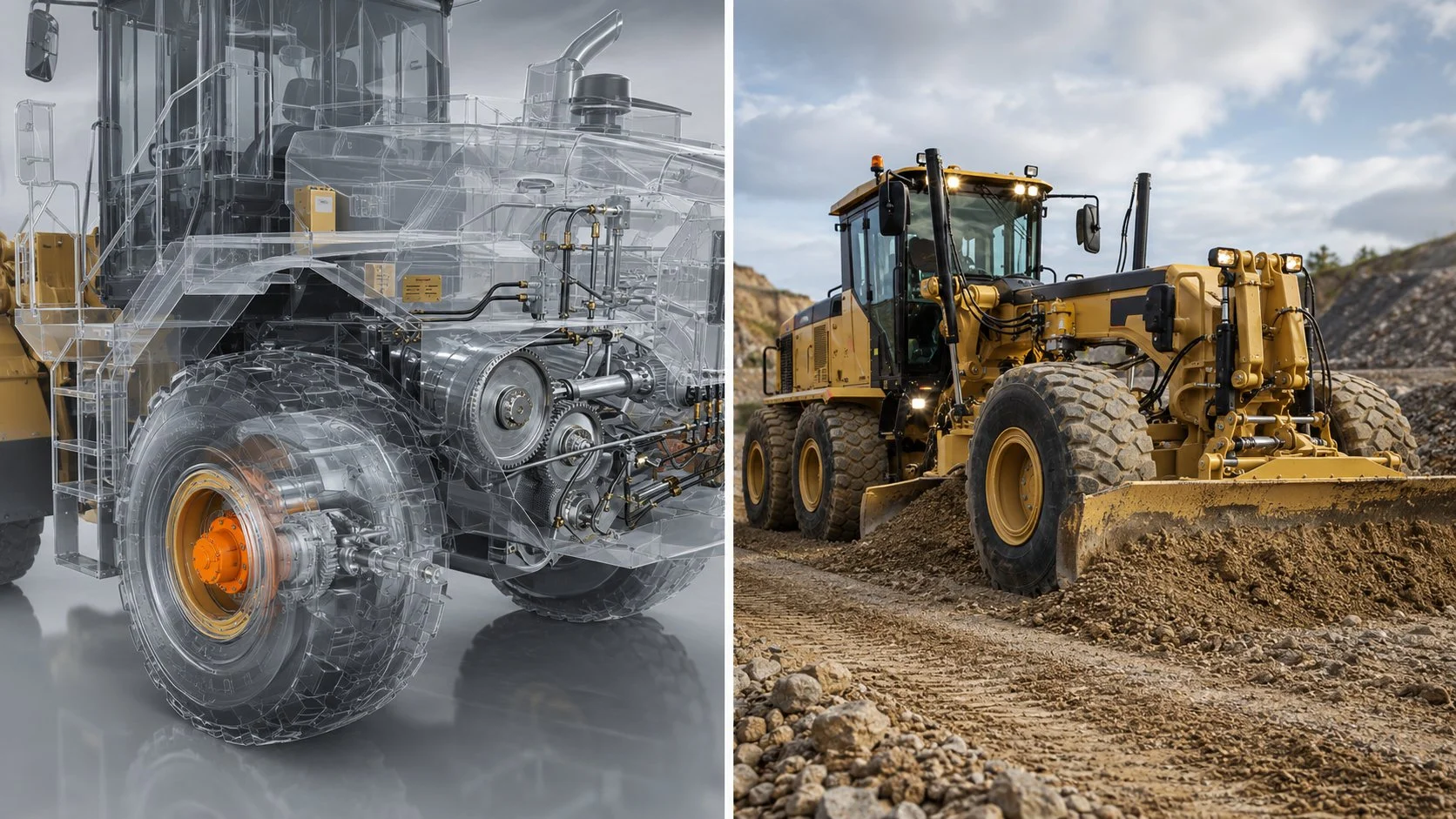
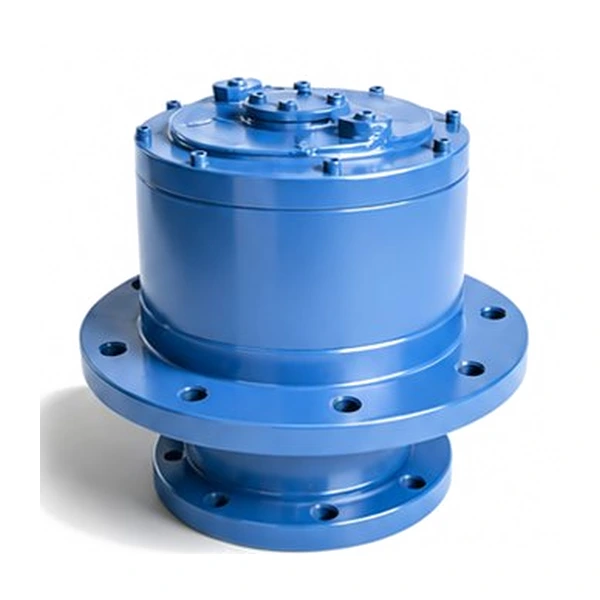
The low-profile requirement constrains the wheel drive radial dimension more severely than any surface application. A surface wheel loader can use a 400 to 500 mm diameter wheel drive housing — because the machine height is not constrained. An LHD in a 4.0-metre heading may have only 250 to 350 mm of vertical clearance for the wheel drive housing between the axle centreline and the tunnel floor — because the machine chassis is designed as low as possible to maximise the bucket volume within the tunnel height. This compact radial envelope requires a higher-ratio planetary gearbox (more stages in less diameter) — using 3 to 4 planetary stages instead of the 2 to 3 stages typical on surface machines.
The compact design also reduces the available bearing size — which is problematic given the high impact loading from muck-floor driving. A bearing that fits within a 300 mm housing diameter has less dynamic load capacity than the same bearing type in a 450 mm housing — and the LHD impact loading (3 to 8 g per rock-fragment crossing, 200 to 500 crossings per trip) is at least as severe as on a surface loader. The bearing specification for an LHD wheel drive must therefore use higher-grade bearing materials (vacuum-degassed steel, ceramic hybrid elements) to achieve the required load capacity within the constrained envelope — a specification approach that adds 30 to 50% to the bearing cost but is the only way to fit the required life into the available space.
Autonomous and Tele-Remote Operation — The Wheel Drive Without an Operator
Underground LHDs are increasingly operated autonomously or by tele-remote control — with no human operator on the machine. Autonomous LHDs navigate the tunnel using laser scanners (LiDAR), GPS-like underground positioning systems (based on radio beacons or ultra-wideband transponders), and pre-programmed route maps. The wheel drive receives speed and direction commands from the autonomous navigation system — and must respond with the same precision and smoothness as a human-operated drive, but without the operator feedback that compensates for torque pulsation, wheel slip, and traction variation.
The autonomous system demands three capabilities from the penggerak roda gigi planet that are less critical on human-operated machines: (1) precise speed feedback — the autonomous system must know the actual wheel speed to within ±0.5% to maintain its position calculation, requiring a high-resolution speed sensor integrated into or adjacent to the gearbox output; (2) deterministic torque response — the drive must produce the commanded torque within ±3% and within 0.3 seconds of the command, without the unpredictable cogging, dead-band, or response-lag variations that a human operator would compensate for unconsciously; and (3) diagnostic self-monitoring — the gearbox must provide temperature, vibration, and oil-quality data to the autonomous system so that maintenance can be scheduled proactively rather than reactively (since no operator is present to notice unusual noises, vibrations, or oil leaks).
The economic case for autonomous LHDs is driven by two factors: safety (removing humans from the most dangerous part of the mine — the active production area where rockfalls, blasting gases, and vehicle collisions cause fatalities) and productivity (autonomous LHDs can operate during re-entry exclusion periods after blasting, when humans are not permitted in the area — adding 2 to 4 hours of productive time per blast cycle). The wheel drive reliability directly determines the autonomous productivity gain — because a wheel drive failure on an autonomous LHD stops production until a maintenance crew can reach the machine underground (typically 30 to 90 minutes), with no option for the operator to nurse the machine to a safe location for repair.
Three Failure Modes Specific to LHD Wheel Drives
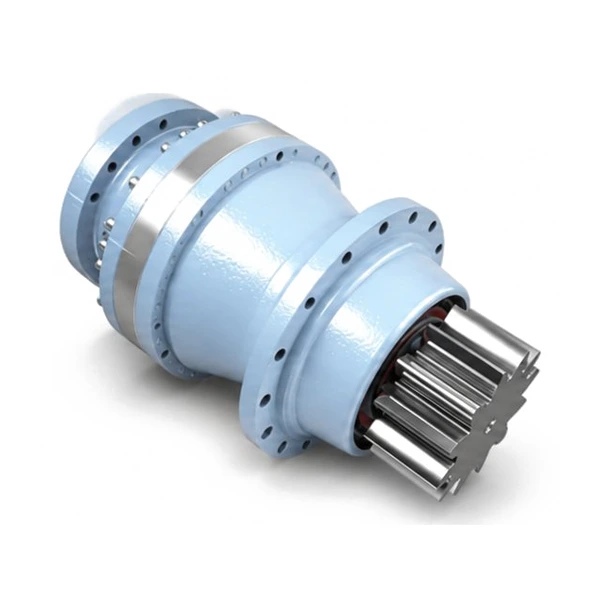
The LHD drives 90 km per shift on blasted-rock floors — accumulating 630 km per week and 30,000+ km per year of bearing rotation under impact loading. This distance-based fatigue loading exceeds every surface application: a surface loader at 400 V-cycles per shift and 30-metre cycle covers only 12 km per shift (84 km per week). The LHD bearing accumulates 7.5 times more revolutions per week — at higher impact amplitude (muck floor versus graded quarry floor). The output bearing must be sized for the cumulative revolution count at the muck-floor dynamic load — not for the torque-based L10 life that is adequate for surface loaders.
The LHD V-cycle reversal count (1.2 to 2.0 million per year) is comparable to surface loaders — but the underground environment adds thermal stress (oil temperature 20 to 35 degrees C higher than surface from reduced ventilation) and corrosive stress (acid mine-water contamination that weakens the gear tooth surface through micro-pitting corrosion). The combined effect of reversal fatigue, elevated temperature, and corrosive oil contamination reduces the gear tooth life to 60 to 75% of the surface-loader equivalent — meaning gears that last 10,000 hours on a surface loader may last only 6,000 to 7,500 hours on an underground LHD in acid-water conditions.
On autonomous LHDs, the wheel-speed sensor integrated into the gearbox provides the primary speed feedback for the navigation system. Rock dust and mine water that accumulate on the sensor face reduce the signal strength and introduce measurement errors of 2 to 5% — sufficient to cause the autonomous system to miscalculate its position by 0.5 to 2 metres over a 300-metre haul trip. This positioning drift can cause the LHD to collide with the tunnel wall, miss the ore-pass opening, or enter a restricted zone — triggering a safety shutdown that stops production until the sensor is cleaned and the system is recalibrated. A contaminated speed sensor that produces a 5% error on a 300-cycle shift generates 300 position corrections — each adding 5 to 10 seconds of correction time and reducing the shift productivity by 5 to 10%.
Pertanyaan yang Sering Diajukan
Korea Ever-Power provides LHD wheel drives from 10,000 to 60,000 Nm with compact underground packaging, mine-grade sealing, and autonomous-operation compatibility.
Editor: Cxm