410W3 Winch Drive Planetary Gearbox Reducer
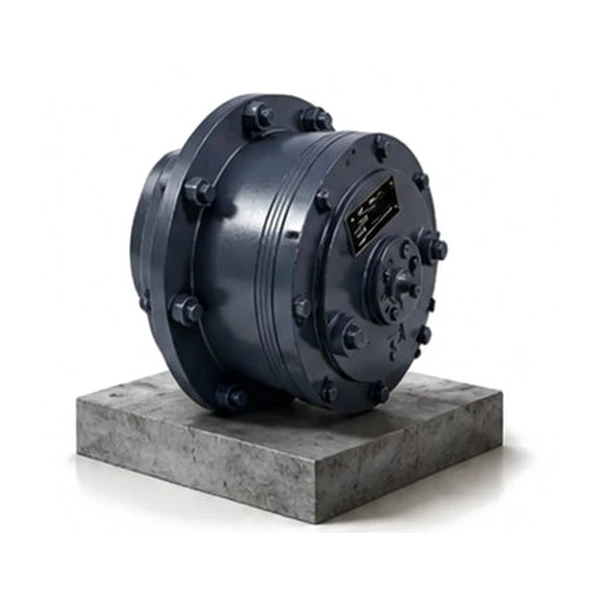
37,500 Nm
Where two motors meet one drum.
The EP-410W3 is the first model in the winch drive planetary gearbox catalogue where the data sheet lists a dual-motor input configuration as the primary architecture rather than a single-motor option. At 37,500 Nm through ratio 100, the motor input torque is 375 Nm — requiring approximately 675 cc/rev from a single motor at 350 bar, which exceeds the practical limit of most axial piston motor catalogues. Two motors at 338 cc/rev each, sharing the input through a Y-adapter, bring the individual motor size back into standard catalogue territory while doubling the available input power for faster hoisting speeds.
The ratio range extends to 177 — the highest maximum in the 4xxW series to this point — serving applications where the drum must turn extremely slowly. At ratio 177 with a 2,000 rpm motor, the drum output is 11.3 rpm. On a 600 mm PCD drum, this produces a line speed of 21.3 m/min — a controlled crawl for deploying heavy subsea equipment through the splash zone or lowering a mine cage through a 500-metre shaft.
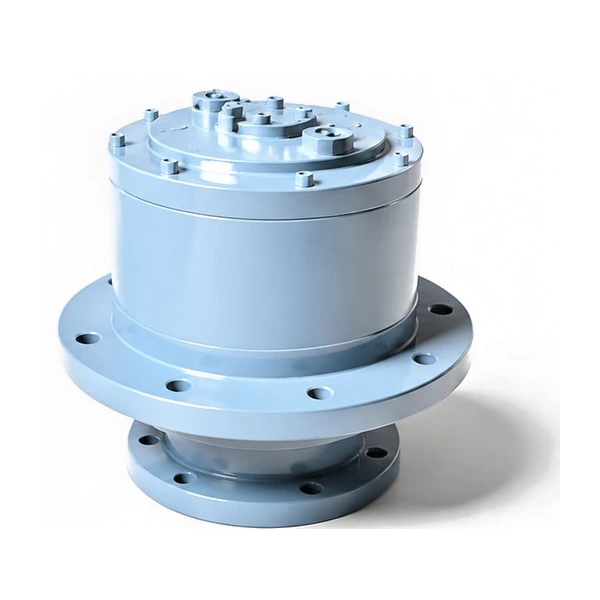
410W3 Winch Drive Planetary Gearbox — Technical Parameters
| 额定输出扭矩 | 37,500 Nm |
| Gear ratio range | 62 to 177 (three-stage planetary) |
| Maximum input speed | 3,500 rpm |
| Maximum output speed | 25 rpm (FEM M5 continuous duty) |
| Mechanical efficiency | ≥ 95% |
| 驻车制动器 | 530 Nm, multi-disc, spring-applied, hydraulic release |
| Brake at drum (ratio-dependent) | 32,860 Nm (r=62) to 93,810 Nm (r=177) |
| Mounting | Rotating housing flanges |
| Dry weight | Approx. 390 kg |
| 润滑 | Oil bath splash, EP gear oil |
| 工作温度 | -20 to +85 deg C |
Dual-Motor Winch Architecture — How Two Motors Drive One Drum Through the 410W3
At 37,500 Nm, the single motor input torque exceeds standard motor frames at most ratios. The solution is not a bigger motor — it is two standard motors sharing the mechanical input through a Y-adapter gearbox or a dual-spline input shaft.
Y-Adapter Configuration
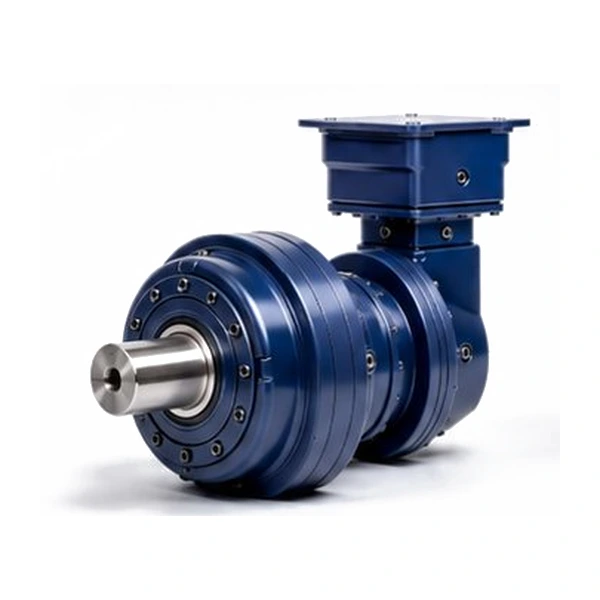
A Y-adapter gearbox mounts between two motors and the 410W3 input shaft, combining the torque from both motors onto a single output spline. Each motor contributes half the required input torque. At ratio 100: each motor provides 188 Nm instead of 375 Nm, requiring approximately 338 cc/rev each at 350 bar — comfortably within standard variable-displacement motor frames (Rexroth A6VM355, Parker V14-160, Eaton 420 series). The Y-adapter adds approximately 15-25 kg and 100-150 mm of axial length to the motor-gearbox assembly.
Torque Synchronisation
Both motors are fed from the same hydraulic supply line, so they operate at identical pressure. If the motor displacements are matched (both set to the same cc/rev), both produce equal torque and share the load evenly. If one motor is set to a slightly different displacement (for example, during controlled lowering where one motor acts as a brake), the torque split becomes asymmetric — the 410W3 input shaft and the Y-adapter must be rated for the full torque in case one motor carries the entire load momentarily during transients.
Redundancy Benefit
If one motor fails (seized shaft, internal leakage, hose burst), the remaining motor can still drive the 410W3 at half torque and half speed — enough to complete a critical lift or lower a suspended load safely rather than relying solely on the parking brake. This inherent redundancy is a significant safety advantage for offshore and mining applications where a winch failure with a suspended load creates an emergency. Some classification societies recognise dual-motor configurations as a form of hoist drive redundancy, simplifying the approval of cranes for over-water personnel transfer.
Speed Range Expansion
Two variable-displacement motors provide twice the flow capacity of a single motor at the same system pressure. At low speed (both motors at maximum displacement), the winch delivers maximum torque. At high speed (both motors de-stroked to minimum displacement), the winch hoists light loads at double the line speed achievable with a single motor. This variable-speed range — from creep to fast — is managed entirely by the motor controller without any mechanical speed change in the gearbox. Contact 韩国永力 for dual-motor integration drawings and the recommended Y-adapter specifications.
Ratio 177 — Where 500-Metre Shaft Depths Dictate the Drum Speed
The 410W3 ratio range extends to 177 — 30% higher than the 407W3 maximum of 136. This additional reduction serves a specific class of applications where the cable length is hundreds of metres and the winch must maintain precise speed control over the entire descent.
Deep Mining Shaft Winders
Mine shaft service winders lowering cages, skips, and equipment to working levels at 300-700 metres depth. At ratio 177 on a 700 mm PCD drum with dual motors at 2,500 rpm: drum output = 14.1 rpm, line speed = 31 m/min. A 500-metre descent takes approximately 16 minutes at this speed. The high ratio ensures the motors operate at efficient mid-range speed (2,000-3,000 rpm) throughout the descent rather than crawling at low speed where motor efficiency and controllability degrade. The 530 Nm brake holds 93,810 Nm at the drum — sufficient for the combined weight of the cage, payload, and 500 metres of wire rope.
Subsea Construction Vessel A&R Winches
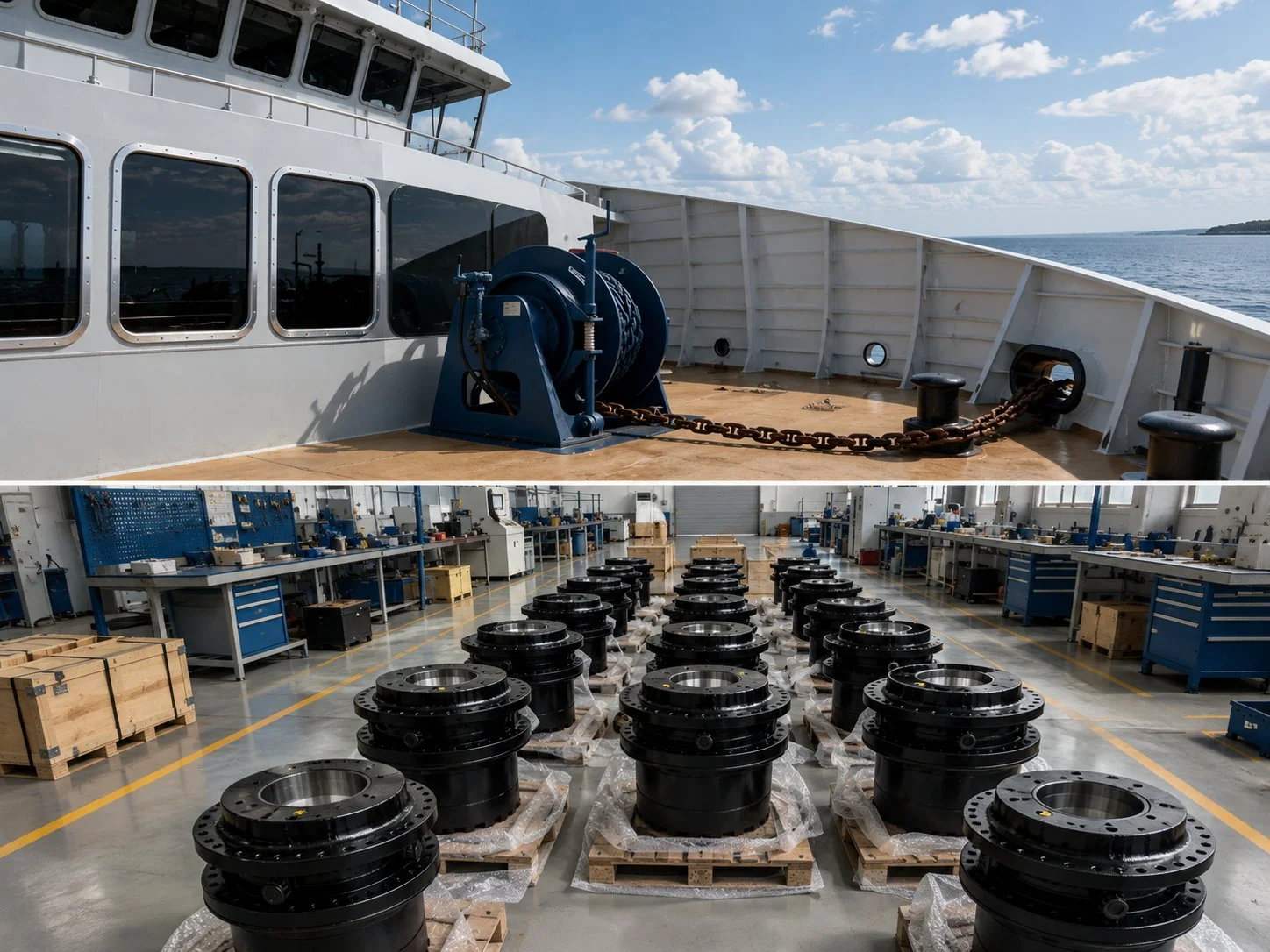
Abandonment and recovery (A&R) winches on pipe-lay and subsea construction vessels handling umbilicals, risers, and flowlines at water depths of 200-500 metres. The combined weight of the product and the cable at these depths produces drum torques approaching the 410W3 capacity. At ratio 150-177, the controlled deployment speed (5-15 m/min) protects the product from shock loading at the seabed touchdown — while the slewing drive positions the overboard chute and the track drive handles the vessel anchor winch crawlers.
37,500 Nm — The Dual-Motor Winch Drive for Extreme Lifting and Deep Deployment

Large Floating and Sheerleg Cranes (30-60 t SWL)
Floating cranes, sheerleg cranes, and heavy-lift barges positioning bridge sections, lock gates, and offshore platform topsides. The 410W3 at ratio 80-120 with dual motors provides the torque for 30-60 tonne lifts and the redundancy that marine classification societies require for over-water heavy lifting. The dual-motor architecture means the crane can complete a lift with one motor failed — a capability that single-motor systems at the 407W3 level cannot provide.
Offshore Construction Vessel Cranes
Main hoist mechanisms on dedicated offshore construction vessels (DSVs, pipe-lay vessels, heavy-lift vessels) handling subsea trees, manifolds, and umbilical termination assemblies at water depths requiring 200-500 metres of wire rope on the drum. The combined rope weight and payload weight at these depths pushes the drum torque into the 30,000-37,500 Nm range. The 410W3 provides the torque, the 530 Nm brake provides the holding capacity, and the ratio 150-177 provides the controlled deployment speed through the critical splash zone.
Deep Mining Shaft Winders and Skip Hoists
Mine shaft winders handling personnel cages (500-1,500 kg payload), skip hoists (5-15 tonne ore skips), and equipment lowering at shaft depths of 300-700 metres. Mine safety authorities in most jurisdictions require the winder brake to hold the cage plus the full cable weight at the deepest point — a combined load that can exceed 30 tonnes when 500+ metres of heavy-gauge rope is factored in. The 410W3 at ratio 150-177 provides both the controlled hoisting speed and the brake holding torque that deep-shaft winding demands.
The Ultra-Heavy Winch Drive Tier
Winch Drive Planetary Gearbox — Dual-Motor Heavy Hoist FAQ
Field Reports
50 t sheerleg crane, main hoist, 410W3 at ratio 100, dual 350 cc/rev motors. The crane positioned a 48-tonne steel bridge section to within 8 mm during the most recent installation. During the lift, one motor developed a minor case drain leak — the control system detected the flow anomaly, alerted the operator, and the lift was completed on both motors before the leak became critical. After the section was in place, we isolated the leaking motor and lowered the hook on the remaining motor at half speed. This is exactly the redundancy we specified the dual-motor system to provide — and it delivered. The motor was replaced the following day; the gearbox required no attention.
A&R winch on a subsea construction vessel, 410W3 at ratio 165, deploying a 15-tonne subsea manifold to 350 metres water depth. Total cable weight at maximum depth: approximately 1,800 kg. The controlled descent at 8 m/min through the splash zone was smooth — the AHC system compensated for 2.5-metre vessel heave and the 410W3 transmitted the rapid speed reversals without any audible stress or vibration anomaly. The brake held the manifold at 350 metres for 45 minutes during the ROV survey before final landing. After 14 months including 8 major subsea deployment campaigns, the gearbox oil analysis is clean and the brake test is within 2% of factory acceptance values.
Personnel cage winder for a 480-metre deep platinum mine shaft, 410W3 at ratio 170, dual motors. The cage carries 12 workers plus the cage weight totalling 2,800 kg. With 480 metres of 32 mm rope at 5.2 kg/m: cable weight = 2,496 kg. Total suspended load at full depth = 5,296 kg. Brake SF at drum = 93,810 / (5,296 x 9.81 x 0.3) = 6.0 — well above the mine safety authority minimum of 3.0 for personnel winding. The 4-star is a commissioning observation: the Y-adapter alignment between the two motors required shimming on site because the adapter mounting face was not perfectly parallel to the motor flanges. Pre-aligning the Y-adapter to the 410W3 input at the factory before shipping would have saved 2 days of commissioning time. The winder itself has been faultless through 9 months of 3-shift daily operation.
其他信息
| 编辑 | CXM |
|---|
相关产品
-

416W3 Winch Drive Planetary Gearbox Reducer
-
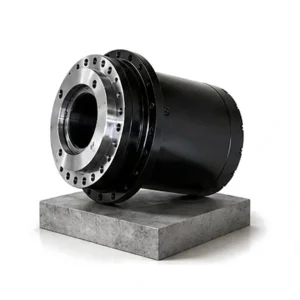
414W3 Winch Drive Planetary Gearbox Reducer
-
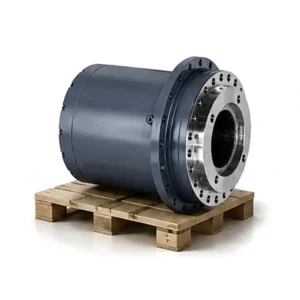
413W3 Winch Drive Planetary Gearbox Reducer
-
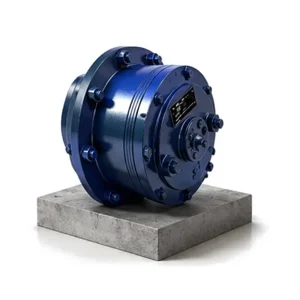
407W3 Winch Drive Planetary Gearbox Reducer
-
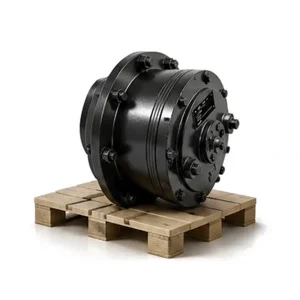
407AW Winch Drive Planetary Gearbox Reducer
-
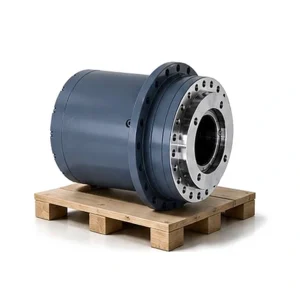
406W Winch Drive Planetary Gearbox Reducer
-

405.4W Winch Drive Planetary Gearbox Reducer
-
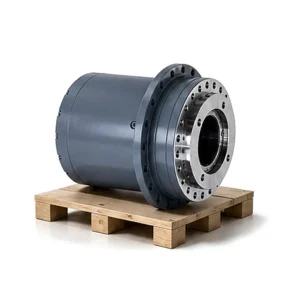
402W2 Winch Drive Planetary Gearbox Reducer