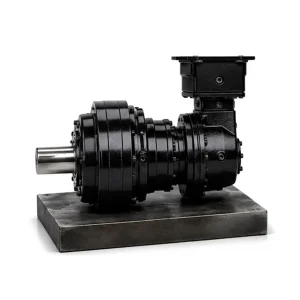
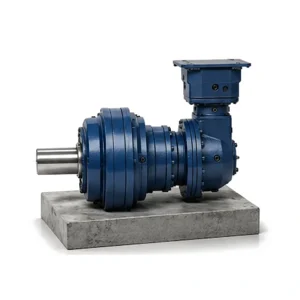
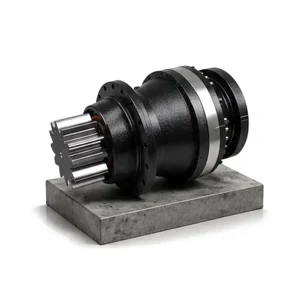
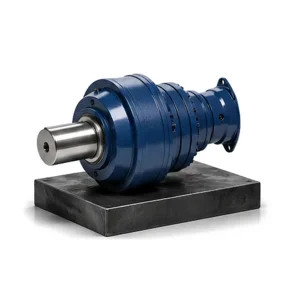
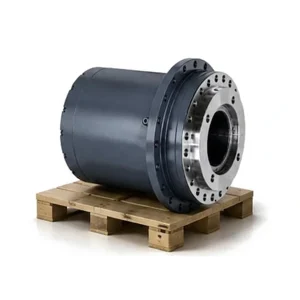
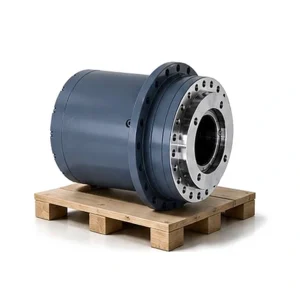
416W3 绞车驱动行星齿轮箱减速器

200,000 牛米
540,000 Nm at the drum. Nearly two tonnes of gearbox.
The EP-416W3 is the first winch drive planetary gearbox in the catalogue to publish a four-digit brake torque rating. The 1,800 Nm multi-disc brake is not an incremental step from the 415W3 — it is a redesigned brake architecture sized for the loads that 200,000 Nm of drum torque implies: mine cages descending through kilometre-deep shafts, 300-tonne anchor assemblies deployed to 2,000-metre seabed depths, and semi-submersible drilling rigs held in position against ocean currents and storm forces that would drag a conventional mooring winch off its bollard. The 10 rpm maximum output speed — the slowest in the catalogue — reflects the thermal reality of sustaining 200,000 Nm at FEM M6 continuous duty within a housing that dissipates heat only through oil-bath convection and the rotating housing surface.
416W3 Winch Drive Planetary Gearbox — Technical Parameters
| 额定输出扭矩 | 200,000 牛米 |
| Gear ratio range | 80 to 300 (three-stage planetary) |
| Maximum input speed | 2,500 rpm |
| Maximum output speed | 10 rpm (FEM M6, catalogue lowest) |
| Mechanical efficiency | ≥ 94% |
| 驻车制动器 | 1,800 Nm, multi-disc, spring-applied, hydraulic release |
| Brake at drum (max ratio 300) | 540,000 Nm |
| 安装 | Heavy-duty rotating housing flanges |
| 干重 | Approx. 1,850 kg |
| 润滑 | Oil bath splash, premium EP gear oil |
| 工作温度 | -25 to +85 deg C |
1,800 Nm — What Half a Million Nm of Drum Holding Torque Means in Practice
Numbers this large lose their intuitive meaning without context. The 1,800 Nm brake through ratio 300 produces 540,000 Nm at the cable drum. Here is what that holds.
| Scenario | Drum PCD | 比率 | Drum Hold (Nm) | Max Hold (t) @ SF=2.0 |
|---|---|---|---|---|
| AHTS anchor chain | 800 mm | 200 | 360,000 | 91.7 t |
| Deep mine skip + 1km rope | 700 mm | 250 | 450,000 | 130.8 t |
| Semi-sub mooring line | 600 mm | 300 | 540,000 | 183.5 t |
The 400W1 — the smallest winch drive in the catalogue — produces 792 Nm of brake holding torque at its drum. The 416W3 at ratio 300 produces 540,000 Nm. That is a 682:1 ratio between the smallest and this model. The entire 4xxW catalogue spans nearly three orders of magnitude in brake holding capacity — from a personnel hoist holding two people to a mooring system holding a drilling rig in a storm.
10 RPM Maximum Output — Why the Catalogue Slows Down as Torque Climbs
The maximum output speed has progressively decreased through the catalogue: 25 rpm (400-413 series), 12 rpm (414-415), and now 10 rpm (416). This is not arbitrary conservatism — it is the thermal limit of the housing.
Power = torque x speed. At 200,000 Nm and 10 rpm: P = 200,000 x 10 x 2 x 3.14 / 60 = 209 kW. At 94% efficiency, the gearbox dissipates 12.6 kW as heat. If the output speed were 25 rpm (like the smaller models): P = 524 kW, heat = 31.4 kW. The oil-bath cooling capacity of the 416W3 housing is approximately 15-18 kW at +85 deg C oil temperature in still air. At 10 rpm, the thermal balance holds. At 25 rpm, it does not.
The output bearings carry 200,000 Nm of torque as a radial load. Bearing L10 life is inversely proportional to speed — doubling the output speed halves the bearing life at the same load. The 10 rpm limit ensures the output bearings achieve the FEM M6 design target of 30,000+ hours at continuous rated torque. At 25 rpm, the L10 life would drop to approximately 12,000 hours — below the M6 requirement and unacceptable for production mining winders.
On an 800 mm PCD drum: 10 rpm = 25.1 m/min. On a 600 mm PCD drum: 10 rpm = 18.8 m/min. These speeds are within the operational range of deep mining winders (15-30 m/min) and AHTS anchor handling (5-20 m/min). The 10 rpm limit does not restrict the practical applications — it aligns the gearbox output with the actual speed range the machines operate in. No 200,000 Nm winch application needs 25 rpm at the drum.
200,000 Nm — The Wire-Rope Hoisting Frontier

Ultra-Deep Mining Main Winders (800-1,500 m)
Main production winders at the deepest operating mines — South African gold and platinum mines at 1,000-1,500 metre depths, and Canadian nickel mines at 800-1,200 metres. The combined skip, ore, and rope weight at these depths reaches 80-120 tonnes. The 416W3 at ratio 200-300 provides the drum torque, and the 1,800 Nm brake holds the loaded skip at any point in the shaft with a safety factor exceeding 2.5 even at the deepest point where the rope weight is maximum.
Large AHTS Main Winches (300+ t Bollard Pull)
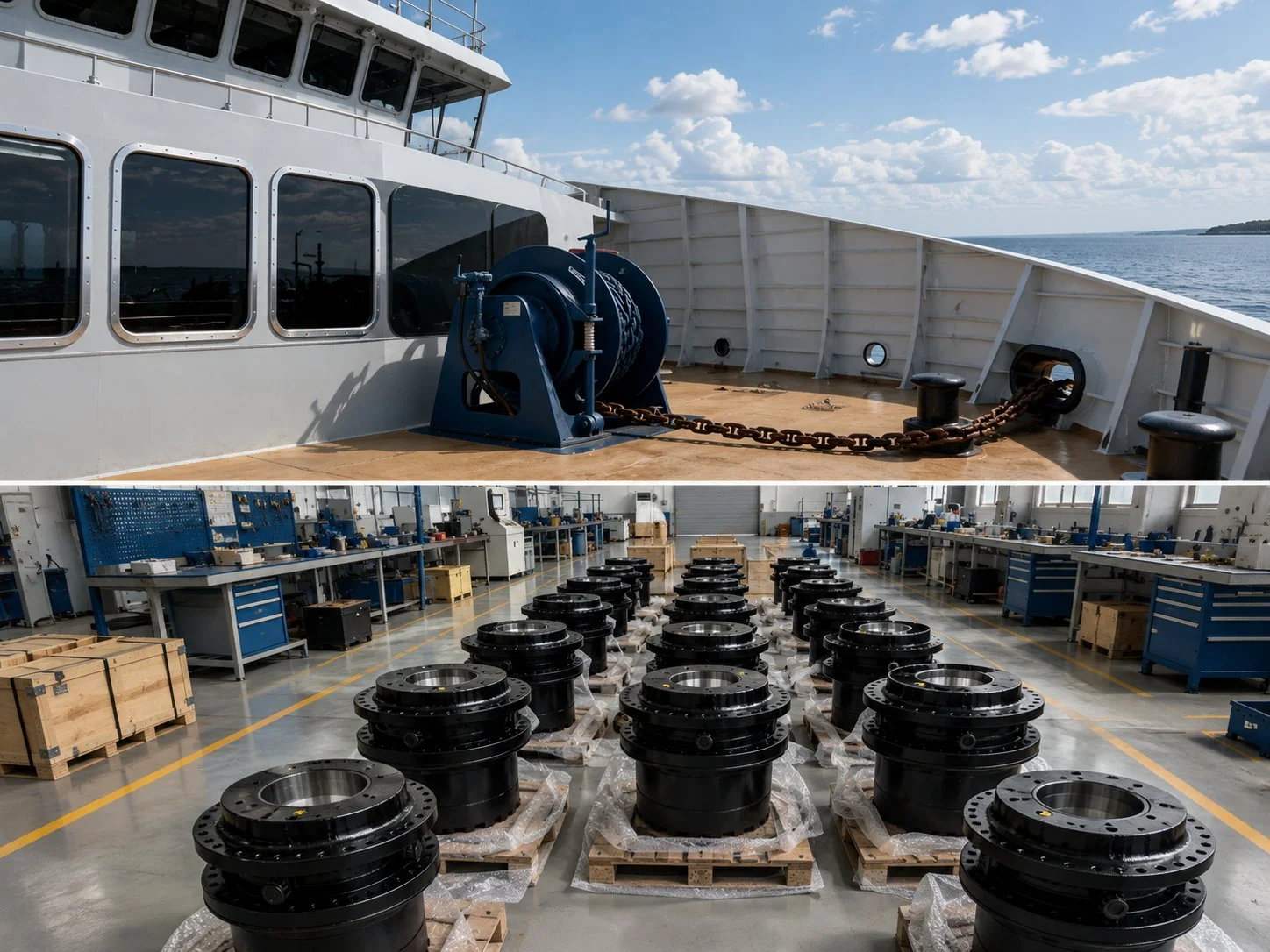
Main anchor handling winches on the largest class of AHTS vessels, deploying and recovering anchor chain assemblies weighing 150-250 tonnes from water depths of 1,000-2,500 metres. The 416W3 at ratio 150-250 with triple or quadruple electric motor drives provides the sustained line pull for deep-water anchor deployment, and the 1,800 Nm brake holds the chain at any depth during operational pauses. The slewing drive positions the stern roller and the auxiliary drives operate the tugger winches and chain stoppers.
Semi-Submersible Mooring Winches
Mooring winches on semi-submersible drilling rigs and floating production platforms maintaining station against ocean currents, wind, and wave forces. Each mooring leg may carry 100-200 tonnes of line tension during storm conditions. The 416W3 provides the torque to pay out or haul in wire rope under these tensions, and the 1,800 Nm brake holds the mooring line at constant tension during station-keeping — a function that may last weeks or months continuously. The track drive handles the anchor chain windlass on the same platform.
The Final Tier — 200,000 Nm and Beyond

Winch Drive Planetary Gearbox — 200,000 Nm Class FAQ
Field Reports
Main production winder at a 1,200-metre gold mine. 416W3 at ratio 280, dual 750 kW AC motors with VFD. The skip carries 22 tonnes of ore at 350 cycles per day through a shaft where the 1,200-metre rope weighs 7,200 kg. The 1,800 Nm brake at ratio 280 produces 504,000 Nm at the drum — holding the loaded skip plus rope at SF = 2.9 at the deepest point. After 10 months of production duty (approximately 5,400 hours), the brake holding test shows 0.8% degradation from factory — well within the 5% threshold for our next DMR inspection. The previous winder (different supplier, 160,000 Nm class) was showing 4.2% brake degradation at the same service hours. The 416W3 is operating in a different reliability league.
350 t bollard pull AHTS, main anchor handling winch, 416W3 at ratio 200, quad 400 kW electric motors. The vessel completed 14 deep-water anchor deployments in the Gulf of Mexico during the first 8 months of operation — the deepest at 1,800 metres. The 1,800 Nm brake held the 180-tonne chain assembly at 1,800 metres for 6 hours during a weather standby without any drift on the chain counter. Oil temperature peaked at 71 deg C during the heaviest retrieval operation (15 m/min at 85% rated torque for 45 continuous minutes). The external oil cooler maintained stable temperatures throughout. ABS class survey passed without findings.
Semi-submersible drilling rig, 8-point mooring system, one 416W3 per mooring leg at ratio 250. The winches maintain constant mooring tension during drilling operations — each leg carries 80-150 tonnes depending on current and weather conditions. The 416W3 has operated continuously for 7 months with periodic tension adjustments and one full mooring line recovery for inspection. The 4-star is a maintenance observation: the 1,850 kg unit weight means that the annual brake inspection requires the rig crane to lift the drum assembly — a 12-hour operation that occupies the main deck crane and blocks cargo operations for an entire day. If the brake could be inspected through an access port in the drum housing without removing the complete unit, the annual inspection downtime would drop from 12 hours to approximately 3 hours per mooring winch. For an 8-winch rig, this is 72 hours of saved crane time per year.
其他信息
| 编辑 | CXM |
|---|