The Chain Reaction Force — The Load Case Unique to Trencher Track Drives
A trenching chain is a continuous loop of cutting teeth mounted on a boom that extends downward into the ground. The chain rotates at 1 to 3 m/s, and each tooth shears a chip of soil or rock from the trench face. By Newtonian mechanics, the cutting force that the teeth exert on the ground produces an equal and opposite reaction force on the machine — directed backward, opposing the direction of travel.
El Caja de cambios planetaria de transmisión por orugas must push the machine forward against this reaction force at a controlled, constant speed. The reaction force is not constant — it fluctuates as each tooth engages and exits the cutting face, and it spikes dramatically when a tooth strikes hard rock, a boulder, or a buried utility. The track drive must absorb these fluctuations without changing the forward feed rate.
The chain teeth cut upward (away from the trench bottom, toward the surface). The horizontal component of the cutting force pushes backward against the machine frame. On a large pipeline trencher cutting rock at 1.5 m depth, the total chain reaction force can reach 80,000 to 150,000 N — comparable to the drawbar pull of a D7-class bulldozer. But unlike a bulldozer (which pushes a defined material volume), the trencher reaction force fluctuates by ±30 to 50% from tooth to tooth as the material hardness varies across the trench face.
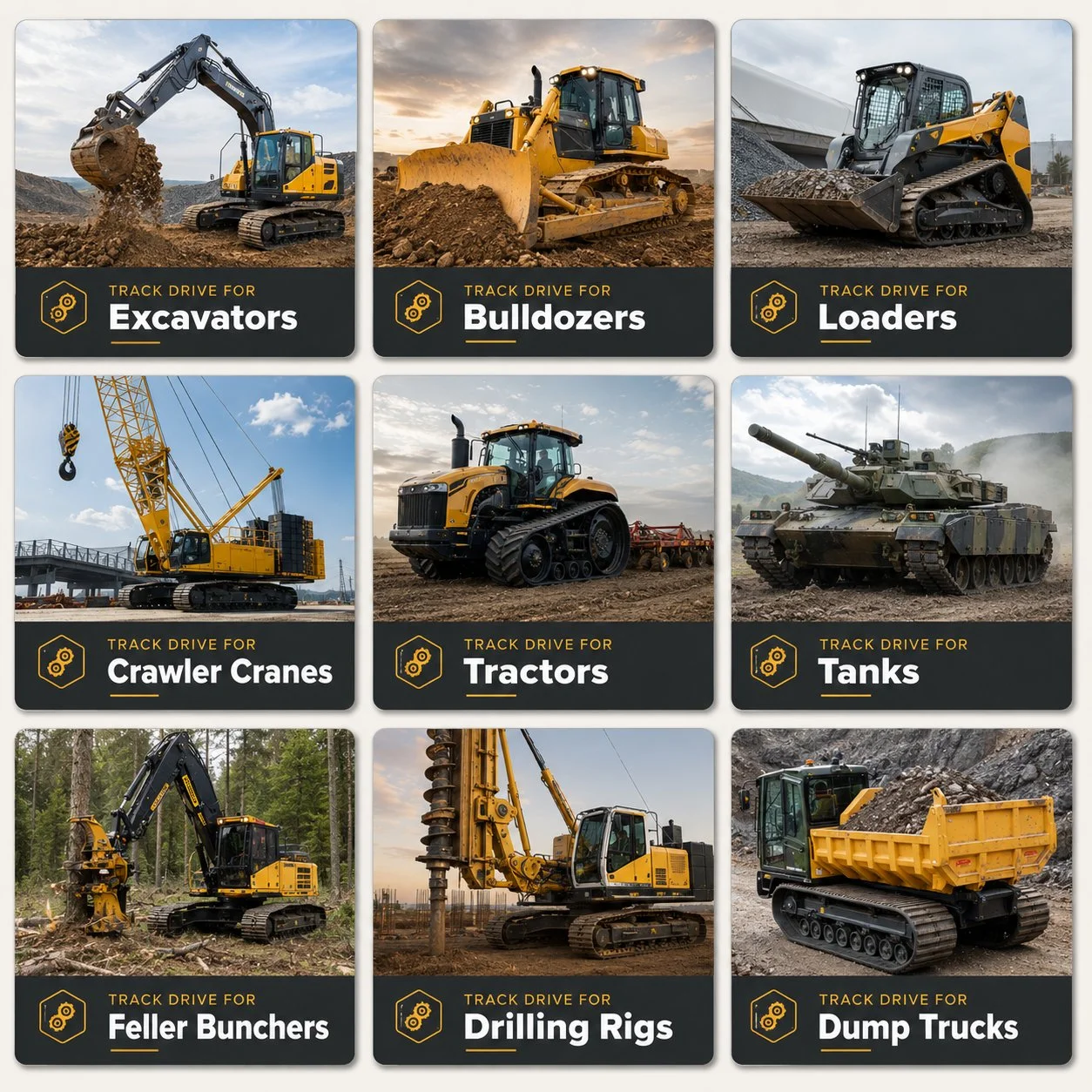
The track drive pushes forward while the cutting chain pushes backward — the final drive resolves the force balance at a controlled feed rate.
Rock vs Soil — Two Fundamentally Different Track Drive Duty Cycles
The difference between trenching soil and trenching rock is not merely a matter of degree — it changes the character of the track drive loading entirely. Soil trenching produces moderate, relatively steady reaction forces. Rock trenching produces high, violently fluctuating reaction forces with impact spikes that can reach 3 times the average.
| Parámetro | Soil Trenching (Clay/Sand) | Rock Trenching (Limestone/Sandstone) |
|---|---|---|
| Typical machine weight | 5 – 25 t | 30 – 65 t |
| Trench depth | 0.3 – 2.0 m | 0.5 – 3.0 m |
| Feed rate | 3 – 15 m/min | 0.3 – 3 m/min |
| Chain reaction force | 15,000 – 50,000 N | 80,000 – 200,000 N |
| Force fluctuation | ±10 – 20% | ±30 – 50% |
| Impact spike (boulder/utility) | 1.5x average | 2.5 – 3x average |
| Track drive torque per track | 8,000 – 25,000 Nm | 40,000 – 100,000 Nm |
| SF recomendado | 1.5 | 2.0 – 2.5 |
Why rock trenching SF is 2.0 to 2.5 — higher than any excavator or bulldozer: The ±50% force fluctuation from tooth-to-tooth material variation means the peak instantaneous torque regularly reaches 150% of the average. On top of this, impact spikes from boulders or hard inclusions add a further 2.5 to 3x multiplier. The combination produces a peak-to-average torque ratio of 3.7 to 4.5x in rock — the highest of any sustained-duty track drive application. The SF of 2.0 to 2.5 covers the statistical distribution of these peaks to ensure the gearbox survives the worst rock conditions for the full service life.
Feed Rate Consistency — Why the Track Drive Determines Trench Quality
A pipeline trench has three critical dimensions: depth (set by the boom position), width (set by the chain width plus the forward feed rate), and wall angle (set by the interaction between chain speed and forward feed rate). The track drive controls the forward feed rate — and therefore directly controls the trench width and wall quality.
If the track drive pushes the machine forward faster than the chain can clear material, the chain teeth are forced to cut a wider arc — producing a trench wider than the chain width. An overwidth trench requires more bedding material, more backfill, and more compaction — adding cost to every metre of pipeline installed.
If the track drive cannot maintain the target feed rate against the chain reaction force (stalling or slowing under peak loads), the chain recirculates through already-cut material — wasting energy, overheating the teeth, and polishing the trench walls smooth. Polished walls in clay soils lose their roughness-dependent friction bond with the backfill, reducing pipe support quality.
If the track drive speed fluctuates with chain reaction force variations — speeding up in soft zones and slowing in hard zones — the boom-to-ground distance changes with the forward pitch of the machine. The result is a wavy trench bottom that fails the pipeline grade tolerance (typically ±25 mm over any 3-metre span). The pipeline cannot follow the waves, and shimming or re-grading is required — at 10 to 20 times the cost per metre of doing it right the first time.
Trenching Torque Calculation — Sizing the Track Drive for a Rock Pipeline Trencher
Notice that the chain reaction force contributes 71% of the total track drive torque requirement — far more than the rolling resistance (16%) or grade resistance (13%). This is the defining characteristic of trencher track drive sizing: the working tool reaction force, not the machine weight or terrain, governs the specification. A trencher on flat ground with zero rolling resistance still requires 71% of the track drive capacity just to overcome the chain reaction. Corea Ever-Power provides application engineering support to match the track drive specification to the specific chain power and cutting material for each trencher project.
Three Failure Modes Unique to Trencher Track Drives
The chain reaction force fluctuates by ±30 to 50% at tooth-engagement frequency — typically 5 to 15 Hz. This produces a 5 to 15 Hz torque oscillation at the track drive input that is transmitted directly through the sun gear spline. Unlike the single-event breakaway spike on a drill rig, this oscillation is continuous for the entire trenching run — potentially hours at a time. The spline root radius endures millions of high-frequency stress cycles per season, leading to fatigue crack initiation at the spline root. Once a crack propagates, the spline tooth fractures and the drive is lost.
The fluctuating chain reaction force produces a pulsating load on every planet gear tooth at the same 5 to 15 Hz frequency. Each tooth surface endures 18,000 to 54,000 stress cycles per hour of rock trenching. Over a 3,000-hour rock trenching career, the tooth surfaces accumulate 54 to 162 million contact stress cycles — a high-cycle fatigue load that exceeds the endurance limit of standard case-hardened 20CrMnTi gear steel if the contact stress is not kept within limits by adequate sizing (SF = 2.0+).
Rock trenching generates a continuous low-amplitude, high-frequency vibration that propagates through the machine frame to the track drive mounting bolts. The vibration frequency (5 to 15 Hz from chain teeth, plus higher harmonics from the chain roller engagement) keeps the mounting bolts in a continuous state of micro-movement that relaxes preload over hundreds of hours. If bolt preload falls below 80% of the specified torque, the track drive housing can shift on its mounting face — misaligning the sprocket and producing rapid track wear and potential track derailment.
Track Drive Planetary Gearbox for Trenchers — Frequently Asked Questions
Korea Ever-Power provides trencher track drive planetary gearboxes from 8,000 to 100,000 Nm for soil and rock trenching. High-cycle fatigue-rated gears, vibration-resistant mounting, and shot-peened spline interfaces for pipeline-grade trenching service. Provide your trencher model and cutting material for a specification recommendation.
Editor: Cxm