Le paramètre qui détermine la précision sous charge — et qui apparaît rarement dans les guides de sélection
Le jeu angulaire est la spécification de précision que tout sélectionneur de réducteurs connaît. Il s'agit de la zone morte angulaire lors de l'inversion du sens de rotation ; mesurable sans charge, il figure en évidence sur toutes les fiches techniques et constitue généralement le premier (et parfois le seul) critère de précision utilisé lors de la comparaison de réducteurs planétaires. La rigidité en torsion, désignée Ct et mesurée en N·m/arcmin, est le paramètre qui détermine la rotation élastique de l'arbre de sortie sous une charge appliquée. Elle apparaît dans moins d'un guide de sélection de réducteurs planétaires sur cinq et est totalement absente de la plupart des outils de dimensionnement spécifiques à une application.
Cela crée un angle mort systématique : les ingénieurs spécifient soigneusement le jeu, sélectionnent un modèle à faible jeu, puis constatent qu’à leur couple de fonctionnement réel, la déformation élastique due à la souplesse en torsion produit une erreur angulaire deux à quatre fois supérieure au jeu spécifié. Ces deux phénomènes sont totalement indépendants par leur origine ; ainsi, une boîte de vitesses avec un faible jeu peut présenter une faible rigidité en torsion, et inversement.
La zone morte angulaire entre l'entrée et la sortie lors de l'inversion du sens de rotation. Purement géométrique, elle est due au jeu entre les dents d'engrenage. Présente à charge nulle. Fixe une fois fabriqué (jusqu'à ce que l'usure l'augmente). Spécifié en minutes d'arc.
Se produit lorsque : la direction s'inverse
Cela dépend de la tolérance de fabrication.
Le « enroulement » élastique des dents d'engrenage, des arbres et du porte-satellites sous l'effet du couple appliqué. Proportionnel à la charge. Se produit à tout niveau de coupleDisparaît lorsque la charge est supprimée (comportement élastique). Augmente pour chaque N·m de couple appliqué au-delà de zéro.
Se produit à tout couple appliqué
Cela dépend de : la rigidité de la boîte de vitesses Ct
Dans les applications servo réelles, l'erreur de positionnement totale inclut simultanément les deux contributions. À faibles couples, le jeu mécanique est prédominant. À couples élevés — au-delà d'un point de croisement dépendant de Ct — la déformation élastique dépasse le jeu mécanique. devient la limite de précision principale.
= BL + T/Ct (arcmin)
Linéaire : E = R × tan(θ_total/60 × π/180)
Tableau complet de la rigidité en torsion de la série EP — Toutes tailles et séries de cadres
Les spécifications suivantes correspondent aux valeurs certifiées de rigidité torsionnelle pour tous les réducteurs planétaires de précision de la série Korea Ever-Power EP. La rigidité torsionnelle Ct est définie comme le couple de sortie nécessaire pour produire une déviation angulaire élastique d'une minute d'arc au niveau de l'arbre de sortie sous charge, l'arbre d'entrée étant fixe. Une valeur de Ct plus élevée signifie une déviation élastique moindre pour un même couple appliqué, et donc une meilleure précision de positionnement dynamique.
| Série | Cadre (mm) | Ct — 1 étape (N·m/arcmin) |
Ct — 2 étapes (N·m/arcmin) |
Couple maximal (N·m) |
Classe Ct |
|---|---|---|---|---|---|
| EP-ZDE / EP-ZDF | 40 mm | 0.7 | — | 6 | Usage léger |
| EP-ZDE / EP-ZDF | 60 mm | 1.8 | — | 16 | Standard |
| EP-ZDE / EP-ZDF | 80 mm | 4.5 | — | 50 | Standard |
| EP-ZDE / EP-ZDF | 120 mm | 12 | — | 110 | Modéré |
| EP-ZDE / EP-ZDF | 160 mm | 38 | — | 450 | Standard-Élevé ★ |
| EP-ZDWE / ZDWF | 60–160 mm | 1,5 – 38 | 2,5 – 43 | 16 – 450 | Identique à ZDE par image |
| EP-ZDS | 115 mm | 20 | 22 | 210 | Haut |
| EP-ZDS | 142 mm | 44 | 46 | 910 | Élevé (1,16× ZDE-160) |
| EP-ZDS | 190 mm | 130 | 140 | 1,800 | Le plus élevé (3,4 × ZDE-160) ★★ |
★ Le couple de torsion (Ct) de l'EP-ZDS-115 (20 N·m/arcmin) est inférieur à celui de l'EP-ZDE-160 (38 N·m/arcmin) car le ZDS-115 possède un bâti plus petit ; il convient donc de comparer les performances au sein d'une même catégorie de bâti, et non entre modèles différents. ★★ L'EP-ZDS-190 atteint un couple de torsion de 130 N·m/arcmin grâce à un arbre de sortie plus grand (Φ55h7 contre Φ40h7), un porte-satellites plus rigide et des roulements de sortie préchargés. Le couple de torsion d'un réducteur à deux étages est supérieur à celui d'un réducteur à un étage car l'ajout d'étages planétaires accroît la rigidité du porte-satellites dans la conception du ZDS.

Le point de basculement — où la déviation torsionnelle devient l'erreur dominante, dépassant ainsi le jeu axial
À faible couple, le jeu angulaire est la principale source d'erreur angulaire totale, car la déformation élastique est faible. Lorsque le couple appliqué augmente, la déformation élastique croît linéairement avec T/Ct, tandis que le jeu angulaire reste constant. Il existe un couple de transition au-delà duquel la déformation élastique devient la principale source d'erreur ; ce point de transition diffère considérablement entre les séries EP-ZDE et EP-ZDS.
C’est le calcul que la plupart des guides de sélection omettent totalement — et il change fondamentalement la façon dont la rigidité en torsion doit être pondérée dans le processus de spécification pour les applications à couple élevé.
Le couple de coupure de l'EP-ZDE-160 atteint 304 N·m, largement en deçà de sa plage nominale de 450 N·m. Sur la moitié supérieure de sa plage de couple (304–450 N·m), la déformation élastique est déjà supérieure au jeu. Réduire la spécification du jeu de 8 à 3 minutes d'arc dans cette plage de couple ne permet de gagner que 5 minutes d'arc de zone morte, alors que la déformation élastique à 380 N·m est de 10 minutes d'arc – une erreur qu'une réduction du jeu ne peut en aucun cas corriger. L'EP-ZDS-190 n'atteint son seuil de coupure qu'à 1 040 N·m – au-delà de sa plage nominale à un étage – le jeu reste donc la principale source d'erreur sur toute sa plage de fonctionnement. C'est pourquoi l'EP-ZDS offre une meilleure précision totale que l'EP-ZDE, même avec la même spécification de jeu (< 8 minutes d'arc).
| Couple appliqué | ZDE-160 Contrecoup (arcmin) |
ZDE-160 θ élastique (arcmin) |
ZDE-160 Total (arcmin) |
ZDS-190 θ élastique (arcmin) |
ZDS-190 Total (arcmin) |
Gain de précision |
|---|---|---|---|---|---|---|
| 50 N·m | 8.0 | 1.3 | 9.3 | 0.4 | 8.4 | 1,1 fois mieux |
| 100 N·m | 8.0 | 2.6 | 10.6 | 0.8 | 8.8 | 1,2 fois mieux |
| 200 N·m | 8.0 | 5.3 | 13.3 | 1.5 | 9.5 | 1,4 fois mieux |
| 304 N·m ← Crossover | 8.0 | 8.0 ← élastique = BL | 16.0 | 2.3 | 10.3 | 1,6 fois mieux |
| 380 N·m | 8.0 | 10.0 > BL | 18.0 | 2.9 | 10.9 | 1,7 fois mieux |
| 800 N·m | 8.0 | 21.1 | 29.1 | 6.2 | 14.2 | 2 fois mieux |
Les deux unités sont spécifiées pour un jeu inférieur à 8 minutes d'arc. Ct : ZDE-160 = 38 N·m/minute d'arc ; ZDS-190 = 130 N·m/minute d'arc. θ_élastique = T/Ct. Total = jeu + élastique. L'amélioration apportée par le ZDS-190 augmente avec le couple car Ct est le seul facteur de différenciation ; le jeu étant identique pour les deux unités.
De l'arcminute au millimètre — Erreur de positionnement dynamique au rayon de votre charge
Comme indiqué dans le guide sur le jeu, la conversion de l'erreur angulaire en erreur linéaire pour un rayon de charge donné est : E_linéaire = R × tan(θ/60 × π/180). Le tableau suivant applique cette conversion à la seule composante de déflexion élastique, illustrant l'erreur de positionnement dynamique de l'ordre du millimètre due à la souplesse en torsion pour quatre rayons de charge représentatifs. C'est cette erreur que des spécifications de jeu plus strictes ne peuvent corriger.
| Couple | Erreur élastique ZDE-160 (Ct=38) | Erreur élastique ZDS-190 (Ct=130) | Amélioration du ZDS | ||
|---|---|---|---|---|---|
| Couple appliqué | R=100mm | R=300mm | R=100mm | R=300mm | à R=300mm |
| 100 N·m | 0,077 mm | 0,230 mm | 0,022 mm | 0,067 mm | 3,4 fois mieux |
| 200 N·m | 0,153 mm | 0,459 mm | 0,045 mm | 0,134 mm | 3,4 fois mieux |
| 380 N·m (coupe lourde) | 0,291 mm | 0,873 mm | 0,085 mm | 0,254 mm | 3,4 fois mieux |
| 800 N·m | 0,613 mm | 1,839 mm | 0,179 mm | 0,538 mm | 3,4 fois mieux |
Informations essentielles pour la spécification des tables rotatives CNC : Une table rotative CNC à axe B avec un rayon de montage de pièce de 300 mm et un couple de coupe maximal de 380 N·m accumulera Erreur de positionnement élastique de 0,873 mm L'erreur due à la seule souplesse de torsion, lorsqu'elle est équipée de l'EP-ZDE-160, varie avec chaque variation de la force de coupe. Dynamique et non statique, elle ne peut être compensée par le servo-retour d'information, car le codeur moteur mesure la position du moteur et non celle de l'outil. La même table, équipée de l'EP-ZDS-190, présente uniquement… 0,254 mm de l'erreur élastique dans des conditions de coupe identiques — une amélioration de 3,4 fois qui se traduit directement par des tolérances de pièces plus serrées.
Rigidité en torsion et fréquence de résonance — Implications pour le réglage du servo
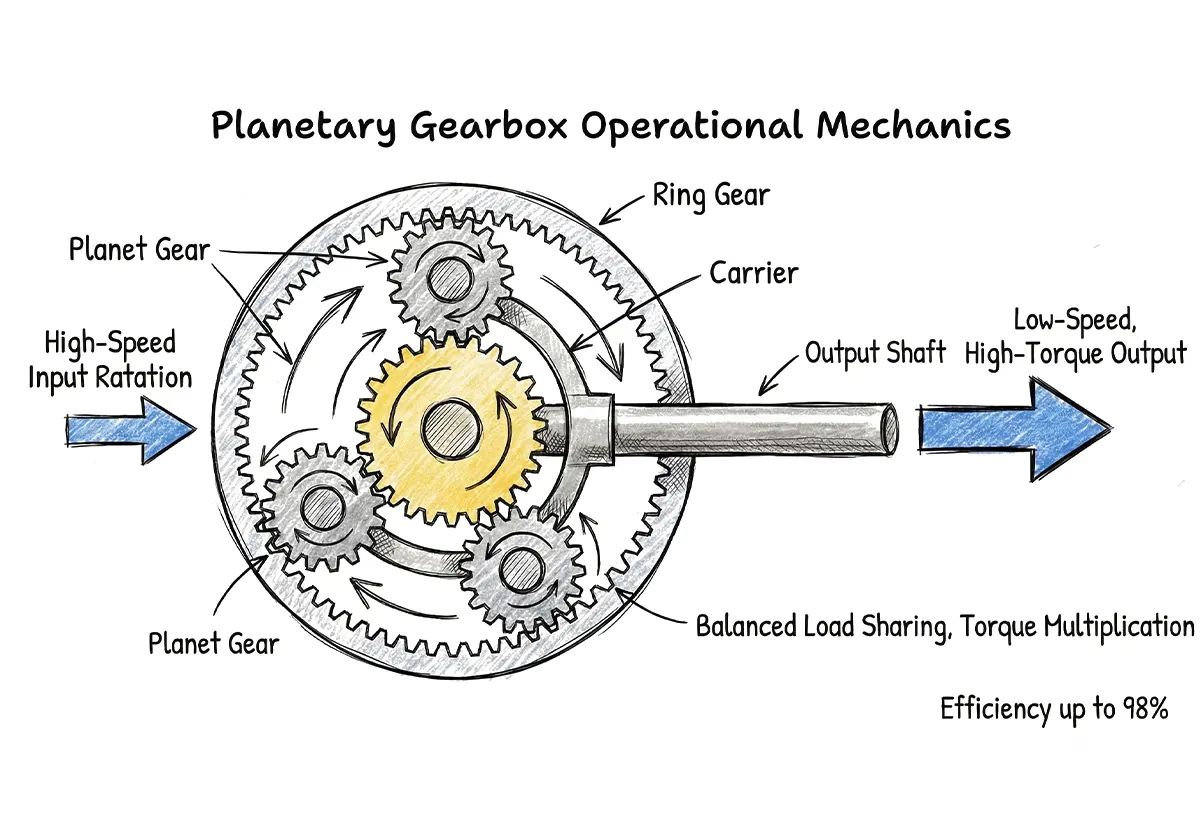
La rigidité torsionnelle d'un réducteur planétaire de précision détermine directement la fréquence de résonance mécanique du système réducteur-charge. Cette fréquence de résonance fixe la limite supérieure de la bande passante de la boucle de vitesse du servomoteur, c'est-à-dire la vitesse à laquelle le contrôleur peut réagir aux erreurs de position sans provoquer de résonance structurelle. Un réducteur à coefficient de torsion (Ct) plus élevé repousse la fréquence de résonance, permettant un réglage plus précis du servomoteur et, par conséquent, de meilleures performances de positionnement dynamique.
| Boîte de vitesse | Ct (N·m/arcmin) | f_résonant Table CNC J=5 kg·m² |
f_résonant Robot J2 J=97 kg·m² |
Limite Kv du servo | Évaluation du réglage |
|---|---|---|---|---|---|
| ZDE-160 | 38 | 25,7 Hz | 5,8 Hz | Limité | Table CNC : OK. Robot J2 : servo BW sous le niveau de tension — risque d'oscillation |
| ZDS-115 | 20 | 18,7 Hz | 4,2 Hz | Faible | Ct inférieur à celui du ZDE-160 — correct uniquement pour les applications à châssis réduit, ne constitue pas une mise à niveau directe |
| ZDS-142 | 44 | 27,7 Hz | 6,3 Hz | Bien | Amélioration modeste par rapport au ZDE-160 — recommandé pour les machines CNC à forte charge et les robots J2/J3 |
| ZDS-190 | 130 | 47,6 Hz | 10,8 Hz | Le plus haut | Réponse dynamique optimale — recommandée pour les grandes tables CNC et les robots J1/J2 |
Le châssis EP-ZDS-115 (Ct = 20 N·m/arcmin) présente une rigidité en torsion inférieure à celle du châssis EP-ZDE-160 (Ct = 38 N·m/arcmin) en raison de sa taille plus réduite. Il ne faut pas supposer que « ZDS = plus rigide que ZDE » : la comparaison n'est valable que pour des châssis de taille identique ou comparable. Le châssis ZDS-142 (44) surpasse légèrement le ZDE-160 (38), tandis que le ZDS-190 (130) le surpasse largement. Pour que la série ZDS offre pleinement son avantage en termes de rigidité, l'application doit être compatible avec la plage de châssis de 115 à 190 mm qu'elle couvre.
Paradoxalement, le couple de cisaillement (Ct) du lanceur EP-ZDS à deux étages est supérieur à celui du lanceur à un seul étage (ZDS-190 : 140 N·m/arcmin contre 130 N·m/arcmin). Ceci s’explique par le fait que l’étage planétaire supplémentaire du ZDS confère une rigidité structurelle à l’ensemble porte-satellites : ce dernier devient effectivement plus rigide grâce au blocage du deuxième étage. Cette caractéristique est spécifique à la conception du ZDS et ne s’applique pas à la série ZDE, où la présence de plusieurs étages apporte de la souplesse plutôt que de la rigidité.
Quand faut-il spécifier la rigidité en torsion comme critère de sélection principal ?
Dans quatre catégories d'applications, la rigidité en torsion doit être le critère de précision prioritaire, avant le jeu. Dans toutes les autres catégories, le seul critère de précision du jeu est suffisant et la série EP-ZDE/ZDF offre des performances optimales à moindre coût.
Couples de coupe maximaux de 200 à 800 N·m sur les grands centres d'usinage horizontaux. À ces couples, la déformation élastique est prépondérante dans l'erreur angulaire totale. La tolérance dimensionnelle des pièces de grande taille (circularité des alésages, perpendicularité des faces) est directement liée à la rigidité dynamique du réducteur. Spécifiez : EP-ZDS-142 ou EP-ZDS-190 selon la classe de couple.
Le rapport d'inertie élevé au niveau des jonctions J1/J2 impose une limitation de la bande passante du servo pour éviter la résonance. Un coefficient de transfert de couple (Ct) plus élevé augmente la fréquence de résonance, permettant ainsi une bande passante plus large et une meilleure précision de suivi de trajectoire. De plus, les couples dynamiques de pointe lors de l'accélération des grands bras robotiques dépassent le seuil de coupure du ZDE-160.
Les opérations de formage par impact soumettent la boîte de vitesses à des couples d'impulsion de 2 à 3 fois sa valeur nominale continue au moment du contact avec la pièce. Sous charge d'impulsion, la déformation élastique est instantanée et la position de l'outil s'écarte de la position commandée. Un coefficient de transfert (Ct) plus élevé réduit cet écart et améliore la régularité dimensionnelle du formage par presse. Un facteur de service supérieur à 2,5, associé à une spécification de rigidité, constitue la solution appropriée pour les entraînements de presse.
Les portiques de découpe laser et les systèmes de prélèvement et de placement à grande vitesse effectuent des inversions de direction de 50 à 200 fois par minute, avec une inertie axiale importante. À chaque inversion, le réducteur doit éliminer le jeu axial et absorber simultanément le couple transitoire dû à la décélération et à la réaccélération de la charge. Un réducteur plus rigide amortit plus rapidement ce couple transitoire et réduit l'erreur de position pendant l'intervalle d'inversion. Pour les portiques fonctionnant à plus de 3 m/s avec des exigences de positionnement inférieures à 0,1 mm, le réducteur EP-ZDS-142 est recommandé, même à des niveaux de couple modérés.
Lorsque l'EP-ZDE/ZDF à Ct=38 N·m/arcmin est suffisant : Pour les applications où le couple maximal appliqué est inférieur au seuil de 304 N·m pour le ZDE-160 — articulations de robots légers (J3–J6), axes de servomoteurs d'emballage, roues motrices d'AGV, entraînements de suiveurs solaires et indexeurs de convoyeurs — le jeu est le paramètre de précision prédominant et l'EP-ZDE/ZDF est le choix le plus approprié et le plus économique. Le Ct plus élevé du ZDS n'est pas nécessaire et son surcoût n'est justifié par aucune amélioration mesurable des performances de l'application.
Une méthode pratique en trois étapes pour intégrer la rigidité en torsion à votre sélection
La plupart des ingénieurs tiennent compte du facteur de service et du degré de jeu, mais omettent totalement la rigidité en torsion du processus de sélection. La méthode en trois étapes suivante intègre Ct au processus de sélection standard en cinq étapes sans le complexifier significativement.
T_crossover = BL × Ct. Pour EP-ZDE-160 : 8 × 38 = 304 N·m. Comparez cette valeur à votre couple de fonctionnement maximal réel (après application du coefficient de service). Si le couple maximal est supérieur à T_crossover, la rigidité en torsion constitue déjà la principale limite de précision et Ct doit être augmenté pour améliorer les performances de positionnement ; une spécification de jeu plus stricte ne sera d’aucune utilité.
Déterminez votre tolérance d'usinage ou de positionnement (par exemple ±0,1 mm au rayon de charge spécifique R). Calculez la flèche élastique maximale admissible : θ_max = arctan(tolérance / R) en minutes d'arc. Calculez ensuite le coefficient de température (Ct) requis : Ct_required = T_peak / θ_max. Sélectionnez l'unité de la série EP dont le Ct est supérieur ou égal à Ct_required.
θ_max = arctan(0,3/300) × 3438 = 3,44 arcmin
Ct_requis = 380/3,44 = 110 N·m/arcmin → spécifier ZDS-190 (Ct=130)
Calculez f_resonant = (1/2π) × √(Ct[N·m/rad] / J_load). Comparez cette valeur à la bande passante de votre servocommande. Par sécurité, f_resonant doit être au moins trois fois supérieure à la fréquence de gain Kv du servo. Si f_resonant est inférieure à trois fois la bande passante du servo, même avec le servomoteur de la série EP le plus rigide, réduisez la bande passante (acceptez une réponse plus lente) ou envisagez de réduire l'inertie de la charge en sortie.
Le service d'ingénierie d'application d'Ever-Power en Corée propose le calcul du couple de coupure, l'analyse des exigences Ct et la vérification de la fréquence de résonance pour des applications spécifiques, en tenant compte des tolérances dimensionnelles et du rayon de charge. Indiquez votre couple de fonctionnement maximal, votre rayon de charge et vos exigences de précision dimensionnelle pour recevoir une recommandation complète concernant les spécifications de rigidité, en coréen ou en anglais.
Éditeur : Cxm