What “Lifetime Lubrication” Actually Means — and What It Does Not
The term “lifetime lubrication” (also marketed as “sealed for life,” “lubricated for life,” or “maintenance-free lubrication”) appears in the datasheets of every EP series precision ग्रहीय गियरबॉक्स from Korea Ever-Power. It carries a specific and bounded engineering meaning:
- No scheduled oil drain or grease replenishment for the rated 20,000-hour L10 life
- No re-greasing ports or drain plugs in the housing design
- Factory-certified lubricant quantity and type, pre-charged before shipment
- Orientation-independent operation — no oil level to monitor
- Zero lubricant-change-related downtime throughout rated service life
- Zero inspection requirement — temperature, noise, and seal integrity still need periodic checks
- Immunity to contamination — a damaged seal allows water or particles to degrade the sealed grease
- Indefinite service life — at 20,000h (L10), replacement is recommended regardless of apparent condition
- Permission to exceed rated operating temperature — grease life halves with every 10°C over baseline
- A substitute for correct initial specification — overloading destroys grease film regardless of seal integrity
The critical distinction from traditional oil-bath gearboxes: A conventional oil-bath servo gear reducer requires oil changes every 2,000–5,000 hours because the oil degrades through oxidation, contamination, and thermal cycling. Each oil change involves draining, cleaning, refilling, and a mandatory production stop. Over 20,000 hours, this means 4–10 planned downtime events for lubrication alone. The EP series sealed grease eliminates all of these — but it does so by enclosing a finite amount of high-performance grease in a sealed cavity, which means the grease condition cannot be inspected directly and the sealed housing integrity becomes the single critical variable.
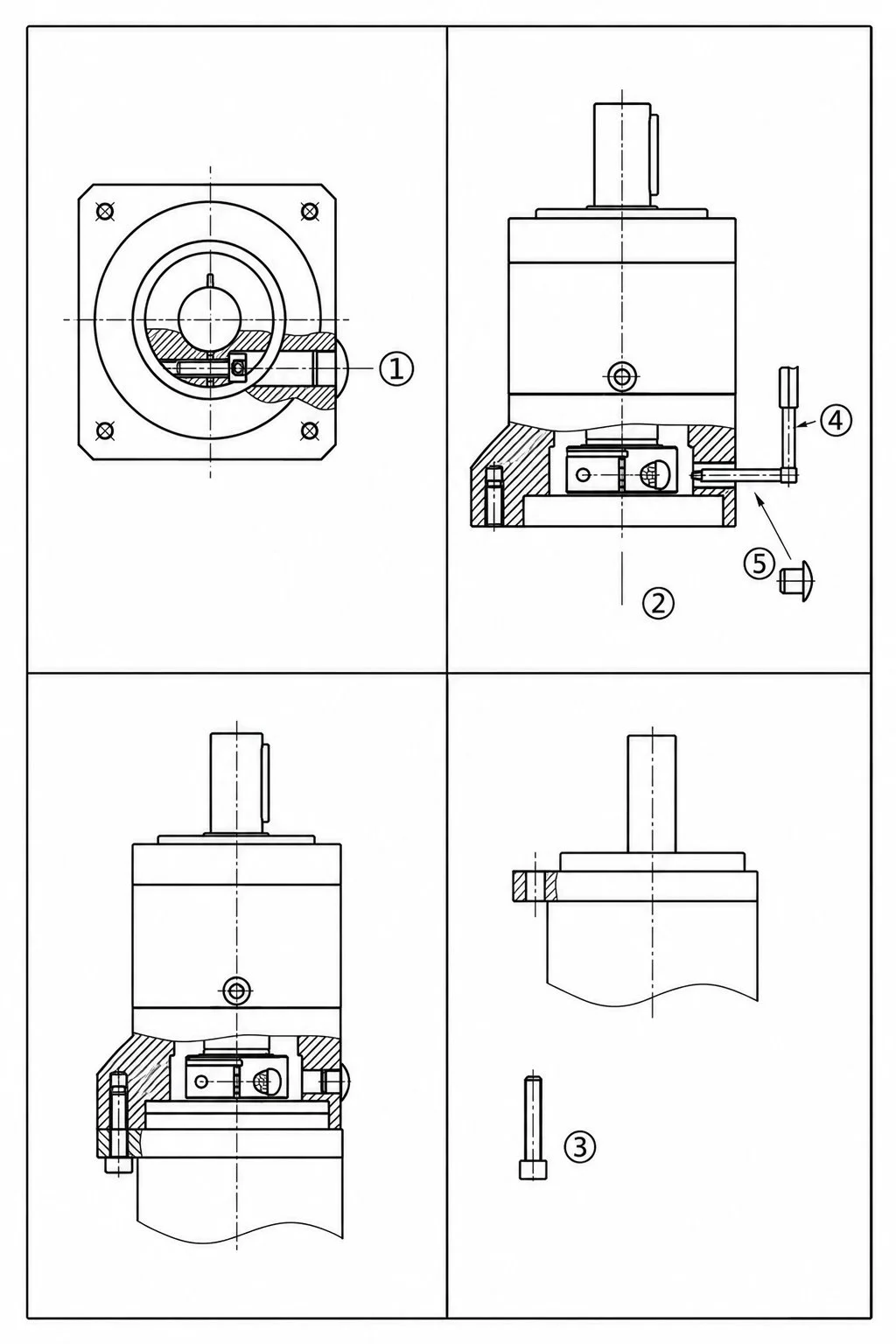
The Grease Chemistry — Why PAO and Polyurea Outlast Mineral Oil in Sealed Gearboxes
Not all grease is the same, and the choice of base oil and thickener is what separates a genuine lifetime-lubricated design from a sealed gearbox that will degrade in 3,000 hours. EP series planetary gear reducers use synthetic grease based on either polyalphaolefin (PAO) base oil or a PAO-ester blend, thickened with lithium complex or polyurea compound. This combination is chosen for three properties that mineral oil greases cannot match over a 20,000-hour service life.
PAO base oil has a viscosity index (VI) of 130–160 and an oxidation onset temperature approximately 30–40°C higher than Group I mineral oil. In a sealed gearbox operating at 70–80°C continuously, mineral-based grease begins oxidising (thickening and forming acidic breakdown products) within 3,000–5,000 hours. PAO-based grease at the same temperature maintains adequate viscosity and EP additive activity for 15,000–20,000 hours. The result is that the 20,000-hour life claim is chemically achievable with PAO but not with mineral grease — which is why any sealed gearbox using mineral grease has a marketing problem if it claims “lifetime lubrication.”
Pressure
The Hertzian contact stress at the tip of a planet gear tooth flank under rated torque can reach 1,000–1,500 MPa — well above the regime where hydrodynamic lubrication film is sufficient. Extreme pressure (EP) additives in the grease form a chemical reaction layer (typically zinc dithiophosphate or sulphur-phosphorus compounds) that prevents metal-to-metal welding at these stress levels. Unlike base oil, EP additives are consumed through use. In sealed gearboxes, the additive package is designed to last the rated service life at the rated load — but overloading (torques above rated × SF) accelerates additive depletion and can exhaust the EP package in 20–30% of the rated hours, effectively reducing the remaining service life to bare-oil conditions.
अस्थायी
PAO base oil retains pumpability and lubricating film at temperatures as low as −40°C, compared to approximately −15°C for typical mineral-based greases. This is why the EP series operating temperature range is stated as −25°C to +90°C without caveat or modification. At cold-chain facility temperatures of −20°C, a mineral-based sealed gearbox would experience oil starvation at start-up — the grease is too viscous to distribute to bearing races and gear meshes during the first minutes of operation. PAO grease at −20°C remains fluid enough to form an adequate film immediately on start-up. The one recommended precaution for EP series units in sub-zero environments is a soft-start (reduced ramp rate for the first 2–3 minutes) to allow gradual thermal equalisation before demanding peak torque.
Temperature Is the Single Biggest Variable in Sealed Grease Life
The 20,000-hour lifetime lubrication claim is not a fixed absolute — it is a function of housing temperature. The relationship follows the Arrhenius model, which for lubricating greases approximates to a halving of service life for every 10°C rise above the baseline operating temperature. The EP series baseline is 70°C housing temperature at rated load and rated input speed. The rated maximum housing temperature is 90°C (ambient + 90°C is specified; for a 30°C Korean factory environment, this means housing temperature ≤ 120°C, but the grease life at 120°C is only 625 hours).
| Housing Temperature | Grease Service Life | % of Rated Life | Status | Implication |
|---|---|---|---|---|
| 60°C | 40,000 h | 200% | ✅ Extended life | Light-duty or low-ambient environments — replace at L10 bearing limit regardless |
| 70°C | 20,000 घंटे | 100% | ✅ Design baseline | Rated condition; grease life equals bearing L10 life exactly as designed |
| 80°C | 10,000 h | 50% | ⚠ Monitor closely | Grease life now shorter than bearing L10; bearing may outlast lubricant |
| 90°C (max rating) | 5,000 h | 25% | ⚠ At rated limit | Schedule replacement at 5,000h; reduce load or add cooling if sustained |
| 100°C | 2,500 घंटे | 12.5% | ❌ Over limit | Investigate overload or cooling failure immediately; plan unit replacement |
| 110°C | 1,250 h | 6.3% | ❌ Critical | Grease failure is imminent; stop machine and investigate cause |
| 120°C | 625 h | 3.1% | ❌ Failure zone | Grease failure within weeks; shutdown required |
Grease service life follows the Arrhenius model: halving per 10°C above 70°C baseline. Values are for PAO/polyurea-type grease used in EP series. Actual housing temperature = ambient + heat generated by gearbox losses (P_heat = P_input × (1−η)).
Housing temperature = ambient temperature + temperature rise from internal losses. For an EP-ZDE-80 at 2-stage efficiency 94%, with 750W input: P_heat = 750 × (1 − 0.94) = 45W. With a housing surface area of approximately 0.06 m² and natural convection coefficient h ≈ 15 W/(m²·K): ΔT = 45 / (15 × 0.06) = 50°C. At 25°C ambient, housing temperature ≈ 75°C — within the 10,000h grease life band. Add forced air cooling to reduce ΔT; reduce input speed (lower rpm → lower friction power) if the housing runs hot.
Grease Contamination — How Water and Particles Shorten Life Exponentially
The sealed housing of an EP series lifetime-lubricated planetary gear reducer is its primary defence against the two contamination types that destroy grease function: water and solid particles. Both enter through the same path — a compromised lip seal on the output shaft or input interface — and both accelerate gear tooth surface fatigue through a mechanism that is exponential rather than linear.
| Grease Condition | Film Strength | Equivalent Load Multiplier | Gear Surface Life | Change vs Clean |
|---|---|---|---|---|
| Clean, new (0% contamination) | 100% | ×1.00 | 20,000 घंटे | आधारभूत |
| Light contamination (20%) | 80% | ×1.08 | 10,240 h | −491टीपी3टी |
| Moderate contamination (40%) | 60% | ×1.19 | 4,320 h | −78% |
| Water emulsification (60%) | 40% | ×1.36 | 1,280 h | −94% |
| Severe contamination (80%) | 20% | ×1.71 | 160 h | −99.2% |
Gear surface fatigue life exponent b ≈ 9 (ISO 6336 surface durability for case-hardened steel). Film strength reduction modelled as proportional load increase. At 60% water contamination, grease is visually emulsified (white/grey) — a reliable field detection indicator.
- Visual: White or grey grease at output shaft seal = water emulsification confirmed
- Thermal: Housing temperature rising without load change = film breakdown increasing friction
- Acoustic: Grinding or crackling at low speed = metallic particle contamination in gear mesh
- Backlash trend: Rapid increase (>20% per 2,000h) = abrasive wear indicating particle contamination
IP54 (EP-ZDE/ZDF/ZDWE/ZDWF): resists water splashing from any direction. Cannot withstand direct sustained hose washing. IP65 (EP-ZDS): withstands direct water jet (IPX5 test: 6.3mm nozzle, 12.5 L/min, any direction). For any HACCP washdown, automotive body-shop, or outdoor installation: use EP-ZDS IP65 from the outset. Never attempt to supplement IP54 sealing with external wrapping — the sealed housing integrity cannot be meaningfully improved after assembly.
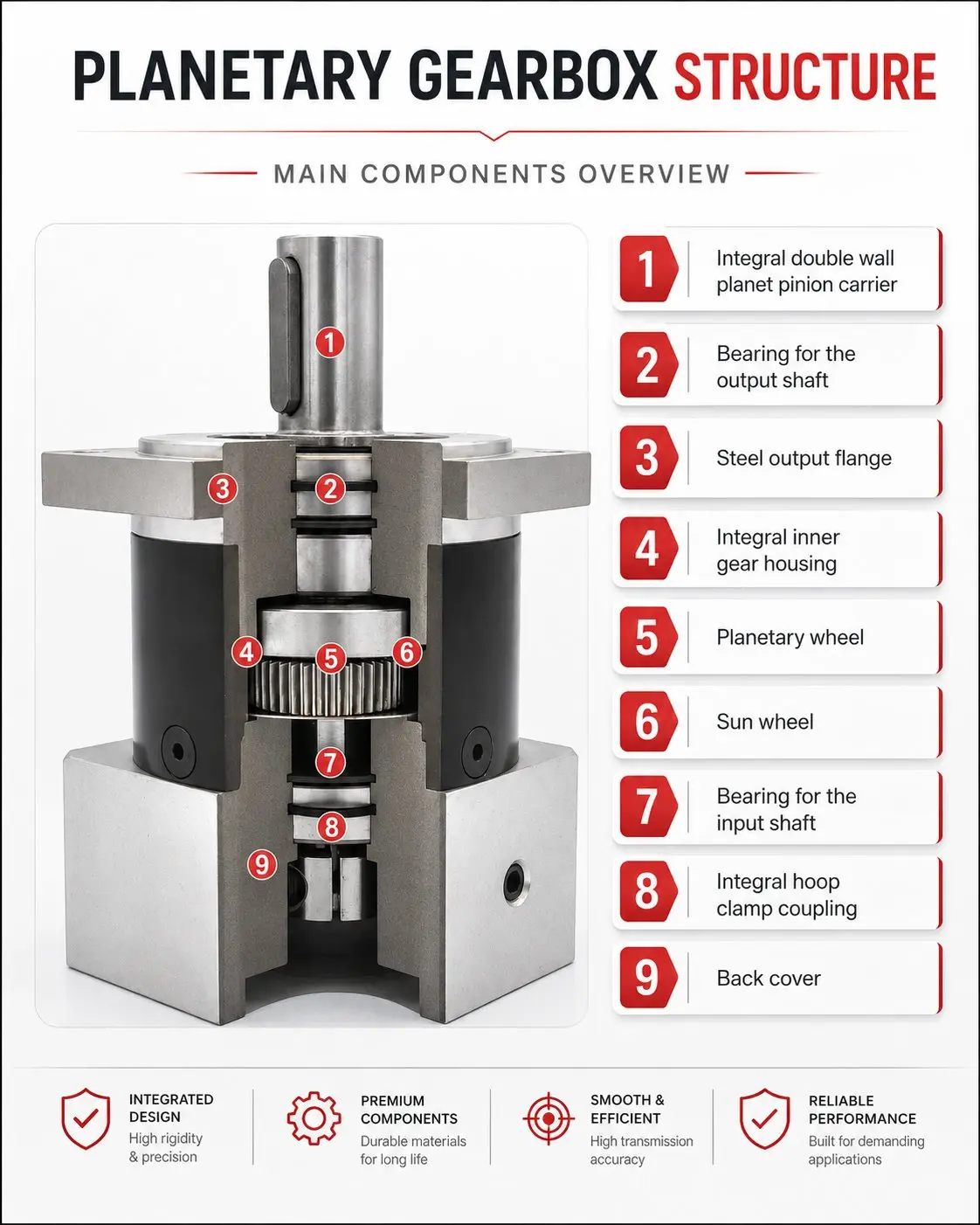
Any Mounting Orientation — Why Sealed Grease Outperforms Oil-Bath in This Respect
One of the practical engineering advantages of sealed grease over oil-bath lubrication that receives insufficient attention in published comparisons is mounting orientation. An oil-bath gearbox has a defined oil level — which means it has a defined “correct” orientation. Install it vertically shaft-up when the oil level is designed for horizontal operation, and the bearing at the top of the housing runs dry. Install it inverted, and the shaft seal — designed to contain oil, not to hold it against reverse head pressure — leaks.
EP series sealed grease gearboxes have no oil level to maintain. The grease is retained by the sealed housing regardless of orientation. Gravity influences grease distribution inside the housing but does not drain lubricant away from any critical surface, because grease — unlike oil — does not flow freely under gravity. The lip seals are designed to retain grease, not a fluid, which means their load in any orientation is the weight of the grease against the seal face rather than fluid head pressure.
One installation warning — never overfill: Because the sealed housing has no vent, any additional grease introduced into the cavity (for example through a modified housing or access port) has no escape path when the grease expands at operating temperature. The result is elevated internal pressure that forces grease past the lip seal, creating apparent “leakage” that is actually overfilling damage. EP series gearboxes have no fill port for this reason — the factory-sealed grease quantity is precisely calibrated. Do not attempt to add grease to an EP series unit in the field.
10-Year Total Cost of Ownership — Lifetime Lubrication vs Conventional Re-Greased Gearbox
The purchase price comparison between an EP series sealed gearbox and a conventional oil-lubricated unit of similar torque class often shows the EP unit at a modest price premium. The full economic analysis consistently reverses this conclusion when operating costs are included. The following comparison uses conservative assumptions appropriate for a Korean servo automation production line operating two shifts per day.
This calculation does not include the probability-weighted cost of contamination events during oil changes — each time a gearbox is opened for oil service, there is a risk of particulate contamination entering the housing. In practice, a fraction of conventional gearbox oil changes result in accelerated wear that manifests months later, making the true maintenance cost of conventional lubrication higher than the scheduled direct cost alone.
The Complete EP Series Maintenance Schedule
Printable reference — covers EP-ZDE, EP-ZDF, EP-ZDWE, EP-ZDWF, and EP-ZDS series
Storage and Pre-Commissioning — Preventing Grease Separation Before the Unit Is Even Installed
A factory-sealed EP series unit in transit or warehouse storage is not immune to grease degradation. The primary risk during long-term storage is grease bleed — the separation of base oil from the thickener matrix under sustained gravitational loading in a stationary gearbox. Bleed creates localised oil pooling and grease-depleted zones, which can cause start-up lubricant film deficiency even in a brand-new unit.
| Storage Duration | Separation Risk | Storage Condition | Required Action |
|---|---|---|---|
| 0–6 months | कम | Original packaging, 10–30°C, dry | Rotate output shaft 5 full turns every 3 months to redistribute grease |
| 6–12 months | मध्यम | Temperature-controlled warehouse | Rotate shaft 10 turns monthly. Inspect for any visible oil weeping at seals before commissioning |
| >12 months | High | कोई | Contact Korea Ever-Power application engineering for inspection recommendation before commissioning |
| >24 months | Very High | कोई | Do not commission without Korea Ever-Power inspection. Consider unit replacement if no inspection is possible. |
Commissioning procedure for stored units: Before first power-on after storage, manually rotate the output shaft 10–15 turns at hand speed while the servo is disabled. This redistributes any separated grease and confirms free rotation. Then run the unit unloaded at 20% rated speed for 5 minutes to allow thermal conditioning. Listen for any abnormal sound before applying load. If any grinding or resistance is felt or heard during hand-rotation, do not commission — contact Korea Ever-Power for assessment.
Five Maintenance Mistakes That Void the Lifetime Lubrication Promise
There is no re-greasing port on EP series gearboxes. Any attempt to add grease through a modified access point pressurises the sealed cavity, forces grease past the lip seal, and introduces air and potential contaminants. If you feel the unit “needs more grease,” the actual problem is seal failure — which requires unit replacement, not more grease.
Aromatic solvents and chlorinated degreasers dissolve the NBR or FKM lip seal elastomer material. Even brief surface contact over many cleaning cycles causes seal swelling and loss of lip contact force. Use only mild alkaline or water-based cleaners on EP series housing exteriors, and keep cleaning agents away from seal faces entirely.
The maximum input speed for EP-ZDE/ZDF/ZDWE/ZDWF is 4,500 rpm; the recommended continuous speed is 3,000 rpm. Operating above 3,000 rpm increases churning losses non-linearly, raising housing temperature and accelerating PAO base oil oxidation. At 4,500 rpm continuously, grease service life drops significantly below the 20,000h rated figure — even if load is within torque limits.
Any grease visible outside the housing is not cosmetic — it is evidence of a seal breach. Seal breaches do not self-heal. A weeping seal means the internal grease quantity is being reduced and contamination is entering simultaneously. Schedule replacement within 500 hours of first visible weeping detection, not at the next annual inspection.
Backlash growth is the most sensitive early indicator of internal gear and bearing wear — it begins increasing measurably well before noise or temperature anomalies appear. A single backlash measurement at installation plus annual measurements at 5,000h intervals provides the trend data needed to predict end-of-life 3,000–5,000 hours before catastrophic failure. Skipping this measurement leaves the unit’s condition invisible until noise or seizure occurs.

Korea Ever-Power’s application engineering team provides application-specific maintenance interval recommendations — adjusted for your actual housing temperature, duty cycle intensity, and operating environment. If your unit is running hotter than expected, or if you have detected unexpected backlash growth, contact us for a technical assessment before the problem becomes a line stoppage.
संपादक: सीएक्सएम