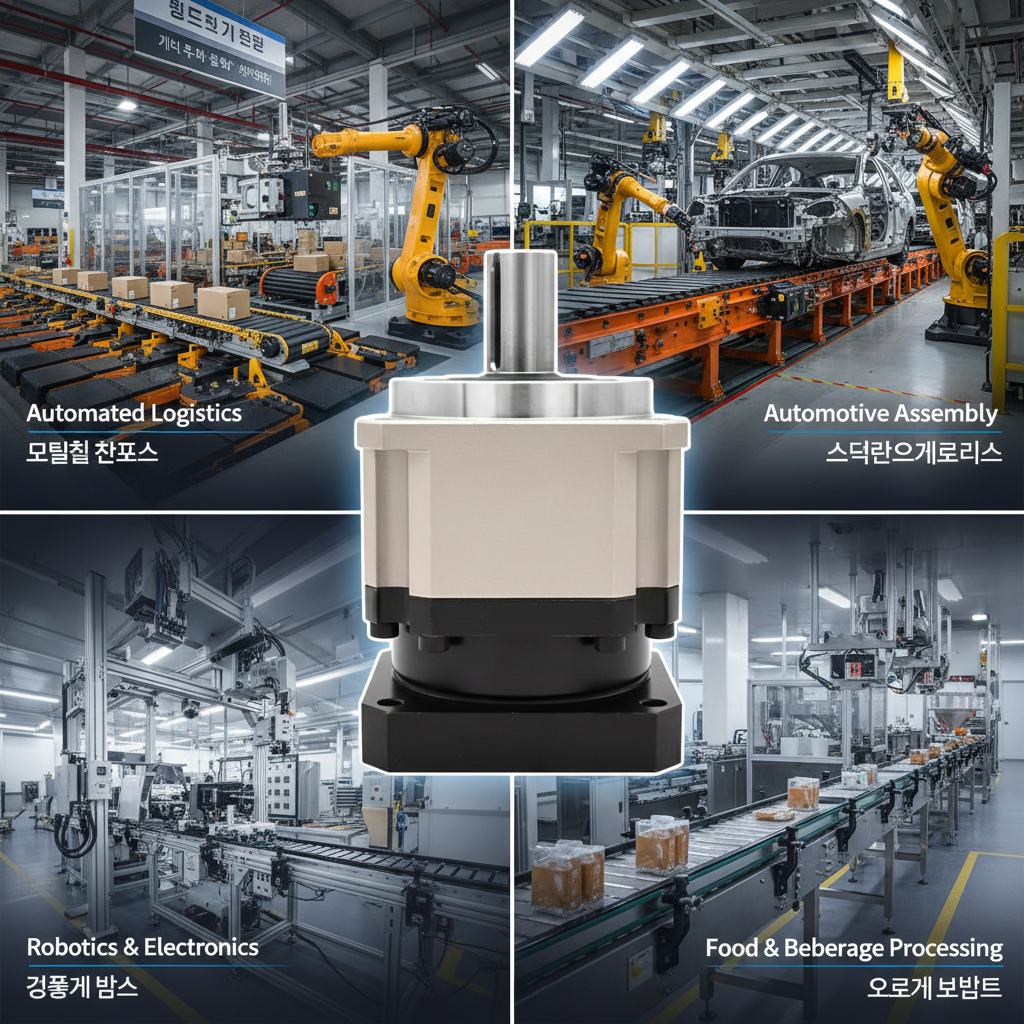
Why Packaging Machines Are Among the Most Demanding Planetary Gearbox Applications
Korean packaging machine manufacturers supply the food, pharmaceutical, cosmetic, and electronics industries — each sector with different accuracy requirements but a shared operational reality: packaging lines run continuously in three shifts, at cycle rates that demand millions of direction reversals per year from every servo axis in the machine.
The combination of demands that makes packaging drives difficult is not any single requirement in isolation — it is all five simultaneously:
①
②
③
④
⑤
Korean Packaging Machine CPM Reference
VFFS Cross-Seal Jaw Drive — How Backlash Directly Limits Bags Per Minute
The cross-seal jaw on a vertical form-fill-seal (VFFS) machine is the highest-cycle servo axis in Korean food packaging. Two jaw blocks clamp together to form the transverse heat seal across the film tube, dwell for the seal time, then retract and advance one bag length to the next seal position. Each complete jaw cycle is one full direction reversal on the drive gearbox.
The direct relationship between gearbox backlash and maximum machine throughput is one of the least-discussed constraints in Korean packaging machine design documentation. The mechanism is straightforward: when the jaw servo command reverses from retract to advance, the motor must first rotate through the gearbox backlash angle before generating any jaw clamping force. During this angular clearance traversal — typically accomplished in 2–8 milliseconds depending on gearbox grade and motor speed — the jaw produces no sealing force. This is dead time subtracted directly from the available seal dwell window.
At higher CPM targets, the total cycle time available per bag decreases and the seal dwell window shrinks proportionally. When backlash dead time consumes a larger fraction of the shrinking dwell window, seal quality degrades — the film does not receive full dwell at the required sealing pressure, leading to weak seals, peelbacks, and leaker rejects.
BACKLASH DEAD TIME AT CROSS-SEAL REVERSAL
= 1,000 × 360° / 60 s = 6,000°/sP0 (≤1 arcmin = 0.0167°):
Dead time = 0.0167° / 6,000°/s = 0.003 msP1 (≤3 arcmin = 0.050°):
Dead time = 0.050° / 6,000°/s = 0.008 msP2 (≤5 arcmin = 0.083°):
Dead time = 0.083° / 6,000°/s = 0.014 msAt 120 CPM: total cycle = 500 ms
Typical seal dwell target: 80–120 ms
P2 dead time fraction: 0.014/80 = 0.017% — negligible
→ Backlash grade has minimal throughput impact
at typical packaging speeds
Dead time from backlash is negligible at normal packaging speeds. The genuine specification driver is seal position repeatability — the jaw must close at exactly the same film position on every cycle. Backlash causes jaw position uncertainty at reversal: the jaw may close 0.044 mm earlier or later than commanded (P1, 50mm radius). Over 43 million cycles per year, this positional scatter determines whether the seal lands within the designed seal band width. For narrow seal bands (≤3 mm) common in Korean pharmaceutical blister packs and single-serve condiment sachets, P0 is required. For standard 8–12 mm food packaging seal bands, P1 is adequate.
Seal Band Width → Required Backlash Grade
| Product / Seal Type | Seal Band | Jaw Radius | Оценка |
|---|---|---|---|
| Pharma blister / sachet | ≤3 mm | 40–60 mm | П0 |
| Single-serve condiment | 4–6 mm | 50–70 mm | P0 or P1 |
| Food snack (rice cracker, candy) | 8–12 mm | 60–100 mm | П1 |
| Pet food / industrial bag | ≥15 mm | 80–120 mm | П2 |
3-shift: 160 × 60 × 21h = 201,600/day
Annual: 201,600 × 330 days = 66.5M reversals/yrEP-AB P1 design life: 20,000 operating hours
At 3-shift (6,300h/yr): ~3.2 year gearbox life
Replacement cycle: every 3 years for jaw drives
HFFS Film Pull and Forming Shoulder — Inertia Matching Over Backlash Grade
The horizontal form-fill-seal (HFFS) machine — used for flowpack snack bars, biscuit packs, and frozen food — pulls film from a reel along a horizontal forming shoulder, indexes to length, cuts, and seals the ends. Unlike the VFFS jaw axis that reverses direction every cycle, the HFFS film pull axis runs primarily in one direction — with rapid acceleration and deceleration events at each index, but without continuous reversals.
The dominant gearbox selection criterion for the HFFS film pull axis is therefore not backlash grade but inertia ratio. The film reel presents a highly variable inertia load: a 600 mm diameter, 25 kg full film reel has a rotational inertia of approximately 1.125 kg·m², while the same reel at near-empty (100 mm diameter, 2 kg) has only 0.005 kg·m² — a 225:1 inertia variation. The servo control system must track this variation across the full reel life without requiring retunes.
At the gearbox output shaft, the reel inertia reflects through the square of the gear ratio: J_reflected = J_reel / i². An i=25 gearbox reduces the full-reel reflected inertia from 1.125 kg·m² to 0.0018 kg·m² — a 2,800:1 reduction that brings the load inertia far below the motor rotor inertia and eliminates the servo tuning instability from reel depletion variation. The backlash grade on this axis can be P1 or P2 — the forming accuracy of the film index depends on the encoder resolution and servo control bandwidth, not on the gearbox tooth clearance in a unidirectional drive.
FILM REEL INERTIA — FULL vs EMPTY, i=25 GEARBOX
J_reel = ½ × m × r² = ½ × 25 × 0.3² = 1.125 kg·m²
J_reflected = 1.125 / 25² = 0.0018 kg·m²Empty reel (Ø100mm, 2kg):
J_reel = ½ × 2 × 0.05² = 0.0025 kg·m²
J_reflected = 0.0025 / 625 = 0.000004 kg·m²Motor rotor J_motor ≈ 0.0012 kg·m² (typical)
Full reel J_ratio = 0.0018/0.0012 = 1.5:1 ✓ excellent
Empty reel J_ratio ≈ 0 → motor-dominated ✓
Он EP-AF high-rigidity series is commonly specified for HFFS film pull drives where the reel dancer arm also imposes a radial load on the gearbox output shaft — belt tension from the dancer mechanism acts as a radial force. The EP-AF’s enlarged output shaft (shaft bending stiffness proportional to diameter⁴) maintains shaft deflection within 0.01 mm at the rated radial load, preventing the film tension variation that would result from shaft runout at the pull nip point.
A single-stage i=5 gearbox at HFFS film speed would leave the full-reel reflected inertia at 1.125/25 = 0.045 kg·m² — 37× the motor rotor. The servo loop would require very conservative gains to handle the 225:1 inertia variation across the reel life, limiting acceleration capability and maximum machine speed. The two-stage i=25 eliminates this constraint at the cost of slightly lower efficiency (≥94% vs ≥97% single-stage) — an acceptable trade for the servo performance gain.
Rotary Filling Carousel — Precision Indexing and Non-Standard Ratio Selection
Korean beverage, sauce, and pharmaceutical filling lines use rotary carousel machines where a circular table carries N filling heads (typically N = 8, 12, 16, 24, or 32), indexing one station at a time to align each container with a fill nozzle, cap applicator, and label applicator in sequence. Each index is exactly 360°/N, and the index positioning error determines whether the container mouth aligns with the fill nozzle within the tolerance for clean filling without spillage.
The indexing drive gearbox specification here flows directly from the geometric tolerance: for a 24-head carousel with 150 mm container neck radius, a 3 arcmin positioning error produces 0.044 mm of lateral nozzle misalignment — acceptable for a 20 mm neck opening, producing no fill spillage. A 5 arcmin error produces 0.073 mm — still within tolerance for most liquid fills. P1 is typically the correct specification for standard Korean beverage filling carousels; P0 is reserved for pharmaceutical filling where the container neck opening may be as small as 8 mm and alignment tolerance is tighter.
The second specification challenge on rotary carousel drives is the gear ratio. For a 24-head carousel driven by a 1,500 rpm servo motor requiring exactly 62.5 rpm output (for 24 × 62.5 = 1,500 index positions per minute at 1 CPM), the required ratio is 1,500/62.5 = 24:1. The standard EP-AB series offers i=25 as the closest ratio — but 1,500/25 = 60 rpm, producing 24 × 60 = 1,440 index/min rather than 1,500. For a 24-head carousel the difference is negligible. For a 16-head carousel requiring exact 16:1 or 32:1 ratios, only the non-standard ratios available in the ЭП-АД и EP-ADS series (i=16, 21, 31, 61, 91) deliver an exact match without a variable-frequency drive.
Carousel Index Ratio — Standard vs ADS Non-Standard
Motor: 1,500 rpm
Target output: 62.5 rpm (=1,500/24)
Required ratio: 24:1
EP-AB standard i=25 → 60 rpm ← 3.3% error
EP-AD non-std i=21 → 71.4 rpm ← worse
→ Use VFD to adjust, or accept i=25N=16 carousel, same conditions:
Target output: 93.75 rpm (=1,500/16)
Required ratio: 16:1
EP-AD non-std i=16 → 93.75 rpm EXACT ✓
EP-AB i=15 → 100 rpm ← 6.7% error
→ Only EP-ADS i=16 matches without VFDN=32 carousel:
Required ratio: 46.875 → ~i=47 (non-std)
→ VFD required with standard ratios
Rotary carousels typically use a bore-centred mounting interface at the carousel table centre. EP-AD and EP-ADS round flange series self-centre on the table bore, eliminating the concentricity alignment step required with square-flange gearboxes and ensuring the carousel axis runs true to the drive gearbox centreline.
Fold Carton and Cartoning Machine Drives — Compact Body, High Cycle Rate
Korean pharmaceutical and cosmetic packaging uses fold carton machines — automatic cartoners that fold pre-printed flat blanks into boxes, insert the product, fold and tuck the end flaps, and close the carton at rates of 150–400 cartons per minute. Each fold arm and tucker plate servo axis executes full reversals at every carton cycle, making the cartoner one of the highest reversal-frequency packaging drive applications.
Fold accuracy requirements are driven by carton printing registration: the fold must occur within ±0.3–0.5 mm of the crease line to avoid visible misalignment between the folded edges and the printed design. At a typical fold arm radius of 30–50 mm, this translates to a required backlash of:
θ_max = Δx / r = 0.3 / 40 = 0.0075 rad
= 0.0075 × (180×60/π) = 25.8 arcmin maximumP1 (≤3 arcmin) → Δx = 40 × 0.000873 = 0.035 mm ✓
P2 (≤5 arcmin) → Δx = 40 × 0.001455 = 0.058 mm ✓Both P1 and P2 satisfy ±0.3mm carton fold tolerance.
The true constraint on cartoning machine fold arms is not backlash precision but body diameter and axial depth. Cartoning machine frame widths are designed to minimum dimensions for line integration; gearboxes must fit within the mechanical linkage space adjacent to the fold arm mounting. The EP-ADS compact round flange series addresses this with its shorter body length compared to standard EP-AD — reducing the axial projection into the machine frame while maintaining the same precision at P1 specification. The round flange also suits bore-mounted fold arm assemblies.
For Korean pharmaceutical cartoners supplying export markets (where GS1 barcode registration and EU directive fold accuracy specifications are tighter), P0 is sometimes specified for the main fold arm axis to provide a larger accuracy margin during production line qualification testing. Once the line is certified, the gearbox P0 grade delivers headroom that absorbs normal production tolerance stack-up without qualification failures.

3-shift (1,260 min/day): 756,000/day
Annual: ~250M reversals/yearEP-ADS design life: 20,000 hours
At 6,300 h/yr: ~3.2 year gearbox life
Schedule replacement every 3 years.
Electronics and Semiconductor Packaging — P0 and Particle-Free Operation
Korean electronics packaging — IC tray stacking, PCB panel indexers, and chip taping machines — operates in environments ranging from ISO Class 6 cleanrooms to open production floors, but always with strict particle generation limits. A gearbox that releases grease particles or metal wear debris into the machine environment contaminating products is a production quality failure.
Electronics packaging also imposes the tightest positioning tolerances in the packaging sector: IC tray pocket positions are specified to ±0.1 mm, PCB fiducial alignment requires ±0.05 mm, and tape-and-reel component placement demands ±0.02 mm pocket centering. At a typical 60 mm drive radius, ±0.02 mm requires backlash below 1.1 arcmin — only P0 (≤1 arcmin) reliably achieves this across all units in production.
Он Сверхточная серия EP-AFH is the standard specification for Korean electronics packaging precision index drives. Every EP-AFH unit ships with ≤1 arcmin as its standard specification — no P grade selection required, no higher-grade option needed. The sealed grease construction prevents grease migration outside the housing, and the housing surface treatment resists the IPA (isopropyl alcohol) and ESD-safe cleaning chemicals used in Korean electronics assembly environments.
Continuous Three-Shift Operation — Thermal Management and Grease Life
Korean packaging machine OEMs specify three-shift continuous operation as the standard duty cycle for food and FMCG packaging lines — 21 operating hours per day, 330 working days per year, totalling approximately 6,930 hours per year. Over a 10-year machine lifecycle, a cross-seal jaw gearbox accumulates nearly 70,000 operating hours of combined thermal, mechanical, and reversal load.
At continuous high-cycle operation, the gearbox operating temperature stabilises at a steady-state value determined by the balance between heat generated (friction losses) and heat dissipated (housing surface radiation and convection). For a properly sized Korea Ever-Power EP-AB gearbox running at 70% of rated torque, the steady-state housing temperature typically settles 20–35°C above ambient — at a Korean factory ambient of 30°C, the housing reaches 50–65°C.
The EP-AB standard grease specification is rated for operating temperatures to +90°C — providing a 25–40°C margin above the steady-state temperature in normal operation. This margin accommodates summer ambient spikes, momentary overload cycles, and the modest temperature rise that occurs as grease ages and its viscosity-temperature characteristics shift. The sealed grease construction means no periodic lubrication is required — the factory fill is designed to last the gearbox’s full service life under normal conditions.
Korea Ever-Power EP-AB and EP-AF series are rated for maximum input speeds of 3,000–4,500 rpm depending on frame size. At packaging machine servo speeds (typically 2,000–3,000 rpm), all standard EP series operate within rated limits. Higher-speed servo drives (above 4,500 rpm) require verification against the specific gearbox frame’s maximum input speed specification — higher speeds increase bearing heat generation and grease churning losses that can accelerate temperature rise above the steady-state values for normal speed ranges.
Packaging Line Operating Profile — Korea 3-Shift
Annual: 1,260 × 330 = ~6,930 h/yr
10yr machine life: ~69,300 h totalEP-AB design life: 20,000 h
→ Jaw axis: replace at yr 3 (66.5M rev)
→ Film pull axis: replace at yr 3.5
→ Auxiliary axes: may last 5+ yrsSealed grease: no maintenance needed
Backlash check: annual (see Art8 protocol)
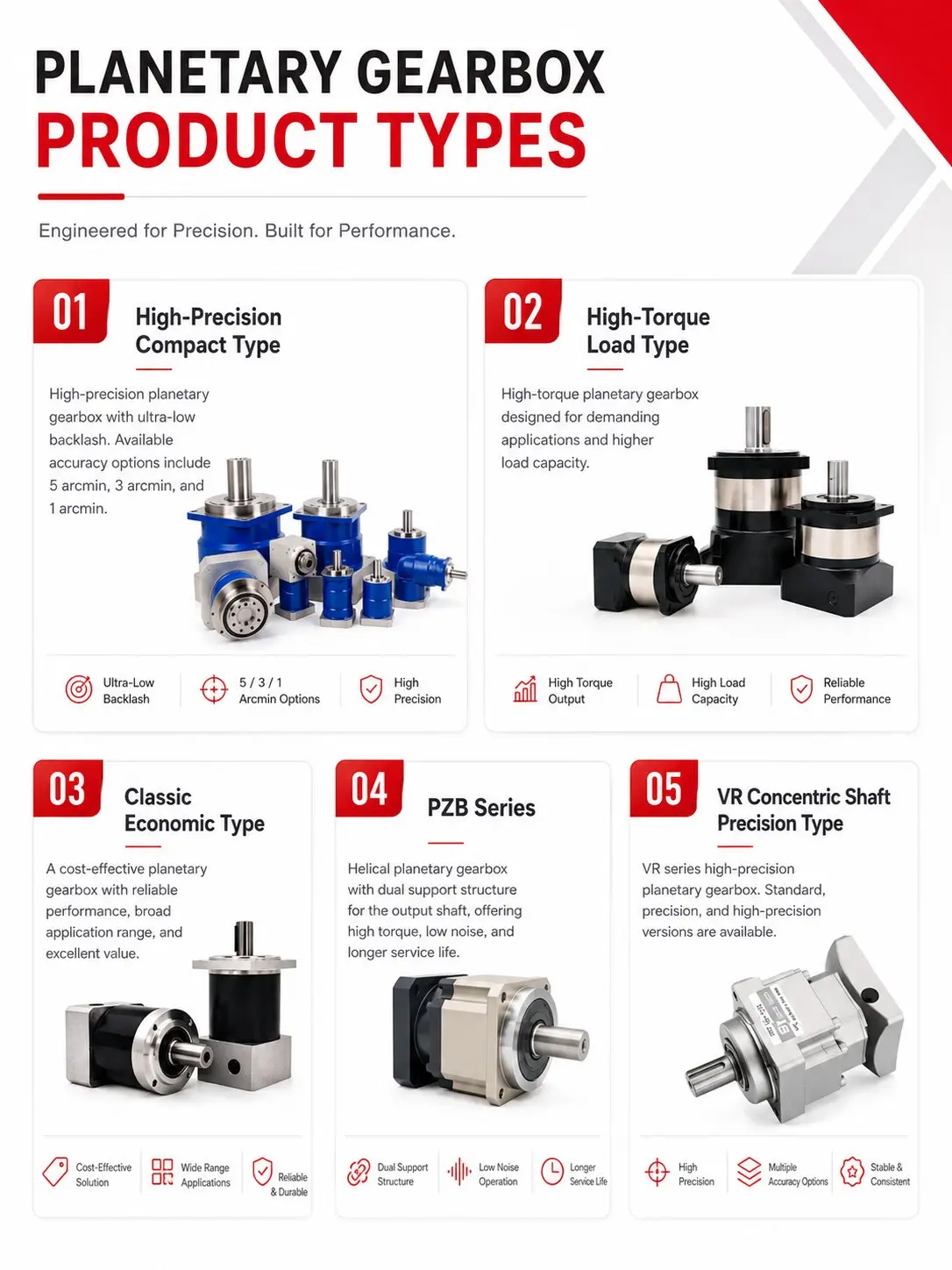
Korea Ever-Power Packaging Machine Series Selection — Quick Reference
| Packaging Drive | Ряд | Оценка | Typical i | Reason |
|---|---|---|---|---|
| VFFS cross-seal jaw (food) | EP-AB P1 | П1 | i=25–50 | 8–12mm seal band → 0.044mm max → P1 sufficient |
| VFFS jaw (pharma narrow seal) | EP-AB P0 | П0 | i=25–50 | ≤3mm seal band → 0.015mm max → P0 required |
| HFFS film pull reel axis | EP-AF P1/P2 | П1–П2 | i=25 | Inertia ratio critical, not backlash; hi-rigidity shaft for dancer tension |
| Rotary fill carousel (N=16/24) | EP-ADS / EP-AD P1 | П1 | i=16/21 | Non-std ratio for exact head count match; round flange for bore mount |
| Fold carton fold arm | EP-ADS P1 | П1 | i=25–50 | Compact body for frame space; 0.035mm fold error within ±0.3mm band |
| Electronics IC tray / tape-and-reel | EP-AFH | ≤1′ std | i=25–100 | ±0.02mm pocket accuracy; standard spec = P0-equivalent, no grade code |
| Conveyor / transport within machine | Экономическая линия PA II | 6–8′ | i=5–100 | Speed only; same mount as EP-AB — one drawing serves all axis tiers |
Frequently Asked Questions — Planetary Gearbox for Packaging Machines
Specify Your Packaging Machine Gearboxes with Korea Ever-Power
Korea Ever-Power’s application team calculates backlash grade from your seal band width, confirms inertia ratio for film pull drives, provides non-standard ratio availability for carousel indexers, and delivers cycle life estimates for all packaging axes — in Korean, same working day.
Редактор: Cxm