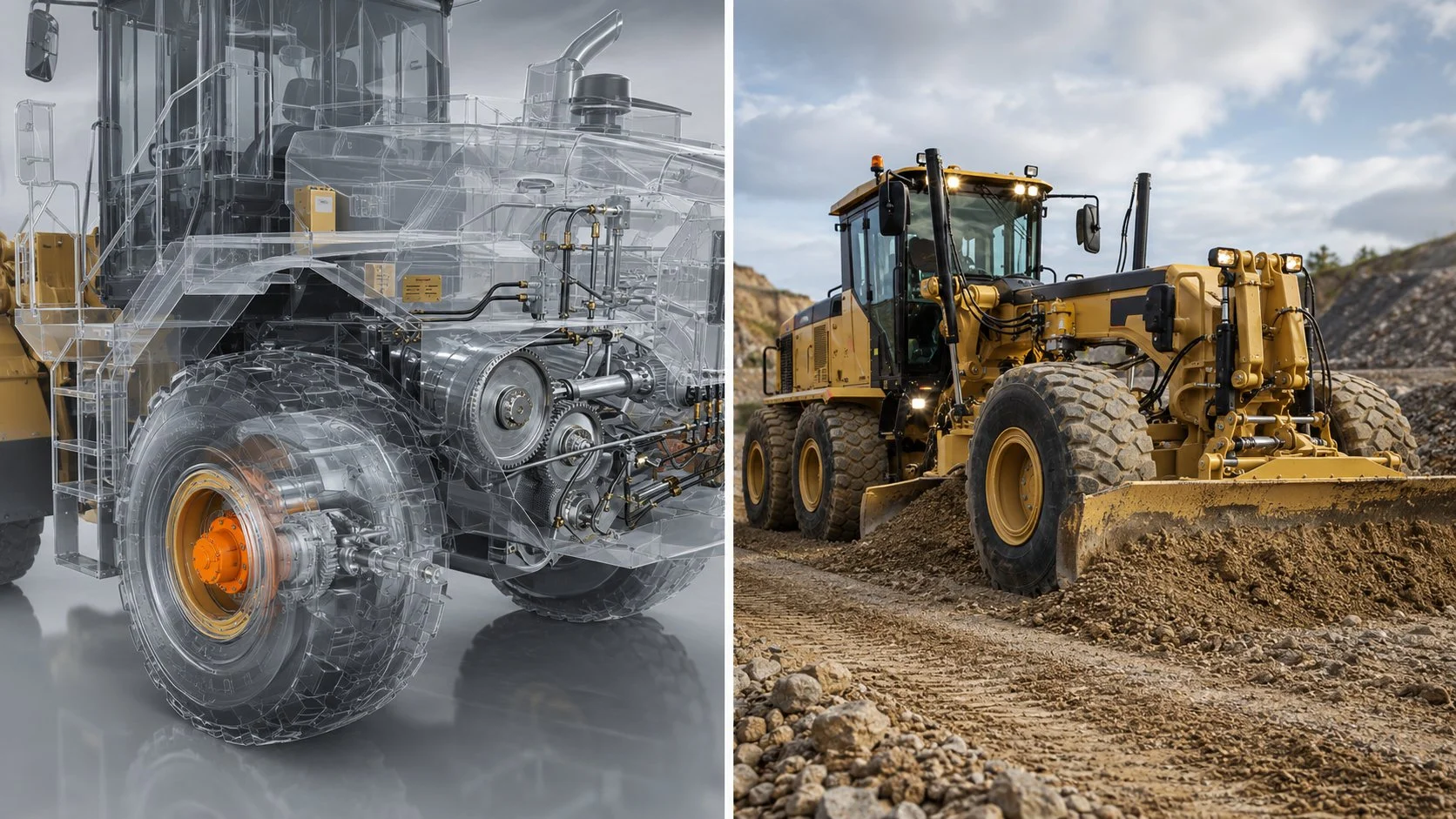
Why Wheeled Excavators Exist — Road Mobility as the Primary Advantage
A tracked excavator must be transported to the jobsite on a low-loader — a process that takes 30 to 90 minutes per move and costs USD 200 to 800 per transport. A wheeled excavator drives itself to the jobsite on public roads at 20 to 40 km/h — arriving in the same time as a truck, without a transport vehicle, without road permits, and without blocking traffic for loading and unloading. For urban utility work (gas, water, sewer, electricity, telecommunications), where the excavator moves between 5 to 30 dig points per day along a road corridor, the wheeled excavator saves 2 to 10 transport moves per day — USD 400 to 8,000 in daily transport costs.
This road-mobility advantage places unique demands on the wheel drive planetary gearbox. The drive must meet the same road-vehicle regulations as a truck (ECE R13 braking, noise limits, axle-weight limits, lighting and signalling) while also providing the low-speed precision needed to position a 20-tonne machine within 100 mm of a utility trench on a crowded city street. No other excavator type requires highway-legal compliance — and no other highway vehicle requires excavator-grade positioning precision.
The wheeled excavator market is concentrated in Europe (where road regulations favour self-propelled machines over transported ones), Japan (where compact urban excavators dominate), and increasingly in North America and Australia for utility and road-maintenance applications. Machine weights range from 9 to 25 tonnes — with the 15 to 20-tonne class being the most common for urban utility work.
The duty cycle is fundamentally different from a tracked excavator. A tracked excavator sits in one position and digs for hours — the undercarriage is loaded statically. A wheeled excavator moves between dig points 15 to 30 times per shift — spending 30 to 60% of its operating time driving and repositioning, and only 40 to 70% actually digging. The wheel drive therefore accumulates 800 to 1,500 driving hours per year — comparable to a delivery truck — while the digging mechanism accumulates 1,000 to 2,000 hours. The wheel drive is not an auxiliary system; it is a primary working component that is used as intensively as the digging arm.
The superstructure slewing (360-degree upper-body rotation) adds a unique loading condition during road transfer. The excavator upper structure (cab, boom, engine) must be locked facing forward during road driving — because a side-facing upper structure shifts the vehicle CG laterally and changes the steering response. The slew lock must hold the upper structure against wind loads, road vibration, and cornering forces during highway transfer. If the slew lock fails during road driving, the upper structure rotates uncontrolled — shifting the CG and potentially causing the vehicle to veer or overturn. The wheel drive braking system must be capable of safely stopping the vehicle even with a laterally displaced CG from a slew-lock failure — an emergency scenario that the ECE R13 brake-system design must accommodate.
The counterweight on a wheeled excavator (2 to 5 tonnes of steel at the rear of the upper structure) provides digging stability but shifts the overall vehicle CG rearward — producing a rear-heavy weight distribution of 55 to 65% on the rear axle during road transfer. This uneven distribution means the rear wheel drives carry more weight, generate more braking force, and experience more bearing fatigue per kilometre than the front drives — and must be specified for the heavier duty even though the front and rear gearboxes are often the same part number for inventory simplicity.
Jobsite Repositioning — Precision Driving in Urban Spaces
The wheeled excavator must position itself within 100 to 200 mm of the dig point — which may be next to a gas main, a water pipe, or a fibre-optic cable. The positioning accuracy on a city street is constrained by parked cars, kerbs, pedestrians, traffic signs, and overhead wires — all of which limit the available manoeuvring space to corridors as narrow as 3 to 4 metres.
All-wheel steering (front and rear axles steer) reduces the turning circle by 30 to 40% compared to front-steer-only configurations — allowing the 8 to 10-metre-long machine to turn in spaces that would require a multi-point turn with conventional steering. Some models offer crab steering (all wheels in the same direction) for lateral positioning — moving the machine sideways toward the kerb without turning. The wheel drive must support all steering modes with smooth, proportional torque at the 1 to 3 km/h positioning speed — because any torque pulsation or hesitation at this speed produces jerky movement that is difficult to control in tight urban spaces.
The transition from driving to digging involves the outrigger deployment sequence. The operator drives to the dig point, lowers the blade (rear stabiliser) and outriggers (side supports), and transfers the machine weight from the tyres to the stabilisers. During this transition, the wheel drive planetary gearbox parking brake must hold the machine stationary — even if the street has a cross-slope or longitudinal grade of 5 to 10%. Once the outriggers are fully loaded, the wheels are partially or fully unloaded — and the wheel drive is effectively idle during the digging phase. This means the wheel drive alternates between intense driving duty (repositioning) and complete rest (digging) — a duty pattern that produces thermal cycling similar to the wheel loader V-cycle but at a lower frequency (15 to 30 transitions per shift versus 400 on a loader).
The urban operating environment also introduces unique hazards for the wheel drive. City streets contain drainage grates, manhole covers, kerb edges, and utility access covers that the wheels must drive over during repositioning. Each of these surface features produces a momentary impact load on the wheel drive output bearing — and the cumulative impact from 500 to 2,000 surface-feature crossings per day adds to the bearing fatigue budget. The wheel drive must be rated for this urban-surface impact duty — which is different from both the smooth-road highway duty and the soft-ground off-road duty. Urban-surface impacts are sharp (5 to 15 ms duration), moderate-amplitude (2 to 5 g), and high-frequency (10 to 50 per hour) — a fatigue profile that standard construction-equipment bearing-life calculations do not capture because they assume either continuous smooth loading (highway) or infrequent heavy impacts (off-road).
Highway Transfer — A Construction Machine That Must Be a Road Vehicle
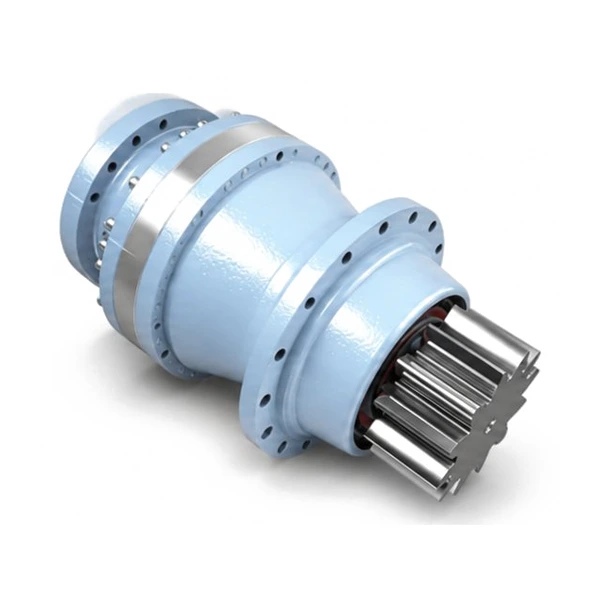
The highway transfer requirement transforms the wheel drive from a construction-equipment component into an automotive component. The wheeled excavator must comply with the same road-vehicle regulations as a truck: ECE R13 braking (deceleration of 5.0 m/s2 from maximum speed), ECE R51 noise limits (80 dBA pass-by at 7.5 metres), axle-weight limits (typically 10 to 13 tonnes per axle), and lighting/signalling requirements. The wheel drive must provide the braking capacity, the gear-mesh noise quality, and the axle-load compatibility to satisfy these regulations — which are more stringent than any construction-site standard.
The maximum road speed varies by market: 20 km/h in some European countries (registration as a mobile machine), 37 km/h in Germany (registration as a self-propelled work machine), and 40 to 50 km/h in some markets with full vehicle registration. At 37 km/h and 20 tonnes, the braking energy is approximately 2.1 MJ — significantly less than an all-terrain crane at 80 km/h but still requiring automotive-grade disc brakes and a dual-circuit brake system with load-sensing proportioning.
The gear-mesh noise at highway speed must comply with the 80 dBA pass-by limit. At 37 km/h, the wheel drive output shaft rotates at 150 to 250 rpm (depending on the tyre size and gear ratio) — producing a gear-mesh frequency of 3,000 to 7,500 Hz (output RPM x number of teeth). At these frequencies, gear-mesh noise radiates efficiently through the housing — and DIN Class 6 gears are the minimum quality for noise compliance. Class 8 gears can produce pass-by noise levels of 82 to 85 dBA — exceeding the legal limit and preventing the machine from obtaining road registration. The noise requirement is particularly challenging because the wheeled excavator housing is typically more compact (less wall thickness for weight saving) and less acoustically optimised (construction priority, not automotive priority) than a truck axle housing — meaning the noise per unit of gear quality is inherently higher than on a purpose-designed automotive axle. The gearbox manufacturer must therefore collaborate with the excavator OEM on the housing acoustic design — optimising the rib pattern, wall thickness, and mounting isolation to achieve the pass-by noise target at the specified gear quality level.
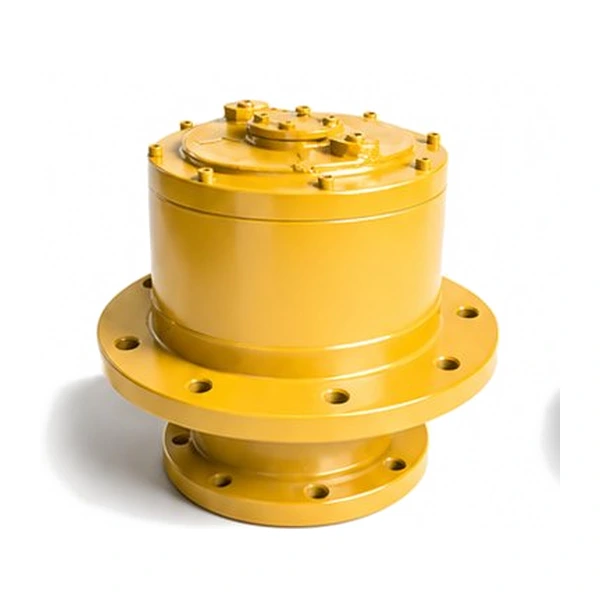
Three Failure Modes Specific to Wheeled Excavator Drives
A wheeled excavator that fails the ECE R51 pass-by noise test cannot be registered for road use — eliminating its primary competitive advantage over tracked excavators. Gear-mesh noise is the dominant contributor to pass-by noise at highway speed: the mesh frequency (3,000 to 7,500 Hz) falls in the frequency range where the human ear is most sensitive and where the noise meter weighting (A-weighting) provides the least attenuation. A 2 dBA reduction at the gear mesh (achieved by upgrading from Class 8 to Class 6) can mean the difference between passing and failing the type-approval test — and the cost of the gear-quality upgrade (15 to 25% of the gearbox price) is trivial compared to the consequence of losing road registration for the entire machine model.
City streets have cross-slopes of 2 to 4% (for drainage) and longitudinal grades of up to 10 to 15% on hilly terrain. During the 30 to 60-second outrigger deployment sequence, the parking brake must hold the 20-tonne machine stationary against the gravity component — approximately 10 to 30 kN depending on the slope. If the brake pad is worn below 60% of its original thickness, the holding torque may be insufficient for the steepest slopes — and the machine creeps slowly downhill during outrigger deployment. On a city street with parked cars, pedestrians, and utility trenches, a creeping excavator during stabiliser setup is a serious safety hazard that can result in property damage, injury, or regulatory sanctions (loss of operating permit).
During the digging phase (40 to 70% of operating time), the wheel drive is stationary with the wheels partially or fully unloaded (outriggers carrying the machine weight). The output bearing sits motionless with a reduced or zero load — and any moisture that has entered the gearbox (through breathing, seal weepage, or condensation) settles on the bearing surfaces and initiates standstill corrosion. Unlike seasonal machines that experience standstill during storage, the wheeled excavator experiences 20 to 40 standstill periods per day — each lasting 10 to 30 minutes. Over 2,000 hours of digging per year, the cumulative standstill time reaches 1,000 to 1,500 hours — long enough for standstill corrosion to initiate micro-pitting on bearings that are not protected by corrosion-inhibiting oil additives. The intermittent nature of the loading (drive-stop-drive-stop) is particularly damaging because each restart grinds the corrosion products into the raceway surface before the oil film can fully re-establish.
Frequently Asked Questions
Korea Ever-Power provides wheeled excavator drives from 5,000 to 30,000 Nm with highway noise compliance, city-street braking, and all-steer urban positioning.
Editor: Cxm